Genre: Biography (Page 9)
Browse 242 movies in the Biography genre.
All Genres
Among the Believers
Cleric Abdul Aziz Ghazi is waging jihad against the Pakistani state. His dream is to impose a strict version of Sharia law throughout the country, as a model for the world. A flashpoint in Aziz's holy war took place in 2007, with the Siege of the Red Mosque. During a standoff with the Pakistani military, the government leveled Aziz's flagship mosque to the ground, killing his mother, brother, only son and 150 students. The filmmakers follow Aziz on his personal quest to create an Islamic utopia, during the bloodiest period in Pakistan's modern history. The film also follows the lives of two teenage students who have attended madrasas (Islamic seminaries) run by Aziz's Red Mosque network. Throughout the film, their paths diverge: Talha, 12, detaches from his moderate Muslim family and decides to become a jihadi preacher. Zarina, also 12, escapes her madrasa and joins a regular school. Over the next few years, Zarina's education is threatened by frequent Taliban attacks on schools like her own. Aziz’s foil is nuclear physicist and leading educational activist Dr. Pervez Hoodbhoy. He passionately opposes Aziz through his public appearances, lectures, and the media. Opposition against Aziz comes to a head in December, 2014, when Aziz insults a grieving nation by trying to justify the brutal massacre of 132 school children in Peshawar by the Taliban. The attack ignites a movement to end extremism in Pakistan’s mosques and madrasas. Led by Hoodbhoy and others, Pakistan's moderate majority focuses on Aziz and calls for his arrest.

Twinsters
The film opens with Futerman explaining to the audience that she wants to share the crazy story that happened to her a few days previously. It introduces her family and explains that she received a friend request on Facebook from a stranger, and when she looks at the account's profile picture, she sees her own face looking back at her. She accepts the friend request, and receives a message from Bordier hinting strongly that they may be twins and asking her for more details of her birthplace. The two women then text back and forth and agree to speak to each other on Skype. After the two women experience their first video call, they can confirm that they do in fact bear a striking resemblance to each other, and from that point set out to prove whether they are sisters, and furthermore if they are in fact twins. Futerman visits twin expert Dr. Nancy Segal and the two women take DNA samples together while using Skype. A trip to London is organized and using friends as buffers, the women finally meet. That evening, they both speak to Dr. Segal over Skype who confirms it is beyond doubt that they are identical twins. The film documents their further experiences, including Bordier's visit to Futerman in California, and the twins' subsequent trip to Seoul for the International Korean Adoptee Associations Conference. All along, they have pursued their birth mother, who denies having the twins. At the end, they compose a message to this woman, to thank her for giving them life.
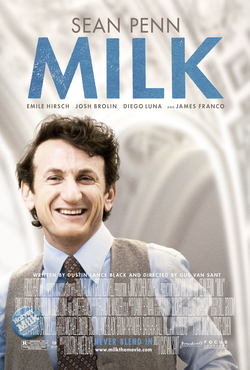
Milk
On the evening of November 27, 1978, Dianne Feinstein announces to the press that Harvey Milk and Mayor George Moscone have been assassinated. Milk is seen recording his will nine days before the assassinations. The film then flashes back to NYC on May 22, 1970, Milk's 40th birthday, and his first meeting with his much younger lover, Scott Smith. In 1972, dissatisfied with their lives and in need of a change, Milk and Smith move to San Francisco, hoping to find greater acceptance of their relationship. They open Castro Camera in the heart of Eureka Valley, a working-class neighborhood evolving into a predominantly gay neighborhood known as The Castro. Frustrated by the opposition they encounter in the once-Irish-Catholic neighborhood, Milk uses his background as a businessman to become a gay activist, eventually becoming a mentor to Cleve Jones. Smith serves as Milk's campaign manager, but he grows frustrated with Milk's devotion to politics and leaves him. Milk later meets Jack Lira, a sweet-natured but unbalanced young man. As with Smith, Lira cannot tolerate Milk's devotion to political activism and eventually hangs himself. Milk clashes with the local gay establishment, which he feels is too cautious. In 1977, after three unsuccessful attempts to become a city supervisor for the California State Assembly, Milk wins a seat on the San Francisco Board of Supervisors for District 5, after a change from at-large elections to district elections. His victory makes him the first openly gay man to be voted into major public office in California and the third openly homosexual politician in the entire United States. Milk meets fellow Supervisor Dan White, a Vietnam veteran and former police officer and firefighter. White is politically and socially conservative, and a complex relationship develops. Milk is invited to and attends the christening of White's first child. White asks Milk for assistance in preventing a psychiatric hospital from opening in White's district, possibly in exchange for White's support of Milk's citywide gay rights ordinance. When Milk fails to support White because of the negative effect it will have on troubled youth, White feels betrayed and becomes the sole vote against the gay rights ordinance. Milk also launches an effort to defeat Proposition 6, an initiative on the California state ballot in 1978. Sponsored by John Briggs, a conservative state senator from Orange County, Proposition 6 seeks to ban gays and lesbians from working in California's public schools. On November 7, 1978, after working tirelessly against Proposition 6, Milk and his supporters rejoice in the wake of its defeat. Three days later, a desperate White favors a supervisor pay raise but does not get much support, and shortly after supporting the proposition, resigns from the Board. He later changes his mind and asks to be reinstated. Mayor Moscone denies his request after being lobbied by Milk. On the morning of November 27, 1978, White enters City Hall through a basement window to conceal a gun from metal detectors. He requests another meeting with Moscone, who rebuffs his request for an appointment to his former seat. Enraged, White murders Moscone in his office and then goes to meet Milk in his, where he kills him, as Milk gazes out at the city. In text, it is revealed that 30,000 people attended Milk's funeral and his ashes were scattered over the Golden Gate Bridge. White's lawyers concocted the story of the " Twinkie Defense " to get him a sentence of seven years for first-degree manslaughter and was released in 1984, committing suicide in 1985.

The Mauritanian
In November 2001, Mohamedou Ould Slahi is in Mauritania, two months after the September 11 attacks. A Mauritanian policeman tells Mohamedou that Americans want to have a talk with him. Mohamedou agrees to go with them. In Albuquerque, New Mexico, in February 2005, lawyer Nancy Hollander is told by French lawyer Emmanuel that a lawyer from Mauritania approached his firm in Paris on behalf of Mohamedou's family. They haven't seen Mohamedou since he was arrested three years ago and only just found out in a newspaper that he is being held by the United States at the Guantanamo Bay detention camp and is accused of being one of the organizers of 9/11. Emmanuel asks Nancy to look into it because she has a security clearance from a previous case and can ask questions he can't. Nancy agrees to check. At a Naval Law Conference in New Orleans, Marine Prosecutor Stuart Couch is told by Colonel Bill Seidel about the Mohamedou case which Seidel wants him to prosecute. Seidel says that Mohamedou fought with Al-Qaeda in the '90s and then recruited for them in Germany, and says it was Mohamedou who recruited the terrorist who flew Stu's friend's plane into the tower. Nancy and Teri (her fellow lawyer) fly down to Guantánamo to meet Mohamedou. Mohamedou agrees to hire them as his lawyers. Meanwhile, Stu tells his team to go through all the intel reports they have to corroborate the story against Mohamedou. Nancy finds out something through Mohamedou's letter which she received from him while Stu looks at the MFR (Memorandum for the Record), showing exactly what happened. The letter and reports talk about enhanced interrogation methods (i.e., torture) and other maltreatment including sexual assault upon Mohamedou by the Guantanamo guards as ordered by General Mandel. General Mandel also threatened the arrest and rape of his mother. Thus, to save his mother and to get the torture to stop, Mohamedou gave a false confession about being a terrorist. Stu withdraws from Mohamedou's prosecution in disgust. In December 2009, at trial Mohamedou testified over video link to the court. In March 2010, Mohamedou received a letter informing him that his case was successful, and the judge has ordered him to be released. Text is shown telling us that it would be another 7 years before he actually was released, because the government appealed. His mother died in 2013 so he never saw her again. He was finally released in 2016, having spent 14 years in prison without ever being charged. Finally, footage of the real Mohamedou arriving back in Mauritania is shown. Texts are shown, telling us Mohamedou lives in Mauritania and got married in 2018 to an American lawyer. They have a son, Ahmed, but haven't been able to live together as a family and are hoping a country will grant them protection and citizenship. Nancy and Teri are still lawyers working against injustice, and we see footage of Mohamedou giving them necklaces with their names in Arabic.

The Aviator
In 1913 Houston, eight-year-old Howard Hughes 's mother gives him a bath and teaches him to spell "quarantine", warning him about the recent cholera outbreak. Fourteen years later, in 1927, he begins to direct his film Hell's Angels, and hires Noah Dietrich to manage the day-to-day operations of his business empire. After the release of The Jazz Singer, the first partially talking film, Hughes becomes obsessed with shooting his film realistically, and decides to convert the movie to a sound film. Despite the film being a hit, Hughes remains unsatisfied with the result and orders it to be recut after its Hollywood premiere. He becomes romantically involved with actress Katharine Hepburn, who helps to ease the symptoms of his worsening obsessive–compulsive disorder (OCD) and germaphobia. In 1935, Hughes test-flies the H-1 Racer, pushing it to a new speed record despite having to crash-land into a beet field when the aircraft runs out of fuel. Three years later, he flies around the world in four days, breaking the world record. He subsequently purchases majority interest in Transcontinental & Western Air (TWA). Juan Trippe, company rival and chairman of Pan Am, asks his crony, Senator Ralph Owen Brewster, to introduce the Community Airline Bill, which would give Pan Am exclusivity on international air travel. Hepburn grows tired of Hughes's eccentricity and workaholism, and leaves him for fellow actor Spencer Tracy. Hughes quickly finds a new love interest with 15-year-old Faith Domergue, and later actress Ava Gardner. However, he still has feelings for Hepburn, and bribes a reporter to keep reports about her affair with the married Tracy out of the press. In the mid-1940s, Hughes contracts two projects with the Army Air Forces, one for a spy aircraft, and another for a troop transport unit for use in World War II. In 1946, with the H-4 Hercules flying boat still in construction, Hughes finishes the XF-11 reconnaissance aircraft and takes it for a test flight. However, one of the engines fails midflight; he crashes in Beverly Hills and is severely injured, but miraculously survives. The army cancels its order for the H-4 Hercules, although Hughes still continues the development with his own money. Dietrich informs Hughes that he must choose between funding the airlines or his flying boat. Hughes orders Dietrich to mortgage the TWA assets so he can continue the development. By 1947, his OCD worsens and Hughes becomes increasingly paranoid, planting microphones and tapping Gardner's phone lines to keep track of her, until she kicks him out of her house. The FBI searches his home for incriminating evidence of war profiteering, searching through his possessions. Brewster privately offers to drop the charges if Hughes sells TWA to Trippe, but Hughes refuses. Hughes's OCD symptoms become extreme, and he retreats into an isolated " germ -free zone" for three months. Trippe has Brewster summon him for a Senate investigation, certain that Hughes will not show up. Gardner visits him and personally grooms and dresses him in preparation for the hearing. An invigorated Hughes defends himself against Brewster's charges and accuses the Senator of taking bribes from Trippe. He concludes by announcing that he has committed to completing the H-4 aircraft, and that he will leave the country if he cannot get it to fly. Brewster's bill is promptly defeated. After successfully flying the aircraft, Hughes speaks with Dietrich and his engineer Glenn Odekirk about a new jetliner for TWA. However, he begins hallucinating and has a panic attack. As Odekirk hides him in a restroom while Dietrich fetches a doctor, Hughes begins to have flashbacks of his childhood, his love for aviation and his ambition for success, compulsively repeating the phrase, "the way of the future".

Cobain: Montage of Heck
Kurt Cobain is born in 1967 to car mechanic Donald Cobain and waitress Wendy Cobain. In 1970, shortly after his sister Kim is born, the family moves to Aberdeen, Washington. Kurt lives a normal childhood, although Donald occasionally picks on him. At the age of nine, his parents divorce. Kurt lives with Donald for a while until the latter marries Jenny Westeby and they have a kid together. He moves back in with Wendy and as a teenager, he becomes unruly and starts smoking pot with friends. He and his friends start to visit the home of a developmentally challenged high school classmate to steal alcohol belonging to her father. It becomes a hard time for Cobain, who considers suicide for the first time. After he attempts to have sex with the girl, his classmates begin insulting and shaming him. Unable to take the ridicule, Cobain lies down on the train tracks one night with the intent of ending his life by being run over by an oncoming train, but the train is diverted on the track next to Kurt, barely missing him. After Kurt becomes homeless and living with friends, he eventually gets his own place at 17 and, in 1987, starts a rock band called "Nirvana" with former classmate Krist Novoselic on bass, Aaron Burckhard on drums, and himself on guitar. Nirvana's first "shows" consist of playing for a few friends and random passersby at local house parties. They eventually start playing at clubs and radio stations and Kurt starts dating Tracy Marander. The band, now with Chad Channing on drums, signs onto record label Sub Pop and they release their first album, Bleach. The band starts to have interviews and doing tours. After a short while, Kurt breaks up with Tracy. Nirvana leaves Sub Pop to sign onto DGC Records and Chad leaves the band, with Dave Grohl filling Chad's spot as the new drummer. Under DGC Records, Nirvana records their landmark second album, Nevermind. The album's lead track, " Smells Like Teen Spirit ", becomes a massive hit and the band is launched into the mainstream. Kurt meets Courtney Love and they start dating. In 1992, they get married after they find out she is pregnant, but at the same time Kurt begins using heroin. In an interview with Vanity Fair, Courtney mentions Kurt's heroin habit and that she tried it as well; Lynn Hirschberg, the journalist in charge of the interview, writes that Courtney used the drug while pregnant, misquoting her. Shortly after their daughter, Frances Bean Cobain, is born, they are confronted by the Los Angeles County Department of Children's Services, who take the Cobains to court, claiming that the couple's drug usage makes them unfit parents. Due to the claims made in the Vanity Fair article, Seattle child welfare agents remove the couple's baby daughter for around four weeks. The couple eventually obtains custody in an exchange for agreeing to provide urine tests and receiving regular visits from a social worker. After months of legal negotiations, the couple is eventually granted full custody of their daughter. Kurt's heroin use continues as the band records their third and ultimately final studio album, In Utero, in 1993. The band begins a new arena tour and adds Pat Smear of the punk rock band Germs as an additional guitarist for the tour. Cobain starts to turn pale while suffering withdrawal. Not long after returning home, Cobain's heroin use resumes. The band continues touring into early 1994, including a December 16, 1993 performance on the cable television channel MTV as part of their MTV Unplugged series, joined by Smear, cellist Lori Goldston, and brothers Christopher "Cris" and Curt Kirkwood of Meat Puppets. After being diagnosed with bronchitis and severe laryngitis, he flies to Rome the next day for medical treatment, and is joined there by Courtney, on March 3, 1994. The next morning, Love awakes to find that Cobain has overdosed on a combination of champagne and Rohypnol. Cobain is immediately rushed to the hospital and spends the rest of the day unconscious. After five days in the hospital, Cobain is released and returns to Seattle. The screen cuts to black and a line of text appears stating: "One month after returning from Rome, Kurt Cobain took his own life. He was 27 years old." The credits then begin.

Blow
George Jung and his parents Fred and Ermine live in Weymouth, Massachusetts. When George is 10 years old, Fred files for bankruptcy but tries to make George realize that money is not important. In the late 1960s, an adult George moves to Los Angeles with his friend "Tuna"; they meet Barbara, a flight attendant, who introduces them to Derek Foreal, a marijuana dealer. With Derek's help, George and Tuna make a lot of money. Kevin Dulli, a visiting college student from Boston, tells them of the demand for marijuana back home. They start selling marijuana there, buying marijuana directly from Mexico with the help of Santiago Sanchez, a Mexican drug lord. Two years later, George is caught in Chicago trying to import 660 pounds (300 kg) of marijuana and is sentenced to two years' imprisonment. After unsuccessfully trying to plead his innocence, George skips bail to take care of Barbara, who dies from cancer. Her death marks the disbanding of the group of friends. While hiding from the authorities, George visits his parents. George's mother calls the police, who arrest him. He is sentenced to 26 months in a federal prison in Danbury, Connecticut. His cellmate Diego Delgado has contacts in the Medellin cartel and convinces George to help him go into the cocaine business. Upon his release from prison, George violates his parole conditions and heads down to Cartagena, Colombia to meet with Diego. They meet with cartel officer Cesar Rosa to negotiate the terms for smuggling 15 kilograms (33 lb) to establish "good faith". As the smuggling operation grows, Diego is arrested, leaving George to find a way to sell 50 kg (110 lb). George reconnects with Derek in California, and the two sell all the cocaine in record time. George then goes to Medellín, Colombia and meets Pablo Escobar, who agrees to go into business with them. With the help of Derek, the pair became Escobar's top U.S. importer. At Diego's wedding, George meets Cesar's fiancée Mirtha and later marries her. However, Diego resents George for keeping Derek's identity secret and pressures George to reveal his connection. George eventually discovers that Diego has betrayed him by cutting him out of the connection with Derek. Inspired by the birth of his daughter and a drug-related heart attack, George severs his relationship with the cartel. All goes well with George's newfound civilian life for five years, until Mirtha organizes a 38th birthday party for him. Many of his former drug associates attend, including Derek, who reveals that Diego cut him out as well. The FBI and DEA raid the party and arrest George. He becomes a fugitive, and his bank account—heretofore under Manuel Noriega 's protection in Panama—is seized by Noriega. One night, he and Mirtha get into a fight while driving. They are pulled over by police and Mirtha tells them George is a fugitive and has stashed a kilogram of cocaine in his trunk. He is sent to jail for three years. During his term, Mirtha divorces him and takes custody of their nine-year-old daughter, Kristina Sunshine Jung. Upon his release, George struggles to maintain his relationship with his daughter. He promises Kristina a vacation in California and seeks one last deal to garner enough money for the trip. George completes a deal with former accomplices but learns too late that the deal had been set up by the FBI and DEA, with Dulli and Derek having leaked the nature and location of the action in exchange for pardons for their involvement in his prior action. George is sentenced to 60 years at Otisville Correctional Facility in upstate New York. He explains in the end that neither the sentence nor the betrayal bothered him, but that he can never forgive himself for having to break a promise to his daughter. While in prison, George requests a furlough to see his dying father, Fred. His mother denies the request. George records a final message to Fred, recounting his memories of working with his father, his run-ins with the law, and finally, too late, his understanding of what Fred meant when he said that money is not "real". An old man in prison, George imagines that his daughter finally comes to visit him. She slowly fades away as a guard calls for George. The film concludes with notes indicating that Jung will not be eligible for parole until 2015 and that his daughter has yet to visit him.