Genre: Biography (Page 8)
Browse 242 movies in the Biography genre.
All Genres
The Enigma of Kaspar Hauser
The film follows Kaspar Hauser, who has lived the first seventeen years of his life chained in a tiny cellar with only a toy horse to occupy his time, devoid of all human contact except for a man wearing a black overcoat and top hat, who feeds him. One day, in 1828, the same man takes Hauser out of his cell, teaches him a few phrases, and how to walk, before leaving him in the town of Nuremberg. Hauser becomes the subject of much curiosity, and is exhibited in a circus before being rescued by Professor Georg Friedrich Daumer, who patiently attempts to transform him. Hauser soon learns to read and write, and develops unorthodox approaches to logic and religion; but music is what pleases him most. He attracts the attention of academics, clergy and nobility. He is then physically attacked by the same unknown man who brought him to Nuremberg. The attack leaves him unconscious with a bleeding head. He recovers, but is again mysteriously attacked; this time, stabbed in the chest. Hauser rests in bed describing visions he has had of nomadic Berbers in the Sahara, and then dies. An autopsy reveals an enlarged liver and cerebellum.

Philomena
London-based journalist Martin Sixsmith has lost his job as a government adviser. He is approached at a party by the daughter of Philomena Lee. She suggests that he write a story about her mother, who was forced to give up her toddler son Anthony nearly fifty years ago. Though Sixsmith is initially reluctant to write a human interest story, he meets Philomena and decides to investigate her case. In 1951, Philomena became pregnant after having sex with a man she did not know at a county fair, so was sent by her father to Sean Ross Abbey in Roscrea in Ireland. After giving birth, she was forced to work in the convent laundry for four years, with little contact with her son. The nuns gave her son up for adoption without giving Philomena a chance to say goodbye. She kept her lost son a secret from her family for nearly fifty years. Martin and Philomena begin their search at the convent. The nuns claim that the adoption records were destroyed in a fire years earlier; they did not, however, lose the contract she was forced to sign decades ago forbidding her from contacting her son, which Martin considers suspicious. At a pub, the locals tell Martin that the convent burnt the records deliberately, and that most of the children were sold for £1,000 each to wealthy Americans. Martin's investigation reaches a dead end in Ireland, but he receives a promising lead from the United States so invites Philomena to accompany him there. His contacts help him discover that Anthony was renamed Michael A. Hess, who became a lawyer and senior official in the Reagan and George H. W. Bush administrations. When Philomena notices Martin in the background of a photo of Michael, he remembers that he met him years earlier while working in the US. They also learn that he has been dead for eight years. Philomena decides she wants to meet people who knew Michael to learn more about him from them. Visiting a former colleague of Michael's they discover that Michael was gay and died of AIDS. They also visit his 'sister' Mary, who was adopted at the same time from the convent, and learn that they were both emotionally and physically abused by their adoptive parents, and hear about Michael’s partner, Pete Olsson. After avoiding Martin's attempts to contact him, Pete agrees to talk to Philomena. He shows her some videos of his life with Michael. To Martin and Philomena's surprise, they see footage of Michael, dated shortly before he died, at the Abbey where he was adopted, and Pete explains that, although he never told his family, Michael had privately wondered about his birth mother all his life, so had returned to Ireland in his final months to try to find her. Pete informs them that the nuns had told Michael that his mother had abandoned him and they had lost contact with her. He also reveals that, against his parents' wishes, he had Michael buried in the convent's cemetery. Philomena and Martin return to the convent to ask where Michael's grave is. Despite Philomena's pleas, Martin angrily forces his way into the private quarters and argues with an elderly nun, Sister Hildegarde McNulty, who worked at the convent when Anthony was forcibly adopted. He accuses her of lying to Anthony and denying him the chance to finally reunite with Philomena, purely out of self-righteousness. Hildegarde is unrepentant, saying that losing her son was Philomena's penance for having sex out of wedlock. Martin demands an apology, telling her that what she did was un-Christian, but is speechless when Philomena instead chooses to forgive her of her own volition. She then asks to see her son's grave, where Martin tells her he has chosen not to publish the story. Philomena tells him to publish it anyway.

Dark Waters
In 1998, Robert Bilott, from Cincinnati, is a corporate defense lawyer at law firm Taft Stettinius & Hollister. Wilbur Tennant, a farmer and friend of Bilott's grandmother, asks him to investigate the deaths of numerous dairy cattle at his farm in Parkersburg, West Virginia. Tennant connects the deaths to chemical manufacturing corporation DuPont and gives Robert a large case of videotapes related to the case. Robert visits the Tennants' farm, where he learns that 190 cows have died after exhibiting unusual medical conditions, including bloated organs, blackened teeth, and tumors. DuPont attorney Phil Donnelly says he is not aware of Tennant's concerns, but will help in any way he can. Bilott files a small suit to gain information through legal discovery of the chemicals dumped at a nearby landfill. When he finds nothing useful in the EPA report, he realizes the chemicals might be unregulated. Bilott confronts Donnelly at an industry event, leading to an angry exchange. In response to Bilott's request to broaden discovery, DuPont sends hundreds of boxes. Bilott finds numerous references to something called "PFOA", and with difficulty learns that it is perfluorooctanoic acid, which DuPont uses to manufacture Teflon, a substance widely used in nonstick frying pans and carpeting. The company has been running tests of the effect of PFOA for decades, finding that it causes cancer and congenital disabilities, but kept the findings private. Dupont dumped several tons of toxic sludge in a landfill uphill from Tennant's farm. PFOA and similar compounds are forever chemicals, which slowly accumulate and never leave the bloodstream. The local community shuns Tennant for suing their most significant employer. Bilott encourages him to accept DuPont's settlement, but he refuses, wanting justice, and reveals that both he and his wife have cancer. Bilott sends a summary and supporting documentation of the DuPont issues to the EPA and United States Department of Justice, among others. The EPA fines DuPont $16.5 million. Bilott is unsatisfied, as he realizes the residents of Parkersburg will continue to suffer the effects of the PFOA and more will likely die from disease. He seeks an agreement for DuPont to pay for medical monitoring for all residents of Parkersburg in one large class-action lawsuit. However, DuPont sends a deceptive letter notifying residents of the presence of PFOA, thus starting the statute of limitations running, giving any further legal action only 12 months to begin. Since PFOA is unregulated, Robert's team argues that the corporation is liable, as the amount in contaminated waters was 6 times higher than the 1 part per billion deemed safe by DuPont's internal documents. In court, DuPont claims that the West Virginia Department of Environmental Protection has recently found that 150 parts per billion are safe (contradicting DuPont's scientific findings since the 1970s). The locals protest, and the story becomes national news. DuPont agrees to settle for benefits valued at over $300 million. It is agreed in mediation that the company will carry out medical monitoring only if it is proven that PFOA caused the ailments, and an independent science panel is set up. To gather data, Robert's team tells locals they can get their settlement money after they donate blood samples for testing. Nearly 70,000 people donate to the study. Seven years pass with no results from the science panel. Tennant dies, and Bilott suffers financially following several pay cuts, since the case is not providing revenue. His marriage and health are strained. Finally, the science panel contacts Bilott and tells him that they have linked PFOA exposure to an increased incidence of two types of cancer and four other diseases in Parkersburg. His celebration is short-lived, however, as DuPont decides to withdraw from the mediated agreement. Bilott defiantly decides to sue the company separately for each Parkersburg resident with an illness that would have been covered by the medical monitoring (which currently includes over 3,500 individuals), and juries award his first three clients multi-million dollar settlements. In response, DuPont settles the remaining cases for $671 million.
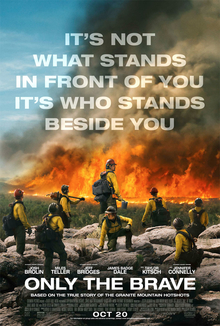
Only the Brave
Fire and Rescue Crew 7 of Prescott, Arizona, superintended by Eric Marsh, responds to the Cave Creek wildfire. Eric predicts that the fire will threaten a residential area, but is disregarded by the assigned superintendent. Eric's fear comes true; he vents his frustration to fire chief and close friend Duane Steinbrink, warning that when a wildfire threatens Prescott, his crew will not be allowed to fight it directly as they lack Hotshot certification. Eric asks for Duane's help, who successfully vouches for the crew with the mayor of Prescott. Crew 7 has until the end of the fire season to pass the evaluation. Meanwhile, 21-year-old heroin addict Brendan McDonough learns that his ex-girlfriend Natalie is pregnant and does not want him involved with the child. Brendan is arrested for larceny, which prompts his mother to evict him from her house. Determined to provide support for his newborn daughter, Brendan interviews with Eric, who gives him an opportunity. After months of training, the crew are given an evaluation during a wildfire deployment as they were set to battle the Horseshoe 2 Fire in the Chiricahuas near the town of Portal. Eric commands his crew but is criticized by their evaluator, Hayes, who Eric bluntly disregards. The fire is halted by Eric's strategy and the crew are certified, officially becoming the first municipal hotshot crew in history, the Granite Mountain Hotshots. Throughout the season, the Granite Mountain crew are deployed across the country. Brendan, who's been anonymously dropping off baby supplies at Natalie's doorstep, is finally accepted by Natalie and allowed to see his daughter. Near Prescott, the crew saves a landmark Alligator juniper and are hailed as local heroes. After battling the fire, Brendan is bitten by a rattlesnake and is rushed to the hospital. Brendan expresses his concerns to Eric about being there for his daughter and asks if he would recommend him for a structural firefighting position next season. Eric snaps, stating that nobody would hire him due to his prior drug addiction. On the way home, Eric has an argument with his wife Amanda, who challenges him about this; reminding him about his own previous drug/alcohol addiction (from which he has been clean for a number of years and which lead to him meeting Amanda) The two talk about starting a family, which they had previously decided not to do due to the nature of their past. Amanda makes it clear to Eric that it is now something she would like to revisit. Eric stops the truck and leaves Amanda alone; unwilling to continue the conversation he leaves stating that he is going for a walk. He ends up at Duane’s house where he speaks openly about his fears. After speaking with Duane, Eric returns to Amanda, announcing that he is ready to settle down. The Granite Mountain Hotshots are called to the Yarnell Hill Fire. Eric informs his captain, Jesse Steed, that he will step down as superintendent after this season and offers Jesse his job. Eric also apologizes to Brendan and promises that he will help him with the transfer. The crew assembles a controlled burn, but is doused mistakenly by an airtanker. Marsh sends Brendan, still recovering from the snakebite, as the lookout, while the remaining crew move to find another suitable location. The wind suddenly shifts, and the fire jumps a trigger point. Brendan is rescued by another hotshot crew while the others relocate to a safe zone, but the fire's speed and intensity continues to increase. The wind picks up again, jumping Granite Mountain's safe zone; cutting them off from escape. Clearing a small site quickly, Eric attempts to douse the blaze with an overhead airtanker, but it misses the drop zone. The crew deploys under their fire shelters as the fire sweeps over them. Brendan listens into the radio traffic, and is devastated when a call finally comes in from the first responders who arrive at their shelters; all 19 of his crewmates have perished. Though the information is treated sensitively, rumors flare amongst the devastated families of what has happened. Brendan, being the sole survivor, demands to meet with them at the gather point at Prescott Middle School. Upon arriving, the families' worst fears are confirmed, with Brendan suffering a psychological breakdown due to survivors guilt. He is ultimately consoled by a grieving newly widowed Amanda. Three years later, Amanda goes on a horseback ride with the horse she rescued earlier in the film watching over a series of horses from a nearby ridge. Brendan takes his daughter to the juniper tree Granite Mountain saved, now adorned as a memorial to the hotshots. The end credits dedicate the film to the 19 fallen firefighters, displaying photos of the real hotshots alongside the actors who played them in the film, and notes that the Yarnell Hill Fire remains the largest loss of firefighter life in a single day since the September 11 attacks.

Control
In 1975, Ian Curtis and Debbie Woodruff marry in their home town of Macclesfield, south of Manchester, England, at ages 19 and 18 respectively. Ian retreats from domestic life, preferring to write poetry in solitude. On 4 June 1976 they attend a Sex Pistols concert with Bernard Sumner, Peter Hook, and Terry Mason, who are starting a band. Mesmerized by the concert, Ian volunteers to be their singer. They name themselves Warsaw, and Terry moves into a managerial role with the addition of drummer Stephen Morris. The band debuts on 19 May 1977 and soon rename themselves Joy Division. At year's end, Ian and Debbie finance the group's first EP, An Ideal for Living. During his job as an employment agent, Ian witnesses his client Corinne Lewis suffering an epileptic seizure. Unsatisfied with the brief mention Joy Division receives from television host Tony Wilson, Ian demands that he put the band on his programme. In April 1978 Joy Division plays a battle of bands, impressing Tony and Rob Gretton, who becomes their new manager. They perform " Transmission " on Tony's programme and sign to his Factory Records label; Tony signs the contract using his blood. In December 1978 Ian suffers a seizure on the way back from the band's first London gig. He is diagnosed with epilepsy and prescribed medications that leave him drowsy and moody. Learning that Corinne has died of a seizure, he writes " She's Lost Control " about her. He begins to neglect Debbie, who gives birth to their daughter Natalie in April 1979. Ian quits his job to go on tour, leaving Debbie to work and care for the baby. Ian admits to Belgian journalist Annik Honoré that he is miserable at home and considers his marriage a mistake. The two begin having an affair during Joy Division's January 1980 European tour. On returning home, Ian tells Debbie he is unsure if he still loves her. During the rehearsing of " Love Will Tear Us Apart ", Rob informs the band that they will be departing 19 May for a tour of the United States. Debbie finds evidence of Ian's infidelity and confronts him. He promises that the affair is over but continues to see Annik during the recording of Closer in Islington. Ian suffers a seizure mid-performance and is comforted by Annik, who admits she is falling in love with him. He attempts suicide by overdosing on phenobarbital but doctors save his life. He continues to perform but is exhausted by the strain and overwhelmed by the audience's expectations. At a performance at Bury's Derby Hall the stress proves too much and he is only briefly able to go onstage. The audience riots when Alan Hempstall of Crispy Ambulance steps in to cover for Ian and the gig is ruined. Ian tells Tony that he believes everyone hates him and that it is all his fault. When Debbie learns that Ian is still seeing Annik, she demands a divorce. Bernard attempts to use hypnotherapy on Ian, who then goes to stay with his parents. He writes to Annik admitting his fear that his epilepsy will eventually kill him and confesses that he loves her. On 17 May 1980, two nights before Joy Division is due to depart for America, Ian returns home and begs Debbie not to divorce him. When she refuses, he angrily orders her out of the house. After drinking alone and writing Debbie a letter, he has another seizure. Regaining consciousness the following morning, he hangs himself from the Sheila Maid in the kitchen. Debbie discovers his body and staggers into the street, crying for help. The news of Ian's death leaves the remaining Joy Division members stunned, while Tony consoles Annik. As Ian's body is cremated, the group gather in a café with Gillian Gilbert, foreshadowing the future of the band.


