← All Movies
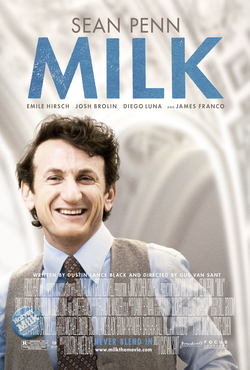
Milk
On the evening of November 27, 1978, Dianne Feinstein announces to the press that Harvey Milk and Mayor George Moscone have been assassinated. Milk is seen recording his will nine days before the assassinations. The film then flashes back to NYC on May 22, 1970, Milk's 40th birthday, and his first meeting with his much younger lover, Scott Smith.
In 1972, dissatisfied with their lives and in need of a change, Milk and Smith move to San Francisco, hoping to find greater acceptance of their relationship. They open Castro Camera in the heart of Eureka Valley, a working-class neighborhood evolving into a predominantly gay neighborhood known as The Castro.
Frustrated by the opposition they encounter in the once-Irish-Catholic neighborhood, Milk uses his background as a businessman to become a gay activist, eventually becoming a mentor to Cleve Jones. Smith serves as Milk's campaign manager, but he grows frustrated with Milk's devotion to politics and leaves him. Milk later meets Jack Lira, a sweet-natured but unbalanced young man. As with Smith, Lira cannot tolerate Milk's devotion to political activism and eventually hangs himself. Milk clashes with the local gay establishment, which he feels is too cautious.
In 1977, after three unsuccessful attempts to become a city supervisor for the California State Assembly, Milk wins a seat on the San Francisco Board of Supervisors for District 5, after a change from at-large elections to district elections. His victory makes him the first openly gay man to be voted into major public office in California and the third openly homosexual politician in the entire United States. Milk meets fellow Supervisor Dan White, a Vietnam veteran and former police officer and firefighter. White is politically and socially conservative, and a complex relationship develops.
Milk is invited to and attends the christening of White's first child. White asks Milk for assistance in preventing a psychiatric hospital from opening in White's district, possibly in exchange for White's support of Milk's citywide gay rights ordinance. When Milk fails to support White because of the negative effect it will have on troubled youth, White feels betrayed and becomes the sole vote against the gay rights ordinance. Milk also launches an effort to defeat Proposition 6, an initiative on the California state ballot in 1978. Sponsored by John Briggs, a conservative state senator from Orange County, Proposition 6 seeks to ban gays and lesbians from working in California's public schools.
On November 7, 1978, after working tirelessly against Proposition 6, Milk and his supporters rejoice in the wake of its defeat. Three days later, a desperate White favors a supervisor pay raise but does not get much support, and shortly after supporting the proposition, resigns from the Board. He later changes his mind and asks to be reinstated. Mayor Moscone denies his request after being lobbied by Milk.
On the morning of November 27, 1978, White enters City Hall through a basement window to conceal a gun from metal detectors. He requests another meeting with Moscone, who rebuffs his request for an appointment to his former seat. Enraged, White murders Moscone in his office and then goes to meet Milk in his, where he kills him, as Milk gazes out at the city.
In text, it is revealed that 30,000 people attended Milk's funeral and his ashes were scattered over the Golden Gate Bridge. White's lawyers concocted the story of the " Twinkie Defense " to get him a sentence of seven years for first-degree manslaughter and was released in 1984, committing suicide in 1985.