Genre: Biography (Page 10)
Browse 242 movies in the Biography genre.
All Genres
Alexander Nevsky
An army of the Teutonic Order invades and conquers the city of Pskov with the help of the traitor Tverdilo, and massacres its population. Novgorod is their next intended target. Despite resistance from the boyars and merchants of Novgorod (urged on by the monk Ananias, Tverdilo's henchman), an appeal is made to Alexander Yaroslavich Nevsky, to again become their prince and defend Novgorod. To do so he rallies the common people of the Novgorod area. In the decisive Battle of the Ice, on the surface of frozen Lake Chudskoe, the Teutonic forces are defeated. Pskov is retaken, and there Nevsky passes judgment: the surviving Teutonic foot-soldiers are set free, while the surviving Teutonic knights will be held for ransom. Tverdilo the traitor, together with a Catholic priest who blessed the burning alive of Pskov children, disappear as they are mobbed by the onlookers. A subplot throughout is the rivalry and friendship of Vasili Buslai and Gavrilo Oleksich, two famous (and historic) warriors of Novgorod. Both become commanders of the Novgorod forces, and are engaged in a contest of courage and fighting skill in order to decide which will win the hand of Olga Danilovna, a Novgorod maiden whom both are courting. At the same time Vasilisa, daughter of a boyar of Pskov killed by the Teutons, joins the Novgorod forces as a soldier. She and Vasili wind up fighting side by side; she throws him a weapon when he is surrounded and weaponless, and it is she who finds and slays Ananias. Gavrilo and Vasili are seriously wounded and are found by Olga, who retrieves them from the battlefield. Though they defer to each other, in the end Vasili publicly states that neither was the bravest in battle: that honor goes to Vasilisa, followed by Gavrilo. Thus Gavrilo and Olga are united while Vasili chooses Vasilisa as his bride-to-be (with her unspoken consent).


Restrepo
After some footage of four inebriated soldiers filmed by PFC Juan Sebastián Restrepo a week before deployment, text is displayed that reads: "In May 2007, the men of Second Platoon, Battle Company began a 15 month deployment in the Korengal Valley of eastern Afghanistan. It was considered one of the most dangerous postings in the U.S. Military." The Korengal flows north to the Pech, which then flows east to the Kunar River Valley on Afghanistan's porous border with Pakistan. American soldiers and supplies were ferried into the remote Combat Outpost (COP) Korengal by Chinook helicopters. As an example of the ever-present dangers faced by the soldiers in the area, the first scene in the film that takes place in Afghanistan depicts a fire-fight after a military Hummer is disabled on a narrow mountain road by an IED. The remainder of the film chronicles the lives of the men of Second Platoon from a few months after their arrival in the Korengal Valley to the time of their return home. Early in their deployment, Pfc. Timothy R. Vimoto, 19, was killed in action, and the unit lost PFC Restrepo, their medic, shortly after. When Capt. Dan Kearney decided to construct an advanced outpost, the men chose to call it "OP Restrepo" in honor of their fallen comrade Juan Restrepo who so many have come to build a strong relationship with, which is where most of the film takes place. At Restrepo, the men came under fire almost daily, and often multiple times in a single day, from shifting enemy positions in the surrounding landscape. In addition to interrupting the flow of Taliban troops and weapons through the Korengal Valley, a major goal for the American troops was to provide security for the construction of a road and gain the trust of the populace. The film portrays negotiations and interactions between the soldiers and local leaders and citizens, some of which are congenial, and some of which are more antagonistic. A significant portion of the second half of the film consists of a depiction of Operation Rock Avalanche, which took place in October 2007. During the dangerous mission to hunt Taliban fighters in the Korengal Valley, Battle Company lost Staff Sergeant Larry Rougle during an ambush by a large number of enemies. SSG Rougle was at point and took the brunt of the attack, allowing his soldiers to secure a position and fight. A recipient of the Purple Heart who served two tours in Iraq and three in Afghanistan, SSG Rougle was subsequently buried in Arlington National Cemetery. According to Junger, Restrepo is a film, not just about the events of combat, but also about "brotherhood", and it shows the soldiers' dedication to their duty, as well as their commitment to one another. Interspersed throughout the film are excerpts from interviews recorded with some of the soldiers after Second Platoon returned to the 173rd Airborne Brigade Combat Team 's base near Vicenza, Italy, in which the men candidly reflect on their experiences, feelings about those who were wounded or killed, and the emotional distress they will carry with them. Before the credits roll, text is displayed that reads: "In April 2010, the United States withdrew from the Korengal Valley. Nearly 50 American soldiers died fighting there."
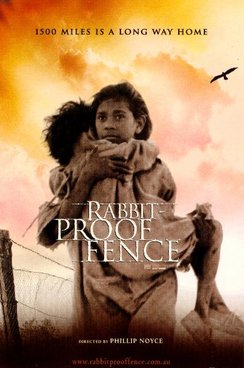
Rabbit-Proof Fence
In 1931, two sisters – 14-year-old Molly and 8-year-old Daisy – and their 10-year-old cousin Gracie are living in the Western Australian town of Jigalong. The town lies along the northern part of one of the fences making up Australia 's rabbit-proof fence (called Number one Fence), which runs for over one thousand miles. More than a thousand miles away in Perth, the official Protector of Western Australian Aborigines, A. O. Neville (called Mr. Devil by them), signs an order to relocate the three girls to the Moore River Native Settlement. The children are referred to by Neville as " half-castes ", because they each have Aboriginal mothers and white fathers. Neville had concluded that the Aboriginal people of Australia were a danger to themselves, and the "half-castes" must be bred out of existence. He plans to place the girls in a camp where they, along with all half-castes of that age range, both boys and girls, will grow up. They would be trained to work as labourers and servants to white families, which were regarded as "good" situations for them in life. It was assumed that they would marry whites, and so on through the generations, so that eventually the Aboriginal "blood" would diminish in society. The three girls are forcibly taken from their families at Jigalong by a local constable, Riggs. They were sent to the camp at the Moore River Native Settlement, in the south west, about 90 km (55 miles) north of Perth. While at the camp, the girls are housed in a large dormitory with dozens of other children, where they are strictly regimented by nuns. They are prohibited from speaking their native language, forced to pray as Christians, and subject to corporal punishment for any infractions of the camp's rules. Attempts at escape are also harshly punished, as seen in the film, where an escapee is beaten and has their hair cut off. During an impending thunderstorm that will help cover their tracks, Molly convinces the girls to escape and return to their home. During their flight, the girls are relentlessly pursued by Moodoo, an Aboriginal tracker from the camp. They eventually find their way back to the rabbit-proof fence, which they believe will lead them back to their home. They follow the fence for months, encountering a family who gives them clothes and food, as well as a camper who shows them a shortcut, which allows them to narrowly avoid Moodoo and Neville's agents. They also encounter a maid, who lets them stay at her room for a night, but they are discovered by her master, who is implied to be abusing her. After another narrow escape, Neville spreads word that Gracie's mother is waiting for her in the town of Wiluna. The information finds its way to an Aboriginal traveller who "helps" the girls. He tells Gracie about her mother and says they can get to Wiluna by train, causing her to leave the other two girls in an attempt to catch a train to Wiluna. Molly and Daisy soon walk after her and find her at a train station. They are not reunited, however, as Riggs appears and Gracie is recaptured. The betrayal is revealed by Riggs, who tells the man he will receive a shilling for his help. Knowing they are powerless to aid her, Molly and Daisy continue their journey. They lose the fence for a while travelling through a harsh desert, but Molly is eventually guided back by an eagle. In the end, after a nine-week journey through the harsh Australian outback, having walked the 1,670 km (1,040 mi) route along the fence, the two sisters return home and go into hiding in the desert with their mother and grandmother. Meanwhile, Neville realizes he can no longer afford the search for Molly and Daisy, and decides to end it.


Thirty Two Short Films About Glenn Gould
With memories revolving around the family's cottage near Lake Simcoe, Glenn Gould recalls how in his childhood, he had ostensibly made the decision to become a concert pianist at age five. In fact, he believes his mother had already chosen that career for him. He recalls being able to read music before he could read books, and learned the music of Johann Sebastian Bach from his mother. Gould later imagines interviewing himself, in which he confronts himself about why he chose to quit giving concerts at the age of 32, preferring to communicate to his audience through media instead. Gould reminds himself that the musician is inescapably an autocrat, no matter how benign. In crafting radio documentaries, Gould works on a piece called The Idea of North, which touches on the effects the environment has on the solitude and isolation of the people of Northern Canada. In a media interview, Gould reveals that The Idea of North is one of only five of his documentaries about isolation, and that he intends to make a comedy next because he is tired of serious expression. Interviewers also push him to explain how he could achieve his level of musical perfection without interest in being overly technical in his piano playing. They ask why he insists on being interviewed only over the telephone. Others question if Gould's supposed obsession in technology is merely a smokescreen to keep his distance from real people. As the markets plummet, Gould picks up word from the bodyguard of the visiting Sheik Yamani to invest in an obscure company called Sotex Resources, which is set to benefit from an exploration contract. Gould becomes the only client to profit in the wake of financial meltdown. However, Margaret Pacsu, a friend, notices Gould's bathroom is stocked heavily with various pills, including Valium, Trifluoperazine and Librax. Gould laughs off the idea that he is taking all of the pills simultaneously, and Pacsu does not notice any effects on his personality. As his birthday approaches, Gould becomes concerned that no one will attend his funeral, despite being aware of strong record sales in Central Europe and Japan. Gould dies at age 50 of a stroke. His cousin, Jessie Greig, says Gould was wrong and his funeral was heavily attended. He had noted that Voyager I and Voyager II, space probes launched for possible contact with extraterrestrial intelligence, contain Bach's music as played by Gould.

The King
After a battle with the Scots, King Henry IV meets with those who fought. Hotspur is angry and insulting towards the king. England 's Prince Henry (" Hal ") spends his days drinking, whoring, and jesting with his companion Falstaff in Eastcheap. His father King Henry IV grows tired of Hal's debauchery and announces that Hal's younger brother Prince Thomas will inherit the throne. King Henry IV sends Thomas to subdue Hotspur's rebellion. However, Hal arrives and challenges Hotspur to single combat, which Hal wins, ending the battle without further conflict. Thomas dies shortly after while campaigning against the rebels in Wales. When King Henry IV dies, Hal is anointed as King Henry V. He opts for peace and conciliation with his father's many adversaries, despite his actions being seen as weakness. At King Henry V's coronation feast, envoys from the Dauphin of France present Hal with a tennis ball as an insulting coronation gift. However, King Henry V frames this as a positive reflection of his boyhood. His sister Philippa, now the Queen of Denmark, cautions her brother that nobles in any royal court have their own interests in mind and will never fully reveal their true intentions. King Henry V interrogates a captured assassin who claims to have been sent to kill him by King Charles VI of France. French agents approach the English nobles Cambridge and Grey. The traitors plot against Hal and unsuccessfully attempt to win over the Chief Justice, Gascoigne. Gascoigne advises Hal that a show of strength is necessary to unite England, so Hal declares war on France and has Cambridge and Grey beheaded. He approaches Falstaff and appoints him as his chief military strategist, saying that Falstaff is the only man he truly trusts. The English army sets sail for France. After completing the Siege of Harfleur, they receive taunting messages from the Dauphin. The English advance parties stumble upon a vast French army gathering to face them. Dorset advises Hal to retreat, but Falstaff proposes using infantry without armor to attack the armored French cavalry, who would get weighed down and stuck in the mud. Hal challenges the Dauphin to single combat to minimize bloodshed, but the Dauphin refuses. Falstaff's plan succeeds, and the outnumbered English army defeats the French, although Falstaff is killed. The Dauphin, witnessing his men's retreat, restates Hal's challenge, but slips in the mud until Hal orders his soldiers to kill him. Hal commands the execution of all French prisoners to prevent regrouping, despite Falstaff's warning against this unchivalrous act unworthy of a king. Hal meets King Charles VI, who agrees to adopt him as his heir and offers him his daughter, Catherine of Valois. Hal returns to England with his new wife for a triumphant celebration. In private, she challenges his reasons for invading France and denies the alleged French actions against him, suggesting that the assassin was a plot from within his own court. Suspicious, Hal confronts Gascoigne, who admits that he staged the insult and acts of aggression, believing his sole duty is to protect the King, even if it requires deceiving him. In a cold fury, Hal kills the Chief Justice. Hal asks Catherine to only speak truth to him.

