Genre: Biography (Page 11)
Browse 242 movies in the Biography genre.
All Genres
The Baader Meinhof Complex
In 1967, a visit by the Shah of Iran to West Berlin leads to a clash between the West German student movement and German police. In the chaos, unarmed protestor Benno Ohnesorg is fatally shot by policeman Karl-Heinz Kurras, outraging the West German public, including left-wing journalist Ulrike Meinhof, who claims in a televised debate that West Germany is a fascist police state. Inspired by Meinhof's rhetoric, radical communists Gudrun Ensslin and Andreas Baader mastermind the Frankfurt department store firebombings of 1968. While covering their trial, Meinhof is moved by the radicals' commitment and befriends Ensslin during a prison interview before leaving her husband for radical-linked journalist Peter Homann. Left-wing activist Rudi Dutschke is injured in an assassination attempt by neo-nazi Josef Bachmann, further radicalizing the Left. Ensslin and Baader are released pending an appeal and recruit youths, including Astrid Proll and Peter-Jurgen Boock, to their cause. After spending some time abroad, Baader, Ensslin, and Proll move in with Meinhof, who begins advocating violent action but does not wish to leave her two children. When Baader is arrested again, Meinhof arranges an "interview" off prison grounds, which Ensslin and the others use to break him out; though the plan called for Meinhof to appear innocent and stay behind, she flees with the radicals, incriminating herself. Meinhof sends her children to Sicily and the group receives guerilla training from Fatah in Jordan. Homann, overhearing the others asking Fatah to kill him and Meinhof planning to recruit her children as suicide bombers, leaves the group and arranges for his colleague Stefan Aust to return Meinhof's children to their father. The radicals, now calling themselves the Red Army Faction (RAF), return to Germany and begin robbing banks. In response, German Federal Police chief Horst Herold orders all municipal police to be put under federal command for one day. During that day, RAF member Petra Schelm is pursued by police and killed in a shootout; viewing her death as murder rather than resisting arrest, Baader and Ensslin overrule Meinhof's objections and launch a deadly bombing campaign against police stations and United States military bases. However, under Herold's command, the police respond in force to the RAF's activities and many members, including Baader, Ensslin, Meinhof, and Holger Meins, are arrested and imprisoned. They stage a hunger strike in separate prisons that results in Meins' death, while the authorities move Baader, Ensslin, Meinhof, and Jan-Carl Raspe to Stammheim Prison, where they work on their defense for their trial and smuggle orders outside. In 1975, a group of younger RAF recruits acting on these orders seize the West German embassy in Stockholm, where they kill two hostages and threaten to blow up the embassy if the prisoners are not released, but their bombs accidentally detonate, wounding everyone inside and killing RAF members Ulrich Wessel and Siegfried Hausner. The prisoners are appalled by the poor execution of their orders. Meinhof, suffering from depression and remorse over the deaths caused by the RAF's bombings, is subjected to sadistic emotional abuse by Baader and Ensslin, leading her to hang herself; the others falsely claim she was killed by the government. Upon completing her sentence in 1977, Brigitte Mohnhaupt takes over command of the RAF and organizes the assassination of Attorney General Siegfried Buback as revenge for Meins and Meinhof's "murders". Mohnhaupt, Christian Klar, and Susanne Albrecht also attempt to kidnap Dresdner Bank president Jürgen Ponto, but they kill him when he fights back. Aware the imprisoned RAF members ordered both murders, the authorities place them in solitary confinement, but Ensslin and Baader obtain radios to continue smuggling orders. Launching a new campaign of terror, Mohnhaupt abducts industrialist Hanns Martin Schleyer while the Popular Front for the Liberation of Palestine hijacks Lufthansa Flight 181, again with the goal of securing the prisoners' release, but the West German government refuses to negotiate for Schleyer, while the PFLP hijackers are defeated by GSG 9. Baader and Ensslin tauntingly warn a negotiator and a prison chaplain respectively that the violence will continue; however, the latter also confides that she fears she will be killed soon. The next morning, Baader and Raspe are found dead from gunshot wounds next to smuggled handguns, while Ensslin is found having been hung from her cell's barred window; Irmgard Möller is also found stabbed four times in the chest, but she survives. The news devastates the RAF, who insist they were murdered, but Mohnhaupt explains that they, like Meinhof, were "in control of the outcome until the very end". The RAF then murders Schleyer, signifying the continuation of RAF terrorism past the original members.

BlackBerry
In Waterloo, Ontario in 1996, Research in Motion (RIM) CEO Mike Lazaridis and his best friend and co-founder Douglas Fregin prepare to pitch their "PocketLink" cellular device to businessman Jim Balsillie. Their pitch is unsuccessful, but after Balsillie is fired from his job due to his aggressive ambition, he offers to invest $20,000 for 50% of the company and a position as CEO. Lazaridis, prompted by Fregin, initially declines Balsillie's offer, but after confirming Balsillie's suspicion that their $16 million deal with USRobotics was in bad faith, they bring Balsillie in as a co-CEO with Lazaridis and sell him a 33% stake in RIM for $125,000. After joining RIM, Balsillie discovers that the company is in a dire financial position and he mortgages his house to add a cash infusion to make payroll. Balsillie arranges a pitch for the PocketLink with Bell Atlantic and forces Fregin and Lazaridis to build a crude prototype overnight, which he and Lazaridis take to New York. Lazaridis forgets the prototype in their taxi, leaving Balsillie to attempt the pitch alone. Lazaridis recovers the prototype at the last second and finishes the pitch, and they rebrand the PocketLink as the " BlackBerry ", which becomes massively successful. In 2003, Palm Inc. CEO Carl Yankowski plans a hostile takeover of the immensely successful RIM, leading Balsillie to try to raise RIM's stockprice by selling more phones than Bell Atlantic's (now Verizon Communications) network can support. This does crash the network, as Lazaridis had warned, so Balsillie poaches engineers from around the world to fix the problem, as well as hiring a man named Charles Purdy as RIM's chief operating officer to keep the engineers in line. Purdy's employment upsets Fregin, who values the casual and fun work environment he and Lazaridis had created. The new engineers fix the network issue under Purdy's strict management, and RIM avoids Yankowski's buyout. In 2007, RIM's upcoming pitch of the BlackBerry Bold to Verizon is thrown into chaos when Steve Jobs announces the iPhone, much to Lazaridis and Fregin's irritation. Balsillie, a hockey fan with a long-term ambition of owning an NHL team, is occupied with trying to purchase the Pittsburgh Penguins, forcing Lazaridis to pitch the Bold with Fregin instead. When it goes poorly, he panics and impulsively promises them the BlackBerry Storm, a touchscreen device. As Lazaridis finally agrees with Purdy's suggestion to outsource the labor of the Storm to China, he insults Fregin during an argument. Fregin later quits RIM as a result. Balsillie becomes nervous when he sees the iPhone's projected sales and tries to arrange a meeting with the CEO of AT&T, only to learn that the Penguins sale is being finalized that day. He prioritizes the Penguins but is rejected when the NHL owners reveal knowledge of his plan to move the team to Hamilton, which they learned of through his boasting to Yankowski. The US SEC raid RIM after learning that Balsillie hired the engineers in 2003 with illegally backdated stock options, threatening Lazaridis with legal action. Balsillie misses his chance to meet with AT&T's CEO, who snubs Balsillie by hinting that AT&T's partnership with Apple is predicated on the fact that data usage has superseded phone minutes as a priority. Balsillie returns to RIM to find that Lazaridis has exposed him to the SEC, leaving Lazaridis as the sole CEO of RIM. One year later, the Storms arrive from China, but Lazaridis finds them to be laden with bugs and can hear buzzing when he holds one to his ear. He begins manually fixing the buzzing phones one by one. Captions over the film's closing titles reveal that the Storms were almost universally inoperable and Verizon sued RIM to cover the financial loss. Lazaridis resigned as CEO in 2012, Balsillie avoided jail, and Fregin had secretly became one of the richest men in the world by selling his stock in 2007 after he left RIM. At the height of RIM's success, BlackBerry phones made up 45% of the cell phone market; today their market share is 0%, and BlackBerry phones are no longer produced.

The Best of Enemies
In 1971 in Durham, North Carolina, Ann Atwater tries to get better housing conditions for poor black people, and is ignored by the all-white judge panel. Ann's daughter's school catches on fire, causing local Ku Klux Klan president C. P. Ellis to fear that the black children will come to the white schools. Bill Riddick sets up a meeting with them both, to arrange charrettes to discuss segregation and other issues. Both refuse at first as they hate each other, but are convinced. C.P. proudly refuses to sit with Bill and Ann, since they are black and he is white. They agree to pick some people randomly from the group to vote on the issues at the end of the meeting sessions. C.P tries to talk to these selected to vote, but is rebuffed. A black reverend asks Bill if he can play gospel music at the end of each session. C.P. refuses, saying that if the Black people want to sing gospel music at the charrette, he should be allowed to put out his KKK items on display. Ann refuses, but Bill agrees. At one meeting, a group of black teenagers tries to destroy the KKK items, but Ann stops them and tells them to instead understand what the KKK is. C.P. observes. Bill insists Black and White people in their group sit next to each other in the cafeteria as they eat. He makes C.P and Ann sit together alone. They eat in tense silence, then she asks him if he has a boy in Murdock. C.P. refuses to talk about his son. Murdock is a facility for disabled boys, and his son has Down syndrome. C.P. rushes to Murdock, as his son Larry has been put in the same room with another boy who is screaming, upsetting Larry. C.P. demands that his son be placed in a room of his own, but the nurses say he can't afford it. Ann visits Larry and convinces Bernadette, who works there, to put him in his own room. Bill takes Ann, C.P., and the rest of their group to visit the black school that was burned. C.P. is shocked by the damage. Ann's daughter says hi to Ann, but gives C.P the evil eye when she realises who he is. C.P.'s wife Mary, overjoyed with Ann's help, goes to thank her. Ann is told that C.P. has always been racist. Mary later calls C.P out when he tells her about his encounter with Ann's daughter, asking him what he expected. The encounter and Mary's words leave C.P shaken and start to question his beliefs. The night before the final vote, C.P.'s KKK troublemaking friends threaten the selected voters to vote for segregation. When C.P. finds out, he is dismayed. Especially since one of the targets is a Vietnam vet who C.P had talked to earlier and learned that the man's manager, a black man, is also a vet and had saved his life on several occasions. When Ann hears about it, she screams at C.P., calling him a coward. During the voting, all the issues pass, coming down to the final issue of desegregation. The voters give their vote one by one. Ann votes for it, and C.P. surprises everyone by doing the same, realizing the KKK is hateful. He also makes a speech and rips up his KKK membership card, to the fury of his watching KKK friends. They threaten him and try to set fire to his gas station but C.P. douses it. The white community shuns and boycotts his station. Ann and Bill bring in the black community to buy from him instead. The real life Ann and C.P. went around to different cities together, to talk about their experiences. They remained friends to the end of C.P.'s life, with Ann giving the eulogy at his funeral.
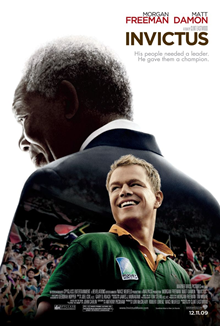
Invictus
On 11 February 1990, Nelson Mandela is released from Victor Verster Prison after 27 years in captivity. Four years later, he is elected President of South Africa at a time of enormous challenges in the post-Apartheid era, including rampant poverty and crime, with Mandela particularly concerned about racial divisions between black and white South Africans. Within his own party, significant cultural changes replacing those of Apartheid rule, such as changing the national flag, national anthem and iconography, are very popular, but he is also aware that these changes will alienate white South Africans, who still control the country's economy, the police and the military. Mandela attempts to foster better relations beginning with his own security detail, employing established white officers previously employed by previous Presidents and the ANC security officers, though the two share a mutual distrust. While attending a rugby union match between South Africa and England, Mandela sees that some black South Africans are supporting England rather than the mostly-white Springboks due to the legacy of apartheid; he remarks that he did the same while imprisoned on Robben Island. Knowing that South Africa is set to host the 1995 Rugby World Cup in one year's time, Mandela persuades the newly black-dominated South African Sports Committee to support the Springboks. He meets with the captain of the Springboks, Francois Pienaar, implying that victory for South Africa in the World Cup will unite and inspire the nation. Mandela also recites to Pienaar William Ernest Henley 's poem " Invictus " that inspired him during his time in prison. During the Springboks' preparations many South Africans, black and white, doubt that rugby union will unite a nation torn apart by forty-six years of apartheid, especially considering the image of the Springboks to many in the black community. Both Mandela and Pienaar, however, stand firm in their belief that the game can successfully unite South Africans. After the players begin interacting with the majority black fans at the request of Mandela, during the preparation matches support for the Springboks begins to grow among the black population. Mandela's security team also grows closer as the racially diverse officers come to respect their comrades' professionalism and dedication, in addition to bonding over the game of rugby union, a sport which previously appealed primarily to the white team members while being disdained by their black counterparts. The Springboks defeat their arch-rival and defending champions Australia in their opening match. They then continue to defy all expectations and, as Mandela conducts trade negotiations in Taiwan, they defeat France in heavy rain to advance to the final against their other rival New Zealand - regarded as the tournament favourite and best team in the world. Meanwhile, during the tournament, the Springboks visit Robben Island, where Mandela had served time; seeing Mandela's cell inspires Pienaar to adopt his idea of self-mastery. A large home crowd of all races gathers at Ellis Park Stadium in Johannesburg for the final, with Mandela in attendance wearing a replica Springboks jersey. Mandela's security detail are alarmed when a South African Airways Boeing 747-200 jetliner flies in low over the stadium - only for the whole crowd to see the message "Good Luck, Bokke" stenciled on the undersides of the plane's wings. The hard-fought final goes into extra time, where fly-half Joel Stransky makes a drop goal to complete the Springboks' run to becoming world champions. Mandela celebrates the victory with the team on the field and hands Pienaar the Webb Ellis Cup. As he is driven back from the match, Mandela feels hope and prosperity for South Africa as he sees the people celebrating together in the streets.

Stand and Deliver
In the early 1980s, Jaime Escalante becomes a mathematics teacher at James A. Garfield High School in East Los Angeles. Latino students from working-class families have academic achievement far below their grade level. Students Angel and another gangster arrive late and question Escalante's authority. Escalante demonstrates how to multiply numbers using one's fingers and appeals to the students' sense of humor. After class, some gangsters threaten him. After school, he stops the gangsters from fighting. Escalante decides to teach the students algebra. At a meeting, he learns that the school's accreditation is under threat, as test scores are not high enough. He says that students will rise to the level that is expected of them and gives the students a quiz every morning. He instructs his class under the philosophy of ganas. Escalante tells other faculty that he wants to teach the students calculus, seeking to change the school culture to help the students excel in academics. Other teachers ridicule him, as the students have not taken the prerequisites. Escalante states that the students can take the prerequisites over the summer, setting a goal of having the students take Advanced Placement Calculus by their senior year. The students sign up for the prerequisites over the summer. In the fall, he gives them contracts to be signed by the parents; they must come in on Saturdays, show up an hour early to school, and stay until 5pm in order to prepare for the AP Calculus exam. Two weeks before the exam, Escalante teaches an ESL class when he suddenly clutches at his torso in pain, stumbles into the hallway, and falls. Escalante escapes from the hospital and shows up at school to continue teaching. After taking the AP calculus exam, the students head to the beach and celebrate. All 18 students who took the exam pass it. At a meeting to congratulate them, a plaque of appreciation is presented to Escalante. To the dismay of Escalante and the students, the Educational Testing Service (ETS) questions the students' exam scores. Escalante finds an anonymous letter of resignation in his school mail and walks home that evening, as his car has been stolen. Dismayed, he confides in his wife that he regrets having taught calculus because the students did well but nothing changed. Fabiola reassures him, stating that his students appreciate his efforts. Outside, students surprise him by fixing his car. Escalante meets with the investigators from ETS and offers to have the students retake the test. Despite having only one day to prepare, all the students pass, and Escalante demands that the original scores be reinstated. End captions indicate that in the summer of 1982, Escalante's entire class passed AP Calculus and in subsequent years, his program became even more successful.

The People vs. Larry Flynt
In 1972, Flynt and his younger brother, Jimmy, run the Hustler Go-Go, a struggling strip club in Cincinnati. In a bid to improve his business, Flynt decides to publish a newsletter for the club featuring nude photos of his strippers, which he names Hustler. The newsletter soon becomes a full-fledged magazine, but sales are weak. After Hustler publishes photos of former first lady Jackie Kennedy Onassis sunbathing nude in 1972, it becomes a national sensation, and Larry decides to focus on it full-time. Flynt becomes smitten with Althea Leasure, who he allows to work as a stripper despite her being underage. With his success comes enemies – as he finds himself a hated figure of anti-pornography activists. He argues with the activists, declaring that "murder is illegal, but if you take a picture of it, you may get your name in a magazine or maybe win a Pulitzer Prize. However, sex is legal, but if you take a picture of that act, you can go to jail." He becomes involved in several prominent court cases, and befriends his young and idealistic lawyer, Alan Isaacman. In 1975, Flynt is convicted on pornography charges, but the decision is overturned on appeal; he is released from jail soon afterwards. Ruth Carter Stapleton, a Christian activist and sister of President Jimmy Carter, seeks out Flynt and urges him to give his life to Jesus; this results in Flynt attempting to turn his life around and even push for Hustler to become a more tasteful publication in line with his competitors. However, Althea, who blames molestation by nuns during her years in Catholic school for her problems in life, grows to resent him. In 1978, during another trial in Georgia, Flynt and Isaacman are both shot by a man with a rifle while they walk outside a courthouse. Isaacman recovers, but Flynt is paralyzed from the waist down and uses a wheelchair for the rest of his life. Broken by the experience, Flynt renounces his faith, turns over control of Hustler to Jimmy and Althea, and moves to Beverly Hills, where he quickly spirals into drug addiction to combat his depression and crippling pain. In 1983, Flynt undergoes surgery to deaden several nerves in his back damaged by the bullet wounds, and as a result, feels rejuvenated. He soon returns to an active role with the publication. Flynt is soon in court again for leaking videos relating to the John DeLorean entrapment case, and during his courtroom antics, he fires Isaacman, then throws an orange at the judge. He later wears an American flag as an adult diaper along with an Army helmet, and wears provocative T-shirts. After spitting water at the judge, Flynt is committed to a psychiatric ward, where he sinks into depression again. Flynt publishes a satirical parody ad in which Jerry Falwell tells of a drunken sexual encounter with his mother. Falwell sues for libel and emotional distress. Flynt countersues for copyright infringement, because Falwell copied his ad and used it to raise funds for his legal bills. The case goes to trial in December 1984, but the decision is mixed, as Flynt is found liable for inflicting emotional distress but not libel and is forced to pay damages to Falwell. Althea, now a morphine addict, visits Flynt and reveals her HIV diagnosis; disgusted to learn that the Hustler staff won't even shake her hand, Flynt arranges a company meeting via phone call and fires everyone. Althea comes to live with him, but later drowns in the bathtub after passing out. Flynt presses Isaacman to appeal the Falwell decision to the Supreme Court of the United States. Isaacman refuses, saying Flynt's courtroom antics humiliated him. Flynt pleads with him, saying that he "wants to be remembered for something meaningful". Isaacman finally agrees to represent him in front of the Supreme Court, in the case Hustler Magazine v. Falwell in December 1987. With Flynt sitting silently in the courtroom, the court overturns the original verdict in a unanimous decision. After the trial, Flynt is shown to be alone in his bedroom watching old videotapes of a happy, healthy Althea and himself before tragedy struck them both.

Lorenzo's Oil
Lorenzo is a bright and vibrant young boy living in the Comoro Islands, as his father Augusto Odone works for the World Bank and is stationed there. However, after relocating with his parents to the United States, he begins to show signs of neurological problems, such as falling, loss of hearing, tantrums, etc. The boy is diagnosed as having adrenoleukodystrophy (ALD), which is fatal within two years. Failing to find a doctor capable of treating their son's rare disease, Augusto and his wife, Michaela, set out on a mission to find a treatment to save their son. In their quest, the Odones clash with doctors, scientists and a support group that is skeptical that anything could be done about ALD, much less by laypeople. But they persist, setting up camp in medical libraries, reviewing animal experiments, enlisting the aid of Professor Gus Nikolais, badgering researchers, questioning top doctors all over the world and even organizing an international symposium about the disease. Despite research dead-ends, the horror of watching their son's health decline and being surrounded by skeptics (including the coordinators of the support group they attend), they persist until they finally hit upon a possible therapy. The Odones sponsor an international meeting of scientists doing research on ALD, requiring two conditions ahead of time. First they insist that the meeting focus on potential treatments and second, they require that they be allowed to participate, despite being non-scientist laypeople. The pivotal scene in the movie portrays this meeting, in which the scientists are presenting their research. When Dr. William B. Rizzo mentions his studies in which the addition of oleic acid to cultured cells blocked accumulation of the factors which cause ALD, the Odones jump into the conversation, asking if this oil might help their son. Although the scientists play down their hope, pointing out that it would take years of work to produce the oil and test in clinical trials, the Odones seize the promise of this possible curative treatment. As the scene ends, Michaela Odone is shown beginning the effort to find someone able and willing to produce the same oil Dr. Rizzo gave to his cells. They obtain oleic acid from an industrial manufacturer of lubricants, but this only lowers Lorenzo's levels by 50% before leveling off, and they realize they are only countering some of the shorter chains produced by one enzyme. To remove the other, they will have to add a distillation of erucic acid. They contact over 100 firms around the world until they find an elderly British chemist, Don Suddaby, who is working for Croda International and is willing to take on the challenge of distilling the proper formula. The Odones obtain a precious vial of the oil (actually containing two specific long chain fatty acids, isolated from rapeseed oil and olive oil) and add it to their son's diet. This treatment proves successful in normalizing the accumulation of the very long chain fatty acids (which had been causing their son's steady decline), as measured in blood levels. This treatment halts the progression of his disease and is dubbed "Lorenzo's Oil". This oil is soon found to be successful in preventing the progression of harm in other patients with ALD. Meanwhile, Lorenzo has a great deal of neurological damage, and the Odones are dismayed to see that the oil can reverse their son's symptoms only very, very slowly. The Odones realize that more rapid improvement of their son's severe condition will require treatments to repair the myelin sheath (a lipid insulator) around the nerves, and Augusto is shown taking on the new challenge of organizing biomedical efforts to heal myelin damage in patients. Lorenzo, at the age of 14, shows definite improvement (swallowing for himself and answering "yes" or "no" questions by blinking) and it is revealed that he has regained his sight, can move his head from side to side, vocalize simple sounds and is learning to use a computer. The movie ends with scenes of ALD patients who were treated with Lorenzo's Oil earlier in the course of their disease. In these patients, the devastating neurological degeneration from which Lorenzo suffered was prevented.

Official Secrets
In early 2003, GCHQ analyst Katharine Gun obtains a memo detailing a joint United States and British operation to spy on diplomats from several non – permanent United Nations Security Council member states (Cameroon, Chile, Bulgaria and Guinea), to "dig dirt" on them. This was to influence the Security Council into passing a resolution supporting an invasion of Iraq. Angered that the UK is being led into a war on false pretences, Katharine leaks the memo to a friend involved in the anti-war movement, who passes it to anti-war activist Yvonne Ridley. She gets it to The Observer journalist Martin Bright. The Observer foreign editor Peter Beaumont allows Martin to investigate the story. To verify the memo's authenticity, Martin enlists the help of the Observer ' s Washington correspondent Ed Vulliamy to contact the memo's author Frank Koza, Chief of Staff at the "regional targets" section of the NSA. Despite the Observer ' s pro-war stance, Peter convinces the chief editor Roger Alton that the leaked memo is worth publishing. The leaked memo's publication in March 2003 generates public and media interest. The Drudge Report attempts to discredit the document as a fake, as staffer Nicole Mowbray had inadvertently changed the text from American to British English with a spellchecker. However, Martin is able to produce the original memo, confirming its authenticity. Katharine's actions prompt GCHQ to launch an internal investigation. Seeking to prevent an invasion of Iraq and to protect her colleagues from suspicion, Katharine confesses to the leak. She is arrested, questioned, then released on bail. Following the outbreak of the Iraq War, Katharine seeks the services of the Liberty lawyers Ben Emmerson and Shami Chakrabarti. The British Government decides to charge her with violating the Official Secrets Act, tasking the Director of Public Prosecutions, Ken Macdonald, with the prosecution. To exert pressure, the British authorities attempt to deport her husband Yasar Gun, a Turkish Kurd. However, Katharine is able to halt the deportation with the help of her MP, Nigel Jones. Katharine's defence strategy is that she acted from loyalty to her country, seeking to prevent it from being led into an unlawful war. With the help of Martin, Ed, and former Foreign Office deputy legal adviser Elizabeth Wilmshurst, Ben discovers that the Attorney General Peter Goldsmith changed his position on the legality of the war after meeting lawyers from the Bush Administration. Despite the odds against her, Katharine refuses to plead guilty in exchange for a reduced charge. In court, the Crown prosecutor offers no evidence against Katharine. Ben responds that this is because doing so would have shown that the Blair government led the UK into war on false pretences. The film then mentions the human toll of the Iraq War and that Lord Goldsmith's advice on the illegality of the Iraq War was made public in 2010. It ends with footage of the real Katharine addressing the media following the dismissal of her case, and Ben shunning Ken for putting Katharine through the ordeal "to make an example of her".

24 Hour Party People
In 1976 television presenter Tony Wilson sees the Sex Pistols perform at the Manchester Lesser Free Trade Hall for the first time. Inspired, Wilson starts a weekly series of punk rock shows at a Manchester club, where the newly formed Joy Division perform, led by the erratic, brooding Ian Curtis. Wilson founds a record label, Factory Records, and signs Joy Division as the first band; the contract is written in Wilson's blood and gives the Factory artists full control over their music. He hires irascible producer Martin Hannett to record Joy Division, and soon the band and label have a hit record. In 1980, just before Joy Division is to tour the United States, Curtis hangs himself. Joy Division rename themselves New Order and record a hit single, " Blue Monday ". Wilson opens a nightclub, the Haçienda; business is slow at first, but eventually the club is packed each night. Wilson signs another hit band, Happy Mondays, led by Shaun Ryder, and the ecstasy -fuelled rave culture is born. Despite the apparent success, Factory Records is losing money. Every copy of "Blue Monday" sold loses five pence, as the intricate packaging by Peter Saville costs more than the single's sale price. Wilson pays for New Order to record a new album in Ibiza, but after two years, they still have not delivered a record. He pays for the Happy Mondays to record their fourth studio album in Barbados, but Ryder spends all the money on drugs. When Wilson finally receives the album, he finds that Ryder has refused to record vocals, and all the tracks are instrumentals. At the Haçienda, ecstasy use is curbing alcohol sales and attracting gang violence. The Factory partners try to save the business by selling the label to London Records. However, Wilson reveals that the Factory does not hold contracts with any of its artists and, therefore, does not own a catalogue of recordings. This renders the company ultimately worthless and the deal falls through. While smoking marijuana on the roof of Haçienda after its closing night, Wilson has a vision of God, who assures Wilson he has earned a place in history.

American Sniper
Growing up in Texas, Chris Kyle is taught by his father how to shoot a rifle and hunt deer. Years later, Chris has become a ranch hand and rodeo cowboy, and returns home early to find his girlfriend in bed with another man. After telling her to leave, he sees news coverage of the 1998 U.S. embassy bombings and decides to enlist in the Navy. He qualifies for special training and becomes a sniper with the U.S. Navy SEALs. Chris meets Taya Studebaker at an Irish pub in San Diego, and the two soon marry. He is sent to the Iraq War after the September 11 attacks. His first kills are a woman and a boy who attacked U.S. Marines on patrol with a Russian-made RKG-3 anti-tank grenade. Chris is visibly upset by the experience, but later earns the nickname "Legend" for his many kills. Assigned to hunt for the al-Qaeda leader, Abu Musab al-Zarqawi, Chris interrogates a family whose father offers to lead the SEALs to "The Butcher", al-Zarqawi's second-in-command. The plan goes awry when The Butcher captures the father and his son, killing them while a sniper pins down Chris. This sniper goes by the name Mustafa and is an Olympic Games medalist from Syria. Meanwhile, the insurgents issue a bounty on Chris. Chris returns home to his wife and the birth of his son. He is distracted by memories of his war experiences and by Taya's concern for them as a couple. She wishes he would focus on his home and family. Chris leaves for a second tour and is promoted to chief petty officer. Involved in a shootout with The Butcher, he helps kill him. Chris becomes increasingly distant from his family when he returns home to a newborn daughter. On Chris's third tour, Mustafa seriously injures a unit member, Ryan "Biggles" Job, and the unit is evacuated back to base. When they decide to return to the field and continue the mission, another SEAL, Marc Lee, is killed by gunfire. Guilt compels Chris to undertake a fourth tour, and Taya tells him she may not be there when he returns. Back in Iraq, Chris is shocked to learn Biggles died in surgery to repair the wounds he sustained. Assigned to kill Mustafa, who has been sniping U.S. Army combat engineers building a barricade, Chris's sniper team is placed on a rooftop inside enemy territory. Chris spots Mustafa and takes him out with a risky long-distance shot at 2,100 yards (1,920 m), but this exposes his team's position to numerous armed insurgents. Amid the gunfight and low on ammunition, Chris tearfully calls Taya and tells her he is ready to come home. A sandstorm provides concealment for a chaotic escape in which he is injured and almost left behind. After Chris gets back stateside, on edge and unable to adjust fully to civilian life, a Veterans Affairs psychiatrist asks if he is haunted by all the things he did in war. When he replies that "all the guys couldn't save" haunt him, the psychiatrist encourages him to help severely wounded veterans in the VA hospital. After that, Chris gradually begins to adjust to home life. Years later, on February 2, 2013, Chris says goodbye to his wife and family as he leaves in good spirits to spend time with Eddie Ray Routh, a veteran suffering from PTSD, at a shooting range. An on-screen subtitle reveals that Chris was killed that day by Routh, followed by archive footage of crowds standing along the highway for his funeral procession. More are shown attending his memorial service.

Lincoln
In January 1865, U.S. President Abraham Lincoln expects the American Civil War to end soon, with the defeat of the Confederate States Army. He is concerned that his 1863 Emancipation Proclamation may be discarded by the courts after the war and that the proposed Thirteenth Amendment will be defeated by the returning slave states. He feels it is imperative to pass the amendment beforehand, to foreclose any possibility that freed slaves might be re-enslaved. The Radical Republicans fear the amendment will be defeated by some who wish to delay its passage; support from Republicans in the states is not yet assured. The amendment also requires the support of several Democratic congressmen in order for it to pass. With dozens of Democrats being lame ducks after losing their re-election campaigns in 1864, some of Lincoln's advisors recommend waiting for a new Republican nominated Congress. Lincoln relies on Francis Preston Blair, a founder of the Republican Party, to influence members of the state conservative faction to vote for the anti-slavery amendment. Blair in turn insists that Lincoln allow him to engage the Confederate government in peace negotiations, knowing his two sons will once again be in danger after the spring thaw permits renewed military operations. While Lincoln knows such negotiations would anger the Radical Republicans, he needs to support the slavery amendment; he also cannot proceed without Blair's support and reluctantly authorizes the peace mission. Lincoln and Secretary of State William H. Seward also need to secure Democratic votes for the amendment and Lincoln suggests they concentrate on the lame-ducks who will feel less restricted so as to vote independently. Lincoln also authorizes agents to offer federal jobs to the soon to be unemployed Democratic congressmen. Robert Todd Lincoln, the eldest son of President Lincoln and First Lady Mary Todd Lincoln, returns from Harvard Law School and announces his intention to discontinue his studies and enlist in the Union army. He hopes to earn a measure of honor and respect outside of his father's shadow. The President reluctantly secures an officer's commission for him. His wife fears their son will be killed and urges her husband to pass the amendment and end the war. At a critical moment in the debate in the United States House of Representatives, racial-equality advocate Thaddeus Stevens agrees to moderate his position and argue that the amendment represents only legal equality between the races, not a declaration of actual equality. Confederate envoys ready to meet with Lincoln are instructed to remain outside of Washington, D.C. as the amendment approaches a vote on the House floor. Rumors of the peace envoy circulate, prompting both Democrats and conservative Republicans to advocate postponing the vote. In a carefully worded statement, Lincoln denies there are envoys in Washington, and the vote passes by a margin of two votes. Black visitors to the gallery celebrate, and Stevens returns home to his "housekeeper" and lover, a biracial woman named Lydia Hamilton Smith. When Lincoln meets with the Confederates, he tells them that slavery cannot be restored, as the North is united for ratification of the amendment, and several of the southern states' reconstructed legislatures would also vote to ratify. As a result, the peace negotiations fail, and the war continues. On April 3, Lincoln visits the battlefield at Petersburg, Virginia and speaks with Lieutenant General Ulysses S. Grant. On April 9, Grant receives General Robert E. Lee 's surrender at Appomattox Courthouse. On April 14, Lincoln meets members of his cabinet to discuss future measures to enfranchise blacks, before leaving for Ford's Theatre. That night, while Lincoln's son Tad is watching a play at Grover's Theatre, the manager stops the play to announce that the President has been shot. The next morning, at the Petersen House, Lincoln dies with a peaceful expression across his face. In a flashback, he finishes reciting his second inaugural address on March 4 with the words, "With malice toward none, with charity for all".

Spare Parts
In 2004, four Mexican students arrive at the Marine Advanced Technology Education Robotics Competition at the University of California, Santa Barbara (UCSB); born in Mexico, raised in Phoenix, Arizona, where they attend an underfunded public high school. Oscar Vazquez goes to an Armed Forces Career Center to enlist into the U.S. Army; while he is waiting for his interview, he sees a video announcement and brochures about a Marine Underwater Robotics Competition, an event sponsored by NASA and the United States Armed Forces. Although he distinguishes himself as part of the Carl Hayden High School Junior Reserve Officer Training Corps, he is forbidden to join the U.S. Army because of his status as an illegal immigrant; he is recommended not to present himself to any government office to avoid being reported to the Immigration and Customs Enforcement (ICE) agency. Vazquez lies to his mother about his progress in the Army; looking for another way to move ahead in life, he investigates the Underwater Robotics Competition. With no previous formal teaching experience and between jobs, Fredi Cameron interviews for a vacant substitute teacher position at Carl Hayden High School. The principal questions his job stability record, but eventually hires Cameron because of his PhD and engineer credentials. After the interview, while in the school's parking lot, Lorenzo Santillan overrides Cameron's car temperature safety sensor for $20 to avoid a more costly repair job. As part of his normal teaching responsibilities, Cameron is assigned to oversee an engineering club, where he meets Vazquez, who is looking for help to build a remotely operated underwater robot for the UCSB robotics competition. Cameron begrudgingly agrees to help, even though he doesn't feel he is going to remain at the school for long. Vazquez, looking for more kids to join the engineering club, talks to teacher Gwen Kolinsky, who recommends Cristian Arcega. After agreeing to help, Arcega takes the technical lead of the project and sketches an early design of the potential robot. Before starting to build it, Cameron suggests a prototype so they can do a proof of concept model. Cameron starts to learn about the competition rules and requirements, which demands the robot to successfully complete a series of underwater tasks. Kolinsky offers to help teaching him about the PBASIC programming language, to implement the robot's intelligence module. After catching Santillan stealing from the principal's car, Cameron forces him to join the team and the now named Robotics Academic Club, so he can help with the mechanical design and building of the prototype. They later recruit Luis Aranda, for being strong enough to help lift the machine in and out of the pool. Because of a lack of funds to see the project through, the team starts looking for spare parts and asking for donations from the local businesses, which raise $663.53, plus $134.63 given by Cameron himself. The small budget forces them to scale back the original design and to innovate in how the robot is constructed, including the glue which gives the robot its name, "Stinky". Needing to go from Phoenix to Santa Barbara creates problems because three of the four boys were illegal immigrants from Mexico. The day before the competition, they have to fix a critical electrical problem, due to a leak in the case that protected the intelligence module, by using tampons to contain the water. They face several highly funded college teams; the team from MIT is backed by a $10,000 grant from ExxonMobil. The Phoenix teenagers scraped together less than $1,000 and built their robot out of scavenged parts. Yet their robot finishes the practical segment of the competition in fourth place with 75 points after missing three tasks. They are still hopeful for a chance to make it into third place because 30% of the total score would be based on the judges' technical evaluation and interview of the teams. The night of the awards ceremony, they are given a Special Achievement award, which the team assumes is their final result. They are later surprised when they are announced as the champions of the event.