← All Movies
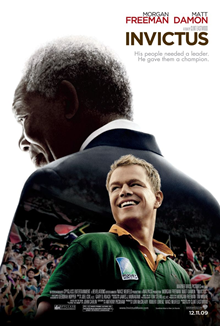
Invictus
On 11 February 1990, Nelson Mandela is released from Victor Verster Prison after 27 years in captivity. Four years later, he is elected President of South Africa at a time of enormous challenges in the post-Apartheid era, including rampant poverty and crime, with Mandela particularly concerned about racial divisions between black and white South Africans. Within his own party, significant cultural changes replacing those of Apartheid rule, such as changing the national flag, national anthem and iconography, are very popular, but he is also aware that these changes will alienate white South Africans, who still control the country's economy, the police and the military. Mandela attempts to foster better relations beginning with his own security detail, employing established white officers previously employed by previous Presidents and the ANC security officers, though the two share a mutual distrust.
While attending a rugby union match between South Africa and England, Mandela sees that some black South Africans are supporting England rather than the mostly-white Springboks due to the legacy of apartheid; he remarks that he did the same while imprisoned on Robben Island. Knowing that South Africa is set to host the 1995 Rugby World Cup in one year's time, Mandela persuades the newly black-dominated South African Sports Committee to support the Springboks. He meets with the captain of the Springboks, Francois Pienaar, implying that victory for South Africa in the World Cup will unite and inspire the nation. Mandela also recites to Pienaar William Ernest Henley 's poem " Invictus " that inspired him during his time in prison.
During the Springboks' preparations many South Africans, black and white, doubt that rugby union will unite a nation torn apart by forty-six years of apartheid, especially considering the image of the Springboks to many in the black community. Both Mandela and Pienaar, however, stand firm in their belief that the game can successfully unite South Africans. After the players begin interacting with the majority black fans at the request of Mandela, during the preparation matches support for the Springboks begins to grow among the black population. Mandela's security team also grows closer as the racially diverse officers come to respect their comrades' professionalism and dedication, in addition to bonding over the game of rugby union, a sport which previously appealed primarily to the white team members while being disdained by their black counterparts.
The Springboks defeat their arch-rival and defending champions Australia in their opening match. They then continue to defy all expectations and, as Mandela conducts trade negotiations in Taiwan, they defeat France in heavy rain to advance to the final against their other rival New Zealand - regarded as the tournament favourite and best team in the world. Meanwhile, during the tournament, the Springboks visit Robben Island, where Mandela had served time; seeing Mandela's cell inspires Pienaar to adopt his idea of self-mastery.
A large home crowd of all races gathers at Ellis Park Stadium in Johannesburg for the final, with Mandela in attendance wearing a replica Springboks jersey. Mandela's security detail are alarmed when a South African Airways Boeing 747-200 jetliner flies in low over the stadium - only for the whole crowd to see the message "Good Luck, Bokke" stenciled on the undersides of the plane's wings. The hard-fought final goes into extra time, where fly-half Joel Stransky makes a drop goal to complete the Springboks' run to becoming world champions. Mandela celebrates the victory with the team on the field and hands Pienaar the Webb Ellis Cup. As he is driven back from the match, Mandela feels hope and prosperity for South Africa as he sees the people celebrating together in the streets.