Genre: History (Page 7)
Browse 133 movies in the History genre.
All Genres

The Best of Enemies
In 1971 in Durham, North Carolina, Ann Atwater tries to get better housing conditions for poor black people, and is ignored by the all-white judge panel. Ann's daughter's school catches on fire, causing local Ku Klux Klan president C. P. Ellis to fear that the black children will come to the white schools. Bill Riddick sets up a meeting with them both, to arrange charrettes to discuss segregation and other issues. Both refuse at first as they hate each other, but are convinced. C.P. proudly refuses to sit with Bill and Ann, since they are black and he is white. They agree to pick some people randomly from the group to vote on the issues at the end of the meeting sessions. C.P tries to talk to these selected to vote, but is rebuffed. A black reverend asks Bill if he can play gospel music at the end of each session. C.P. refuses, saying that if the Black people want to sing gospel music at the charrette, he should be allowed to put out his KKK items on display. Ann refuses, but Bill agrees. At one meeting, a group of black teenagers tries to destroy the KKK items, but Ann stops them and tells them to instead understand what the KKK is. C.P. observes. Bill insists Black and White people in their group sit next to each other in the cafeteria as they eat. He makes C.P and Ann sit together alone. They eat in tense silence, then she asks him if he has a boy in Murdock. C.P. refuses to talk about his son. Murdock is a facility for disabled boys, and his son has Down syndrome. C.P. rushes to Murdock, as his son Larry has been put in the same room with another boy who is screaming, upsetting Larry. C.P. demands that his son be placed in a room of his own, but the nurses say he can't afford it. Ann visits Larry and convinces Bernadette, who works there, to put him in his own room. Bill takes Ann, C.P., and the rest of their group to visit the black school that was burned. C.P. is shocked by the damage. Ann's daughter says hi to Ann, but gives C.P the evil eye when she realises who he is. C.P.'s wife Mary, overjoyed with Ann's help, goes to thank her. Ann is told that C.P. has always been racist. Mary later calls C.P out when he tells her about his encounter with Ann's daughter, asking him what he expected. The encounter and Mary's words leave C.P shaken and start to question his beliefs. The night before the final vote, C.P.'s KKK troublemaking friends threaten the selected voters to vote for segregation. When C.P. finds out, he is dismayed. Especially since one of the targets is a Vietnam vet who C.P had talked to earlier and learned that the man's manager, a black man, is also a vet and had saved his life on several occasions. When Ann hears about it, she screams at C.P., calling him a coward. During the voting, all the issues pass, coming down to the final issue of desegregation. The voters give their vote one by one. Ann votes for it, and C.P. surprises everyone by doing the same, realizing the KKK is hateful. He also makes a speech and rips up his KKK membership card, to the fury of his watching KKK friends. They threaten him and try to set fire to his gas station but C.P. douses it. The white community shuns and boycotts his station. Ann and Bill bring in the black community to buy from him instead. The real life Ann and C.P. went around to different cities together, to talk about their experiences. They remained friends to the end of C.P.'s life, with Ann giving the eulogy at his funeral.
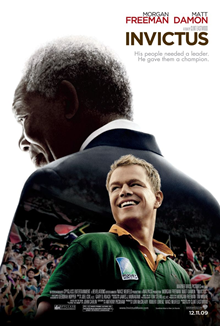
Invictus
On 11 February 1990, Nelson Mandela is released from Victor Verster Prison after 27 years in captivity. Four years later, he is elected President of South Africa at a time of enormous challenges in the post-Apartheid era, including rampant poverty and crime, with Mandela particularly concerned about racial divisions between black and white South Africans. Within his own party, significant cultural changes replacing those of Apartheid rule, such as changing the national flag, national anthem and iconography, are very popular, but he is also aware that these changes will alienate white South Africans, who still control the country's economy, the police and the military. Mandela attempts to foster better relations beginning with his own security detail, employing established white officers previously employed by previous Presidents and the ANC security officers, though the two share a mutual distrust. While attending a rugby union match between South Africa and England, Mandela sees that some black South Africans are supporting England rather than the mostly-white Springboks due to the legacy of apartheid; he remarks that he did the same while imprisoned on Robben Island. Knowing that South Africa is set to host the 1995 Rugby World Cup in one year's time, Mandela persuades the newly black-dominated South African Sports Committee to support the Springboks. He meets with the captain of the Springboks, Francois Pienaar, implying that victory for South Africa in the World Cup will unite and inspire the nation. Mandela also recites to Pienaar William Ernest Henley 's poem " Invictus " that inspired him during his time in prison. During the Springboks' preparations many South Africans, black and white, doubt that rugby union will unite a nation torn apart by forty-six years of apartheid, especially considering the image of the Springboks to many in the black community. Both Mandela and Pienaar, however, stand firm in their belief that the game can successfully unite South Africans. After the players begin interacting with the majority black fans at the request of Mandela, during the preparation matches support for the Springboks begins to grow among the black population. Mandela's security team also grows closer as the racially diverse officers come to respect their comrades' professionalism and dedication, in addition to bonding over the game of rugby union, a sport which previously appealed primarily to the white team members while being disdained by their black counterparts. The Springboks defeat their arch-rival and defending champions Australia in their opening match. They then continue to defy all expectations and, as Mandela conducts trade negotiations in Taiwan, they defeat France in heavy rain to advance to the final against their other rival New Zealand - regarded as the tournament favourite and best team in the world. Meanwhile, during the tournament, the Springboks visit Robben Island, where Mandela had served time; seeing Mandela's cell inspires Pienaar to adopt his idea of self-mastery. A large home crowd of all races gathers at Ellis Park Stadium in Johannesburg for the final, with Mandela in attendance wearing a replica Springboks jersey. Mandela's security detail are alarmed when a South African Airways Boeing 747-200 jetliner flies in low over the stadium - only for the whole crowd to see the message "Good Luck, Bokke" stenciled on the undersides of the plane's wings. The hard-fought final goes into extra time, where fly-half Joel Stransky makes a drop goal to complete the Springboks' run to becoming world champions. Mandela celebrates the victory with the team on the field and hands Pienaar the Webb Ellis Cup. As he is driven back from the match, Mandela feels hope and prosperity for South Africa as he sees the people celebrating together in the streets.

Thirteen Days
In October 1962, U-2 aerial surveillance photos reveal that the Soviet Union is placing intermediate-range ballistic missiles carrying nuclear weapons in Cuba. U.S. president John F. Kennedy and his advisers must come up with a plan to prevent their activation. Kennedy wants to show that the United States will not allow a missile threat. The Joint Chiefs of Staff advise military strikes against the missile sites followed by an invasion of Cuba. Kennedy is reluctant to this because it would likely cause the Soviets to invade West Berlin, which could lead to an all-out war. Kennedy sees an analogy to the events that started World War I, where the tactics of both sides' commanders had not evolved since the previous war and were obsolete, only this time nuclear weapons are involved. War appears to be almost inevitable. The Kennedy administration tries to find a solution that will remove the missiles but avoid an act of war. They reject a blockade, as this is formally regarded as an act of war, and settle on what they publicly describe as a quarantine. They announce that the U.S. naval forces will stop all ships entering Cuban waters and inspect them to verify they are not carrying weapons. The Soviet Union sends mixed messages in response. Off the shores of Cuba, the Soviet ships turn back from the quarantine lines. Spy plane pictures continue to be ordered, but one of Kennedy's top advisers, Kenneth O'Donnell, calls the pilots to ensure they do not report that they were shot at or fired upon, because if they were, the country would be forced to retaliate under the rules of engagement. John A. Scali, a reporter with ABC News, is contacted by Soviet "emissary" Aleksandr Fomin, and through this back-channel communication method the Soviets offer to remove the missiles in exchange for public assurances that the U.S. will never invade Cuba. A long message in the same tone as the informal communication from Fomin, apparently written personally by Soviet Premier Nikita Khrushchev, is received. This is followed by a second, more hard line cable in which the Soviets offer a deal involving U.S. removal of its Jupiter missiles from Turkey. The Kennedy administration interprets the second as a response from the Soviet Politburo, and decides to ignore it and respond to the message assumed to be from Khrushchev. There are several mis-steps during the crisis: the defense readiness level of Strategic Air Command (SAC) is raised to DEFCON 2 (one step shy of maximum readiness for imminent war), without informing Kennedy; a U.S. nuclear weapon test proceeds (Bluegill Triple Prime) and a routine test launch of a U.S. offensive missile is also carried out without the President's knowledge. In a bid for time while under pressure from the military for an immediate strike, President Kennedy authorizes attacks on the missile sites and an invasion of Cuba, to commence the following Monday. An Air Force U-2 reconnaissance plane is sent over Cuba to gather intelligence for the attack, but is shot down, killing the pilot Rudolf Anderson. After much deliberation with the Executive Committee of the National Security Council, Kennedy makes a final attempt to avoid a war by sending his brother Robert to meet with Soviet ambassador Anatoly Dobrynin on Friday night. Bobby reiterates the demand that the Soviets remove their missiles from Cuba, and in return promises not to invade or assist in the invasion of Cuba. Dobrynin insists that the U.S. must also remove all Jupiter missiles from Turkey, on the border of the Soviet Union. Bobby says that a quid pro quo is not possible, but in exchange for Khrushchev removing the missiles from Cuba, there will be a secret understanding that the U.S. will remove all of its "obsolete" missiles from Turkey within six months as part of a pre-scheduled plan. The Soviets announce on Sunday that they will remove their missiles from Cuba, averting a war that could have escalated to the use of nuclear weapons. President Kennedy later dictates a letter of condolence to the family of the reconnaissance pilot Anderson.

The Death of Stalin
" For 20 years, Stalin's NKVD security forces have imposed The Great Terror. Those on Stalin's list of 'enemy' names are arrested, exiled or shot. " –Opening caption On the night of 1 March 1953, Joseph Stalin demands the director of Radio Moscow provide a recording of a live recital of Piano Concerto No. 23 after the show has concluded. The director recalls the audience and orchestra and records the recreated concert. Pianist Maria Yudina, who hates the cruel dictator, only complies after being bribed and slips a note into the recording before it is couriered to Stalin. Stalin is hosting a tense, but rowdy, gathering of Central Committee members at Kuntsevo Dacha. As Foreign Minister Vyacheslav Molotov leaves, NKVD head Lavrentiy Beria reveals to Nikita Khrushchev and Deputy Chairman Georgy Malenkov that Molotov is to be part of the latest purge. The concert recording arrives and Maria's note, admonishing Stalin and wishing him dead, causes him to suffer a cerebral haemorrhage as he laughs at the note. Stalin's guards hear him fall in his office but fear disturbing him. Stalin's housemaid discovers him unconscious the next morning and members of the Central Committee rush to the dacha. Beria finds Maria's note but only after Malenkov, Khrushchev, Lazar Kaganovich, Anastas Mikoyan, and Nikolai Bulganin arrive, does the Committee finally decide to send for medical help. The best doctors in Moscow have been arrested after the " Doctors' plot ". When Stalin dies under the care of mediocre doctors, Beria orders the NKVD to relieve the Soviet Army of control of Moscow. Beria and Khrushchev vie for the support of Molotov and Stalin's children, Svetlana and her unstable, alcoholic brother Vasily. Beria removes Molotov's name from the impending purge and releases Polina Zhemchuzhina, Molotov's wife, from prison. The Committee names Malenkov, a puppet of Beria, as chairman. He hijacks Khrushchev's proposed reforms, such as releasing political prisoners and loosening clerical restrictions, relegating Khrushchev to planning Stalin's funeral. Beria threatens Khrushchev with Maria's note, and Krushchev reverses Beria's order to halt all transport into Moscow. When 1,500 arriving mourners are killed, the Committee wants to blame junior NKVD officers. In an effort to deflect blame, Beria threatens his colleagues with documents detailing their involvement in various purges. Angered by the NKVD's takeover of security from the Army, Marshal Georgy Zhukov supports Khrushchev in launching a coup against Beria after Stalin's funeral. Khrushchev gets support from the rest of the Committee save Malenkov, and on Zhukov's orders the Army reclaims its posts from the NKVD. Zhukov, Kiril Moskalenko and Leonid Brezhnev storm a meeting of the Committee and arrest Beria. Malenkov reluctantly signs Beria's death warrant. At Beria's emergency trial, Khrushchev finds him guilty of counter-revolutionary activities, sexual assault, and paedophilia. Beria is summarily executed and Zhukov has his body burned. Krushchev sends Svetlana to Vienna under protest, keeps Vasily in Russia, where he can be watched, and concurs with Kaganovich that Malenkov is too weak to lead. In 1956, Krushchev has defeated his rivals on the Committee to become the new leader of the Soviet Union, and is in the audience as Maria once again performs the Mozart concerto. Brezhnev, who will succeed Khrushchev in 1964, eyes Khrushchev from his seat.

Lincoln
In January 1865, U.S. President Abraham Lincoln expects the American Civil War to end soon, with the defeat of the Confederate States Army. He is concerned that his 1863 Emancipation Proclamation may be discarded by the courts after the war and that the proposed Thirteenth Amendment will be defeated by the returning slave states. He feels it is imperative to pass the amendment beforehand, to foreclose any possibility that freed slaves might be re-enslaved. The Radical Republicans fear the amendment will be defeated by some who wish to delay its passage; support from Republicans in the states is not yet assured. The amendment also requires the support of several Democratic congressmen in order for it to pass. With dozens of Democrats being lame ducks after losing their re-election campaigns in 1864, some of Lincoln's advisors recommend waiting for a new Republican nominated Congress. Lincoln relies on Francis Preston Blair, a founder of the Republican Party, to influence members of the state conservative faction to vote for the anti-slavery amendment. Blair in turn insists that Lincoln allow him to engage the Confederate government in peace negotiations, knowing his two sons will once again be in danger after the spring thaw permits renewed military operations. While Lincoln knows such negotiations would anger the Radical Republicans, he needs to support the slavery amendment; he also cannot proceed without Blair's support and reluctantly authorizes the peace mission. Lincoln and Secretary of State William H. Seward also need to secure Democratic votes for the amendment and Lincoln suggests they concentrate on the lame-ducks who will feel less restricted so as to vote independently. Lincoln also authorizes agents to offer federal jobs to the soon to be unemployed Democratic congressmen. Robert Todd Lincoln, the eldest son of President Lincoln and First Lady Mary Todd Lincoln, returns from Harvard Law School and announces his intention to discontinue his studies and enlist in the Union army. He hopes to earn a measure of honor and respect outside of his father's shadow. The President reluctantly secures an officer's commission for him. His wife fears their son will be killed and urges her husband to pass the amendment and end the war. At a critical moment in the debate in the United States House of Representatives, racial-equality advocate Thaddeus Stevens agrees to moderate his position and argue that the amendment represents only legal equality between the races, not a declaration of actual equality. Confederate envoys ready to meet with Lincoln are instructed to remain outside of Washington, D.C. as the amendment approaches a vote on the House floor. Rumors of the peace envoy circulate, prompting both Democrats and conservative Republicans to advocate postponing the vote. In a carefully worded statement, Lincoln denies there are envoys in Washington, and the vote passes by a margin of two votes. Black visitors to the gallery celebrate, and Stevens returns home to his "housekeeper" and lover, a biracial woman named Lydia Hamilton Smith. When Lincoln meets with the Confederates, he tells them that slavery cannot be restored, as the North is united for ratification of the amendment, and several of the southern states' reconstructed legislatures would also vote to ratify. As a result, the peace negotiations fail, and the war continues. On April 3, Lincoln visits the battlefield at Petersburg, Virginia and speaks with Lieutenant General Ulysses S. Grant. On April 9, Grant receives General Robert E. Lee 's surrender at Appomattox Courthouse. On April 14, Lincoln meets members of his cabinet to discuss future measures to enfranchise blacks, before leaving for Ford's Theatre. That night, while Lincoln's son Tad is watching a play at Grover's Theatre, the manager stops the play to announce that the President has been shot. The next morning, at the Petersen House, Lincoln dies with a peaceful expression across his face. In a flashback, he finishes reciting his second inaugural address on March 4 with the words, "With malice toward none, with charity for all".

Spare Parts
In 2004, four Mexican students arrive at the Marine Advanced Technology Education Robotics Competition at the University of California, Santa Barbara (UCSB); born in Mexico, raised in Phoenix, Arizona, where they attend an underfunded public high school. Oscar Vazquez goes to an Armed Forces Career Center to enlist into the U.S. Army; while he is waiting for his interview, he sees a video announcement and brochures about a Marine Underwater Robotics Competition, an event sponsored by NASA and the United States Armed Forces. Although he distinguishes himself as part of the Carl Hayden High School Junior Reserve Officer Training Corps, he is forbidden to join the U.S. Army because of his status as an illegal immigrant; he is recommended not to present himself to any government office to avoid being reported to the Immigration and Customs Enforcement (ICE) agency. Vazquez lies to his mother about his progress in the Army; looking for another way to move ahead in life, he investigates the Underwater Robotics Competition. With no previous formal teaching experience and between jobs, Fredi Cameron interviews for a vacant substitute teacher position at Carl Hayden High School. The principal questions his job stability record, but eventually hires Cameron because of his PhD and engineer credentials. After the interview, while in the school's parking lot, Lorenzo Santillan overrides Cameron's car temperature safety sensor for $20 to avoid a more costly repair job. As part of his normal teaching responsibilities, Cameron is assigned to oversee an engineering club, where he meets Vazquez, who is looking for help to build a remotely operated underwater robot for the UCSB robotics competition. Cameron begrudgingly agrees to help, even though he doesn't feel he is going to remain at the school for long. Vazquez, looking for more kids to join the engineering club, talks to teacher Gwen Kolinsky, who recommends Cristian Arcega. After agreeing to help, Arcega takes the technical lead of the project and sketches an early design of the potential robot. Before starting to build it, Cameron suggests a prototype so they can do a proof of concept model. Cameron starts to learn about the competition rules and requirements, which demands the robot to successfully complete a series of underwater tasks. Kolinsky offers to help teaching him about the PBASIC programming language, to implement the robot's intelligence module. After catching Santillan stealing from the principal's car, Cameron forces him to join the team and the now named Robotics Academic Club, so he can help with the mechanical design and building of the prototype. They later recruit Luis Aranda, for being strong enough to help lift the machine in and out of the pool. Because of a lack of funds to see the project through, the team starts looking for spare parts and asking for donations from the local businesses, which raise $663.53, plus $134.63 given by Cameron himself. The small budget forces them to scale back the original design and to innovate in how the robot is constructed, including the glue which gives the robot its name, "Stinky". Needing to go from Phoenix to Santa Barbara creates problems because three of the four boys were illegal immigrants from Mexico. The day before the competition, they have to fix a critical electrical problem, due to a leak in the case that protected the intelligence module, by using tampons to contain the water. They face several highly funded college teams; the team from MIT is backed by a $10,000 grant from ExxonMobil. The Phoenix teenagers scraped together less than $1,000 and built their robot out of scavenged parts. Yet their robot finishes the practical segment of the competition in fourth place with 75 points after missing three tasks. They are still hopeful for a chance to make it into third place because 30% of the total score would be based on the judges' technical evaluation and interview of the teams. The night of the awards ceremony, they are given a Special Achievement award, which the team assumes is their final result. They are later surprised when they are announced as the champions of the event.

Salyut-7: The True Story of the Soviet 'Apollo 13'
The Soviet Union, June 1985. After contact with the Salyut 7 space station is lost, cosmonauts Vladimir Fyodorov and Viktor Alyokhin attempt to dock with the empty, frozen craft to bring it back to life.


Thirty Seconds Over Tokyo
Not long after the Pearl Harbor attack, United States Army Air Forces Lieutenant Colonel James Doolittle assembles two dozen North American B-25 Mitchell medium bombers with volunteer crews at Eglin Field, Florida, for a secret mission. Among them is Ted Lawson and his crew, co-pilot Lieutenant Dean Davenport, navigator Lieutenant Charles McClure, bombardier Lietuenant Bob Clever and gunner-mechanic Corporal David Thatcher. Given the opportunity to decline the mission, the crews opt to stay on, including Lawson whose pregnant wife Ellen joins him at Eglin Field. The crews are taught to take off from a runway only 500 feet long by a naval aviator from nearby Pensacola Naval Air Station. Lawson's plane acquires the nickname Ruptured Duck with nose art to match. Doolittle leads the group on a low-level flight at hedge-top height to Naval Air Station Alameda, California where their planes are loaded aboard the aircraft carrier USS Hornet. He informs the men their mission is to bomb Tokyo, Yokohama, Osaka, Kobe, and Nagoya. They will launch from the carrier 400 miles from Japan and after dropping their payloads continue to designated landing spots in parts of China controlled by Nationalist forces and regroup in Chungking. When an enemy surface vessel discovers the convoy, the crews are forced to take off twelve hours earlier than planned, to attack in broad daylight over Japan and land after nightfall in China. Doolittle leads the raid, dropping incendiary bombs to mark key targets for the others. The Ruptured Duck arrives over Tokyo to find some targets already burning, and attacks its targets as planned. Anti-aircraft fire bursts harmlessly around them, and confused enemy fighters ignore them. Ruptured Duck continues toward China and runs low on fuel approaching the coast in darkness and heavy rain. Lawson attempts a belly landing on the beach and crashes in the surf. With the exception of Thatcher, the entire crew is badly injured: Lawson's left leg is laid open to the bone, and McClure's shoulders are broken. Friendly Chinese soldiers help them, and the Americans face hardships and danger while being escorted through Japanese-held territory. In the absence of medical supplies, the injured men endure terrible pain, and Lawson's leg becomes infected. Delirious, he dreams of Ellen. A Red Cross banner hangs in the village of Xing Ming where Doctor Chung offers to take them to his father's hospital, 19 miles farther. He informs the men the Japanese have captured one of the other crews, and they hurry into the hills just before Japanese search parties arrive to burn the village down. No surgeon is at the elder Dr. Chung's hospital, but Lieutenant Smith's crew is on its way with Lieutenant "Doc" White, who volunteered as gunner. The Japanese approach, and the able-bodied Americans leave, except for Doc. He amputates Lawson's leg well above the knee, using the single dose of spinal anesthesia in their possession. It wears off too soon. Lawson passes out and dreams of Ellen. A chorus of Scouts singing " The Star-Spangled Banner ", in Mandarin, celebrates Lawson's first day out of bed. When the elder Dr. Chung gives Lawson an heirloom bracelet for his wife, Lawson is puzzled. He does not remember talking about her. When he totters on his crutches, he becomes distraught at the idea of Ellen seeing him without a leg. They hurry to Ch'ang Chou to rendezvous with an American plane that takes them home. General Doolittle visits Lawson in the hospital and tells him he has work for him to do. Lawson does not want to see Ellen until he obtains a prosthetic leg and learns to walk properly. Ellen arrives unannounced. Lawson forgets his missing leg and stands; he falls and Ellen rushes to him and the two embrace on the floor.

Leto
The film is mainly set in the summer of 1981 in Leningrad. The main storyline of the film tells the story of the relationship between the 19-year-old Viktor Tsoi (Teo Yoo), 26-year-old Mike Naumenko (Roman Bilyk), and Naumenko's girlfriend Natalia (Irina Starshenbaum), as well as the formation of the Leningrad Rock Club and the recording of Kino 's first album, 45. The film's setting, the Leningrad Rock Club, was one of the few state-permitted public performance spaces for rock musicians in its time. The Club is generally a theatrical venue for boundary-pushing music, where audiences are instructed to sit politely and listen rather than mosh. However, interjections by narrator Skeptic (Alexander Kuznetsov) occasionally recast the club as extravagant, hedonistic, reckless, and dangerous. The musicians live frugally; their indulgences are creative rather than material. Much of the narrative focuses on Mike, the frontman of one of the Club's more popular, old-guard bands, and his girlfriend Natacha, whose close, initially monogamous relationship stands in contrast to the expected behavior of rockstars. Also significant to the plot is Viktor, a quiet, slightly otherworldly young man with a knack for melody and a beguilingly peculiar turn of lyrical phrase. Natacha is the first to notice a kind of melancholic magic about Viktor, as the film gradually reorients itself around his budding stardom rather than Mike's less obviously ascending career. However, the film maintains a more general look at the musicians in the club, including the various musicians who come in and out of the lives of the protagonists. The film's musical numbers alternate between diegetic stage performances and sudden flights of music-video fancy. In one such performance, an altercation between musicians and more conservative citizens on a packed train escalates into a demented, carriage-traversing singalong of Talking Heads' "Psycho Killer," the hitherto realist imagery disrupted with early-MTV-style cartoon flourishes. There are a few sequences in which Mike and the other Leningrad rockers seize their moment, using their music to defy the bureaucrats and wow audiences. However, nearly all of these scenes all followed by a caveat to the effect of "this didn’t really happen."
