Genre: History (Page 8)
Browse 133 movies in the History genre.
All Genres
Ukroshcheniye ognya
The film, split into two parts, is based on a true story of the creation and development of the Soviet space and missile industry. Due to security concerns, names were altered in the script, though most of the characters are easily recognizable. Sergei Korolev was the prototype for the lead character of Andrei Bashkirtsev, played by Kirill Lavrov. Part 1: Andrei Bashkirtsev has been obsessed with flying since his youth. Bashkirtsev's career takes shape after meeting with the visionary space scientist Konstantin Tsiolkovsky (played by Innokenti Smoktunovsky). Before World War II he develops the first rockets and builds a launch center in Central Russia. Then he makes the " Katyusha " weapon and takes it to the front-lines of World War II. In spite of his arrest and imprisonment, he continues working on rocket design. He is released from prison upon his request to fight in the front-lines against the Nazis. Part 2: After the end of World War II, Bashkirtsev designs a new rocket system and works with nuclear scientist Igor Kurchatov on the nuclear missiles program. Then he makes a new rocket that launched " Sputnik " to orbit in 1957 from Baykonur Cosmodrome in Kazakhstan. His next achievement is the first man in space, Yuri Gagarin, and other human space missions. By the mid 1960s Bashkirtsev makes developments for the flight to the Moon. However, Bashkirtsev's uncompromising character causes him many problems with Soviet politicians, in addition to other pressures in his life, and he dies from a heart attack. His mission is carried on by his colleagues and apprentices.


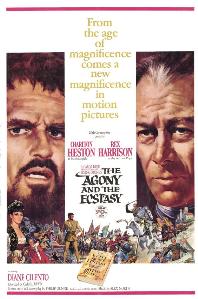
The Agony and the Ecstasy
The film opens in documentary style, chronicling the work of Michelangelo Buonarroti.It then follows Michelangelo, a renowned Cinquecento sculptor of the Republic of Florence, in the early 16th century, and shows him at work on large-scale sculptures near St. Peter's Basilica. When Pope Julius II commissions him to paint the Sistine Chapel, Michelangelo resists because he finds the ceiling's paneled layout of the Twelve Apostles uninspiring. Nonetheless, he is forced into taking the job. During the initial attempt, Michelangelo is discontented with the results, and destroys the frescoes. He flees to Carrara, and then into the mountains where he finds inspiration from nature. Michelangelo returns and is allowed to paint the entire vault in a variety of newly designed biblical scenes based on the Book of Genesis, which the Pope approves. The work proceeds nonstop, even with Mass in session. Michelangelo faces opposition and criticism from the Pope's cardinals, due to its depictons of nudity in the paintings. As months turn to years, Michelangelo's work is threatened when he collapses due to fatigue. He is nursed back to health by Contessina de' Medici, daughter of his old friend Lorenzo de' Medici. After recovering, Michelangelo returns to work after learning he is at risk of being replaced by Raphael, whom the Pope commissions to paint the reception rooms of the Papal palace. Meanwhile, the Papal States are threatened during the War of the League of Cambrai. Preparing for battle and having reached the limits of his patience, the Pope terminates Michelangelo's contract, and has the scaffolding torn down. Raphael, impressed with the work in progress, asks Michelangelo to show humility and finish the ceiling. Michelangelo travels to see the injured and weakened Pope, and pleads for him to restore the patronage. Though the Pope believes an invasion of Rome is inevitable, he raises the money needed to resume work on the ceiling. One night, Michelangelo finds the ailing Pope inspecting the portrait of God in The Creation of Adam, which the Pope declares "a proof of faith" yet doubts Michelangelo's conception of God as merciful and Adam as innocent, then the Pope collapses and becomes bedridden. Though everyone assumes that the Pope will die, Michelangelo goads him into having the will to live and to finish his work and asks permission to allow him return to Florence, a request the Pope refuses. As Michelangelo leaves, the Pope recovers and upon seeing the cardinals and the monks, as well the choir, he angrily shooes them away. The tide of war turns in favor of the Papal States, as allies (including England and Spain) pledge to assist the Pope. A Mass is held in which the congregation is shown the completed ceiling, to a positive response. After the ceremony, Michelangelo asks to begin carving the Pope's tomb. Realizing he has a short time to live, the Pope agrees but changes his mind when he gives Michelangelo another commission to paint a new fresco behind the altarpiece to replace the dilapidated ones (and gives Michelangelo the choice of subject like the crucifixion or the last judgment). The Pope then admits that Michelangelo's conception of God is accurate before goading him to continue his work. As the Pope leaves, Michelangelo turns back to look at the space behind the altarpiece, where he will later paint his Last Judgement 25 years later.

An Officer and a Spy
In 1894, Alfred Dreyfus, a captain in the French army, is found guilty of high treason for passing military secrets to the German Empire. He is condemned to exile on Devil's Island; his affair triggers an echo in France since Dreyfus is Jewish. One year later, officer Georges Picquart, Dreyfus' former teacher, is appointed head of the secret service section in the French army (Deuxième Bureau). The man, despite alleged anti-Semitic sentiments, is aware that the trial against Dreyfus was summary and biased by Dreyfus' Jewish origins. Noticing some irregularities in the dossier of the affair, he decides to conduct an investigation to verify Dreyfus' guilt. Picquart discovers that the so-called bordereau, the document that ostensibly proves his guilt, was not written by Dreyfus, as the graphologist Alphonse Bertillon had claimed, but by another soldier: Major Ferdinand Walsin Esterhazy. According to Picquart, he is the real spy, but the evidence has been prejudiced or even falsified to the detriment of Dreyfus. Picquart is convinced of Dreyfus' innocence and tries to reopen the trial to exonerate him and arrest Esterhazy, but meets the opposition of his superiors: admitting Dreyfus' innocence would result in a great scandal that would lead to the discovery of corruption in the army, while the man, as a Jew, is the perfect scapegoat. Picquart is then removed from office and sent on a mission far from Paris. However, he manages to return and tell everything to his friend, the lawyer Louis Leblois, who begins to organise a committee for the rehabilitation of Dreyfus, involving his colleague Fernand Labori, members of the Parliament and intellectuals, including the famous author Émile Zola. Picquart's insubordination leads to his arrest, but on the same day Zola publishes in the newspaper L'Aurore the article entitled J'accuse, where he fiercely criticises the irregularities of the trial of Dreyfus and exposes all the people involved in the case. Zola, on a complaint from the government, is tried for defamation and, due to the false declarations made in the courtroom by the soldiers called to witness, the writer is sentenced to one year in prison. While the whole of France is divided between innocent and guilty parties, the intellectuals signing the pro-Dreyfus petition are targeted for popular hatred. Later, after losing a duel against Picquart, Lieutenant Colonel Hubert Joseph Henry, who had testified against Dreyfus, admits he perjured himself, and dies shortly after, apparently by suicide. Following Henry's depositions, Picquart is acquitted and released, while Dreyfus is repatriated for a second trial which occurs in Rennes in 1899. Shortly before the decisive hearing, the lawyer Labori suffers an assassination attempt and is unable to defend Dreyfus. The man is sentenced again, but the sentence to be served is made lighter by the recognition of the extenuating circumstances. Immediately, the Prime Minister grants Dreyfus a pardon. Picquart would like to continue fighting to prove his innocence, but Dreyfus, exhausted, accepts it. Seven years later there will be full acquittal and reintegration into the army. In 1907, Picquart is appointed Minister of War, also thanks to the recognition of the judicial error to the detriment of him. Dreyfus asks him for an audience and protests because the years in which he has unfairly served his sentence have not been recognised, preventing him from reaching the rank of lieutenant colonel. Picquart cannot make this concession to him as the political climate has changed again, which causes Dreyfus' outrage. The two men part from each other with respect, never to see each other again.

The Dish
An old man drives up to the Parkes Radio Telescope to admire the dish. A technician gently cautions him that he has driven in through "the old entrance" and is therefore trespassing. Requesting that the man leave immediately, the technician encourages him to visit the observatory's nearby visitor centre and take the tour, as the dish has seen some amazing times. The old man thoughtfully agrees. The movie flashes back to July 1969, days before the launch of Apollo 11. NASA anticipates using the dish as a primary receiving antenna for the video transmission of Neil Armstrong 's historic first steps on the Moon. The dish's staff, Mitch, Glenn, and their boss, Cliff (the old man from the prologue) have been assigned a liaison by NASA, Al Burnett. Mitch resents Al, as he feels that Al is condescending; and that his presence likewise reflects a wider perception among NASA that the Australians are incompetent and unreliable. Cliff chastises Mitch for his hostility, explaining that Al's presence is justified, and that he and NASA merely want to ensure that the Moon landing proceeds as smoothly as possible. The major role that the dish is set to play in the Moon landing draws great interest upon the sleepy town of Parkes from major dignitaries, including the U.S. Ambassador and the Prime Minister. Parkes mayor, Bob, is delighted, as he played a key role in securing the dish's construction at Parkes, and thus the dish's prominent role in the Moon landing will be a boon to his political career. A power cut strikes Parkes. The dish's backup generator fails, as Mitch had previously conducted a maintenance procedure on it incorrectly. When the mains power returns, the station's tracking computers have been wiped of all their programming, and the dish can no longer locate Command Module Columbia ' s signal in space. Houston notices that they are no longer receiving any information from the Parkes station and queries them about the problem. Fearing that NASA may demote the team's role in the Moon landing if it learns of the mistake, Cliff falsely responds that the dish is receiving a clear signal from the spacecraft. Al reluctantly corroborates the lie. Mitch confesses his own culpability to Al, who immediately forgives him, mending their strained relationship. The four men work together to try to relocate Apollo 11's signal. After several hours and mishaps, they are able to lock on to the spacecraft's signal with minutes to spare before their scheduled shift as Apollo 11's main receiver begins, thus ensuring their mistake has gone undiscovered. After the Lunar Module Eagle makes a successful landing upon the Moon, Cliff notes with concern that the wind seems unusually strong. Regulations state that if the wind reaches 30 knots, the dish must be "stowed", meaning it can not be pointed at the Moon, and thus will not be able to receive Eagle ' s video broadcasts. Events conspire such that the Parkes dish becomes the only antenna on Earth capable of receiving the historic video footage of Armstrong's first steps upon the Moon. The wind reaches and exceeds 30 knots. Despite risking the total collapse of the dish, and therefore, their own lives, all four members of the dish team opt to keep the dish pointed at the Moon, adamant that allowing the world to witness and record the first moonwalk is worth the risk. The world watches in silent awe as man sets foot upon the Moon. As the Prime Minister, the ambassador, and Parkes dignitaries watch the moonwalk together, Bob is informed that the video feed is coming from the dish. Everybody is delighted, and the Prime Minister toasts Parkes. As the moonwalk concludes, the dish staff congratulate one another. Back in the present day, the technician once again insists that Cliff must leave. Cliff solemnly takes one last look at the dish before returning to his car. Before he leaves, the technician remarks that Cliff seems familiar, suggesting that Cliff's legacy is immortalized within the observatory's visitor centre. A title card explains that the dish withstood winds of over 60 mph (52 knots) to deliver the video footage of man walking on the Moon.


Made in Dagenham
Based on a true story, Made in Dagenham explores the movement that caused a significant law reform. Rita O'Grady (a fictional character) leads the 1968 Ford sewing machinists strike at the Ford Dagenham plant, where female workers walk out to protest against sexual discrimination, demanding equal pay. The strike drew major attention around the world because it was considered contrary to women's traditional family roles. The successful strike led to the Equal Pay Act 1970.

The Dig
In 1939, Suffolk landowner Edith Pretty hires local self-taught archaeologist Basil Brown to tackle the large burial mounds at her rural estate in Sutton Hoo near Woodbridge. At first, she offers the same money he received from the Ipswich Museum, the agricultural wage, but he says it is inadequate; so she increases her offer by 12% to £2 a week which he accepts. His former employers fail to persuade Brown to work on a Roman villa they deem more important. They ignore Brown, who left school aged 12, when he suggests the mounds could be Anglo-Saxon rather than the more common Viking era. Working with assistants from Pretty's estate, Brown slowly excavates the more promising of the mounds. One day the trench collapses on him, but they dig him out in time. He spends more time with Edith, a widow, and her young son Robert, finding common interest in archaeology and astronomy with them. Brown's wife, May, supports his jobs as excavator despite the poor pay. Edith struggles with her health, warned by her doctor to avoid stress. Brown is astonished to uncover iron rivets from a ship, suggesting that it is the burial site of someone of tremendous distinction, such as a king. Prominent local archaeologist James Reid Moir attempts to join the dig but is rebuffed; Edith instead hires her cousin Rory Lomax to join the project. News of the discovery soon spreads, and Cambridge archaeologist Charles Phillips arrives, declares the site to be of national importance, and takes over the dig by order of the Office of Works. As the Second World War approaches, Phillips brings in a large team, including Stuart Piggott, and his wife Peggy Piggott who uncovers proof that it is Anglo-Saxon in origin. Brown is demoted to only keep the site in order but Edith intervenes and he resumes digging. Brown discovers a Merovingian Tremissis, a small gold coin of Late Antiquity and Phillips declares the site to be of major historical significance. Phillips wants to send all the artefacts to the British Museum but Edith, concerned about air raids in London, asserts her rights. An inquest finding confirms that she is the owner of the ship and its priceless treasure trove of grave goods but she despairs as her health continues to decline. Peggy, neglected by her husband Stuart, is attracted to Rory, but he is soon called up by the Royal Air Force; Peggy ends her marriage and sleeps with Rory before he leaves. Edith decides to donate the Sutton Hoo treasure to the British Museum, requesting that Brown be given recognition for his work. The film ends with Brown and his co-workers replacing earth over the ship to preserve it. As the end credits begin, text explains the fate of Edith and the recovered objects. The treasure was hidden in the London Underground during the war and first exhibited — without any mention of Basil Brown — nine years after Edith's death. Only much later was Brown given full credit for his contribution and his name is now displayed permanently alongside Pretty's at the British Museum.

Silkwood
In 1972, Karen Silkwood, a worker at the Kerr-McGee Cimarron Fuel Fabrication Site (near Crescent, Oklahoma), shares a ramshackle house with two co-workers, her boyfriend Drew Stephens and her lesbian friend Dolly Pelliker. She makes MOX fuel rods for nuclear reactors, where she deals with the threat of exposure to radiation. She has become a union activist, concerned that corporate practices may adversely affect the health of workers. She is also engaged in a conflict with her former common-law husband in an effort to have more time with their three children. Because the plant has ostensibly fallen behind on a major contract – fabricating MOX fuel rods for a breeder reactor at the Hanford Site in Washington state – employees are required to work long hours and weekends of overtime. She believes that managers are falsifying safety reports and cutting corners wherever possible, risking the welfare of the personnel. Karen approaches the union with her concerns and becomes active in lobbying for safeguards. She travels to Washington, D.C. to testify before the Atomic Energy Commission. When Silkwood and other workers become contaminated by radiation, plant officials try to blame her for the incident. When she sees weld sample radiographies of fuel rods being retouched to hide shoddy work, and that records of inadequate safety measures had been altered, she decides to investigate further herself. Complications arise in her personal life when Angela, a funeral parlour beautician, joins the household as Dolly's lover. Unable to deal with Silkwood's obsession with gathering evidence, and suspecting her of infidelities, Drew moves out. On November 13, 1974, once she feels she has gathered sufficient documentation, Silkwood contacts a journalist from The New York Times and arranges a nighttime meeting. She first attends a union meeting, carrying documentation of her findings on her way to meet with the journalist. En route, she sees approaching headlights in her rear-view mirror, which draw so close that they distract and blind her, preventing her from seeing the road ahead, leading to her fatal one-car crash. No documents are found in the wreckage of her car.