Genre: Drama (Page 29)
Browse 989 movies in the Drama genre.
All Genres
Synecdoche, New York
Theater director Caden Cotard finds his life unraveling. He has mysterious physical ailments and has been growing increasingly alienated from his artist wife, Adele, who creates microscopic paintings. He hits bottom when their couple's therapy fails and Adele leaves him for a new life in Berlin, taking their four-year-old daughter, Olive. After Caden's successful production of Death of a Salesman, he unexpectedly receives a MacArthur Fellowship, giving him the means to pursue a new theatrical project on a gigantic scale. He decides to create a play of brutal realism and honesty that will span years and into which he can pour his whole self. Gathering an ensemble cast into an enormous warehouse in Manhattan's Theater District, he directs a celebration of the mundane, instructing the cast to live out their roles in real time. As the mockup stage inside the warehouse grows increasingly mimetic of the city outside, Caden continues to seek solutions to his personal crises. He is traumatized to discover that Adele has become a world-famous painter in Berlin and has given Olive a full-body tattoo. After a failed attempt at a fling with his box-office employee, Hazel, Caden instead marries a leading actress in his cast, Claire, and has a daughter with her, though reality is blurred as he refers to Olive alone as his "real daughter". His and Claire's relationship fails, and he continues his awkward friendship with Hazel while still harboring feelings for her. Hazel lives in a house that is constantly on fire and filled with smoke. She marries and has her own children, eventually returning to work as Caden's assistant. Meanwhile, an unknown condition is gradually shutting down Caden's autonomic nervous system, so he has to walk with a cane. As the decades pass, the continually expanding warehouse is isolated from the slow decline of the city outside. Caden buries himself ever deeper into his magnum opus, further muddying the line between reality and the world of the play by populating both the cast and crew with doppelgängers. For instance, he hires a man named Sammy to play the role of Caden himself after Sammy reveals that he has been obsessively following Caden for 20 years. (Eventually, a Sammy lookalike is cast as Sammy.) In one scene, Caden is mistaken for Ellen, the housekeeper of his absent first wife Adele's apartment, and he passively takes the role, regularly scrubbing objects in the model of her apartment. In other scenes whose reality is unclear, Caden meets with the adult Olive, who works as an erotic dancer; finally, she demands that he ask forgiveness for abandoning her as she lies on her deathbed as a result of her tattoo becoming infected. He also lives through his parents' deaths and begins a short-lived affair with Hazel's doppelgänger. Sammy begins to romantically pursue Hazel, which sparks a revival of Caden's own relationship with her. This makes Sammy feel spurned. Mirroring an earlier moment where Caden nearly jumped off a building in anguish, Sammy jumps to his death off one of the warehouse's many buildings. Caden and Hazel finally begin a full romantic relationship, but Hazel soon dies of smoke inhalation in her constantly burning house. As Caden becomes ever older and feebler, he continues to push against the limits of his relationships in his work and private lives. One day, the actress he hires to play Adele's housekeeper Ellen offers to take over his role as director so that he can fully commit to the role of Ellen, which relieves him of his many professional duties and stresses. She soon gives him an earpiece that she instructs him to leave in permanently. Through the earpiece, she directs his every move as he lives out his days cleaning Adele's apartment. The actress playing Caden inserts increasing amounts of her own self and personal reflections into Caden's role as Ellen. The world deteriorates into chaos until some unexplained calamity leaves the warehouse in ruins, with the corpses of his cast and crew strewn around the massive set. Eventually, an elderly Caden wakes in the abandoned set of Adele's apartment without any clear sense of where his play begins and his life ends. Following the stage directions from his earpiece, he wanders the ruins of the warehouse, finding within it another warehouse, and another within that, and so on. Finally, Caden prepares to die as he rests his head on the shoulder of an actress who had previously played Ellen's mother, seemingly the only other living person in the warehouse. As the scene fades to gray, Caden says he has a new idea for how to perform the play, but the director's voice in his ear cuts him off with his final cue: "Die".

Blow
George Jung and his parents Fred and Ermine live in Weymouth, Massachusetts. When George is 10 years old, Fred files for bankruptcy but tries to make George realize that money is not important. In the late 1960s, an adult George moves to Los Angeles with his friend "Tuna"; they meet Barbara, a flight attendant, who introduces them to Derek Foreal, a marijuana dealer. With Derek's help, George and Tuna make a lot of money. Kevin Dulli, a visiting college student from Boston, tells them of the demand for marijuana back home. They start selling marijuana there, buying marijuana directly from Mexico with the help of Santiago Sanchez, a Mexican drug lord. Two years later, George is caught in Chicago trying to import 660 pounds (300 kg) of marijuana and is sentenced to two years' imprisonment. After unsuccessfully trying to plead his innocence, George skips bail to take care of Barbara, who dies from cancer. Her death marks the disbanding of the group of friends. While hiding from the authorities, George visits his parents. George's mother calls the police, who arrest him. He is sentenced to 26 months in a federal prison in Danbury, Connecticut. His cellmate Diego Delgado has contacts in the Medellin cartel and convinces George to help him go into the cocaine business. Upon his release from prison, George violates his parole conditions and heads down to Cartagena, Colombia to meet with Diego. They meet with cartel officer Cesar Rosa to negotiate the terms for smuggling 15 kilograms (33 lb) to establish "good faith". As the smuggling operation grows, Diego is arrested, leaving George to find a way to sell 50 kg (110 lb). George reconnects with Derek in California, and the two sell all the cocaine in record time. George then goes to Medellín, Colombia and meets Pablo Escobar, who agrees to go into business with them. With the help of Derek, the pair became Escobar's top U.S. importer. At Diego's wedding, George meets Cesar's fiancée Mirtha and later marries her. However, Diego resents George for keeping Derek's identity secret and pressures George to reveal his connection. George eventually discovers that Diego has betrayed him by cutting him out of the connection with Derek. Inspired by the birth of his daughter and a drug-related heart attack, George severs his relationship with the cartel. All goes well with George's newfound civilian life for five years, until Mirtha organizes a 38th birthday party for him. Many of his former drug associates attend, including Derek, who reveals that Diego cut him out as well. The FBI and DEA raid the party and arrest George. He becomes a fugitive, and his bank account—heretofore under Manuel Noriega 's protection in Panama—is seized by Noriega. One night, he and Mirtha get into a fight while driving. They are pulled over by police and Mirtha tells them George is a fugitive and has stashed a kilogram of cocaine in his trunk. He is sent to jail for three years. During his term, Mirtha divorces him and takes custody of their nine-year-old daughter, Kristina Sunshine Jung. Upon his release, George struggles to maintain his relationship with his daughter. He promises Kristina a vacation in California and seeks one last deal to garner enough money for the trip. George completes a deal with former accomplices but learns too late that the deal had been set up by the FBI and DEA, with Dulli and Derek having leaked the nature and location of the action in exchange for pardons for their involvement in his prior action. George is sentenced to 60 years at Otisville Correctional Facility in upstate New York. He explains in the end that neither the sentence nor the betrayal bothered him, but that he can never forgive himself for having to break a promise to his daughter. While in prison, George requests a furlough to see his dying father, Fred. His mother denies the request. George records a final message to Fred, recounting his memories of working with his father, his run-ins with the law, and finally, too late, his understanding of what Fred meant when he said that money is not "real". An old man in prison, George imagines that his daughter finally comes to visit him. She slowly fades away as a guard calls for George. The film concludes with notes indicating that Jung will not be eligible for parole until 2015 and that his daughter has yet to visit him.

The Player
Griffin Mill is a Hollywood studio executive dating story editor Bonnie Sherow. He hears story pitches from screenwriters and decides which have the potential to be made into films, green-lighting only twelve out of 50,000 submissions every year. His job is threatened when up-and-coming exec Larry Levy begins working at the studio. Mill has also been receiving death threat postcards, assumed to be from a screenwriter whose pitch he rejected. Mill surmises that the disgruntled writer is David Kahane, and Kahane's girlfriend June Gudmundsdottir tells him that Kahane is at the Rialto Theater in South Pasadena, at a screening of The Bicycle Thief. Mill pretends to recognize Kahane in the lobby and offers him a scriptwriting deal, hoping this will stop the threats. The two go to a nearby bar where Kahane gets intoxicated and rebuffs Mill's offer, calling him a liar and continuing to goad him about his job security at the studio. In the bar's parking lot, the two men fight. Mill goes too far and drowns Kahane in a shallow pool of water while screaming, "Keep it to yourself!" Mill then stages the crime to make it look like a botched robbery. The next day, after Mill is late for and distracted at a meeting, studio security chief Walter Stuckel confronts him about the murder and says that the police know that he was the last one to see Kahane alive. At the end of their conversation Mill receives a fax from his stalker. Thus, Mill has killed the wrong man, and the stalker apparently knows this. Mill attends Kahane's funeral and gets into conversation with Gudmundsdottir. Detectives Avery and DeLongpre suspect Mill is guilty of murder. Mill receives a postcard from the stalker suggesting that they meet at a hotel bar. While Mill is waiting, he is cornered by two screenwriters, Tom Oakley and Andy Sivella, who pitch Habeas Corpus, a legal drama featuring no major stars and with a depressing ending. Because Mill is not alone, his stalker does not appear. After leaving the bar, Mill receives a fax in his car, advising him to look under his raincoat. He discovers a live rattlesnake in a box and, terrified, bludgeons it with his umbrella. Mill tells Gudmundsdottir that his near-death experience made him realize he has feelings for her. Apprehensive that Levy continues encroaching on his job, Mill invites the two writers to pitch Habeas Corpus to him, convincing Levy that the movie will be an Oscar contender. Mill's plan is to let Levy shepherd the film through production and have it flop. Mill will step in at the last moment, suggesting some changes to salvage the film's box office, letting him reclaim his position at the studio. Having persuaded Sherow to leave for New York on studio business, Mill takes Gudmundsdottir to a Hollywood awards banquet and their relationship blossoms. After Sherow confronts Mill about his relationship with Gudmundsdottir, Mill coldly severs their relationship in front of two writers. Mill takes Gudmundsdottir to an isolated Desert Hot Springs resort and spa. In the middle of Mill and Gudmundsdottir making love, Mill confesses his role in Kahane's murder, and Gudmundsdottir responds by saying she loves him. Mill's attorney informs him that studio head Joel Levison has been fired, and that the Pasadena police want Mill to participate in a lineup. An eyewitness has come forward, but she fails to identify Mill. One year later, studio power players are watching the end of Habeas Corpus with a new, tacked-on, upbeat ending and famous actors in the lead roles. Mill's plan to save the movie has worked and he is head of the studio. Gudmundsdottir is now Mill's wife and pregnant with his child. Sherow objects to the film's new ending and is fired by Levy. Mill rebuffs her when she appeals her termination to him. Mill receives a pitch over the phone from Levy and a man who reveals himself as the postcard writer. The man pitches an idea about a studio executive who kills a writer and gets away with murder. Recognizing the pitch as blackmail, Mill gives the writer a deal, if he can guarantee an ending in which the executive lives happily with the writer's widow. The writer's title for the film is The Player.

Stranger Than Fiction
Harold Crick is an Internal Revenue Service (IRS) agent living a solitary life of strictly scheduled routine in Chicago. On the day he is assigned to audit an intentionally tax-delinquent baker named Ana Pascal, Harold begins hearing the voice of a woman narrating his life. When his wristwatch stops working and he resets it using the time from a bystander, the voice narrates that this action will eventually result in Harold's death. Harold consults a psychiatrist, who suggests he see a literary expert if he believes there is a narrator. He visits literature professor Jules Hilbert, who initially dismisses him. However, he recognizes omniscient narrative devices in what Harold claims the voice said, and is intrigued. He tries to help Harold identify the author, and determine if his story is a comedy or tragedy. As Harold audits Ana, he develops an attraction to her, but when he obliviously rejects a gift of cookies because it could be considered a bribe, he takes it as a sign that he is in a tragedy. Jules tells Harold to spend the day at home doing nothing, and his living room is destroyed by a demolition crew that went to the wrong building. Jules takes such an improbable occurrence as proof that Harold is no longer in control of his own life, and advises he enjoy the time he has left, accepting whatever destiny the narrator has for him. Harold takes time off from work, learns to play guitar, moves in with his co-worker Dave, and starts dating Ana. When she begins to fall in love with him, he reevaluates his story as a comedy. While meeting with Jules, Harold sees a television interview with author Karen Eiffel, and recognizes her voice as his narrator's. Jules, an admirer of Karen's work, says that all of her books are tragedies: the protagonist always dies. Karen has been struggling with writer's block on her next book because she cannot figure out how to kill Harold Crick, but has had a breakthrough and has begun writing again. Harold telephones Karen and stuns her by accurately recounting her book to her. They meet in person, and she explains she has outlined the conclusion, but has not yet typed it in full. Her assistant, Penny, recommends that Harold read the outline, but he cannot bring himself to do so, and gives it to Jules. Jules deems it Karen's masterpiece to which Harold's death is integral, and he consoles Harold that death is inevitable, but this death will hold a deeper meaning. Harold reads the outline and returns it to Karen, telling her the death she has written for him is beautiful and he accepts it. He takes care of some errands, and spends his last night with Ana. The next morning, Harold goes about his routine again, as Karen writes and narrates. Karen reveals that when Harold reset his wristwatch, the bystander's time was three minutes fast, so he reaches the bus stop early that morning. A boy riding a bicycle falls in front of the bus; Harold runs into the street to save him, and is hit himself. However, Karen, traumatized by the idea that she unwittingly narrated real people to their deaths, cannot bring herself to finish the sentence declaring him dead. She meets Jules and offers him a revised ending. Harold, heavily injured, wakes up in a hospital, and learns that shrapnel from his wristwatch — which was destroyed in the collision — blocked his ulnar artery and saved him from bleeding to death. Jules thinks this new ending weakens the book. Karen replies that the book was about a man who did not know he was going to die, but if Harold knew and accepted his fate, he is the kind of person who deserves to live. Karen's narration closes the film over a montage of Harold's newly invigorated life, ending on the ruined wristwatch that saved his life.
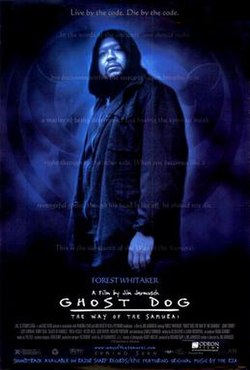
Ghost Dog: The Way of the Samurai
Ghost Dog sees himself as a retainer of Louie, a local mobster, who saved Ghost Dog's life years earlier. While living as a hitman for the American Mafia, he adheres to the code of the samurai, and interprets and applies the wisdom of the Hagakure. Louie tells Ghost Dog to kill a gangster, Handsome Frank, who is sleeping with the daughter of local mafia boss Vargo. Ghost Dog arrives and kills the gangster, before seeing that the girl is also in the room; he leaves her alive, and she gives him a copy of the book Rashōmon to read. To avoid being implicated in the murder of a made man, Vargo and his associate Sonny Valerio decide to get rid of Ghost Dog. Louie knows practically nothing about Ghost Dog, as the hitman communicates only by homing pigeon. The mobsters start by tracing all the pigeon coops in town. They find Ghost Dog's cabin atop a building and kill his pigeons. Ghost Dog realizes he must kill Vargo and his men or they will kill him and his master. During the day, Ghost Dog frequently visits the park to see his best friend, a French-speaking ice cream man named Raymond. Ghost Dog does not understand French and Raymond does not understand English but the two nonetheless seem to connect with each other. Ghost Dog also befriends a little girl named Pearline, to whom he lends the book Rashōmon. Eventually, Ghost Dog invades Vargo's mansion and kills almost everyone single-handedly, sparing only Louie and Vargo's daughter. That night, Ghost Dog kills Sonny Valerio at his home by shooting him through a pipe. Ghost Dog expects that Louie will attack him, as he feels that Louie is obliged to avenge the murder of his boss Vargo. He goes to the park and gives Raymond all his money, helping him to stay in the country. Pearline appears and gives back Rashōmon to Ghost Dog, saying that she liked it. Ghost Dog gives Pearline his copy of Hagakure and encourages her to read it. Though Louie feels some loyalty to Ghost Dog, he finally confronts him at Raymond's ice cream stand with Raymond and Pearline watching. Ghost Dog is unwilling to attack his master and allows Louie to kill him. His last act is to give Louie the copy of Rashōmon and encourage him to read it. Pearline takes Ghost Dog's empty gun and aims at Louie as he flees. Ghost Dog dies from his wounds, lying on the asphalt. Raymond weeps while Pearline watches Louie leave; Louie gets into a car with Vargo's daughter (who now has replaced her father as his boss). Later, Pearline reads the Hagakure.

Enemy at the Gates
Vassili Zaitsev, a replacement soldier of the Red Army, arrives east of the River Volga during the Battle of Stalingrad in 1942. After a dangerous trip across the river into the city, he is forced to join a human wave attack carrying only rifle cartridges. He takes cover during the chaotic battle with Commissar Danilov. With one rifle, Vassili kills five German soldiers before they escape. Red Army commander Nikita Khrushchev asks his subordinates how to improve morale. Danilov recommends inspiring hope rather than punishing in fear and suggests that they revive the army newspaper and publishes heroic tales of Vassili's exploits. Vassili is transferred to the sniper division and becomes friends with Danilov. Both also become romantically interested in Tania Chernova, a private in the local militia. In fear for her safety, Danilov has her transferred to an intelligence unit, ostensibly to make use of her German skills in translating radio intercepts. With Soviet snipers taking an increasing toll on the Germans, Major Erwin König is deployed to kill Vassili and crush Soviet morale. When the Red Army command learns of König's mission after he wipes out Vassili's sniper unit, they dispatch König's former student Koulikov to help Vassili kill him. König, however, outmaneuvers Koulikov and kills him, shaking Vassili's spirits. Danilov finds a boy, Sacha Filipov, who volunteers to act as a double agent by passing König false information about Vassili's whereabouts in exchange for food. Vassili sets a trap for König and manages to wound him with the help of Tania. During a second attempt, Vassili falls asleep, and his sniper log is stolen by a looting German soldier. The German command takes the log as evidence of Vassili's death and plans to send König home, but König does not believe that Vassili is dead. General Friedrich Paulus confiscates König's dog tags to prevent Soviet propaganda from profiting if König is killed and identified. In turn, König gives the general a War Merit Cross that was posthumously awarded to his son, a lieutenant in the 116th Infantry Division who was killed in the early days of the battle. König tells Sacha where he will be next after deducing that the boy is responsible for his being wounded. Tania and Vassili have meanwhile fallen in love. That night, Tania secretly goes to the Soviet barracks and makes love with Vassili. The jealous Danilov disparages Vassili in a letter to his superiors. König spots Tania and Vassili waiting for him at his next ambush spot, confirming his suspicions about Sacha. He then kills the boy and hangs his body to bait Vassili. Vassili vows to kill König and asks Tania and Danilov to evacuate Sacha's mother. Tania is wounded by shrapnel en route to the boats. Thinking she is dead, Danilov regrets his jealousy of Vassili and even his ardor for communist ideals begins to falter. Finding Vassili waiting to ambush König, Danilov removes his helmet and exposes himself to provoke König into shooting him and revealing his own position. Thinking that he has killed Vassili, König goes to inspect the body only to find himself in Vassili's rifle sights. Accepting his fate and removing his cap, König grimly turns to look Vassili in the face before being shot in the head. Two months later, after Stalingrad has been liberated and German forces have surrendered, Vassili finds Tania alive and recovering in a field hospital.

Ratcatcher
Glasgow, 1973. The film starts with a young boy—James's friend Ryan Quinn—twirling himself in mesh curtains before his mother clouts him and readies him to visit his father. But Ryan chooses to play with James instead and runs off, with his mother unawares. Ryan meets James at the canal and drowns during some rough horseplay, at which point James runs away. No one apparently saw that James had tussled with Ryan before his death, but his sense of guilt lingers. Ryan's family are re-housed. On leaving day, Ryan's mother gives James the pair of brown sandals she'd bought for her son on the day of his death, which James purposefully scratches with a piece of broken glass. Sensitive James tries to make sense of the insensitive aspects of his environment as the film proceeds in an episodic structure. He encounters the local gang bullying a girl, Margaret Anne, as they throw her glasses into the canal, but he does nothing. James falls in with the gang at one point—though they threaten to throw him into the canal to drown him like Ryan—and joins them when they visit Margaret Anne, where they each penetrate her sexually. When James is offered a turn, he lies fully clothed on Margaret Anne as she strokes his head tenderly. One day he takes a bus to the end of its route on the outskirts of Glasgow. He explores a new housing estate under construction. Standing in front of a kitchen window in a half-built house, he wonders in awe at the view: an expansive field of wheat, blowing in the wind and reaching to the horizon. James climbs through the window and escapes into the blissful freedom of the field. One of James' friends, a simple boy named Kenny, receives a pet mouse as a birthday present. After the gang throw the mouse around in the air to make him "fly," Kenny asks James where he would fly to. James, trying to prevent the gang from throwing it at the wall, says the moon. Kenny then ties the mouse's tail to a balloon and releases it as James and the gang watch. In a fantastical shift, the film shows it floating to the moon. Then, Kenny's mouse joins a whole colony of other mice frolicking on the moon. James and Margaret Anne become friends and find comfort in each other's company. After his mother delouses James and his sister, he uses the materials to delouse Margaret Anne at her flat. They bathe together during the process, playing with the soap together in a child-like way. Kenny later falls in the canal trying to catch a perch and is rescued by James' father, who briefly becomes a local hero and is given a medal for bravery. While his father is in a deep sleep following the rescue, James lets in the council inspectors tasked with assessing merit for rehousing. In his disheveled state, his father makes a poor impression on the inspectors. He berates James for the mistake and says that their likely rejection would be James's fault. After receiving the medal, his father goes out drinking with friends. He also buys a pair of cleats for James, presumably to mend their relationship. The local gang falls upon James's father while he's playing with a stray cat on the way home and slashes him with a switchblade. When he comes home, drunk and injured, he forcefully offers the cleats to James, who rejects them. When James's mother tries to tend to his father's injuries, he slaps her as the family look on. After, James throws the cleat at him and runs away. He visits Margaret Anne's home and the two embrace in bed. She asks him if he loves her and he says that he does. The Army eventually arrive to clean all the rubbish from the neighbourhood. After failing to recover Margaret Anne's glasses from the canal, James sees her once again with the local gang taking turns sexually abusing her. James snaps at Kenny, saying that he killed his own mouse. Kenny then starts chanting "poor cow" about Margaret Anne, drawing James's anger. He continues, chanting that he saw James kill Ryan Quinn. After a tender moment with his little sister, James rises early and goes to the canal, where he sinks below the surface. A brief scene is shown of James and his family moving into the new neighbourhood, carrying their furniture and possessions across the wheat field that James discovered earlier. James walks behind the main group and slowly faces the camera, his face breaking into a full smile. The closing credits play, showing James sinking in slow motion in the murky canal water, with his fate left up to interpretation.
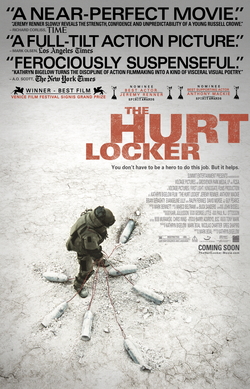
The Hurt Locker
During the second year of the Iraq War, a U.S. Army Explosive Ordnance Disposal team with Bravo Company identifies and attempts to destroy an improvised explosive device (IED) with a robot, but the wagon carrying the trigger charge breaks. Team leader Staff Sergeant Matthew Thompson places the charge by hand, but is killed when an Iraqi insurgent uses a cell phone to detonate the charge. Squadmate Specialist Owen Eldridge feels guilty for failing to kill the man with the phone. Sergeant First Class William James replaces Thompson. He is often at odds with Sergeant J. T. Sanborn because he prefers to defuse devices by hand and does not communicate his plans. He blocks Sanborn's view with smoke grenades as he approaches an IED and defuses it only moments before an Iraqi insurgent attempts to detonate it with a 9-volt battery. In another incident, James insists on disarming a complex car bomb despite Sanborn's protests that it is taking too long; James responds by taking off his headset and flipping off Sanborn. Sanborn is so worried by his conduct that he openly suggests fragging James to Eldridge while they are exploding unused ordnance outside of base. On their return to base, they encounter five armed men in Iraqi garb by an SUV which has a flat tire. After a tense encounter, James learns they are friendly British private military contractors. While fixing the tire, they come under sniper fire. Three of the contractors are killed before James and Sanborn take over counter-sniping, killing three insurgents. Eldridge kills the fourth who attempts to flank their position. During a raid on a warehouse, James discovers a " body bomb " he believes is Beckham, an Iraqi boy who sells DVDs and plays soccer outside of base. During the evacuation, Lieutenant Colonel John Cambridge, the camp's psychiatrist and Eldridge's counselor, is killed in an explosion; Eldridge is further traumatized. James sneaks off base with Beckham's apparent associate at gunpoint, telling him to take him to Beckham's home. He is left at the home of an unrelated Iraqi professor, and James flees. Called to a tanker truck detonation, James decides to hunt for the insurgents responsible nearby. Sanborn protests, but when James begins a pursuit, he and Eldridge follow. After they split up, insurgents capture Eldridge. James and Sanborn rescue him, although Eldridge is shot in the leg. The following morning, James is approached by Beckham, alive and well, whom James ignores and walks by silently. Before being airlifted for surgery, Eldridge angrily blames James for his wound. The day before their deployment ends, they are called to disarm a bomb vest strapped to a man against his will. James cannot cut the locks off before the timer expires, and they are forced to abandon the man. Sanborn is distraught at the near-death experience, and lamenting that no one other than his parents would have been sad at his death, tells James that he wishes to leave the service in order to have a son. After Bravo Company's rotation ends, James returns to his ex-wife Connie and their infant son. However, he is unfulfilled by routine civilian life at home. James confesses to his son there is only one thing he knows he loves. He starts another year-long tour of duty with Delta Company.
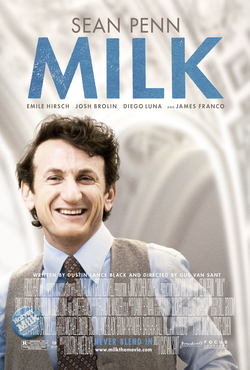
Milk
On the evening of November 27, 1978, Dianne Feinstein announces to the press that Harvey Milk and Mayor George Moscone have been assassinated. Milk is seen recording his will nine days before the assassinations. The film then flashes back to NYC on May 22, 1970, Milk's 40th birthday, and his first meeting with his much younger lover, Scott Smith. In 1972, dissatisfied with their lives and in need of a change, Milk and Smith move to San Francisco, hoping to find greater acceptance of their relationship. They open Castro Camera in the heart of Eureka Valley, a working-class neighborhood evolving into a predominantly gay neighborhood known as The Castro. Frustrated by the opposition they encounter in the once-Irish-Catholic neighborhood, Milk uses his background as a businessman to become a gay activist, eventually becoming a mentor to Cleve Jones. Smith serves as Milk's campaign manager, but he grows frustrated with Milk's devotion to politics and leaves him. Milk later meets Jack Lira, a sweet-natured but unbalanced young man. As with Smith, Lira cannot tolerate Milk's devotion to political activism and eventually hangs himself. Milk clashes with the local gay establishment, which he feels is too cautious. In 1977, after three unsuccessful attempts to become a city supervisor for the California State Assembly, Milk wins a seat on the San Francisco Board of Supervisors for District 5, after a change from at-large elections to district elections. His victory makes him the first openly gay man to be voted into major public office in California and the third openly homosexual politician in the entire United States. Milk meets fellow Supervisor Dan White, a Vietnam veteran and former police officer and firefighter. White is politically and socially conservative, and a complex relationship develops. Milk is invited to and attends the christening of White's first child. White asks Milk for assistance in preventing a psychiatric hospital from opening in White's district, possibly in exchange for White's support of Milk's citywide gay rights ordinance. When Milk fails to support White because of the negative effect it will have on troubled youth, White feels betrayed and becomes the sole vote against the gay rights ordinance. Milk also launches an effort to defeat Proposition 6, an initiative on the California state ballot in 1978. Sponsored by John Briggs, a conservative state senator from Orange County, Proposition 6 seeks to ban gays and lesbians from working in California's public schools. On November 7, 1978, after working tirelessly against Proposition 6, Milk and his supporters rejoice in the wake of its defeat. Three days later, a desperate White favors a supervisor pay raise but does not get much support, and shortly after supporting the proposition, resigns from the Board. He later changes his mind and asks to be reinstated. Mayor Moscone denies his request after being lobbied by Milk. On the morning of November 27, 1978, White enters City Hall through a basement window to conceal a gun from metal detectors. He requests another meeting with Moscone, who rebuffs his request for an appointment to his former seat. Enraged, White murders Moscone in his office and then goes to meet Milk in his, where he kills him, as Milk gazes out at the city. In text, it is revealed that 30,000 people attended Milk's funeral and his ashes were scattered over the Golden Gate Bridge. White's lawyers concocted the story of the " Twinkie Defense " to get him a sentence of seven years for first-degree manslaughter and was released in 1984, committing suicide in 1985.

Bob le Flambeur
The film opens with a tracking shot around the Montmartre quarter where the film is set, and the director, Jean-Pierre Melville, as narrator, then says " c'est tout à la fois le ciel et...... l'enfer " ("It is at one and the same time heaven... and... hell"). Bob is a gambler who lives on his own in the Montmartre district of Paris, where he is well-liked by the demi-monde community. A former bank robber and convict, he has mostly kept out of trouble for the past 20 years, and is even friends with a Commissaire de police in the Prefecture of Police in Paris, Ledru, whose life he once saved. Ever the gentleman, Bob lets Anne, an attractive young woman who has just lost her job, stay in his apartment in order to keep her from the attentions of Marc, a pimp he hates. Bob declines Anne's advances, instead steering her to his young protégé Paolo, who soon sleeps with her. Through Jean, an ex-con who is now a croupier at the casino in Deauville, Bob's friend Roger, a safecracker, learns that, by 5:00 in the morning on the day of a big horse race at the nearby track, the casino safe is expected to contain around 800 million French francs in cash, equivalent to a little more than $24,000,000 in 2025. As Bob has had a run of bad luck, he plans to rob the safe, convincing a man named McKimmie to finance the preparations and recruiting a team to carry out the heist. Jean gets detailed floor plans of the casino and the specifications of the safe, and buys a bracelet for his wife, Suzanne, with some of the money he is paid for his services. The smitten Paolo brags to Anne about the upcoming raid to try to impress her. Not taking him seriously, she lets this information slip to Marc just before the two have sex. Earlier, Marc had been arrested by Ledru for beating up one of his prostitutes, but Ledru had released him on the condition that he provide some information on a bigger crime; Marc's reaction makes Anne realize she may have made a mistake. The next morning, Anne tells Bob what she did, and he and Roger search for Marc, but cannot find him. Marc tells Ledru that he has heard about a caper involving Bob, but needs a few more hours to obtain confirmation, so Ledru lets him go. When Bob tells Paolo about Marc and Anne, the young man finds Marc and shoots the man dead just as he is about to tell Ledru what he was able to find out. Meanwhile, Suzanne discovers where her husband got the money to buy the bracelet and decides to ask Bob for a larger share of the take. They drive to Paris, but are unable to find him or Roger. She then persuades Jean to back out of it and anonymously tips off Ledru. Thinking that, with Marc dead, their plan is still a secret, Bob and his team head to Deauville. Ledru searches fruitlessly for Bob to convince him to abandon his plan. He reluctantly leads a convoy of armed police to the casino. Bob enters the casino to check on things. The plan is that, unless he signals them otherwise, his team will burst in at 5:00 a.m. and rob the safe at gunpoint. He had promised Roger that he would not gamble until after the heist was over, but, after wandering around for a while, he cannot resist placing a bet. He has an incredible run of good luck, first at roulette, then at chemin de fer, and loses track of the time. Just before 5:00, he finally looks at his watch. He orders the staff to cash his huge pile of chips and hurries out the door. The police arrive as Bob's team are walking toward the casino, and a shootout ensues; Paolo is shot. Bob comes upon the aftermath and holds Paolo as he dies. He and Roger are handcuffed and put into Ledru's car, and Bob's winnings are put in the trunk. Ledru says Bob will probably only spend three years in prison, but Roger says that, with a good lawyer, he will get acquitted. Bob quips that he may even sue for damages.

Still Alice
Dr. Alice Howland, a linguistics professor at Columbia University, celebrates her 50th birthday with her physician husband John and their three adult children. After she forgets a word during a lecture and becomes lost during a jog on campus, Alice's doctor diagnoses her with early onset familial Alzheimer's disease. Alice's elder daughter, Anna, and son, Tom, take a genetic test to learn if they will develop the disease. Anna's test is positive, while Tom's is negative. Alice's younger daughter Lydia, an aspiring actress, declines to be tested. As Alice's memory begins to fade, she daydreams of her mother and sister, who died in a car crash when she was a teenager. She memorizes words and sets a series of personal questions on her phone, which she answers every morning. She hides sleeping pills in her room, and records a video message instructing her future self to kill herself by overdosing on the pills when she can no longer answer the personal questions. As her disease advances, she becomes unable to give focused lectures and loses her job. She becomes lost searching for the bathroom in her home and does not recognize Lydia after seeing her perform in a play. John is offered a job at the Mayo Clinic in Minnesota. Alice asks him to postpone accepting, but he feels this is impossible. At her doctor's suggestion, Alice delivers a speech at an Alzheimer's conference about her experience with the disease, using a highlighter to remind herself which parts of the speech she has already spoken, and receives a standing ovation. Alice begins to have difficulty answering the questions on her phone. She loses the phone and becomes distressed. John finds it a month later in the freezer, but Alice thinks it has only been missing for a day. After a video call with Lydia, Alice inadvertently opens the video with the suicide instructions. With some difficulty, she finds the pills and is about to swallow them, but when she is interrupted by the arrival of her caregiver, she drops the pills and forgets what she was doing. John, unable to watch his wife deteriorate, moves to Minnesota. Lydia, who has been living in California, moves back home to care for Alice. Lydia reads her a section of the play Angels in America and asks her what she thinks it is about. Alice, now barely able to speak, responds with a single word: "love".