Genre: War (Page 3)
Browse 64 movies in the War genre.
All Genres

Dievu miskas
This story is about one man — who is an artist and an intellectual — imprisoned by two brutal regimes, the Nazis and the Soviets. 'The Professor' is a man who lives by his own personal version of the Ten Commandments. After miraculously surviving imprisonment in a Nazi concentration camp through a bit of ironic fate, he writes a memoir of his life, which becomes the target of the Soviet censors.

A Time for Drunken Horses
A Kurdish family is trying to survive after the death of its parents. Ayoub, the eldest boy in the family, becomes the head of the household and must do whatever work available to survive. Madi, Ayoub's handicapped brother, is in need of surgery. Ayoub goes to great lengths to collect money for the surgery. He becomes a kolbar and smuggles truck tires with a group of Kurdish villagers near the Iran-Iraq border. Ayoub ultimately falls short of his intended goal and his uncle decides to marry off his sister in return for the groom's family financing Madi's surgery on the Iraqi side of the border. When they arrive the mother of the groom refuses to accept Madi and agrees to give Ayoub and his uncle a mule as compensation. Ayoub decides to take the mule to Iraq, where it is worth more, and sell it to pay for his brother's surgery. Some smugglers let him come along with him. They use mules to carry goods and feed them whisky, allowing them to better survive the harsh mountain winter. However, they are ambushed while heading to the border, and the mules are too drunk to carry on. Ayoub narrowly manages to escape, and the last shot is of him and his brother crossing the border.

Black Book
In 1944, Dutch Jewish singer Rachel Stein is hiding in the occupied Netherlands. When the farmhouse where she had been hiding is destroyed by an Allied bomber, she goes to see a lawyer named Smaal who had been helping her family. He arranges for her to escape to the liberated southern part of the country. Aided by a man named Van Gein, Rachel is reunited with her family and boards a boat that is to take them and other refugees to the south. They are ambushed by the German SS who kill them and rob valuables from the bodies. Rachel alone survives but does not manage to escape from the occupied territory. Using a non-Jewish alias, Ellis de Vries, Rachel becomes involved with a resistance group in The Hague, under the leadership of Gerben Kuipers and working closely with a doctor, Hans Akkermans. Smaal is in touch with this Resistance cell. When Kuipers's son and other members of the Resistance are captured, Ellis agrees to help by seducing local SD commander Hauptsturmführer Ludwig Müntze. During a party at SD headquarters, Ellis recognises Obersturmführer Günther Franken, Müntze's brutal deputy, as the officer who had overseen the massacre on the boat. She obtains a job at the SD headquarters while falling in love with Müntze who, in contrast to Franken, is not abusive or sadistic. He realises that she is a Jew but does not care. Thanks to a hidden microphone that Ellis plants in Franken's office, the Resistance realises that Van Gein is the traitor who betrayed Rachel, her family, and the other Jews. Against Kuipers's orders, Akkermans decides to abduct Van Gein to expose him. Their attempt goes wrong, and Van Gein is killed. Franken responds by planning to kill 40 hostages, including most of the plotters but Müntze, who realises the war is lost and has been negotiating with the Resistance, countermands the order. Müntze forces Ellis to tell him her story. On her evidence, he confronts Franken with a superior officer, Obergruppenführer Käutner, who orders Franken to open his safe, expecting to find the valuables stolen from the Jews he had killed, this being a capital offense. The safe contains no valuables and Franken then tells Käutner that Müntze has been negotiating with the resistance for a truce. Müntze is imprisoned and condemned to death. The resistance plot to rescue their imprisoned members; Ellis agrees to cooperate only on the condition that they also free Müntze. The plan is betrayed and the rescuers find the prisoners' cells filled with German troops. Only Akkermans and one other man manage to flee. Ellis is arrested and taken to Franken's office. He knows about her and the microphone and, knowing that the resistance members are listening, he stages a confrontation to make them believe that Ellis is the collaborator responsible for the failure of the rescue. Kuipers and his companions swear to make her pay for her treason. Ronnie, a Dutch woman working at the SD headquarters to whom Ellis had confided her role in the resistance, helps her and Müntze escape. When the country is liberated by the Allies, Franken attempts to escape by boat but is killed by Akkermans, who takes the Jewish loot. Suspecting Smaal is the traitor, Müntze and Ellis return to confront him. Smaal states that the identity of the traitor is evidenced by his 'black book', in which he had detailed all his dealings with Jews. He refuses to discuss it further, wanting to go to the Canadian authorities. When they are about to leave, Smaal and his wife are killed by an unknown assailant. Müntze chases him into the street, only to be recognised by the Dutch crowd and arrested by soldiers from the Canadian Army. The Dutch also recognise Ellis and arrest her as a collaborator but not before she grabs the black book. Müntze is brought before the Canadian officers and finds that Käutner is helping to keep order among the defeated German forces. Käutner convinces a Canadian colonel that under military law, the defeated German military retains the right to punish its own soldiers (this is based on the real executions of German deserters). Due to the German death warrant, Müntze is executed by a firing squad. Ellis is imprisoned with accused collaborators, humiliated and tortured by the violently anti-Nazi volunteer jailers but rescued by Akkermans, who is now a colonel in the Dutch Army. Akkermans brings her to his medical office and says that he killed Franken when the Nazi tried to escape. He shows her the valuables stolen from Jewish victims. When informed about Müntze's fate, Ellis goes into shock and Akkermans administers a tranquilliser which is in fact an overdose of insulin. Ellis, feeling dizzy, sees the bottle of insulin and survives by quickly eating a bar of chocolate. She realises then that Akkermans is the traitor who had collaborated with Franken and had killed the Smaals. While Akkermans is distracted, waving to a crowd that cheers him, she jumps from the balcony into the crowd below and runs away. He tries to follow but is blocked by the crowd. Ellis proves her innocence to Canadian military intelligence and the former Resistance leader Gerben Kuipers through Smaal's black book, which lists how many Jews had been taken to Akkermans for medical help just prior to their murder. Ellis and Kuipers intercept the fleeing Akkermans, hiding in a coffin in a hearse with the stolen money, gold, and jewels. They beat the driver, and while Kuipers drives the hearse, Ellis screws down the coffin's secret air vents. They drive to Hollands Diep where the original SS trap had been sprung and wait until Akkermans suffocates. Ellis and Kuipers wonder what to do with the stolen money and jewels. The scene changes to Israel in 1956, reprising the opening scenes and shows Rachel meeting her husband and their two children, walking back into Kibbutz Stein, with a sign at the gate announcing that it was funded with recovered money from Jews killed during the war. In the final scene, the tranquillity of Rachel and her family is interrupted by explosions heard in the distance; the siren announces an air attack and Israeli soldiers position themselves at the front of the kibbutz.

When the Wind Blows
Jim Bloggs and his wife Hilda are an aging couple, living in an isolated cottage in rural Sussex, England. Jim frequently travels to the local town to read newspapers and keep abreast of the deteriorating international situation regarding the Soviet–Afghan War, which is threatening to escalate into a nuclear conflict between the Western Allies and the Soviet Union. Hearing a radio news report stating that a war may be only days away, Jim follows the instructions outlined in the government-issued Protect and Survive pamphlets to build a fallout shelter, including covering the windows with white paint and readying sacks to lie down in when a nuclear strike hits. Jim and Hilda are confident they can survive, as they did the Second World War, and that a Soviet defeat will ensue. As a radio transmission warns of an imminent ICBM strike and civil defence sirens sound, the couple rush to their shelter, just escaping as distant shock waves batter their home. They emerge after a few nights to find all utilities, services, and communications destroyed. Jim (incorrectly) speculates that most have temporarily ceased due to "wartime measures". The couple remains stoic and tries to resume their daily routine, preparing tea and dinners on a camping stove, noting numerous errands they will have to run once the crisis passes, and trying to renew their evaporated water stock with rainwater. Fallout dust is visible in the air throughout the house. Jim believes that a rescue operation will soon be launched to help civilians. The couple venture outside where radioactive ash has blocked out the sun and caused heavy fog. They are oblivious to the dead and dying animals strewn across the landscape, the destroyed buildings of the nearby town, and the scorched vegetation outside their cottage. Their optimism begins to fade due to the prolonged isolation, lack of food and water, growing radiation sickness, and absence of communication from the authorities. Jim worries that the Soviets will soon invade, experiencing a vision where a Soviet soldier breaks into their house. Hilda, whose symptoms are worsening, encounters a rat in the dried toilet, which traumatises her. Coupled with her worsening symptoms - bloody diarrhea, bleeding gums - she begins to lose hope. Jim tries to comfort her, still optimistic that he may be able to get medications for her from the chemist. After a few days, the Bloggs are practically bedridden, and Hilda is despondent when her hair begins to fall out. Jim clings to his belief that emergency services will arrive. Hilda suggests they lie down in the paper sacks. Jim, now resigned to their fate, agrees. As they crawl into the sacks Jim tries reciting prayers, including Psalm 23, but, forgetting the lines, starts to read " The Charge of the Light Brigade ", whose militaristic and ironic undertones distress the dying Hilda, who weakly asks him not to continue. Finally, Jim's voice mumbles away into silence as he finishes the line, "...rode the Six Hundred..." Outside, the smoke and ash-filled sky begins to clear, revealing the sun rising through the gloom. Towards the end of the credits, a Morse code signal taps out "MAD" - mutually assured destruction.


Where Eagles Dare
During World War II, MI6 officers Colonel Turner and Admiral Rolland assemble a commando team to rescue American Brigadier General George Carnaby, a chief planner for the Western Front, who is a prisoner at Schloß Adler (Castle of the Eagles), an alpine mountaintop fortress in Bavaria, accessible only by cable car. Disguised as German soldiers, the team—Major John Smith, Sergeants Harrod and MacPherson, Captains Lee Thomas, Ted Berkeley, and Olaf Christiansen, and US Army Ranger Lieutenant Morris Schaffer—parachutes near the castle. Harrod is found dead with a broken neck, and Smith deduces he was murdered. Smith secretly meets with his lover, British agent Mary Ellison, but keeps her involvement from his men. Smith and his team infiltrate the village at the base of Schloß Adler where he meets undercover agent Heidi Schmidt in a tavern, who has arranged for Mary to work inside the castle. Smith discloses to Mary that Carnaby is actually an imposter, US Corporal Cartwright Jones, and his capture was staged by the British. Later, Smith discovers MacPherson dead. When a German colonel arrives in the tavern with soldiers ostensibly searching for deserters, Smith realises he is really searching for his team, and surrenders to avoid an unwinnable fight. Thomas, Berkeley, and Christiansen are taken to the castle, while Smith and Schaffer escape and infiltrate the castle via cable car. Inside, they reunite with Mary and observe General Rosemeyer and Colonel Kramer interrogate Carnaby. Thomas, Berkeley, and Christiansen arrive, revealed to be German double agents. Smith and Schaffer intrude, weapons drawn on the men. However, Smith then forces Schaffer to surrender his weapon and identifies himself as Major Johann Schmidt of the Schutzstaffel 's (SS) intelligence branch. He exposes Carnaby's identity and claims that Thomas, Berkeley, and Christiansen are MI6 agents impersonating German spies. Smith conveys proof of his identity by showing the name of Germany's top spy in Whitehall to Kramer, who silently affirms it, and challenges the double agents to prove themselves as German agents by providing the list of agents they set up across Britain. With the list in his hand, Smith reveals the truth: believing German spies have extensively infiltrated British intelligence, MI6 identified Thomas, Berkeley, and Christiansen as suspects, and launched the mission to prove this and obtain the identities of their agents and commander. Smith's ploy is interrupted by the arrival of SS Major von Hapen, who suspects everyone, but Smith causes a distraction which allows Schaffer to fatally shoot von Hapen, Kramer, and Rosemeyer. The team, including Mary and Carnaby, make their escape, taking Thomas, Berkeley, and Christiansen as prisoners. As alarms sound, Schaffer sets explosives around the castle while Smith radios Rolland for extraction. The group travel to the cable car station, sacrificing Thomas as a decoy. Berkeley and Christiansen attempt to escape on a cable car, but they are killed by Smith. The team escapes on the next cable car. Reunited with Heidi in the village, they use a bus to battle their way onto an airfield and escape aboard a Ju 52 transport, with Turner waiting onboard. In the air, Smith reveals that Kramer identified Turner as Germany's top spy in Britain, confirming Rolland's suspicions. Turner chose Smith to lead the mission, believing he was a German double agent—unaware he was working undercover for Rolland. To ensure the mission's success, Smith secretly recruited Mary—his trusted ally—and Schaffer, who had no ties to the compromised MI6. To avoid a humiliating court martial and execution, Turner is permitted to jump from the aircraft to his death. As the exhausted operatives fly home, Schaffer wryly suggests that Smith keep his next mission "all-British".

Gettysburg
The film begins with a narrated map showing the Confederate Army of Northern Virginia, commanded by Robert E. Lee, crossing the Potomac River to invade the North in June 1863, marching across Maryland and into Pennsylvania. On June 30, Confederate spy Henry Thomas Harrison reports to Lt. Gen. James Longstreet, commander of the First Corps, that the Union Army of the Potomac is moving in their direction, and that Union commander Joseph Hooker has been replaced by George Meade. Longstreet reports the information to General Lee, who is concerned that the army is moving "on the word of an actor", as opposed to that of his cavalry chief, J. E. B. Stuart. Nonetheless, Lee orders the army to concentrate near the town of Gettysburg. At the Union encampments near Union Mills, Maryland, Col. Joshua Lawrence Chamberlain of the 20th Maine is ordered to take in 120 men from the disbanded 2nd Maine who had resigned in protest, with permission to shoot any man who refuses to fight. Chamberlain speaks to the men, and is able to persuade all but six to take up arms. In Gettysburg, Brig. Gen. John Buford and his cavalry division spot elements of Henry Heth 's division of A. P. Hill 's Third Corps approaching the town and deduce that the main body of the Confederate army is not far behind. Buford recognizes that, with precedent from previous battles, the Confederates will arrive at Gettysburg first and entrench in strong positions, forcing the Union to charge them and suffer heavy casualties. To prevent this, he opts to stand and fight where he is, judging the terrain to be "lovely ground" for slowing the Confederate advance. Buford sends word to I Corps commander Maj. Gen. John F. Reynolds to bring up reinforcements. Heth's troops engage Buford's cavalry the following morning, July 1, with Richard S. Ewell 's Second Corps moving in to flank them. Reynolds brings his corps forward, but is killed by a Confederate sharpshooter. The Union army is pushed out of Gettysburg to Cemetery Ridge, and Lee—rejecting Longstreet's suggestion to redeploy south of Gettysburg and go on the defensive—orders Ewell to take the Union position "if practicable". However, Ewell hesitates and does not engage. The armies concentrate at their chosen positions for the remainder of the first day. At Confederate headquarters at Seminary Ridge, Maj. Gen. Isaac R. Trimble angrily denounces Ewell's inaction to Lee, and requests another assignment. On the second day, July 2, Col. Strong Vincent 's brigade from the Union V Corps is deployed to Little Round Top, and Vincent places the 20th Maine at the end of the line, warning Chamberlain that he and his regiment are the flank, and that if they retreat, the Confederate army can swing around behind them and rout the Union forces. Chamberlain speaks to the six remaining men of the 2nd Maine, and three of them decide to fight. Lee orders Longstreet to deploy his two available divisions to take Little Round Top and the neighboring Big Round Top. As Longstreet's corps deploys, Maj. Gen. John Bell Hood, commanding one of the divisions, protests to Longstreet; with the Union holding the high ground, he would lose half his forces if he attacked as ordered. Longstreet, despite his own protests to Lee, orders Hood to attack; Hood is later wounded fighting at Devil's Den. At the summit of Little Round Top, Chamberlain and the 20th Maine fight off wave after wave of advancing Confederates, and begin running out of ammunition. Colonel Vincent is mortally wounded, and none of the other three regiments in his brigade are able to provide support. Chamberlain orders his men to fix bayonets, and charge in a right wheel down the slope against the attacking Confederates, which Chamberlain describes as "we'll swing it down; we swing like a door." The attack successfully drives the Confederate assault back, and the Union flank holds. That evening, Stuart finally arrives, and Lee reprimands him for his being out of contact. At the same time, Longstreet's remaining division, under Maj. Gen. George Pickett, arrives on the field. For the third day, July 3, Lee decides to send three divisions—Pickett's, Trimble's, and J. Johnston Pettigrew 's—to attack the center of the Union line at Cemetery Ridge. Longstreet expresses his belief to Lee that the attack will fail, as the movement is a mile over open ground, and that the Union II Corps under Maj. Gen. Winfield Scott Hancock is deployed behind a stone wall, just as Longstreet's men had been at Fredericksburg. Lee nonetheless orders the attack to proceed. Longstreet then meets with the three division commanders and details the plan, beginning first with Colonel Edward Porter Alexander 's artillery clearing the Union guns off the ridge, before deploying the men forward. Despite heavy Confederate fire, Alexander is unable to make an impact upon the Union guns. When Pickett asks to move forward, Longstreet simply nods. The Confederate divisions march across the open field, and Hancock is wounded as he commands from the front line. One of Pickett's brigades, commanded by Brig. Gen. Lewis Armistead, makes it over the stone wall, but Armistead is wounded and captured by Union troops. The Confederates retreat due to high casualties. Seeing a despondent General Pickett, General Lee implores him to "look to your division," to which Pickett replies "General Lee, I have no division." Pickett's Charge ultimately fails. Meeting with Longstreet that evening, Lee finally decides that they will withdraw. The film ends with the fates of the major figures of the battle.

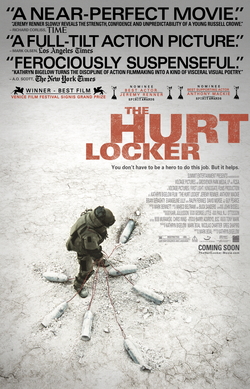
The Hurt Locker
During the second year of the Iraq War, a U.S. Army Explosive Ordnance Disposal team with Bravo Company identifies and attempts to destroy an improvised explosive device (IED) with a robot, but the wagon carrying the trigger charge breaks. Team leader Staff Sergeant Matthew Thompson places the charge by hand, but is killed when an Iraqi insurgent uses a cell phone to detonate the charge. Squadmate Specialist Owen Eldridge feels guilty for failing to kill the man with the phone. Sergeant First Class William James replaces Thompson. He is often at odds with Sergeant J. T. Sanborn because he prefers to defuse devices by hand and does not communicate his plans. He blocks Sanborn's view with smoke grenades as he approaches an IED and defuses it only moments before an Iraqi insurgent attempts to detonate it with a 9-volt battery. In another incident, James insists on disarming a complex car bomb despite Sanborn's protests that it is taking too long; James responds by taking off his headset and flipping off Sanborn. Sanborn is so worried by his conduct that he openly suggests fragging James to Eldridge while they are exploding unused ordnance outside of base. On their return to base, they encounter five armed men in Iraqi garb by an SUV which has a flat tire. After a tense encounter, James learns they are friendly British private military contractors. While fixing the tire, they come under sniper fire. Three of the contractors are killed before James and Sanborn take over counter-sniping, killing three insurgents. Eldridge kills the fourth who attempts to flank their position. During a raid on a warehouse, James discovers a " body bomb " he believes is Beckham, an Iraqi boy who sells DVDs and plays soccer outside of base. During the evacuation, Lieutenant Colonel John Cambridge, the camp's psychiatrist and Eldridge's counselor, is killed in an explosion; Eldridge is further traumatized. James sneaks off base with Beckham's apparent associate at gunpoint, telling him to take him to Beckham's home. He is left at the home of an unrelated Iraqi professor, and James flees. Called to a tanker truck detonation, James decides to hunt for the insurgents responsible nearby. Sanborn protests, but when James begins a pursuit, he and Eldridge follow. After they split up, insurgents capture Eldridge. James and Sanborn rescue him, although Eldridge is shot in the leg. The following morning, James is approached by Beckham, alive and well, whom James ignores and walks by silently. Before being airlifted for surgery, Eldridge angrily blames James for his wound. The day before their deployment ends, they are called to disarm a bomb vest strapped to a man against his will. James cannot cut the locks off before the timer expires, and they are forced to abandon the man. Sanborn is distraught at the near-death experience, and lamenting that no one other than his parents would have been sad at his death, tells James that he wishes to leave the service in order to have a son. After Bravo Company's rotation ends, James returns to his ex-wife Connie and their infant son. However, he is unfulfilled by routine civilian life at home. James confesses to his son there is only one thing he knows he loves. He starts another year-long tour of duty with Delta Company.

Enemy at the Gates
Vassili Zaitsev, a replacement soldier of the Red Army, arrives east of the River Volga during the Battle of Stalingrad in 1942. After a dangerous trip across the river into the city, he is forced to join a human wave attack carrying only rifle cartridges. He takes cover during the chaotic battle with Commissar Danilov. With one rifle, Vassili kills five German soldiers before they escape. Red Army commander Nikita Khrushchev asks his subordinates how to improve morale. Danilov recommends inspiring hope rather than punishing in fear and suggests that they revive the army newspaper and publishes heroic tales of Vassili's exploits. Vassili is transferred to the sniper division and becomes friends with Danilov. Both also become romantically interested in Tania Chernova, a private in the local militia. In fear for her safety, Danilov has her transferred to an intelligence unit, ostensibly to make use of her German skills in translating radio intercepts. With Soviet snipers taking an increasing toll on the Germans, Major Erwin König is deployed to kill Vassili and crush Soviet morale. When the Red Army command learns of König's mission after he wipes out Vassili's sniper unit, they dispatch König's former student Koulikov to help Vassili kill him. König, however, outmaneuvers Koulikov and kills him, shaking Vassili's spirits. Danilov finds a boy, Sacha Filipov, who volunteers to act as a double agent by passing König false information about Vassili's whereabouts in exchange for food. Vassili sets a trap for König and manages to wound him with the help of Tania. During a second attempt, Vassili falls asleep, and his sniper log is stolen by a looting German soldier. The German command takes the log as evidence of Vassili's death and plans to send König home, but König does not believe that Vassili is dead. General Friedrich Paulus confiscates König's dog tags to prevent Soviet propaganda from profiting if König is killed and identified. In turn, König gives the general a War Merit Cross that was posthumously awarded to his son, a lieutenant in the 116th Infantry Division who was killed in the early days of the battle. König tells Sacha where he will be next after deducing that the boy is responsible for his being wounded. Tania and Vassili have meanwhile fallen in love. That night, Tania secretly goes to the Soviet barracks and makes love with Vassili. The jealous Danilov disparages Vassili in a letter to his superiors. König spots Tania and Vassili waiting for him at his next ambush spot, confirming his suspicions about Sacha. He then kills the boy and hangs his body to bait Vassili. Vassili vows to kill König and asks Tania and Danilov to evacuate Sacha's mother. Tania is wounded by shrapnel en route to the boats. Thinking she is dead, Danilov regrets his jealousy of Vassili and even his ardor for communist ideals begins to falter. Finding Vassili waiting to ambush König, Danilov removes his helmet and exposes himself to provoke König into shooting him and revealing his own position. Thinking that he has killed Vassili, König goes to inspect the body only to find himself in Vassili's rifle sights. Accepting his fate and removing his cap, König grimly turns to look Vassili in the face before being shot in the head. Two months later, after Stalingrad has been liberated and German forces have surrendered, Vassili finds Tania alive and recovering in a field hospital.