Genre: History (Page 5)
Browse 133 movies in the History genre.
All Genres


Balloon
The film is set in Pößneck, Thuringia, in the summer of 1979. The Strelzyk and Wetzel families develop a daring plan to flee the GDR to West Germany in a self-made hot air balloon. About to attempt an escape in perfect wind conditions, Günter Wetzel decides it is too dangerous. He thinks the balloon is too small for eight people, and his wife Petra is afraid for their two young children. Therefore, they stop trying to escape for a short time. Doris and Peter Strelzyk now want to dare to escape alone with their two sons. Their teenage son Frank has fallen in love with Klara Baumann, the daughter of his neighbour Erik, who works for the Stasi, and writes her a farewell letter. The same night, the Strelzyk family packs the balloon and other accessories in their trailer, drives into the forest, and takes off. Hidden in the clouds, they cannot be seen by the border guards. However, the balloon goes down with Doris, Peter, and their two sons Frank and Andreas (called "Fitscher") in the gondola shortly before the border because the pipes from the gas bottles to the burner freeze up and become clogged. None of the four are injured, they get back to their car and destroy all evidence. Frank just manages to retrieve the letter to Klara. The Stasi finds the abandoned balloon and discovers the attempted escape, and under the direction of Lieutenant Colonel Seidel, begins a large investigation. He interrogates the border guards who were on duty at the time of the attempt to escape and accuses them of not taking their task seriously enough. The investigators narrow down the radius in which the balloon must have started, and thus also the circle of suspects. For the next few weeks, both families live in constant fear that the Stasi might link them to the attempted escape. Doris in particular is worried because she lost her medication in the forest, which gave the Stasi important information in the form of personalised pills. Peter wants to try again. Before that, however, they travel to East Berlin, where they hope to be able to get out of the country with the help of the East Berlin US Embassy, but this attempt fails. Peter can convince Günter to make another balloon attempt to escape. Since they must be careful in obtaining the materials to avoid raising suspicion, the family members only buy small quantities of suitable fabric in different cities. Günter sits at the sewing machine every night to join the pieces of fabric. Meanwhile, Seidel is fast putting together all the clues tying the family to the escape. He must prevent the GDR from being embarrassed by a successful escape attempt at all costs. Just as Doris feared, the investigators trace their medication back to the local pharmacy, where all recipients of the tablets are now being identified and checked. The Stasi published photos in the press of objects that the Strelzyks had to leave behind at the landing site of their first attempt. Günter has to move the sewing work to the Strelzyks' cellar because his neighbours have become aware of the constant running noise of the sewing machine. When Frank realises that Klara's father Erik has to go to the pharmacy because someone is wanted and that the wind is blowing to the south, the prerequisite for their escape, they want to make the second attempt that same night. When the Stasi employees work out their identities and break into their houses, the families are already on their way to the starting point. The start is not as perfect this time as on their first attempt and when the gas runs out they have to land in a forest after half an hour's flight. At first, it is not clear whether they have successfully crossed the border. Peter and Günter then explore the area and meet a police patrol car. When the police tell them that they are in Upper Franconia, the families react joyfully. Lieutenant Colonel Seidel and his superior must explain themselves to Stasi chief Erich Mielke, and Erik Baumann is interrogated by the Stasi. Ten years later, Doris and Peter Strelzyk watch Hans-Dietrich Genscher 's announcement from the Prague embassy on television that the GDR citizens gathered there are allowed to leave.


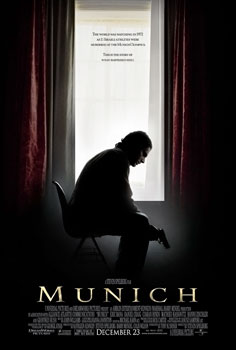
Munich
At the 1972 Summer Olympics in Munich, the Palestinian militant group Black September carried out a terrorist attack resulting in the deaths of eleven members of the Israeli Olympic team. Avner Kaufman, a Mossad agent of German-Jewish descent, is chosen to lead a mission to assassinate eleven Palestinians involved in the massacre. At the direction of his handler Ephraim, to give the Israeli government plausible deniability, Kaufman resigns from Mossad and operates with no official ties to Israel. His team includes four Jewish volunteers from around the world: South African driver Steve, Belgian toy-maker and explosives expert Robert, former Israeli soldier and " cleaner " Carl, and German antique dealer and document forger Hans from Frankfurt. They are given information by a French informant, Louis, whose family's history is connected to the French Resistance. In Rome, the team shoots and kills Wael Zwaiter, who is living as a poet. In Paris, they detonate a bomb in the home of Mahmoud Hamshari. In Cyprus, they bomb the hotel room of Hussein Abd Al Chir. With IDF commandos, they pursue three Palestinian militants— Muhammad Youssef al-Najjar, Kamal Adwan, and Kamal Nasser —to Beirut, penetrate the Palestinians' guarded compound and kill all three. Between hits, the assassins argue with each other about the morality and logistics of their mission, expressing fear about their individual lack of experience, as well as their apparent ambivalence about accidentally killing innocent bystanders. Avner makes a brief visit to his wife, who has given birth to their first baby. In Athens, when they track down Zaiad Muchasi, the team finds out that Louis arranged for them to share a safe house with their rival PLO members and the Mossad agents escape trouble by pretending to be members of foreign militant groups like ETA, IRA, ANC, and the Red Army Faction. Avner has a heartfelt conversation with PLO member Ali over their homelands and who deserves to rule over the lands. Ali is later shot by Carl while the team escapes from the hit on Muchasi. The squad moves on to London to track down Ali Hassan Salameh, who orchestrated the Munich massacre, but the assassination attempt is interrupted by several drunken Americans. It is implied that these are agents of the CIA, which, according to Louis, protects and funds Salameh in exchange for his promise not to attack United States diplomats. Meanwhile, attempts are made to kill the assassins themselves. Carl is killed by an independent Dutch contract killer. In revenge, the team tracks her down and executes her at a houseboat in Hoorn, Netherlands. Hans is found stabbed to death on a park bench, and Robert is killed by an explosion in his workshop. Avner and Steve finally locate Salameh in Spain, but again their assassination attempt is thwarted, this time by Salameh's armed guards. Avner and Steve disagree on whether Louis has sold information on the team to the PLO. A disillusioned Avner flies to Israel, where he is unhappy to be hailed as a hero by two young soldiers, and then to his new home in Brooklyn, where he suffers post-traumatic stress, paranoia and has flashbacks from the Munich massacre. Concerns continue to grow when he speaks to Louis' father by phone and it is revealed he knows his real name and promises no violence will come to him from his family. He is thrown out of the Israeli consulate after storming in to demand that Mossad leave his wife and child alone. Ephraim comes to ask Avner to return to Israel and Mossad, but Avner refuses. Avner then asks Ephraim to come to dinner with his family, to break bread as an allegory to make peace, but Ephraim refuses, perhaps as a sign that neither side will reconcile. A title card reveals nine of the eleven targeted Palestinians were killed, including Salameh, who was finally killed in 1979.
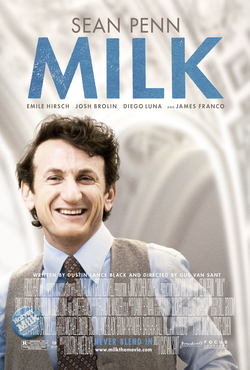
Milk
On the evening of November 27, 1978, Dianne Feinstein announces to the press that Harvey Milk and Mayor George Moscone have been assassinated. Milk is seen recording his will nine days before the assassinations. The film then flashes back to NYC on May 22, 1970, Milk's 40th birthday, and his first meeting with his much younger lover, Scott Smith. In 1972, dissatisfied with their lives and in need of a change, Milk and Smith move to San Francisco, hoping to find greater acceptance of their relationship. They open Castro Camera in the heart of Eureka Valley, a working-class neighborhood evolving into a predominantly gay neighborhood known as The Castro. Frustrated by the opposition they encounter in the once-Irish-Catholic neighborhood, Milk uses his background as a businessman to become a gay activist, eventually becoming a mentor to Cleve Jones. Smith serves as Milk's campaign manager, but he grows frustrated with Milk's devotion to politics and leaves him. Milk later meets Jack Lira, a sweet-natured but unbalanced young man. As with Smith, Lira cannot tolerate Milk's devotion to political activism and eventually hangs himself. Milk clashes with the local gay establishment, which he feels is too cautious. In 1977, after three unsuccessful attempts to become a city supervisor for the California State Assembly, Milk wins a seat on the San Francisco Board of Supervisors for District 5, after a change from at-large elections to district elections. His victory makes him the first openly gay man to be voted into major public office in California and the third openly homosexual politician in the entire United States. Milk meets fellow Supervisor Dan White, a Vietnam veteran and former police officer and firefighter. White is politically and socially conservative, and a complex relationship develops. Milk is invited to and attends the christening of White's first child. White asks Milk for assistance in preventing a psychiatric hospital from opening in White's district, possibly in exchange for White's support of Milk's citywide gay rights ordinance. When Milk fails to support White because of the negative effect it will have on troubled youth, White feels betrayed and becomes the sole vote against the gay rights ordinance. Milk also launches an effort to defeat Proposition 6, an initiative on the California state ballot in 1978. Sponsored by John Briggs, a conservative state senator from Orange County, Proposition 6 seeks to ban gays and lesbians from working in California's public schools. On November 7, 1978, after working tirelessly against Proposition 6, Milk and his supporters rejoice in the wake of its defeat. Three days later, a desperate White favors a supervisor pay raise but does not get much support, and shortly after supporting the proposition, resigns from the Board. He later changes his mind and asks to be reinstated. Mayor Moscone denies his request after being lobbied by Milk. On the morning of November 27, 1978, White enters City Hall through a basement window to conceal a gun from metal detectors. He requests another meeting with Moscone, who rebuffs his request for an appointment to his former seat. Enraged, White murders Moscone in his office and then goes to meet Milk in his, where he kills him, as Milk gazes out at the city. In text, it is revealed that 30,000 people attended Milk's funeral and his ashes were scattered over the Golden Gate Bridge. White's lawyers concocted the story of the " Twinkie Defense " to get him a sentence of seven years for first-degree manslaughter and was released in 1984, committing suicide in 1985.

Tora! Tora! Tora!
In September 1940, following a severe trade embargo imposed on a belligerent Japan by the United States a year prior, influential Japanese army figures and politicians push through an alliance with Germany and Italy, despite opposition from the Japanese navy, and prepare for war. The newly appointed Commander-in-Chief of the Combined Fleet, Admiral Isoroku Yamamoto, reluctantly plans a pre-emptive strike, believing Japan's best hope of controlling the Pacific Ocean is to quickly annihilate the American Pacific fleet anchored at Pearl Harbor. Air Staff Officer Minoru Genda is chosen to mastermind the operation, while his old Naval Academy classmate Mitsuo Fuchida is selected to lead the attack. In Washington, U.S. military intelligence has broken the Japanese Purple Code, allowing them to intercept secret Japanese radio transmissions indicating increased Japanese naval activity. U.S. Army Colonel Rufus S. Bratton and U.S. Navy Lieutenant Commander Alwin Kramer monitor the transmissions. At Pearl Harbor, Admiral Husband E. Kimmel increases defensive naval and air patrols around Hawaii. General Walter Short orders aircraft concentrated on the airfield runways to avoid sabotage by enemy agents, while some planes are dispersed to other airfields on Oahu. Diplomatic tensions escalate as the Japanese ambassador to Washington continues negotiations to stall for time. Bratton and Kramer learn from intercepted radio messages that the Japanese planned to send 14 messages from Tokyo to their embassy in Washington, with orders to destroy their code machines after receiving the final message. Deducing that the Japanese will launch a surprise attack after the messages are delivered, Bratton tries to warn his superiors. However, Chief of Naval Operations Harold R. Stark is indecisive over notifying Hawaii without first alerting President Franklin D. Roosevelt. In contrast, Army Chief of Staff General George Marshall 's order to alert Pearl Harbor of an attack is stymied by poor atmospheric conditions that prevent radio transmission and by a warning telegram not marked urgent. The Japanese fleet launches its aircraft at dawn on December 7, 1941. Two radar operators detect their approach to Hawaii, but the duty officer, Lieutenant Kermit Tyler, dismisses their concerns. Similarly, the claim by the destroyer USS Ward to have sunk a Japanese miniature submarine off the entrance to Pearl Harbor is dismissed as unimportant. The Japanese achieve total surprise, which Commander Fuchida indicates with the code signal "Tora! Tora! Tora!" The damage to the naval base is catastrophic, and casualties are severe. Several battleships are either sunk or heavily damaged; General Short's anti-sabotage precautions allow Japanese aircraft to easily destroy American planes on the ground. In Washington, a stunned Secretary of State Cordell Hull is asked to receive the Japanese ambassador Kichisaburō Nomura. The 14-part message – including a declaration that peace negotiations were at an end – was meant to be forwarded to the Americans thirty minutes before the attack, but the Japanese embassy failed to decode and transcribe it in time. The attack started while the two nations were technically still at peace. The distraught Nomura, helpless to explain the late ultimatum and unaware of the ongoing attack, is rebuffed by Hull. The Japanese fleet commander, Vice-Admiral Chūichi Nagumo, refuses to launch a scheduled third wave of attack aircraft for fear of exposing his fleet to U.S. submarines. General Short and Admiral Kimmel finally receive Marshall's telegram warning of impending danger hours after the attack is over. Aboard his flagship, Admiral Yamamoto informs his staff that their primary target – the American aircraft carriers – were not at Pearl Harbor, having departed days previously. Lamenting that the declaration of war arrived after the attack began, Yamamoto notes that nothing would infuriate the U.S. more and concludes: "I fear all we have done is to awaken a sleeping giant and fill him with a terrible resolve."

Killers of the Flower Moon
Osage Nation elders bury a ceremonial pipe, mourning their descendants' assimilation into White American society. Wandering through their Oklahoma reservation during the annual "flower moon" phenomenon of fields of blooms, several Osage find oil gushing from the ground. The tribe becomes wealthy as it retains mineral rights. However, the law requires court-appointed white legal guardians to manage the money of full and half-blood members, assuming them "incompetent". In 1919, Ernest Burkhart returns from World War I to live with his brother Byron and uncle William King Hale on Hale's reservation ranch. Hale, a reserve deputy sheriff and cattle rancher, poses as a friendly benefactor to the Osage. Ernest and Byron commit armed robbery against the Osage. Ernest develops a romance with Mollie Kyle, an Osage whose family owns oil headrights. They marry in an Osage ceremony with Catholic elements and raise three children. Hale contracts the killing of multiple wealthy Osage, explaining that Ernest will inherit more headrights the more of Mollie's family dies. Mollie is diabetic, and her mother, Lizzie, is ill. After Mollie's sister Minnie dies of a mysterious illness, Hale orders Byron to kill another of Mollie's sisters, Anna. Lizzie and the Osage council blame the white residents and urge the tribe to fight back. The 1921 Tulsa race massacre causes further concern amongst the Osage that they could suffer similarly. Lizzie's ancestors welcome her to the afterlife as she dies. Hale has Ernest arrange the murder of Mollie's first husband, Henry Roan, but Ernest's hitman neglects to make the murder look like a suicide as instructed. Even so, the sheriff and judges are in Hale's pocket, so there are no investigations. An Osage Nation representative seeking to lobby Congress is murdered in Washington, D.C. Mollie hires private detective William J. Burns, but he is severely beaten by Ernest and Byron. Again at Hale's behest, Ernest arranges the bombing of the home of Mollie's last surviving sister, Reta, and her husband, Bill. As the last surviving member of her family, Mollie inherits their headrights. She travels to Washington and asks President Calvin Coolidge for help. Hale orders Ernest to poison Mollie's insulin to "slow her down". Mollie's condition worsens, and Ernest exhibits similar symptoms after also ingesting the poison. Bureau of Investigation Agent Thomas Bruce White Sr. and his assistants discover the truth. Hale tries to cover his tracks by murdering his hitmen, but White arrests Hale and Ernest. Two agents find Mollie near death and rush her to the hospital, where it is found that she has been repeatedly poisoned. She recovers. White persuades Ernest to confess and turn state's evidence against his uncle. Hale's attorney, W. S. Hamilton, tries to convince Ernest to claim he was tortured and recant. After his daughter dies of whooping cough, Ernest testifies, wanting to be around for his remaining family. Mollie leaves Ernest after he refuses to admit to poisoning her. A radio drama years later reveals the Shoun brothers were implicated in other "wasting deaths" but never prosecuted due to lack of evidence; Byron was tried as an accomplice to Anna's murder but served no prison time due to a hung jury; Hale and Ernest were sentenced to life imprisonment but later paroled despite Osage protests; and Mollie died of diabetes-related complications in 1937 at the age of 50, her obituary stating that she was buried with her parents, sisters, and daughter while making no mention of the Osage murders.

The Counterfeiters
The film begins shortly after the end of the Second World War, with a man arriving in Monte Carlo. After checking into an expensive hotel and paying with cash, he takes in the high life of Monte Carlo, successfully gambling in a casino and attracting the attention of a beautiful French woman. Later, she discovers tattooed numerals on his arm, revealing him as a survivor of the Nazi concentration camps. The film then flashes back to Berlin in 1936, where the man, Salomon Sorowitsch, is revealed as a successful forger of currency and passports. Caught by the police, he is imprisoned, first in a labour camp, then in Mauthausen concentration camp near Linz. In an effort to secure himself protection and meagre comforts at the camp, he turns his forging skills to portraiture, attracting the attention of the guards, who commission him to paint them and their families in exchange for extra food rations. Sorowitsch's talents bring him wider attention, and he is transferred out of the concentration camp. Brought in front of the police officer who arrested him in Berlin, he finds himself put together with other prisoners with artistic or printing talents and begins working in a special section of the Sachsenhausen concentration camp devoted to forgery. The counterfeiters are kept in relatively humane conditions, with comfortable bunks, a washroom and adequate food, although their guards continue to subject them to brutality and insults. His fellow prisoners have a range of backgrounds from Jewish bank managers to political agitators, and while some are content to work for the Nazis to avoid the extermination camps, others see their efforts as supporting the German war effort. At first, self-preservation appears to guide Sorowitsch, but his motives for forging for the Nazis are complicated by his growing concern for his fellow prisoners, his awareness of their role in the wider war against the Nazis, and his professional pride in counterfeiting the US dollar, a currency he was previously unable to forge. Sorowitsch juggles the Nazi demands for progress, his co-counterfeiters' determination to sabotage the operation, and his loyalties to his fellow prisoners. The prisoners successfully counterfeit the British pound but intentionally delay the forgery of the US dollar. Gradually, the inmates discern slivers of evidence that the war has turned decidedly against the Nazis. One day the camp guards suddenly announce that the printing machines are to be dismantled and shipped away, which leads the counterfeiters to fear that they will finally be killed. Before anything happens to them, the German guards flee the camp in advance of the Red Army. Starving prisoners from other parts of the camp, armed with confiscated weapons, take over and break into the compound where the counterfeiters had been held in relative luxury. Until the insurrectionists see the well-fed printers' prison tattoos, they believe them to be SS officers and threaten to shoot them. The counterfeiters then must account for their forging actions to the half-dead prisoners. The film then returns to post-war Monte Carlo, where Sorowitsch, apparently disgusted by the life he is now leading on the currency that he forged for the Nazis, intentionally gambles it all away. Sitting alone afterward on the beach, he is joined by the French woman, concerned after his seemingly disastrous losses at the table. Dancing slowly together on the beach, she continues to remark on all the money he has lost, to which he replies, laughing, "We can always make more".
