Genre: Drama (Page 40)
Browse 989 movies in the Drama genre.
All Genres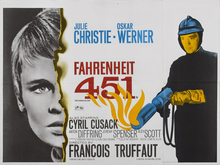
Fahrenheit 451
In the future, a totalitarian government will employ a force known as Firemen to seek out and destroy all literature. They can search anyone, anywhere, at any time, and burn any books they find. One of the firemen, Guy Montag, meets one of his neighbors, Clarisse, a young school teacher who may be on the government's radar due to her unorthodox views. The two discuss his job, and she asks whether he ever reads the books he burns. Curious, he begins to hide books in his house and read them, starting with Charles Dickens's David Copperfield. This leads to conflict with his wife, Linda, who is more concerned with being popular enough to be a member of The Family, an interactive television programme that refers to its viewers as "cousins". At the house of an illegal book collector, the fire captain, Beatty, talks with Montag at length about how books make people unhappy and make them want to think that they are better than others, which is considered anti-social. The book collector, an old woman who was seen with Clarisse a few times during Montag's rides to and from work, refuses to leave her house, opting instead to burn herself and the house so that she can die with her books. Returning home that day, Montag tries to tell Linda and her friends about the woman who martyred herself in the name of books and confronts them about knowing anything about what's going on in the world, calling them "zombies" and telling them that they're just "killing time" instead of living life. Disturbed over Montag's behavior, Linda's friends try to leave, but Montag stops them by forcing them to sit and listen to him read a passage from the novel David Copperfield. Montag reads a highly abridged excerpt from chapter 48, beginning with the words "There can be no disparity in marriage like unsuitability of mind and purpose" which describe Dora's death. During the reading, one of Linda's friends breaks down crying, aware of the feelings she repressed over the years, while Linda's other friends leave in disgust over Montag's alleged cruelty and the "sick" content of the novel. That night, Montag dreams of Clarisse as the book collector who killed herself. The same night, Clarisse's house is raided, but she escapes through a trapdoor in the roof, thanks to her uncle. Montag breaks into Beatty's office, looking for information about the missing Clarisse, and is caught but not punished. Montag meets with Clarisse and helps her break back into her house to destroy papers that would bring the Firemen to others like her. She tells him of the "book people", a hidden sect of people who flout the law, each of whom has memorised a book to keep it alive. Later, Montag tells Beatty that he is resigning but is persuaded to go on one more call, which turns out to be Montag's own house. Linda leaves the house, telling Montag that she couldn't live with his book obsession and leaves him to be punished by the Firemen. Angrily, he destroys the bedroom and television before setting fire to the books. Beatty lectures him about the books and pulls a last book from Montag's coat, for which Montag kills him with the flamethrower. He escapes and finds the book people, including Clarisse, where he views his "capture" on television, staged to keep the masses entertained and because the government doesn't want it to be known that he is alive. Montag selects a book to memorise, Tales of Mystery and Imagination by Edgar Allan Poe, and becomes one of the book people.


Over the Edge
In Colorado's planned community of New Granada, Carl, Richie, and Claude hang out at "The Rec", an adult-supervised venue where teenagers can socialize. One afternoon, as The Rec closes, Carl and Richie are confronted by Police Sergeant Doberman, who suspects them of perpetrating a freeway sniping incident, but after being questioned at the station, both are released to their parents. The next day Carl befriends Cory, a new arrival who mildly rejects Carl's suggestion that they date. That evening, after learning from his father of the community's plans to nix construction of an amusement center, he walks to a local park where he meets Richie and they head to a nearby house party. But when police arrive to squelch the fun by reminding them of the newly- mposed curfew, Carl walks home alone and is assaulted by Mark, the real instigator of the freeway sniping. Meanwhile, Carl's father has been trying to interest out-of-town investors in New Grenada, but Carl thwarts his attempts by booby-trapping their car. Latcher, Carl, and Richie accompany Cory and other kids on a picnic. They take along a pistol that Cory stole during a break-in. For fun, they take turns shooting tin cans until they run out of ammo. Claude, recently arrested for possession of hash, explains that the local neighborhood pusher, a fellow student named Tip, sold it to him, but when Cory reveals Tip's recent coincidental arrest, the kids drop in and interrogate him, and he confesses that he told Doberman about giving Claude hash. Richie, Carl, and Claude dump him into a pond as Tip's mother watches in horror from a nearby tennis court. Her descriptions of Carl and the others lead to panic. Richie steals his mother's car an he and Carl flee. It all ends tragically as Doberman chases them down. Richie produces a gun and aims it at Doberman, who fires in self-defense. Richie dies. The next day, Carl sneaks home and overhears his mother on the phone discussing a community meeting at the school that night. Carl sneaks back out to notify his friends, and they decide to confront the parents there. But when police show up, locking their weapons inside their cars, the meeting turns into a nightmare. The kids chain the school's doors, light fireworks, and proceed to trash the parking lot. Then they break into patrol cars, pull out police shotguns, and blow up several vehicles, igniting fires all around. When reserve police finally arrive, the kids disperse. Doberman apprehends Carl, but Mark, the freeway sniper, shoots Doberman's car, causing it to crash and catch fire. Carl pulls himself free, leaving the unconscious Doberman inside the car to perish in the massive explosion. When next seen, Carl and others are being herded onto a school bus and driven away. From atop an overpass, Cory and Claude wave goodbye to Carl as the bus heads to a juvenile detention facility.

The Rainmaker
Recent Memphis State University Law School grad Rudy Baylor has no high-paying work prospects lined up. He takes a job at a Memphis bar where he meets the bar's owner, J. Lyman "Bruiser" Stone, who is also a ruthless but successful ambulance chaser. He hires Rudy as an associate. Bruiser's associates only get paid by finding cases and working them up for trial. Rudy says he has cases, including an insurance bad faith matter he boasts could be worth several million in damages. Interested, Bruiser introduces Rudy to office paralegal Deck Shifflet, a former insurance adjuster of questionable ethics who has a law degree but has failed the bar exam six times. Bruiser employs him because he is resourceful, finds cases, is adept at gathering information, and has useful knowledge of the insurance industry. Rudy has passed the Tennessee bar exam, but is not yet properly licensed to stand as an attorney. When Bruiser fails to show up for court, Rudy attempts to argue the case, but Judge Harvey Hale scolds Rudy and tells him to first get his license. Defense attorney Leo F. Drummond offers to stand for Rudy as Rudy is sworn in before the judge. Afterwards, Rudy discovers that the FBI has raided Bruiser's office, and Bruiser has disappeared. Before fleeing, Bruiser gave Rudy and Deck $5500 each, as payment for a successful case. They pool their money to open a practice. They file suit for middle-aged couple Dot and Buddy Black, whose 22-year-old son, Donny Ray, is terminally ill with leukemia but could have been saved with a bone marrow transplant that their insurance carrier, Great Benefit, denied. Rudy, having never argued a case in court before, now faces experienced lawyers led by Drummond from the prestigious firm Tinley Britt. In chambers, Hale tells Rudy and Drummond that he is set to dismiss the case, seeing it as a "lottery" case that slows down the judicial process. However, Hale suffers a fatal heart attack before he grants the petition for dismissal. A more sympathetic Judge Tyrone Kipler, a former civil rights attorney, replaces Hale. Kipler, known by Deck as disliking Tinley Britt, immediately denies Great Benefit's petition for dismissal. He agrees to fast-track the case so Donny Ray Black's testimony can be recorded before he dies. While seeking new clients at the hospital, Rudy meets Kelly Riker, a victim of domestic violence, whose husband Cliff has beaten her numerous times causing her to require hospitalization. Rudy and Kelly become romantically involved. Rudy persuades Kelly to file for divorce. This eventually leads to a bloody confrontation with Cliff, resulting in Rudy nearly beating him to death. To keep Rudy from being implicated, Kelly orders Rudy to leave the house. She then kills Cliff herself, telling the police it was self-defense. Based on Cliff's long history of domestic abuse, the district attorney declines to prosecute Kelly. Donny Ray dies days after giving a video deposition. The case goes to trial, where Drummond gets the vital testimony of Rudy's key witness, Jackie Lemanczyk, stricken from the record as it is based on a stolen manual disallowed as evidence. Nevertheless, thanks to Rudy's determination and some clandestine reference help from now Caribbean-based fugitive Bruiser (with whom Deck is connected by intermediaries), Jackie's testimony and the Great Benefit Employee Manual are finally admitted into evidence, to Drummond's dismay. Rudy skillfully cross-examines Great Benefit's CEO, Wilfred Keeley. As part of his closing argument, he plays an emotional excerpt from Donny Ray's deposition. The jury finds for Donny Ray's family for both actual damages and enormous punitive damages that Great Benefit cannot pay. It is a great triumph for Rudy and Deck, with Keeley being arrested by the FBI and investigation proceedings into Great Benefit launched in multiple jurisdictions. The insurance company declares bankruptcy, allowing it to avoid paying punitive damages. There is no payout for the grieving parents and no fee for Rudy or Drummond. Dot expresses satisfaction at putting Great Benefit out of business, leaving the company unable to victimize other families. As this success will create unrealistic expectations for future clients, Rudy decides to abandon his new practice and become a law teacher. He and Kelly leave town together.

Beasts of the Southern Wild
Six-year-old Hushpuppy and her ailing, hot-tempered father Wink live in a small community on an island in the Louisiana bayou called the "Bathtub". Although it lies beyond the levee system that helps protect the land to the north from rising sea levels, Wink thinks it is the most beautiful place in the world and looks down on the way people live on the other side of the levee. In a rustic community schoolhouse, Miss Bathsheba teaches the children of the Bathtub about prehistoric creatures she calls aurochs (portrayed as giant horned boar-like creatures in the film, unlike the true aurochs, a species of wild cattle) that terrorized cavemen and ate their children. She says the cavemen did not bemoan their fate, however, and the students should remember this lesson and learn how to survive, since the fabric of the universe will soon come "unraveled", causing the ice caps to melt and the Bathtub to end up underwater. At home, Hushpuppy finds Wink has gone missing, so she fends for herself. When he returns, he is wearing a hospital gown and bracelet. They argue, and he tells Hushpuppy to leave him alone. She returns to her house, which is a separate building from the one in which Wink resides, and finds her food burning on the stove. She turns up the heat, which sets her house on fire and draws Wink's attention. A chase ensues between the two, and she ends up getting slapped by Wink. When she retaliates by punching him in the chest, he collapses. At the same moment, there is a rumble of thunder. Hushpuppy thinks she has thrown off the balance of the universe by striking her father and runs to get help. Miss Bathsheba gives her some herbal medicine, but when Hushpuppy gets back home Wink is nowhere to be found. Meanwhile, Hushpuppy imagines that the ice calving releases some aurochs that have been frozen in polar ice into the ocean. Throughout the rest of the film, they are seen to reach land, break out of the ice that encases them, and make their way toward the Bathtub. As the weather worsens and Hushpuppy watches many residents of the Bathtub fleeing the impending flood, she sees Wink staggering along the side of the road. He finds some friends and encourages them to ride out the storm before taking Hushpuppy home to do the same. The Bathtub floods overnight, and the next day Wink and Hushpuppy tour the devastation and reconnect with the handful of their neighbors who have also stayed behind. The remaining Bathtub residents build floating homes and make plans to rebuild their community. Some of them think the flooding is only temporary, but Miss Bathsheba thinks it is permanent and says the amount of time before they will have to move is limited. As time passes, it seems likely that she is right, so Wink hatches a plan to drain the water away by blowing a hole in the levee with an alligator gar carcass stuffed with explosives. The water recedes, but then authorities arrive to enforce a mandatory evacuation of the Bathtub. They remove the remaining residents to an emergency shelter and Wink undergoes an operation for his ailment against his wishes. It has come too late to restore his health, however, and he tries to send Hushpuppy to be raised by someone else, but she refuses to go. At the first opportunity, the evacuees escape back to their homes. While Wink lies dying, Hushpuppy and a few of her friends attempt to swim to a flashing light across the water that she feels might lead her to her absent mother. They are picked up by a boat that takes them to a floating bar known as the Elysian Fields. Hushpuppy thinks that the cook is her mother, though the woman doesn't recognize her. The cook says Hushpuppy can stay with her if she wants, but Hushpuppy says she needs to go home. Hushpuppy gets back to the Bathtub just as the aurochs are also arriving. Her friends run away, but she calmly stands her ground and confronts the aurochs. She convinces them to leave and goes to be with Wink. They say their last goodbyes, and she and the remaining residents of the Bathtub give him the funeral he asked for.

Sex, Lies, and Videotape
Ann Bishop Mullany lives in Baton Rouge, unhappily but comfortably married to John, a successful lawyer. She is in therapy, where she reveals that she is repulsed by the idea of him touching her. Graham Dalton, an old close college friend of John and now a drifter with some money saved up, visits Baton Rouge to see John and perhaps stay in the city. When he arrives at their home, he meets Ann, who learns that John has invited Graham to stay with them until he finds an apartment. When John arrives home, Graham's demeanor becomes remarkably more guarded; though he realizes he now has nothing in common with John, he and Ann get along well. John is having an affair with Ann's sister Cynthia, a free-spirited artist and bartender, which he rationalizes by blaming Ann's frigidity. Ann helps Graham look for an apartment. Once he has a place, she makes an impromptu visit and notices stacks of camcorder videotapes, labeled with women's names. When asked, Graham explains that they contain interviews with women about their deepest sexual desires and fantasies. Uncomfortable, Ann abruptly leaves. The next day, Cynthia appears uninvited at Graham's apartment and presses Graham to explain what "spooked" Ann. He reluctantly explains it was the videotapes that disturbed her and that he achieves gratification by watching the videos in private. Graham propositions Cynthia to make an interview tape, assuring her that only he will see it. She agrees, and later tells Ann about the experience. She is horrified, as is John, when Cynthia later tells him. Cleaning her home the next day, Ann discovers Cynthia's pearl earring in her bedroom while vacuuming and deduces her affair with John. Furious, Ann goes to Graham's apartment with the intention of making a videotape. He objects, but she is insistent. Later, Ann demands a divorce from John and reveals that she made a tape with Graham. John immediately becomes enraged so that he seems ready to strike Ann, but instead rushes to Graham's apartment and assaults Graham, punching him in the face, then dragging him outside and locking him out, then watches Ann's tape. In the video, Ann says she has never felt any kind of "satisfaction" from sex. Graham asks if she ever thinks of having sex with other men; she admits she has thought of Graham. Ann turns the camera on Graham, who resists opening up but soon confesses that he is haunted by his ex-girlfriend Elizabeth and that his motivation in returning to Baton Rouge was an attempt to achieve some closure. He explains that he was a pathological liar, which destroyed his relationship with her. Graham has since gone to great lengths to avoid people and relationships. Ann kisses him, then he turns off the camcorder, ending the tape. An unhinged John joins Graham on the front porch and, with intense viciousness, claims to have had sex with Elizabeth while she and Graham were a couple, saying: "She was no saint. She was good in bed, and she could keep a secret. That's all I can say about her." After he leaves, a distraught Graham destroys his camcorder and all of the videotapes. Some time later, John is urgently summoned to his boss's office. Ann and Cynthia reconcile at the bar Cynthia tends. Later, Ann goes to Graham's and joins him on the front porch. She predicts rain, to which he replies: "It is raining."

The Man Who Knew Infinity
At the turn of the twentieth century, Srinivasa Ramanujan is a struggling and indigent citizen in the city of Madras in India working at menial jobs at the edge of poverty. While performing his menial labour, his employers notice that he seems to have exceptional skills in mathematics and they begin to make use of him for rudimentary accounting tasks. It becomes equally clear to his employers, who are college-educated, that Ramanujan's mathematical insights exceed the simple accounting tasks they are assigning to him and soon they encourage him to make his personal writings in mathematics available to the general public and to start to contact professors of mathematics at universities by writing to them. One such letter is sent to G. H. Hardy, a famous mathematician at University of Cambridge, who begins to take a special interest in Ramanujan. Hardy soon invites Ramanujan to Cambridge to test his mettle as a potential theoretical mathematician. Ramanujan is overwhelmed by the opportunity and decides to pursue Hardy's offer, even though this means he must leave his wife Janaki for an extended period. He parts lovingly with Janaki and promises to keep up his correspondence with her. Upon arrival at Cambridge, Ramanujan encounters various forms of racial prejudice and finds his adjustment to life in England more difficult than expected. Hardy, though much impressed by Ramanujan's abilities, remains concerned about Ramanujan's ability to communicate effectively due to his lack of experience in writing proofs, but with perseverance, he manages to get Ramanujan published in a major journal. In the meantime, Ramanujan is diagnosed with tuberculosis and his frequent letters home to his wife remain unanswered after many months. Hardy continues to see much more promise in Ramanujan. However, he remains unaware of the personal difficulties his student is having with his housing and with his lack of contact with his family back home in India. Ramanujan's health worsens while he continues delving into deeper and more profound research interests in mathematics under the guidance of Hardy and others at Cambridge. Janaki, after much elapsed time, wonders why she has not heard from Ramanujan and eventually discovers that his mother has been intercepting his letters, and withholding hers to him. Hardy makes special efforts to get Ramanujan's now recognisably exceptional mathematical skills accepted by the university, by nominating Ramanujan for a fellowship of Trinity College. At first, Hardy fails for reasons related to college politics and racial prejudice. By gaining the support of key members of the college, Hardy again successfully nominates Ramanujan as a Fellow of the Royal Society, thereby forcing his acceptance as a fellow of Trinity. Ramanujan is eventually reunited with his family in India, though his declining health, exacerbated by poor housing and harsh winter weather in England, ultimately takes its toll and leads to his death aged 32, soon after his recognition as a mathematician of international merit and importance.

Arlington Road
Michael Faraday is a history professor at George Washington University, teaching a class on American terrorism and living in Reston, Virginia, with his young son Grant. Since the death of his wife Leah, an FBI agent, Michael remains friends with her partner Whit Carver and is dating his former graduate student Brooke Wolfe. Finding a boy named Brady injured by fireworks, Michael rushes him to the hospital and meets his parents, Oliver and Cheryl Lang. They discover they are neighbours on Arlington Road and their sons become friends, joining a scouting troop together. Oliver appears to lie about an alumni letter delivered by mistake and about a blueprint Michael notices in the Langs' house. Michael becomes suspicious, intensified by Oliver's anti-government sentiments and his interest in Leah's death, but reluctantly lets Grant join Brady on a scouting trip. He presents his class with the case of Dean Scobee, who died bombing a federal building in St. Louis months earlier despite no record of terrorist activity. Bringing his students to the site of the Ruby Ridge -style standoff where Leah was killed, an emotional Michael excoriates the FBI for mistakenly identifying their target as a potential terrorist. Michael determines Oliver lied about where he attended college and was actually born William Fenimore in the same Kansas town as the deceased Oliver Lang, and 16-year-old William was arrested for trying to blow up a government office. Michael convinces the Langs' children to let him into Oliver's home office while their parents are out, and he finds the suspicious blueprint hidden behind a Gateway Arch schematic, but is nearly caught when Cheryl returns. Brooke dismisses Michael's concerns, suggesting his terrorism studies and Leah's death have made him paranoid and obsessive. Oliver confronts Michael for investigating him, explaining that the attempted bombing was a regrettable act as an angry teenager: the government cut off his family's farm from their water supply, and his father committed suicide, staged as an accident so the family could collect his life insurance payout, but they lost their land. To escape his past, William assumed the name of Oliver Lang, a childhood friend who died after college. Brooke later spots Oliver switching vehicles and follows him to a warehouse where he loads his car with mysterious cases. She leaves Michael a voicemail but is confronted by Cheryl. That night, Michael learns Brooke has been killed in an apparent car accident, and is comforted by the Langs, apologising to them for his mistrust. However, a call from Whit reveals that Michael's answering machine has been erased, and he warns Whit to investigate his suspicions about Oliver. Visiting Dean Scobee's father, who is certain his son could not have acted alone, Michael notices a photo of Dean with Grant's scout leader. He realizes Grant has been taken by Oliver, who declares that he and his sinister group killed Brooke; he murdered the real Oliver to assume his identity, and threatens Grant's life, warning Michael not to interfere with their plans. Whit finds nothing incriminating about Oliver but confirms that Michael received a call from the payphone Brooke used. Driving there, Michael spots the Langs' associates and tries to follow them but sees Grant inside their van. Michael is intercepted and beaten by Oliver, who asserts his group's mission, but Michael overpowers him and realises he intends to blow up the J. Edgar Hoover Building. Warning Whit, Michael pursues the van into the building's garage, only to discover he is chasing a decoy. He finds the bomb planted in the trunk of his car as it detonates (having unknowingly driven the bomb to its destination in his own vehicle), and Oliver watches from a distance as the blast destroys FBI headquarters. With Michael and Whit among the dead, the Langs and their conspirators successfully frame Michael as a lone wolf terrorist — just as they did with Dean Scobee — seeking revenge on the FBI for Leah's death, supported by accounts of his increasingly erratic behaviour. It is implied that the Langs and their organization had chosen Faraday long before to be their patsy because of his history, and had been planning to involve and frame him all along. The orphaned Grant moves in with relatives, unaware of his father's innocence, while Oliver and Cheryl prepare to move their family to another safe suburb for their next attack.

Steve Jobs
In 1984, the Apple Macintosh 128K 's voice demo fails less than an hour before its unveiling at Flint Center. Apple co-founder Steve Jobs demands engineer Andy Hertzfeld to fix it, threatening to publicly implicate him in the presentation's credits if he does not. Hertzfeld finally suggests faking the demo by using the prototype Macintosh 512K computer. Jobs rants to marketing executive Joanna Hoffman about a Time magazine article exposing his paternity dispute with ex-girlfriend Chrisann Brennan as he denies he is the father of Brennan's five-year-old daughter, Lisa. Brennan arrives with Lisa to confront him – she is bitter over his denials and refusal to support her despite his wealth. Jobs bonds with Lisa over her MacPaint art and agrees to provide more money and a house. Apple co-founder Steve Wozniak asks Jobs to acknowledge the Apple II team in his presentation, but Jobs feels that mentioning the computer (which he considers obsolete) is unwise. By 1988, following the Macintosh's apparent failure, Jobs has founded a new company, NeXT. Before the NeXT Computer launch at the War Memorial Opera House, he spends time with 9-year-old Lisa. However, his relationship with Brennan is still strained. He accuses her of irresponsible behavior and using Lisa to get money from him. Wozniak arrives and predicts the NeXT will be another failure. Jobs confronts him about his public criticism of him, and Wozniak questions Jobs' contributions to computing history. Jobs defends his role as that of a conductor who directs "musicians" like Wozniak. Apple CEO John Sculley demands to know why the world believes he fired Jobs – Jobs was actually forced out by the Apple board, who were resolute on updating the Apple II following the Macintosh's lackluster sales. Despite Sculley's warnings, Jobs criticized the decision and dared them to cast a final vote on his tenure. After Hoffman and Jobs discuss NeXT's unclear direction, she realizes Jobs designed the computer to entice Apple to buy the company and reinstate him. By 1998, Apple has fired Sculley, purchased NeXT, and named Jobs CEO, and Jobs is about to unveil the iMac at Davies Symphony Hall. He is delighted by Hoffman's strong commercial forecasts but furious that Lisa has allowed her mother to sell the house Jobs bought for them. Hoffman reminds Jobs that he threatened to withhold Lisa's college tuition, and Hertzfeld admits that he paid Lisa's tuition and suggested she attend therapy. Wozniak again asks Jobs to credit the Apple II team during the presentation, and again, he refuses in an argument. Sculley arrives in secret, and the two make amends. Jobs and Sculley discuss Jobs' life as an adopted child, and Jobs admits that his need for control stems from his feelings of powerlessness in being given up. At the behest of Hoffman, Jobs apologizes to Lisa for his mistakes and accepts that he is her father, admitting he is "poorly made." He confesses to Lisa that " the Lisa " was named after her. On seeing her Walkman, he also promises Lisa that he will put more music in her pocket. Lisa watches her father take the stage to introduce the first iMac, but only after he hands her the printout of the abstract she made as a kid on the original Macintosh, which he kept with him all those years.

Animal Farm
Manor Farm is mismanaged by its drunken owner, Mr. Jones. Prize pig Old Major encourages the farm animals to rebel against Jones and take over the farm, teaching them the revolutionary song "Beasts of England" before he dies from a heart attack. When Mr. Jones forgets to feed the animals the next morning, Major's successor Snowball leads the animals into the storehouse for food, before leading them into chasing away Jones, who returns later with neighbouring farmers in attempt to retake the farm. The animals defeat the invaders, rename the farm "Animal Farm" and destroy the tools of oppression that had been used against them. They decide against living in the farmhouse, though Saddleback boar Napoleon is interested and begins to secretly raise an orphaned litter of puppies as attack dogs while helping himself to Jones's jam storage. The Seven Commandments of Animalism are written on a barn wall, the most important being "All animals are equal". The animals cooperate to run the farm and produce plenty of food, but the pigs, led by Napoleon and his second-in-command Squealer, avoid physical labor yet claim leadership and special foods such as milk "by virtue of their brainwork". As the winter causes work to slow, Snowball holds a meeting where he promises electric power at the cost of harder work and rationing in the meantime, which Napoleon opposes. When the animals decide to proceed in favour of Snowball, Napoleon has his dogs chase Snowball from the farm and killed before declaring himself leader of Animal Farm and denouncing Snowball as a traitor. He promptly abolishes farm policy meetings, appropriates all decision-making, and advances Snowball's plan for a windmill as his own. Work begins on the windmill, spearheaded by Boxer the workhorse and Benjamin the donkey who work overtime, while the pigs consume more food and appropriate more luxuries for themselves. When Boxer and Benjamin find the pigs sleeping on beds in the farmhouse, the pigs alter the Commandment "No animal shall sleep in a bed" to "No animal shall sleep in a bed WITH SHEETS". Napoleon starts trading some of the hens' eggs for jam from local businessman Mr. Whymper without their consent, prompting the hens to revolt against the pigs before Napoleon's dogs intervene. To impose his will through fear, Napoleon holds a show trial of the hens, where a sheep and a duck also confess to dissenting; they are all executed by the dogs, and the victims' blood is used to change one of the Commandments into "No animal shall kill another animal WITHOUT CAUSE". Fearful of a potential counter-revolution, Napoleon also bans "Beasts of England" under penalty of death, declaring the revolution complete and the dream of Animal Farm realised. Later, farmers jealous of Mr. Whymper's profits attack Animal Farm. The animals ambush and repel the farmers at the cost of numerous casualties, while Jones drunkenly blows up the windmill with himself inside. The animals are forced to rebuild the windmill, including Boxer, whose injuries and age cause an accident that forces him to retire. Napoleon calls a van to take Boxer away, which Benjamin recognises as being from Whymper's glue factory; he and the other animals try to save him, but to no avail. Squealer delivers a sham eulogy in which he claims Boxer's last words were to glorify Napoleon. The animals see through the propaganda but are driven away by the snarling dogs. That night, the pigs toast to Boxer's memory with whisky they traded for his life. Several years later, Napoleon rules Animal Farm under a cult of personality and has expanded its influence into neighbouring farms owned by pigs who now act almost identically to humans, walking upright on two legs and wearing clothes. During one pig ceremony, Benjamin and the animals, now famished after constant harsh labour and rationing, are horrified to learn that the pigs have reduced the Commandments to one single phrase: "All animals are equal, but some animals are more equal than others". Benjamin spies on the pigs' dinner party, where Napoleon is congratulated for having the hardest-working and lowest-consuming animals in the country, and the pigs toast to a future of similar pig-owned farms everywhere. Benjamin has a hallucination of Napoleon and the pigs all turning into Jones. Realizing the only thing the revolution accomplished was trading one dictator for another, Benjamin rallies the farm animals and others from nearby farms to storm the farmhouse while the dogs are too drunk to respond. The animals smash through the house and kill Napoleon and his followers as Benjamin stands with triumph.

Unbroken
Louis "Louie" Zamperini is a bombardier in the United States Army Air Forces in World War II. An April 1943 bombing mission against Japanese installations on Nauru exposes him to danger. His B-24 Liberator is hit by enemy fire, a crewman is badly wounded, and the pilot, Phil, nurses the damaged aircraft to a stop just short of the end of the runway. In a flashback to his youth in Torrance, California, Louie misbehaves by stealing, drinking alcohol and smoking. He is often bullied by others for his Italian ethnicity. His brother Peter trains him to be an athlete and Louie becomes a disciplined distance runner, earning the nickname "The Torrance Tornado". He finishes 8th in the 1936 Summer Olympics and sets a record in the final lap for the 5,000-meter race. In his 1943 combat service, Louie flies on a search-and-rescue mission in a war-weary plane which loses engine power and crashes into the ocean. Louie, Phil and Mac are the only survivors. After 27 days adrift on two rafts, they're strafed by a Japanese fighter plane. Mac dies six days later. On the 47th day, Japanese sailors capture Louie and Phil. They become prisoners of war on Kwajalein Atoll and are interrogated for technical information on aircraft models and the Norden bombsight. Louie successfully navigates the interrogation without revealing important information, and the pair are transferred to Japan and split up. Louie goes to camp Ōmori, in Tokyo. Japanese corporal Mutsuhiro Watanabe is especially hard on Louie, beating him often. Louie is given an opportunity to broadcast a message home after learning the U.S. government classified him as KIA. He refuses to broadcast anti-American propaganda and returns to camp where Watanabe has each prisoner punch him. After two years, Watanabe leaves the camp, but when the prisoners are transferred to Naoetsu prison camp, Sergeant Watanabe is again in command. When Louie pauses during work of loading coal barges, he is punished by Watanabe, who makes him lift a large wooden beam and hold it over his head. The sergeant orders a guard to shoot Louie if he drops it, but the American defiantly holds it up despite his exhaustion. The enraged Watanabe beats Louie for defiantly staring into his eyes. The prisoners are liberated when the Americans occupy Japan at the end of the war. Louie looks in Watanabe's quarters, finding he's fled, and is transfixed by a photo of Watanabe as a child. Louie returns to America and kisses the ground, happy to be home. The film ends with a slideshow of contemporary photos showing the post-war lives of the characters. Louie married and had two children. Phil married. Mutsuhiro "The Bird" Watanabe went into hiding and evaded prosecution despite being on the top 40 most-wanted Japanese war criminals list compiled by General Douglas MacArthur 's staff. Louie lived out his promise to convert to Christianity, to devote his life to God and to forgive his wartime enemies. Louie met with many of his Japanese captors but Watanabe refused. Louie was honored by running a leg of the Olympic Torch relay for the 1998 Winter Olympics in Nagano, Japan, four days short of his 81st birthday. His leg was near one of the POW camps where he was held. The closing titles reveal that Louie Zamperini died on July 2, 2014, at 97.

The Dish
An old man drives up to the Parkes Radio Telescope to admire the dish. A technician gently cautions him that he has driven in through "the old entrance" and is therefore trespassing. Requesting that the man leave immediately, the technician encourages him to visit the observatory's nearby visitor centre and take the tour, as the dish has seen some amazing times. The old man thoughtfully agrees. The movie flashes back to July 1969, days before the launch of Apollo 11. NASA anticipates using the dish as a primary receiving antenna for the video transmission of Neil Armstrong 's historic first steps on the Moon. The dish's staff, Mitch, Glenn, and their boss, Cliff (the old man from the prologue) have been assigned a liaison by NASA, Al Burnett. Mitch resents Al, as he feels that Al is condescending; and that his presence likewise reflects a wider perception among NASA that the Australians are incompetent and unreliable. Cliff chastises Mitch for his hostility, explaining that Al's presence is justified, and that he and NASA merely want to ensure that the Moon landing proceeds as smoothly as possible. The major role that the dish is set to play in the Moon landing draws great interest upon the sleepy town of Parkes from major dignitaries, including the U.S. Ambassador and the Prime Minister. Parkes mayor, Bob, is delighted, as he played a key role in securing the dish's construction at Parkes, and thus the dish's prominent role in the Moon landing will be a boon to his political career. A power cut strikes Parkes. The dish's backup generator fails, as Mitch had previously conducted a maintenance procedure on it incorrectly. When the mains power returns, the station's tracking computers have been wiped of all their programming, and the dish can no longer locate Command Module Columbia ' s signal in space. Houston notices that they are no longer receiving any information from the Parkes station and queries them about the problem. Fearing that NASA may demote the team's role in the Moon landing if it learns of the mistake, Cliff falsely responds that the dish is receiving a clear signal from the spacecraft. Al reluctantly corroborates the lie. Mitch confesses his own culpability to Al, who immediately forgives him, mending their strained relationship. The four men work together to try to relocate Apollo 11's signal. After several hours and mishaps, they are able to lock on to the spacecraft's signal with minutes to spare before their scheduled shift as Apollo 11's main receiver begins, thus ensuring their mistake has gone undiscovered. After the Lunar Module Eagle makes a successful landing upon the Moon, Cliff notes with concern that the wind seems unusually strong. Regulations state that if the wind reaches 30 knots, the dish must be "stowed", meaning it can not be pointed at the Moon, and thus will not be able to receive Eagle ' s video broadcasts. Events conspire such that the Parkes dish becomes the only antenna on Earth capable of receiving the historic video footage of Armstrong's first steps upon the Moon. The wind reaches and exceeds 30 knots. Despite risking the total collapse of the dish, and therefore, their own lives, all four members of the dish team opt to keep the dish pointed at the Moon, adamant that allowing the world to witness and record the first moonwalk is worth the risk. The world watches in silent awe as man sets foot upon the Moon. As the Prime Minister, the ambassador, and Parkes dignitaries watch the moonwalk together, Bob is informed that the video feed is coming from the dish. Everybody is delighted, and the Prime Minister toasts Parkes. As the moonwalk concludes, the dish staff congratulate one another. Back in the present day, the technician once again insists that Cliff must leave. Cliff solemnly takes one last look at the dish before returning to his car. Before he leaves, the technician remarks that Cliff seems familiar, suggesting that Cliff's legacy is immortalized within the observatory's visitor centre. A title card explains that the dish withstood winds of over 60 mph (52 knots) to deliver the video footage of man walking on the Moon.