Genre: Drama (Page 39)
Browse 989 movies in the Drama genre.
All Genres

The Road
A man and his young son struggle to survive after an unspecified catastrophe results in an extinction event, which causes the death of all plant life and virtually all animal life. The man and boy travel on a road to the coast in hope that they can find safe haven, scavenging for supplies in their journey, and avoiding roaming cannibalistic gangs armed with guns. Years earlier, the man's wife gives birth to their son shortly after the catastrophe and she gradually loses hope. When the man shoots an intruder using one of three bullets they have saved for their family as a last resort, she accuses him of wasting the bullet deliberately to prevent her suicide. Removing her coat and hat in the freezing cold, she walks into the woods, never to be seen again. In the present, after shooting a member of a gang of cannibals who stumbles upon them, the man is left with only one bullet. Exploring a mansion, he and the boy discover people locked in the basement, imprisoned as food for their captors. When the cannibals return, the man and his son hide. With discovery imminent, the man prepares to shoot his son, but they flee when the cannibals are distracted by the escaping captives. Further down the road, the man and boy discover an underground shelter full of canned food and supplies. They feast and bathe. When they hear noises above, including a dog, the man decides it is too dangerous to remain and they move on. They meet a near-blind old man, and the son persuades the father to share food with him. Later, the two encounter a campsite with infants' skulls on pikes. They are hurriedly moving away from this campsite when they witness a cheering mob descend upon a mother and her son in a meadow, and flee as the mob murders the two. At the coast, the man leaves the boy to guard their possessions while he swims out to scavenge a beached ship. The boy falls asleep and their supplies are stolen. The man chases down the thief and takes everything from him, even his clothes. This distresses the boy so much the man turns back and leaves the clothes and a can of food for the thief, who has since disappeared. As they pass through a ruined town, the man is shot in the leg with an arrow. He kills his ambusher with a flare gun he found on the ship and finds the archer's female companion in the same room. The man thinks the archer and woman were following them, but she claims it was the other way around. He leaves her weeping over the body. Weakened, the man and boy abandon their cart and most of their possessions. The man's condition deteriorates and eventually, he dies. The boy is approached by a man with his wife, two children, and dog. The wife explains they have been following the boy and his father for some time and were worried about him. The father convinces the boy he is one of the "good guys" and takes him under his protection.


Tai Chi Master
Junbao and Tienbo grow up together in a Shaolin Temple as monks, studying the Shaolin kung fu and generally getting into trouble. They are both expelled from the temple after Tienbo impulsively almost kills a fellow student who cheats in a fight against him. Aided in their escape by their sympathetic teacher, they receive final instructions regarding the potential paths of their different personalities, with a specific warning given to Tienbo. Junbao and Tienbo then go into the outside world to find their way in life. Meanwhile, a gang of henchmen are forcibly taking money from a local shop owner. A girl nicknamed Miss Li steals the money and returns it. Having noticed the money gone, the henchmen start to chase down Miss Li, who holds her own during the fight but soon gets outnumbered and into trouble. Junbao comes to her aid and defeats the gang, before Army reinforcements arrive to break up the fight and so the trio flee to escape capture. At this moment the eunuch governor Liu Jin travels through the town, roughing up the locals as he does so. Tienbo realizes that he wants to be as rich and powerful as the governor, but Miss Li warns him that the governor has "the heart of a viper". Miss Li then shows the two sworn brothers to a pub for food. Inside the pub, they find a young woman named Siu-lin, who is searching for her lost husband, during which she supports herself by playing on a sanxian that said husband gave to her as a wedding gift. She finds him inside the pub as the new husband of the governor's sister, who picks a fight with Siu-lin. Siu-lin gets the upper hand in the duel, but the husband, eager to please his wealthy new wife, hits and injures Siu-lin on the head with a stool. Junbao comes to Siu-lin's rescue by fighting off the governor's sister's bodyguards before fleeing. The next day, while Junbao and Tienbo are making money with their amazing kung fu skills, the governor's second-in-command spots them and is impressed with Tienbo's abilities (and his eagerness to kow-tow to authority). He offers him a position in the army, which Tienbo readily accepts. However, Junbao is more reluctant to do so and declines going with Tienbo, and so the two brothers part ways. Later, some soldiers come to the pub to collect taxes (which have increased due to the governor's greedy nature), but Junbao and the rebels (who have stolen great valuables from the governor to give back to the poor) fight and kill them one by one. One soldier escapes alive and starts off towards the army's camp to warn them about the rebels with Junbao in pursuit. Just in front of the army encampment, Tienbo kills the soldier before he warns the rest of the army about the rebels whereabouts. Tienbo warns Junbao to stay clear of the rebels as they'll get him into trouble. Now knowing where the rebels are hiding however, Tienbo takes this unique opportunity to gain a promotion. He sets a trap for Junbao and the rebels by telling them that the army is on patrol and when would be the best time to attack them. Junbao and Siu-lin collect all the rebels from the region and go to the army camp (thus, falling for Tienbo's trap). A big battle occurs where most of the rebels die. Tienbo captures Miss Li and Siu-lin. In the end, the only escaped survivors are Junbao and a few rebels. Because of the trap, the governor promotes Tienbo to Embroidered Uniform Guard lieutenant. Tienbo kills Miss Li to prove his devotion to the governor, and with his new authority (and some poignant advice from the governor) holds Siu-lin as bait so that he can lure Junbao to defect. Junbao shows up to confront Tienbo and rejects his offer, and after a fierce fight manages to rescue Siu-lin. However, due to the injury he receives and the fact that his best friend betrayed him, Junbao's mind snaps and he goes crazy. While recuperating in the countryside safehouse with the help of Siu-lin, he has a sudden epiphany that regains his mental health, and begins using natural phenomenon as inspiration to create a new style of martial arts which uses "soft" movements to offset power, speed and strength. While the governor is traveling to Beijing to see the emperor, Junbao and Siu-lin intercept the convoy, defeat his sister and guards and captures the governor as a hostage, before going to the army camp to confront Tienbo. Due to his arrogance, Tienbo declines and starts to fight Junbao, thinking the latter is still the inferior fighter. To Tienbo's surprise, however, Junbao is now fighting using the heretofore unseen style, which he calls tai chi, and is able to fend off Tienbo's superior strength with ease. Out of frustration, Tienbo kills the governor in order to gain complete control over the troops surrounding them. Siu-lin intervenes and convinces them not to listen to Tienbo, as he just betrayed their leader. Seeing this (and also the brutal way Tienbo utilizes his troops as battle fodder), the troops back off and leave Tienbo's fate to Junbao. After a stunning series of parries and blows by Junbao, Tienbo is defeated and eventually killed when he falls upon a bundle of spears. After the fight, Junbao parts way with Siu-lin, and returns Tienbo's ashes to the Shaolin Temple, before establishing his own school at Wudang Mountains.

The Paper Chase
At Harvard Law School, James T. Hart attends his first day in a contract law course taught by Professor Charles W. Kingsfield Jr. When Kingsfield immediately delves into the material using the Socratic method, Hart is totally unprepared and is humiliated when Kingsfield asks him the first question. After class, Hart throws up in the bathroom. Hart is invited to join a study group with five others: Each member of the group agrees to focus on a specific course and write a synopsis of their notes to share with each other before the final exams. Hart chooses contract law. While out getting pizza, Hart is asked by a young woman, Susan Fields, to walk her home, as she says she feels uncomfortable about a man who has been following her. Hart returns to her house soon after and asks her on a date, after which they begin a complicated relationship: she resents the time he devotes to his studies and his fascination with Kingsfield, while he expects her to provide him with considerable attention and wants a firm commitment. When Hart and a select few of his classmates are invited to a cocktail party hosted by Kingsfield, he is stunned to discover that Susan is Kingsfield's married daughter. She is, however, separated from her husband and eventually gets a divorce. She and Hart break up and get back together several times. Hart categorizes his classmates into three groups: those who have given up; those who are trying but fear being called upon in class to respond to Kingsfield's questions; and the "upper echelon" who actively volunteer to answer. Hart strives to move from the second classification to the third, and succeeds as time goes on. Hart eventually learns of the existence of the "Red Set", the archived and sealed personal notes that Harvard professors wrote when they were students, which are stored in a locked room of the library. Late one night, Hart and Ford break into the library to read Kingsfield's notes. The mounting pressure gets to everyone as the course nears its end. Brooks attempts suicide and drops out of school. The study group is torn apart by personal bickering, with only three of the six members remaining. With final exams looming, Hart and Ford hole up in a hotel room for three days and study feverishly. On the last day of class, Hart and his classmates give Kingsfield a standing ovation. Later, when Susan brings Hart his mail at the beach, he climbs the highest rock, makes a paper airplane out of the unopened envelope containing his grades and sends it flying into the water. The film is a faithful adaptation of the novel, although it adds two elements not in the book: Hart's first name and middle initial (James T.), and his final grade in contract law (93, an A).

A Dog of Flanders
The emotional story of a boy, his grandfather, and his dog. The boy's dream of becoming a great classical painter appears shattered when his loving grandfather dies.

American Hustle
In 1978, Irving Rosenfeld and Sydney Prosser work together as con artists. Sydney, posing as English aristocrat "Lady Edith Greensly", has improved the scams. Irving loves Sydney but is unwilling to leave his unstable, histrionic wife Rosalyn, fearing that he will lose contact with adopted son Danny. Rosalyn has also threatened to report Irving to the police if he leaves her. FBI agent Richie DiMaso catches Irving and Sydney in a loan scam but offers to release them if Irving can line up four additional arrests. Richie believes that Sydney is English but has proof that her aristocratic claim is fraudulent. She tells Irving that she will manipulate Richie, which distances her from Irving. Irving's friend pretends to be a wealthy Arab sheikh looking for potential investments in America. An associate of Irving's suggests that the sheikh do business with Mayor Carmine Polito of Camden, New Jersey, who is trying to revitalize gambling in Atlantic City but has struggled to find investors. Carmine seems to have a genuine desire to help the area's economy and his constituents. Richie devises a plan to make Mayor Polito the target of a sting operation despite the objections of Irving and of Richie's boss Stoddard Thorsen. Sydney helps Richie manipulate an FBI secretary to make an unauthorized wire transfer of $2 million. When Stoddard's boss Anthony Amado hears of the operation, he praises Richie's initiative, pressuring Stoddard to continue. Carmine leaves the meeting when Richie presses him to accept that cash bribe. Irving convinces him the sheikh is legitimate, expressing his dislike of Richie, and they become friends. Richie arranges for Carmine to meet the sheikh, and without consulting the others, has Mexican-American FBI agent Paco Hernandez play the sheikh, which displeases Irving. Carmine brings the sheikh to a casino party, explaining that mobsters are there and that it is a necessary part of doing business. Irving is surprised to hear that Mafia boss Victor Tellegio, right-hand man to Meyer Lansky, is present and wants to meet the sheikh. Tellegio explains that the sheikh needs to become an American citizen, and that Carmine will need to expedite the process. Tellegio also requires a $10 million wire transfer to prove the sheikh's legitimacy. Richie confesses his strong attraction to Sydney but becomes confused and aggressive when she drops her British accent and admits to being from Albuquerque, New Mexico. Rosalyn starts an affair with mobster Pete Musane, whom she met at the party. She mentions her belief that Irving is working with the IRS, causing Pete to threaten Irving, who promises to prove that the sheikh's investment is real. Irving confronts Rosalyn, who admits that she told Pete and agrees to keep quiet but wants a divorce. With Carmine's help, Richie and Irving videotape members of Congress receiving bribes. Richie assaults Stoddard in a fight over the money and soon convinces Amado that he needs the $10 million to get Tellegio, but he gets only $2 million. A meeting is arranged at the offices of Tellegio's lawyer Alfonse Simone, but Tellegio does not appear. Irving visits Carmine and admits to the scam but says that he has a plan to help him. Carmine throws Irving out, and the loss of their friendship deeply upsets Irving. The federal agents inform Irving that their $2 million is missing and that they have received an anonymous offer to return the money in exchange for Irving and Sydney's immunity and a reduced sentence for Carmine. As it turns out, Alfonse Simone, with whom Richie had arranged the wire transfer, was a con man working with Irving and Sydney. Amado accepts the deal, and Stoddard removes Richie from the case, which ends his career. The congressmen are prosecuted, and so is Carmine, who is sentenced to 18 months in prison. Irving and Sydney move in together and open a legitimate art gallery, while Rosalyn lives with Pete and shares custody of Danny with Irving.

An Officer and a Spy
In 1894, Alfred Dreyfus, a captain in the French army, is found guilty of high treason for passing military secrets to the German Empire. He is condemned to exile on Devil's Island; his affair triggers an echo in France since Dreyfus is Jewish. One year later, officer Georges Picquart, Dreyfus' former teacher, is appointed head of the secret service section in the French army (Deuxième Bureau). The man, despite alleged anti-Semitic sentiments, is aware that the trial against Dreyfus was summary and biased by Dreyfus' Jewish origins. Noticing some irregularities in the dossier of the affair, he decides to conduct an investigation to verify Dreyfus' guilt. Picquart discovers that the so-called bordereau, the document that ostensibly proves his guilt, was not written by Dreyfus, as the graphologist Alphonse Bertillon had claimed, but by another soldier: Major Ferdinand Walsin Esterhazy. According to Picquart, he is the real spy, but the evidence has been prejudiced or even falsified to the detriment of Dreyfus. Picquart is convinced of Dreyfus' innocence and tries to reopen the trial to exonerate him and arrest Esterhazy, but meets the opposition of his superiors: admitting Dreyfus' innocence would result in a great scandal that would lead to the discovery of corruption in the army, while the man, as a Jew, is the perfect scapegoat. Picquart is then removed from office and sent on a mission far from Paris. However, he manages to return and tell everything to his friend, the lawyer Louis Leblois, who begins to organise a committee for the rehabilitation of Dreyfus, involving his colleague Fernand Labori, members of the Parliament and intellectuals, including the famous author Émile Zola. Picquart's insubordination leads to his arrest, but on the same day Zola publishes in the newspaper L'Aurore the article entitled J'accuse, where he fiercely criticises the irregularities of the trial of Dreyfus and exposes all the people involved in the case. Zola, on a complaint from the government, is tried for defamation and, due to the false declarations made in the courtroom by the soldiers called to witness, the writer is sentenced to one year in prison. While the whole of France is divided between innocent and guilty parties, the intellectuals signing the pro-Dreyfus petition are targeted for popular hatred. Later, after losing a duel against Picquart, Lieutenant Colonel Hubert Joseph Henry, who had testified against Dreyfus, admits he perjured himself, and dies shortly after, apparently by suicide. Following Henry's depositions, Picquart is acquitted and released, while Dreyfus is repatriated for a second trial which occurs in Rennes in 1899. Shortly before the decisive hearing, the lawyer Labori suffers an assassination attempt and is unable to defend Dreyfus. The man is sentenced again, but the sentence to be served is made lighter by the recognition of the extenuating circumstances. Immediately, the Prime Minister grants Dreyfus a pardon. Picquart would like to continue fighting to prove his innocence, but Dreyfus, exhausted, accepts it. Seven years later there will be full acquittal and reintegration into the army. In 1907, Picquart is appointed Minister of War, also thanks to the recognition of the judicial error to the detriment of him. Dreyfus asks him for an audience and protests because the years in which he has unfairly served his sentence have not been recognised, preventing him from reaching the rank of lieutenant colonel. Picquart cannot make this concession to him as the political climate has changed again, which causes Dreyfus' outrage. The two men part from each other with respect, never to see each other again.

The Report
In early 2009, Senator Dianne Feinstein selects Senate staffer Daniel J. Jones, who has just spent two years investigating the 2005 destruction of CIA interrogation videotapes, to lead a review of six million pages of CIA materials related to the agency's use of enhanced interrogation techniques (EITs). Jones and his team of six get to work in a sensitive compartmented information facility at a covert CIA site in Virginia. Intelligence psychologists Bruce Jessen and James Elmer Mitchell were contracted in 2002 to instruct the CIA in EITs. They started their work on Abu Zubaydah, for whom the FBI initially used the CIA rapport-building, where they started using EITs. Jones learned from an FBI agent that he gathered crucial intelligence from Zubaydah before the CIA took over the interrogations, though the agency claims that most valuable intel came from EITs. He shows evidence from the CIA's own records that prove that the agency falsely claimed that Zubaydah was a high-ranking member of Al-Qaeda to received authorization to start using EITs on him. A physician assistant with the Office of Medical Services who works at a CIA black site secretly reveals to Jones that he and other medical professionals had complained that the EITs were torture. However, they only got told to stop putting their objections in writing by the Director. Among files provided by the CIA, Jones finds the Panetta Review, a critical internal CIA review of the EIT program that was prepared in 2009 but never shared. A pundit on the news later claims that EITs had yielded good intelligence and prevented terrorist attacks. Jones stays up all night to disprove the claims, and the CIA's own records show that crucial information it is claiming to have obtained by subjecting a terrorist to torture was obtained by other means. Jones finishes the 6,200-page report, and it is approved by the Senate Intelligence Committee, chaired by Feinstein, on December 13, 2012, and sent to the CIA for final comments. Two months later, John Brennan is sworn in as the new director of the CIA. Brennan sets up meetings with CIA personnel and Jones to try to get the committee to change elements of the report. However, Jones repeatedly provides evidence to back up everything they want to change. Feinstein decides to stop this discussion with the CIA and keep the report as it is. Frustrated, Jones reveals the Panetta Review to Senator Mark Udall of the Intelligence Committee. During a Senate Intelligence Committee hearing on the nomination of the CIA general counsel, Udall asks why both the committee's reports and the Panetta Review conflict with the CIA's official position. The CIA, humiliated by Udall's revelation, conducts an illegal search and threaten to prosecute Jones for "stealing" the Panetta Review from the CIA's computers. Jones hints the search to the New York Times national security reporter, which ultimately leads Feinstein to formally accuse the CIA of unlawfully searching the Senate's computers in violation of the separation of powers. Brennan and the CIA are forced to back down, and the charges against Jones are dropped. Feinstein tells Jones that she is prepared to release a shorter summary of the report, but President Barack Obama grants the CIA broad authority to redact it first. When it becomes uncertain if the released document will have any useful information after redaction, Jones again meets with the Times reporter, but ultimately decides not to leak the report to the media. The Republican Party wins control of the Senate in the November 2014 midterm elections, meaning that the report will likely be buried forever when the new Congress is sworn in January 2015. Faced with this deadline, the Senate agrees to release the summary of the report. Feinstein gives a speech summarizing the report and its implications, and then Senator John McCain, who was tortured as a prisoner of war during the Vietnam War, gives an impassioned speech supporting the report. Jones leaves his job as a Senate staffer after the report summary released. No CIA officers are criminally charged in connection with the actions outlined in the report, with many promoted, and one later becomes the agency director.

Proof
The story concerns the tribulations of Martin, a blind photographer. Through a series of flashbacks, Martin is shown as a child, distrustful of his own mother. She describes to him the garden outside his bedroom window. She tells him that someone is raking leaves, but he cannot hear the sound and angrily decides she is lying to him. This childhood experience strongly affects Martin as an adult, as he anticipates that sighted people will take advantage of his blindness to lie to him, or worse yet, pity him. He has become a resentful, vaguely bitter person who spends his days taking some photographs of the world around him, then having various people describe them. He uses these photographs and the Braille descriptions before he stamps on them as "proof" that the world around him really is as others describe it to him. He also takes secret pleasure in rebuking the romantic advances of Celia, his housekeeper. Celia harbours a deep-seated and obsessive crush on Martin, as evidenced by the scores of photographs of him adorning the walls of her flat, and takes out her frustration at her unrequited love by tormenting Martin in small ways, such as rearranging the furniture in his house. Martin keeps Celia around because her love and hatred of him means he knows she cannot pity him. One day Martin encounters Andy, and is pleased with the depth and detail with which Andy describes his photos. The two fast become close friends, and Martin soon comes to trust him implicitly. The jealous Celia is threatened by Andy's increasing presence in Martin's life. She seduces Andy, and Martin catches the two in the act, before Andy reluctantly lies to him about it. Celia recognizes this opportunity to foil Martin yet again, and sets up a series of events leading Martin to discover Andy's dishonesty. Martin is devastated and plunged into a deep despair, and breaks off his friendship with Andy. Later on, Andy confronts him, and tries to convince him that everyone has flaws, and should not be judged on such simple terms. "People lie," he tells Martin, "but not all the time. And that's the point." Martin does not respond, but is swayed by Andy's impassioned words. Near the story's conclusion, Martin decides to fire Celia, but acknowledges his own role in purposely antagonizing her in their love-hate relationship. Despite his openness she is extremely angry that her efforts have gone to waste, and when asked to return her key to Martin's house, she throws it in a sink full of water. Finally, Martin asks Andy to describe one last photo for him, one he has kept locked away for years. Martin had previously told Andy that this was the first and most important photo he had ever taken. It is a photo of the garden from Martin's childhood, taken moments after his mother described it on that fateful day. However, Andy's detailed description includes the iconic man raking leaves Martin's mother told him about, that he had rejected for all these years. This revelation provides Martin with his proof and emotional release.
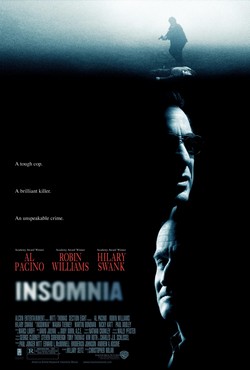
Insomnia
In Nightmute, Alaska, teenager Kay Connell is found beaten to death, her body scrubbed of forensic evidence and dumped naked in a landfill. At the request of the local chief, LAPD detectives Will Dormer and Hap Eckhart are sent to assist with the investigation. Ellie Burr, a young local detective who idolizes Dormer, is assigned as their guide. They question Kay's abusive boyfriend Randy Stetz, who admits he discovered Kay had a secret admirer but could not force her to reveal his identity. In private, Eckhart admits he is being pressured by an Internal Affairs investigation and will testify against Dormer in exchange for immunity. Kay's backpack is discovered at a shack near the coast and Dormer uses it to set a trap, but this backfires and the suspect flees into a heavy fog, shooting an officer in the leg. Giving pursuit, Dormer spots an unidentifiable figure and fires at them with his backup weapon after his sidearm jams. Grabbing a.38 caliber pistol the suspect dropped, Dormer rushes to the figure and discovers he has shot and killed Eckhart. The police assign blame to the suspect and Dormer does not dissuade them, knowing Internal Affairs will never believe the shooting was an accident due to Eckhart's pending testimony. Burr is assigned to the shooting investigation and finds the.38 bullet that pierced the officer's leg. That night, Dormer fires the.38 into an animal carcass, then retrieves and cleans the bullet. At the morgue, the pathologist gives him the 9 mm caliber bullet from Eckhart's body, which she doesn't recognize as very few people in the area own pistols. Dormer replaces it with the.38 bullet. When Burr believes the case is closed, however, Dormer's conscience refuses to let him sign off and he tells her to do another review, which causes her to notice inconsistencies in his statement. Dormer becomes plagued by insomnia, brought on by his guilt and further exacerbated by the perpetual daylight. He begins receiving phone calls from the killer, who witnessed Dormer shoot his partner. Questioning her estranged best friend, Dormer learns Kay was a fan of local crime writer Walter Finch, and realizes he was her secret admirer based on the alias she gave him. Dormer goes to Finch's apartment in a nearby village and breaks in, hiding the.38 in a heating vent. Returning home, Finch realizes someone is inside and escapes after a chase. Finch contacts Dormer again and arranges a public meeting on a ferry. Finch wants help shifting suspicion to Randy, offering to stay silent about the Eckhart shooting in return. Attempting to dissuade him from this, Dormer tells Finch he can't hide his relationship with Kay and gives advice on handling the inevitable police questioning. As Finch leaves the ferry, he reveals he has recorded the conversation. In another phone call, Finch admits he flew into a blind rage after Kay laughed at his romantic advances, stressing that her death was "an accident." Having lied that he lost the gun, Dormer suggests Kay's dress would be sufficient evidence to implicate Randy. The next day, Finch is questioned and mentions that Kay described Randy's abuse to him in her letters. Finch then claims Randy threatened Kay with a gun, and Dormer realizes his trap has again failed. Randy is arrested when the.38 is found in his house. Finch asks Burr to come to his lake house the next day to collect Kay's letters. Returning to the cabin, Burr discovers a 9mm shell casing. She reads her police academy thesis about one of Dormer's cases and realizes he carries a 9mm as a backup weapon. After trashing his room in an attempt to block the sunlight coming through the window, Dormer confides in the hotel clerk about the Internal Affairs investigation: he fabricated evidence against a pedophile he was certain had murdered one of his victims, and the conviction (among many others) would have been overturned had Eckhart testified. When he tries to justify this to himself, the clerk asks him if it's something he's willing to live with. Dormer breaks into Finch's apartment again and discovers Kay's letters. Realizing Burr is being lured into a trap, he rushes to Finch's lake house, where Finch reveals he has Kay's dress before knocking Burr unconscious. Dormer arrives and confronts Finch, but is disorientated from lack of sleep and overpowered before Burr revives and drives Finch off. She tells Dormer she knows he shot Eckhart, and he admits he is no longer certain it was an accident. Finch retrieves a shotgun from his boathouse and begins shooting; Burr returns fire while Dormer outflanks Finch. In a struggle Dormer wrestles the shotgun away, but Finch draws Burr's gun and they shoot each other, resulting in both of them being respectively wounded and killed. Attempting to comfort the mortally wounded Dormer, Burr moves to throw away the shell casing that proves his guilt. Dormer stops her, telling her not to lose her way as he did, before dying.
