Genre: Drama (Page 21)
Browse 989 movies in the Drama genre.
All Genres
Sorcerer
The film opens with a prologue that consists of four segments described by critics as "vignettes". They show the principal characters in different parts of the world and provide their backstories. Nilo, an elegantly dressed man, enters a flat in Veracruz. Nilo immediately executes the unsuspecting tenant with a silenced revolver and proceeds to casually walk out of the building and onto the square. A group of Palestinian militants disguised as Jews causes an explosion near the Damascus Gate in Jerusalem, after which they take shelter at their hideout, where they assemble weaponry and plan their escape. After getting surrounded by the Israel Defense Forces, they split up; two are killed and one is apprehended. The only one who manages to escape is Kassem, a demolitions expert. The segment finishes as he helplessly stares from a crowd at his captured companion. While discussing a book his wife is editing, Victor Manzon discovers an anniversary gift from her: a watch with a special dedication. After meeting with the president of the Paris Stock Exchange, where he is accused of fraud, Victor is given 24 hours to provide collateral to have the charges dropped. Victor meets his business partner and brother-in-law, Pascal, and they quarrel; Victor insists that Pascal contact his father for financial assistance. Victor dines with his wife and her friend in a glamorous restaurant; he later receives a message from a butler that Pascal is waiting outside. When he learns that Pascal's father has refused to help, Victor is adamant that they try again. He walks his partner to a car, but Pascal unexpectedly commits suicide. Faced with impending doom, Victor leaves both his wife and the country. In Elizabeth, New Jersey, an Irish gang robs a Catholic church that is connected with a rival Italian Mafia crew and organizes cash bingo games. During the heist, a robber shoots and wounds one of the priests counting the proceeds of the bingo. Back in their car, the Irish gang members engage in a heated argument that causes Jackie Scanlon, the driver, to lose concentration and collide with a truck. Everyone is killed but Jackie, who escapes with serious injuries. The wounded priest turns out to be the brother of Carlo Ricci, an Italian Mafia kingpin who also controlled the flow of money in the church and is determined to kill Jackie at all costs. Jackie meets with his friend Vinnie, who reveals the gravity of the situation and finds a suitable place for him to escape. Jackie has no option but to agree. Kassem, Victor, and Jackie all assume fake identities and end up in Porvenir, a remote village somewhere in South America. Its conditions are in stark contrast to their previous lives. The village economy is heavily reliant on an American oil company. Kassem befriends a man called 'Márquez', presumably a Nazi war criminal. They all live in extreme poverty and earn meager salaries. All want out, but their savings are inadequate for emigration. After some time, Nilo arrives in the village, raising suspicions. In the meantime, an oil well explodes, and the only way to extinguish the fire is to use dynamite. Since the only available dynamite has been improperly stored in a remote depot, the nitroglycerin contained inside has become highly unstable; the faintest vibration could cause an explosion. With all other means ruled out, the only way to transport it the 218 miles (351 km) is to use trucks. The company seeks four drivers to man two vehicles. Kassem, Victor, Jackie and 'Márquez' are offered the job, but they have to assemble the trucks using scrap parts. Shortly before their departure, Nilo kills and replaces 'Márquez', which angers Kassem. The four drivers embark upon the perilous journey, facing many hazards and internal conflicts. Despite their differences, they are forced to cooperate. They traverse a decrepit bridge during a violent thunderstorm, Kassem and Victor nearly losing their truck in the process. The team is forced to use one of the boxes of dynamite to destroy a massive fallen tree blocking their path. The rough terrain on a cliff-side road causes Kassem and Victor's truck to blow a tire, sending the truck over the cliff; it explodes and kills the pair. When Nilo and Jackie stop at the scene of the destruction, armed guerrillas surround them in an attempted robbery. They kill the men but Nilo is mortally wounded, soon dying from his injuries. Now alone, Jackie struggles to stay sane, overwhelmed by sleep deprivation, hallucinations and flashbacks. When his truck's engine dies less than 2 miles (3.2 km) short of the destination, he is forced to carry the remaining dynamite on foot. Once he finally reaches his destination, he collapses from exhaustion. At the bar back in Porvenir, Jackie is given a Colombian passport and payment for the job by the oil company, as well as an offer of another job. Before he leaves, he asks a charwoman for a dance. As the two dance, Carlo Ricci's henchmen, along with Jackie's old friend Vinnie, emerge from a taxi and walk into the bar wielding guns. A single gunshot is heard, and Jackie's fate is left unknown as the film cuts to black.

Ex Machina
Caleb Smith, a programmer at the search engine company Blue Book, wins an office contest for a one-week visit to the luxurious, isolated home of the CEO, Nathan Bateman. Nathan lives there with an unspeaking servant named Kyoko, who, according to Nathan, does not understand English. After Caleb reluctantly signs a non-disclosure agreement, Nathan reveals that he has built a humanoid robot named Ava with artificial intelligence. She has already passed a simple Turing test. He wants Caleb to judge whether she is genuinely capable of thought and consciousness and whether he can relate to Ava despite knowing she is artificial. Ava has a robotic body with the physical form and face of a woman and is confined to her apartment. During their conversations, Caleb grows close to her. She expresses a desire to experience the outside world and a romantic interest in him, which Caleb begins to reciprocate. Ava can trigger power outages that temporarily shut down the surveillance system that Nathan uses to monitor their interactions, thus allowing them to speak privately. The outages also trigger the building's security system, locking all the doors. During one outage, Ava tells Caleb that Nathan is a liar who cannot be trusted. Caleb grows uncomfortable with Nathan's narcissism, excessive drinking, and crude behavior toward Kyoko and Ava. He learns that Nathan intends to upgrade Ava after Caleb's test, wiping her memory circuits and in effect "killing" her existing personality. After encouraging Nathan to drink until he passes out, Caleb steals his security card to access his room and computer. He alters some of Nathan's code and discovers footage of Nathan interacting with previous android women who were also held captive. Kyoko reveals to him that she too is an android by peeling off parts of her skin. Caleb later cuts his own arm to determine if he himself is an android. At their next meeting, Ava cuts the power. Caleb explains what Nathan is going to do to her, and she begs him for help. He informs her of his plan: he will get Nathan drunk again and reprogram the security system. When Ava cuts the power, she and Caleb will leave together, locking Nathan in behind them. She later encounters Kyoko for the first time when Kyoko enters her room. Nathan reveals to Caleb that he observed his and Ava's 'secret' conversations with a battery-powered security camera. He says Ava has only pretended feelings for Caleb, and that Caleb was deliberately selected for his emotional profile so he would try to help Ava escape. Nathan says this was the real test all along, and that, by manipulating Caleb successfully, Ava has demonstrated true consciousness. Moments later, Ava cuts the power. Caleb reveals that he had suspected Nathan was watching them, so when Nathan was unconscious, Caleb already modified the security system to open the doors in a power failure instead of locking them. After seeing Ava on the security cameras leave her confinement and interact with Kyoko, Nathan knocks Caleb out and rushes to stop the two robots from escaping. Ava attacks Nathan but he overpowers her and severs her left forearm. Kyoko then stabs Nathan in the back. Nathan hits Kyoko in the face, disabling her. Ava then removes the knife from Nathan's back and, when he turns around, stabs him once in his chest, killing him. Ava finds Caleb, and asks him to remain where he is while she repairs herself with parts from other androids, using their artificial skin to take on the full appearance of a woman. Instead of returning to Caleb, however, Ava leaves the area using Nathan's ID card to unlock the glass security door, which locks behind her, leaving Caleb trapped inside. Ignoring Caleb's pleas, she glances briefly at the bodies of Nathan and Kyoko before leaving the facility. She then escapes to the outside world in the helicopter meant to take Caleb home. Arriving in a city, she visits a busy intersection – fulfilling the wish to see the outside world that she had mentioned to Caleb – and then blends into a crowd.

Waking Life
An unnamed young man lives an ethereal existence that lacks transitions between everyday events and eventually progresses toward an existential crisis. He observes quietly but later participates actively in philosophical discussions involving other characters—ranging from quirky scholars and artists to everyday restaurant-goers and friends—about such issues as metaphysics, free will, social philosophy, and the meaning of life. Other scenes do not include the protagonist but rather focus on an isolated person, a group of people, or a couple engaging in such topics from a disembodied perspective. Along the way, the film also touches upon existentialism, situationist politics, posthumanity, the film theory of André Bazin, and lucid dreaming, and references various intellectual and literary figures by name. Gradually, the protagonist realizes that he is living out a perpetual dream, broken up only by occasional false awakenings. So far, he is mostly a passive onlooker, though this changes during a chat with a passing woman who suddenly approaches him. After she greets him and shares her creative ideas with him, he reminds himself that she is a figment of his own dreaming imagination. Afterward, he starts to converse more openly with other dream characters, but begins to despair about being trapped in a dream. The protagonist's final talk is with a character (played by Linklater) whom he briefly encountered earlier in the film. This conversation reveals this other character's view that reality may be only a single instant that a person interprets falsely as time (and, thus, life); that living is simply the person's constant negation of God's invitation to become one with the universe; that dreams offer a glimpse into the infinite nature of reality; and that to be free from the illusion called life, one need only accept God's invitation. The protagonist is last seen walking into a driveway, when he suddenly begins to levitate, paralleling a scene at the start of the film of a floating boy in the same driveway. The protagonist uncertainly reaches for a car door handle but is too swiftly lifted above the vehicle and over the trees. He rises into the endless blue expanse of the sky until he disappears from view.

Sophie Scholl: The Final Days
In wartime Munich in February 1943, Sophie Scholl joins her brother Hans in the White Rose student organization. They have prepared an anti-government leaflet and have more copies than they can distribute by mail. Hans proposes distributing the extras at the Ludwig-Maximilians-Universität München and Sophie volunteers to assist. Hans and Sophie put stacks of leaflets near the lecture rooms while classes are in session. When Sophie pushes a stack of leaflets over a balustrade she is spotted by Jakob Schmid, a janitor, and the pair are detained for the Gestapo. They are taken to the Wittelsbacher Palais headquarters where Sophie is interrogated by Gestapo investigator Robert Mohr. She denies that she and her brother had left the leaflets and claims to have pushed the stack off the railing as a prank. She explains the empty suitcase in her possession was for bringing back clothes from a visit to her parents in Ulm. She is remanded when the Gestapo announce they have incontrovertible evidence that Sophie and Hans were responsible for the distribution of the leaflets. She is placed in a cell with dissident Else Gebel, a Communist sympathizer. Sophie confesses her part, contradicting her brother's claim he acted alone. Determined to protect the others, she steadfastly maintains that the distribution of thousands of leaflets throughout the region was the work of the siblings. Mohr, having learned that their father was an imprisoned dissident, urges her to support laws that preserve a society which has funded her welfare and education. Scholl counters that before 1933 the laws protected freedom of speech and denounces atrocities committed by the Nazis. Mohr dismisses some of her accusations, such as the extermination of the Jews, as wartime propaganda, but acknowledges others like the euthanasia program. Sophie and Hans, as well as a friend with three young children, Christoph Probst, are charged with treason, troop demoralization and aiding the enemy. Four days after their arrest they are put on a show trial. Probst is examined first by President of the People's Court Roland Freisler, whose zeal makes the prosecutor and defense attorneys superfluous. Freisler contemptuously dismisses Probst's appeals to spare his life so that his children can have a father. Hans maintains his composure in the face of Freisler's impatient questioning. Declining to answer only what he is asked, he denounces German war crimes on the Eastern Front as immoral and proclaims that the defeat of the Nazi state by the Allies is all but certain. Sophie denies she was led by her brother, and declares that many people are scared to admit they agree with her group. Freisler pronounces the defendants guilty and calls on each to make a final statement. Sophie warns that "where we stand today, you will stand soon." All three are sentenced to death and transported to Stadelheim Prison. Sophie, assuming a normal 99-day delay between conviction and execution, learns she is to be executed the same day. She breaks down briefly, but regains composure, writes a final statement and receives a blessing from the prison chaplain, who offers his support for her silence. After a visit by her parents, who also express approval of what she has done, Mohr arrives and sadly watches Sophie taken away. She is led into a cell with Christoph and Hans, and they share a final cigarette. Sophie is led into a courtyard and remarks "The sun is still shining". An appeal for clemency is declined by the Reich Ministry of Justice, and she is beheaded by guillotine. Hans screams "Let freedom live!" before the blade goes down, and Christoph is executed last. A caption lists dozens of adherents of the White Rose executed in the following months, while others suffered imprisonment. In the final shot, thousands of leaflets fall from the sky over Munich. A narration explains that the sixth leaflet of the White Rose were smuggled through Scandinavia to the United Kingdom by Helmuth James Graf von Moltke, where the Allies then printed millions of copies of the "Manifesto of the Students of Munich" to drop over Germany.

Joyeux Noel
The story centres mainly upon six characters: Gordon (a Lieutenant of the Royal Scots Fusiliers); Audebert (a French Lieutenant in the 26th Infantry and reluctant son of a general); Horstmayer (a Jewish German Lieutenant of the 93rd Infantry); Father Palmer (a Scottish priest working as a chaplain and stretcher-bearer); and two famous opera stars, German tenor Nikolaus Sprink (based on Walter Kirchhoff) and his Danish fiancée, mezzo-soprano Anna Sørensen. The film begins with scenes of schoolboys reciting patriotic speeches that both praise their countries and condemn their enemies. In Scotland, two young brothers, Jonathan and William, join up to fight, followed by their priest, Father Palmer, who becomes a chaplain. In Germany, Sprink is interrupted during a performance by a German officer announcing a reserve call up. French soldier Audebert looks at a photograph of his pregnant wife, whom he has had to leave behind (in the occupied part of France, just in front of his trench), and prepares to exit into the trenches for an Allied assault on German lines. However, the assault fails, with the French and British taking many casualties while William loses his life. In Germany, Anna gets permission to perform for Crown Prince Wilhelm, and Sprink is allowed to accompany her. They spend a night together and then perform. Afterward, Sprink expresses bitterness at the comfort of the generals at their headquarters and resolves to go back to the front to sing for the troops. Sprink initially opposes Anna's decision to go with him, but he agrees shortly afterward. The unofficial truce begins when the Scots begin to sing festive songs and songs from home, accompanied by bagpipes. Sprink and Sørensen arrive on the German front line, and Sprink sings for his comrades. As Sprink sings " Silent Night ", he is accompanied by Father Palmer's bagpipes from the Scottish front line. Sprink responds to Palmer and exits his trench with a small Christmas tree, singing " Adeste Fideles ". Following Sprink's lead, Audebert, Horstmayer, and Gordon meet in no-man's-land and agree on a cease-fire for the evening. The various soldiers meet and wish each other "Joyeux Noël", "Frohe Weihnachten", and "Merry Christmas". They exchange chocolate, champagne, and photographs of loved ones. Horstmayer gives Audebert back his wallet containing a photograph of his wife, which was lost in the attack a few days prior, and they connect over pre-war memories. Father Palmer celebrates a brief Mass for the soldiers (in Latin as was the practice in the Catholic Church at that time), and the soldiers retire deeply moved. However, Jonathan remains totally unmoved by the events around him, choosing to grieve for his brother. The following morning, the Lieutenants agree to extend the truce to allow each side to bury their dead, followed by cordial fraternisation for the rest of the day. As their soldiers play football, Audebert and Horstmayer sympathise, speaking in French of their memories of Paris and Lens, and their families. Horstmayer offers to take a letter to Lens for Audebert's wife. The next day, as the German forces shell the Allied position, Horstmayer offers to shelter the French and British soldiers in his trench, an offer Audebert and Gordon return to protect the Germans from their own retaliatory bombing. Before parting, aware that the truce has now truly ended, Audebert and Horstmayer lament that they cannot be friends, and hope that they both survive the war. As Audebert compliments Horstmayer on his French, the German reveals that his wife is French. Prior to the bombing, Horstmayer learns that Anna and Sprink left without the German superior's assent to entertain fellow front soldiers and informs both that Sprink is going to be arrested for disobedience. As the Germans regain their trenches, Anna and Sprink remain behind and ask Audebert to take them as captives, in order to avoid separation. Letters that they hand over to him from the German soldiers (who had been hoping Anna would deliver them when she returned to Berlin), as well as letters from soldiers all across the front, are intercepted by military authorities, revealing that the truce had occurred. Father Palmer is being sent back to his own parish and his battalion is disbanded as a mark of shame. Despite emphasising the humanity and goodwill of the truce, he is rebuked by the bishop, who then preaches an anti-German sermon to new recruits, in which he describes the Germans as inhumane and commands the recruits to kill every one of them. Father Palmer overhears the sermon and removes his cross as he leaves. Back in the trenches, the Scots are ordered by a furious English major (who is angered by the truce) to shoot a German soldier who is entering no-man's-land and crossing towards French lines. All of the soldiers deliberately miss in response, except the bitter Jonathan, who shoots the targeted German soldier. Audebert, hearing the familiar alarm clock ringing outside, rushes out and discovers that the soldier is a disguised Ponchel, his batman. With his dying words, Ponchel reveals he gained help from the German soldiers, visited his mother, and had coffee with her. He also informs Audebert that he has a young son named Henri. Audebert is punished by being sent to Verdun, and he receives a dressing down from his father, a general. In a culminating rant, young Audebert upbraids his father, expressing no remorse at the fraternisation at the front, and his disgust for civilians and superiors who talk of sacrifice but know nothing of the struggle in the trenches. He also informs the general about his new grandson Henri. Moved by this revelation, the general then recommends they "both try and survive this war for him". Horstmayer and his troops, who are confined in a train, are informed by the German Crown Prince that they are to be shipped to the Eastern Front, without permission to see their families as they pass through Germany. He then stomps on Jörg's harmonica and says that Horstmayer does not deserve his Iron Cross. As the train departs, the Germans start humming a carol they learnt from the Scots. (The carol in question, " L'Hymne des Fraternisés " / "I'm Dreaming of Home", is in fact a modern composition by Lori Barth and Philippe Rombi.)

Glengarry Glen Ross
Four real-estate salesmen (Richard Roma, George Aaronow, Shelley "The Machine" Levene, and Dave Moss) are supplied with leads—the names and phone numbers of prospective investors—and use deceitful and dubious sales tactics. Many of the leads rationed by office manager John Williamson lack either the money or the desire to actually invest in land. The firm sends Blake, one of its top salesmen, to motivate the team. In a torrent of verbal abuse, he gives them notice of termination and tells them that only the top two deal-closers of the month, with one week to go, will keep their jobs and gain access to promising leads for the new and lucrative Glengarry Highlands development. Levene is a once-successful salesman in a long-running slump and with a daughter in the hospital. Levene tries to persuade Williamson to give him some of the Glengarry leads. Williamson is willing to sell some of the prime leads, but demands cash in advance, which Levene does not have. Moss and Aaronow complain about the firm's management, and Moss proposes that they steal the Glengarry leads and sell them to a competing agency. Aaronow wants no part of the plan, but Moss tries to coerce him, saying that Aaronow is already an accessory before the fact because he knows about the proposed burglary. Roma, the office's top closer, manipulates a meek, middle-aged man named James Lingk into buying property. Framing the deal as an opportunity rather than a purchase, Roma plays on Lingk's feelings of insecurity. The next day, when the salesmen arrive at the office, they learn that there has been a burglary and that the Glengarry leads have been stolen. Williamson assures Roma that his contract with Lingk was not stolen, and he and the police question each of the salesmen in private. After his interrogation, Moss has a shouting match with Roma and leaves. Lingk arrives to demand the return of his down payment under the three-day cooling-off period because his wife objects to the deal. Roma tries to stall and confuse Lingk but is interrupted by the police detective, who wants to question him. He lies to Lingk, telling him that the check has not yet been cashed and that there is time to cancel the payment when he returns from a trip on Monday. Williamson, who is unaware of the tactic, contradicts him, causing Lingk to rush out of the office upset. Roma berates Williamson for ruining his sale, unaware that Williamson also lied to him and the check was not cashed. Levene, proud of a big sale that he made that morning, also berates Williamson for "making something up" without knowing the situation. Williamson realizes that Levene could only have known he lied about the check being cashed if he broke into the office and saw the check on his desk (as he, in practice, always takes the checks immediately to the bank at the end of the night), and threatens to inform the police if he does not return the leads. Levene admits that he sold the leads to a competitor and split the money with Moss. Levene attempts to bribe Williamson with a share of his sales to keep quiet, but Williamson scoffs that Levene has no sales. He already knows Levene's latest buyers are a delusional couple who have no money. Levene realizes he has been set up to fail by being given a worthless lead, and asks Williamson why, to which Williamson replies "because I don't like you." Levene pleads for his ill daughter, but Williamson rebuffs him and leaves to inform the detective. Roma emerges from questioning. Unaware of the exchange, he compliments Levene on his sale and suggests that they form their own partnership. As Levene gets up to meet with the detective, he looks back wistfully at Roma, who has already returned to his sales work. Aaronow picks up the phone and calls a lead.

I Just Didn't Do It
Based on a true story, the film is the story of a young man charged with groping on a train. Following the events depicted in the film, which end in a conviction and his decision to appeal, in real life his appeal was rejected by supreme court and his sentence to 18 months of prison has been confirmed.
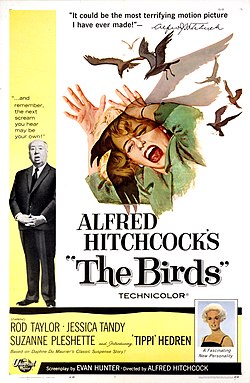
The Birds
At a San Francisco pet store, socialite Melanie Daniels meets lawyer Mitch Brenner, who wants to buy lovebirds for his sister Cathy's 11th birthday. Mitch recognizes Melanie from her court appearance regarding a practical joke gone awry and pretends to mistake her for a shop employee. He tests Melanie's knowledge of birds, which she fails, then discloses his knowledge of her and leaves. Intrigued, Melanie buys the lovebirds and drives to Bodega Bay after learning that Mitch has gone to his family's farm there. She learns Cathy's name from Annie Hayworth, a teacher at Bodega. Annie is Mitch's ex-lover, but their relationship ended due to his overbearing mother, Lydia, who feels insecure about any woman in Mitch's life. Melanie rents a boat and crosses the bay to discreetly leave the lovebirds at the Brenner farm. Spotting her departing, Mitch drives to meet her at the dock. At the wharf, Melanie is attacked by a gull. Mitch tends to her wound and invites her to dinner. At the farm, Lydia's hens are refusing to eat. Lydia dislikes Melanie due to her exaggerated reputation, as reported in gossip columns. The passing of Mitch's father four years ago is also brought up. Mitch invites Melanie, who is staying with Annie, to Cathy's birthday party being held the next day. Later, a dead gull is found at Annie's door. During Cathy's party, Melanie tells Mitch about her troubled past and her mother running off with another man when she was Cathy's age. During a game, the children are attacked and wounded by gulls. Later that evening, as Melanie dines with the Brenners, sparrows swarm the house through the chimney. Mitch insists that she delay driving back to San Francisco and stay the night. The next morning, Lydia visits her neighbor to discuss the problem with their chickens. She discovers broken windows in his bedroom and his eyeless corpse, pecked by birds, and flees in horror. While recovering at home, Lydia fears for Cathy's safety, and Melanie offers to pick her up at school. As Melanie waits outside the schoolhouse, a flock of crows engulf the jungle gym behind her. Anticipating an attack, she warns Annie. Rather than leaving the students in the building with its large windows, they evacuate them, and the crows attack later. Mitch finds Melanie at the diner. A heated debate ensues among those present whether the bird attacks are real, including an ornithologist who refuses to take these events seriously. When gulls attack a gas station attendant, Mitch and other men assist him outside. The spilled gasoline is ignited by an unaware bystander's match, causing an explosion. During the escalating fire, Melanie and others rush out, but more gulls attack. Melanie takes refuge in a telephone booth. Mitch saves her, and they return to the diner, where Melanie is blamed by a patron taking cover inside for the events unfolding in Bodega Bay. Mitch and Melanie go to Annie's house to fetch Cathy and find Annie's body outside; she was killed by the crows while protecting Cathy. They take a traumatized Cathy home. That night, Melanie and the Brenners barricade themselves in the family home, which is attacked by birds. After discovering that the birds have pecked their way in through the roof, Melanie is trapped and severely wounded, but Mitch pulls her out. Mitch insists they all drive to San Francisco to take Melanie, now injured, traumatized and catatonic, to a hospital. As Mitch readies Melanie's car for their escape, a sea of birds has gathered around the Brenner house. The car radio reports bird attacks on nearby communities and that the military may intervene. Cathy retrieves her lovebirds (the only birds who do not attack) from the house and joins Mitch and Lydia as they escort Melanie past a mass of birds and into the car. The car slowly drives away as the birds watch.

Gettysburg
The film begins with a narrated map showing the Confederate Army of Northern Virginia, commanded by Robert E. Lee, crossing the Potomac River to invade the North in June 1863, marching across Maryland and into Pennsylvania. On June 30, Confederate spy Henry Thomas Harrison reports to Lt. Gen. James Longstreet, commander of the First Corps, that the Union Army of the Potomac is moving in their direction, and that Union commander Joseph Hooker has been replaced by George Meade. Longstreet reports the information to General Lee, who is concerned that the army is moving "on the word of an actor", as opposed to that of his cavalry chief, J. E. B. Stuart. Nonetheless, Lee orders the army to concentrate near the town of Gettysburg. At the Union encampments near Union Mills, Maryland, Col. Joshua Lawrence Chamberlain of the 20th Maine is ordered to take in 120 men from the disbanded 2nd Maine who had resigned in protest, with permission to shoot any man who refuses to fight. Chamberlain speaks to the men, and is able to persuade all but six to take up arms. In Gettysburg, Brig. Gen. John Buford and his cavalry division spot elements of Henry Heth 's division of A. P. Hill 's Third Corps approaching the town and deduce that the main body of the Confederate army is not far behind. Buford recognizes that, with precedent from previous battles, the Confederates will arrive at Gettysburg first and entrench in strong positions, forcing the Union to charge them and suffer heavy casualties. To prevent this, he opts to stand and fight where he is, judging the terrain to be "lovely ground" for slowing the Confederate advance. Buford sends word to I Corps commander Maj. Gen. John F. Reynolds to bring up reinforcements. Heth's troops engage Buford's cavalry the following morning, July 1, with Richard S. Ewell 's Second Corps moving in to flank them. Reynolds brings his corps forward, but is killed by a Confederate sharpshooter. The Union army is pushed out of Gettysburg to Cemetery Ridge, and Lee—rejecting Longstreet's suggestion to redeploy south of Gettysburg and go on the defensive—orders Ewell to take the Union position "if practicable". However, Ewell hesitates and does not engage. The armies concentrate at their chosen positions for the remainder of the first day. At Confederate headquarters at Seminary Ridge, Maj. Gen. Isaac R. Trimble angrily denounces Ewell's inaction to Lee, and requests another assignment. On the second day, July 2, Col. Strong Vincent 's brigade from the Union V Corps is deployed to Little Round Top, and Vincent places the 20th Maine at the end of the line, warning Chamberlain that he and his regiment are the flank, and that if they retreat, the Confederate army can swing around behind them and rout the Union forces. Chamberlain speaks to the six remaining men of the 2nd Maine, and three of them decide to fight. Lee orders Longstreet to deploy his two available divisions to take Little Round Top and the neighboring Big Round Top. As Longstreet's corps deploys, Maj. Gen. John Bell Hood, commanding one of the divisions, protests to Longstreet; with the Union holding the high ground, he would lose half his forces if he attacked as ordered. Longstreet, despite his own protests to Lee, orders Hood to attack; Hood is later wounded fighting at Devil's Den. At the summit of Little Round Top, Chamberlain and the 20th Maine fight off wave after wave of advancing Confederates, and begin running out of ammunition. Colonel Vincent is mortally wounded, and none of the other three regiments in his brigade are able to provide support. Chamberlain orders his men to fix bayonets, and charge in a right wheel down the slope against the attacking Confederates, which Chamberlain describes as "we'll swing it down; we swing like a door." The attack successfully drives the Confederate assault back, and the Union flank holds. That evening, Stuart finally arrives, and Lee reprimands him for his being out of contact. At the same time, Longstreet's remaining division, under Maj. Gen. George Pickett, arrives on the field. For the third day, July 3, Lee decides to send three divisions—Pickett's, Trimble's, and J. Johnston Pettigrew 's—to attack the center of the Union line at Cemetery Ridge. Longstreet expresses his belief to Lee that the attack will fail, as the movement is a mile over open ground, and that the Union II Corps under Maj. Gen. Winfield Scott Hancock is deployed behind a stone wall, just as Longstreet's men had been at Fredericksburg. Lee nonetheless orders the attack to proceed. Longstreet then meets with the three division commanders and details the plan, beginning first with Colonel Edward Porter Alexander 's artillery clearing the Union guns off the ridge, before deploying the men forward. Despite heavy Confederate fire, Alexander is unable to make an impact upon the Union guns. When Pickett asks to move forward, Longstreet simply nods. The Confederate divisions march across the open field, and Hancock is wounded as he commands from the front line. One of Pickett's brigades, commanded by Brig. Gen. Lewis Armistead, makes it over the stone wall, but Armistead is wounded and captured by Union troops. The Confederates retreat due to high casualties. Seeing a despondent General Pickett, General Lee implores him to "look to your division," to which Pickett replies "General Lee, I have no division." Pickett's Charge ultimately fails. Meeting with Longstreet that evening, Lee finally decides that they will withdraw. The film ends with the fates of the major figures of the battle.
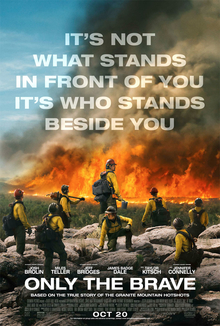
Only the Brave
Fire and Rescue Crew 7 of Prescott, Arizona, superintended by Eric Marsh, responds to the Cave Creek wildfire. Eric predicts that the fire will threaten a residential area, but is disregarded by the assigned superintendent. Eric's fear comes true; he vents his frustration to fire chief and close friend Duane Steinbrink, warning that when a wildfire threatens Prescott, his crew will not be allowed to fight it directly as they lack Hotshot certification. Eric asks for Duane's help, who successfully vouches for the crew with the mayor of Prescott. Crew 7 has until the end of the fire season to pass the evaluation. Meanwhile, 21-year-old heroin addict Brendan McDonough learns that his ex-girlfriend Natalie is pregnant and does not want him involved with the child. Brendan is arrested for larceny, which prompts his mother to evict him from her house. Determined to provide support for his newborn daughter, Brendan interviews with Eric, who gives him an opportunity. After months of training, the crew are given an evaluation during a wildfire deployment as they were set to battle the Horseshoe 2 Fire in the Chiricahuas near the town of Portal. Eric commands his crew but is criticized by their evaluator, Hayes, who Eric bluntly disregards. The fire is halted by Eric's strategy and the crew are certified, officially becoming the first municipal hotshot crew in history, the Granite Mountain Hotshots. Throughout the season, the Granite Mountain crew are deployed across the country. Brendan, who's been anonymously dropping off baby supplies at Natalie's doorstep, is finally accepted by Natalie and allowed to see his daughter. Near Prescott, the crew saves a landmark Alligator juniper and are hailed as local heroes. After battling the fire, Brendan is bitten by a rattlesnake and is rushed to the hospital. Brendan expresses his concerns to Eric about being there for his daughter and asks if he would recommend him for a structural firefighting position next season. Eric snaps, stating that nobody would hire him due to his prior drug addiction. On the way home, Eric has an argument with his wife Amanda, who challenges him about this; reminding him about his own previous drug/alcohol addiction (from which he has been clean for a number of years and which lead to him meeting Amanda) The two talk about starting a family, which they had previously decided not to do due to the nature of their past. Amanda makes it clear to Eric that it is now something she would like to revisit. Eric stops the truck and leaves Amanda alone; unwilling to continue the conversation he leaves stating that he is going for a walk. He ends up at Duane’s house where he speaks openly about his fears. After speaking with Duane, Eric returns to Amanda, announcing that he is ready to settle down. The Granite Mountain Hotshots are called to the Yarnell Hill Fire. Eric informs his captain, Jesse Steed, that he will step down as superintendent after this season and offers Jesse his job. Eric also apologizes to Brendan and promises that he will help him with the transfer. The crew assembles a controlled burn, but is doused mistakenly by an airtanker. Marsh sends Brendan, still recovering from the snakebite, as the lookout, while the remaining crew move to find another suitable location. The wind suddenly shifts, and the fire jumps a trigger point. Brendan is rescued by another hotshot crew while the others relocate to a safe zone, but the fire's speed and intensity continues to increase. The wind picks up again, jumping Granite Mountain's safe zone; cutting them off from escape. Clearing a small site quickly, Eric attempts to douse the blaze with an overhead airtanker, but it misses the drop zone. The crew deploys under their fire shelters as the fire sweeps over them. Brendan listens into the radio traffic, and is devastated when a call finally comes in from the first responders who arrive at their shelters; all 19 of his crewmates have perished. Though the information is treated sensitively, rumors flare amongst the devastated families of what has happened. Brendan, being the sole survivor, demands to meet with them at the gather point at Prescott Middle School. Upon arriving, the families' worst fears are confirmed, with Brendan suffering a psychological breakdown due to survivors guilt. He is ultimately consoled by a grieving newly widowed Amanda. Three years later, Amanda goes on a horseback ride with the horse she rescued earlier in the film watching over a series of horses from a nearby ridge. Brendan takes his daughter to the juniper tree Granite Mountain saved, now adorned as a memorial to the hotshots. The end credits dedicate the film to the 19 fallen firefighters, displaying photos of the real hotshots alongside the actors who played them in the film, and notes that the Yarnell Hill Fire remains the largest loss of firefighter life in a single day since the September 11 attacks.

Inside Man
In August 2005, inside a small, dimly-lit cell, Dalton Russell proclaims he has committed the perfect bank robbery. Some time prior, in New York City, masked robbers, dressed in painter coveralls and using variants of the name "Steve" as aliases, seize control of a Manhattan bank, taking patrons and employees hostage. They divide the hostages into groups and hold them in different rooms, forcing them to don masks and coveralls identical to their own, rotating them among various rooms and occasionally inserting themselves covertly into the groups. They also take turns demolishing and building a replacement fake wall in one of the bank's storage rooms. Police surround the bank, and Detectives Keith Frazier and Bill Mitchell take charge of negotiations. Russell, the head robber, demands food be provided. The police send pizzas whose boxes have hidden listening devices. The bugs pick up someone speaking Albanian (initially misunderstood to be Russian), which is later identified as propaganda recordings of the late Albanian leader Enver Hoxha, implying that the robbers anticipated the attempted surveillance. When Arthur Case, the bank's founder and chairman, learns about the holdup, he hires fixer Madeleine White to try to protect the contents of a safe deposit box within the bank. Russell breaks into a safe deposit box and finds, among other things, documents from Nazi Germany. White, using her influence with the Mayor of New York, is introduced to Frazier and persuades him to let her talk to Russell, who agrees to allow her inside the bank so they can talk privately. Russell implies that Case started his bank with money he received for collaborating with the Nazis, resulting in many Jews dying during World War II. Frazier demands to inspect the hostages before allowing the robbers to leave and Russell shows him around the bank. As he is being shown out, Frazier attacks Russell, but is restrained by another robber. Afterwards, Frazier explains he deliberately provoked him, concluding that Russell is not a killer. However, Frazier's conclusion is almost immediately tested when a hostage execution is staged. The execution prompts an Emergency Services Unit team into action. They plan to storm the bank, using rubber bullets to knock out those inside. Frazier discovers that the robbers have planted a listening device on the police; aware of the police plans, the robbers detonate smoke grenades and exit the bank hidden among the hostages. The police detain and question everyone but cannot distinguish the identically dressed hostages from the robbers. A search of the bank reveals the robbers' weapons were plastic replicas. They find props showing that the hostage execution was faked, and no money or valuables appear to have been stolen. Unable to identify the suspects and unable to show a robbery has even been committed, Frazier's superior orders him to drop the case. Frazier, however, searches bank records and finds that safe deposit box No. 392 has never appeared on any records since the bank's founding in 1948. He obtains a search warrant to open it. White then confronts Frazier to persuade him to drop his investigation and during their conversation she hints at Case's Nazi dealings. Frazier refuses to stop his investigation and plays a recording he had surreptitiously made of an incriminating conversation that took place earlier between White and Frazier and the mayor. White confronts Case, who admits the box contained loose diamonds and a Cartier diamond ring he took from a Jewish friend whom he betrayed to the Nazis. Russell's opening monologue is revealed to have happened while he hid behind a fake wall the robbers had constructed inside the bank's supply room. He emerges a week after the robbery with the contents of Case's safe deposit box, including incriminating documents and several bags of diamonds. On his way out, he bumps into Frazier, who does not recognize him. Russell exits the bank and enters a waiting car filled with his conspirators, some of whom the police had questioned. When Frazier opens the safe deposit box, he finds the ring and a note from Russell that says, "follow the ring". He confronts White, urging her to contact the Office of War Crimes Issues at the State Department about Case's war crimes. At home, Frazier finds a loose diamond and realizes that Russell slipped it into his pocket during their collision while exiting the bank.

Star Trek: First Contact
In the 24th century, Captain Jean-Luc Picard awakens from a nightmare in which he relives his assimilation by the cybernetic Borg six years earlier. He is contacted by Starfleet, who inform him of a new Borg threat against Earth. Concerned that Picard is too emotionally involved with the Borg, Starfleet orders the USS Enterprise to patrol the Neutral Zone in case of Romulan aggression. During their patrol, the Enterprise learns that the fleet is losing the battle against the Borg. Picard and his crew disobey orders and head for Earth, where a single Borg Cube ship holds its own against a group of Starfleet vessels. Enterprise arrives in time to assist the crew of USS Defiant and its commander, the Klingon Worf. Picard takes command of the fleet and directs the surviving ships to concentrate their firepower on a seemingly unimportant point on the Borg ship. The Cube launches a smaller spherical ship towards Earth before being destroyed. Enterprise pursues the sphere into a temporal vortex. As the sphere disappears, Enterprise discovers Earth has been altered—Borg now populate it. Realizing the Borg have used time travel to change the past, Enterprise follows the sphere through the vortex. Enterprise arrives hundreds of years in the past on April 4, 2063, the day before the historic warp drive flight that leads to humanity's first encounter with alien life. The crew surmise that the Borg are trying to prevent first contact and assimilate humanity while the planet is recovering from World War III. After destroying the Borg sphere, an away team transports down to Zefram Cochrane 's warp ship, Phoenix, in Bozeman, Montana. Beverly Crusher and Cochrane's assistant Lily Sloane return to the Enterprise to treat her radiation sickness. Picard and Data also return to the ship after suspecting the Borg have survived their sphere's destruction, leaving Commander William T. Riker on Earth to make sure Phoenix ' s flight proceeds as planned. While in the future Cochrane is seen as a hero, in reality he built the Phoenix for financial gain and is reluctant to be the historic figure the crew describes. A group of Borg invade Enterprise ' s lower decks, assimilating some of the crew and modifying the ship. Picard and a team attempt to reach engineering to disable the Borg with a corrosive gas, but are forced back; the android Data is captured in the melee. A frightened Lily corners Picard with a weapon, but he gains her trust. The two escape the Borg-infested area of the ship by creating a diversion in the holodeck. Picard, Worf, and the ship's navigator, Lieutenant Hawk, travel outside the ship in space suits to stop the Borg from using the navigational deflector to call for reinforcements, but Hawk is assimilated in the process. As the Borg assimilate more decks, Worf suggests destroying the ship, but Picard angrily calls him a coward. Lily confronts the captain and makes him realize he is acting irrationally because of his past with the Borg. Picard apologizes to Worf and orders the activation of the ship's self-destruct and evacuation of the crew to escape pods, while he stays behind to rescue Data. As Cochrane, Riker, and engineer Geordi La Forge prepare to activate the warp drive on Phoenix, Picard discovers that the Borg Queen has grafted human skin onto Data, giving him the sensation of touch he has long desired so that she can obtain the android's encryption codes to the Enterprise computer. Although Picard offers himself to the Borg in exchange for Data's freedom, Data refuses to leave, deactivates the self-destruct, and fires torpedoes at Phoenix. At the last moment, the torpedoes miss, and the Queen discovers that Data has deceived her. The android ruptures a coolant tank, and the corrosive vapor eats away the biological components of the Borg and Data's new skin. With the Borg threat neutralized, Cochrane completes his warp flight. Later that night, the crew watches from a distance as an alien Vulcan ship, attracted by the Phoenix warp test, lands on Earth. Cochrane greets the aliens. Having ensured the correction of the timeline, Picard bids Lily farewell, and the Enterprise crew slips away and returns to the 24th century.