Genre: Drama (Page 16)
Browse 989 movies in the Drama genre.
All Genres
The Big Short
In 2005, eccentric hedge fund manager Michael Burry discovers that the U.S. housing market is extremely unstable due to subprime loans. He draws this conclusion after recognizing similarities to the 1930s crisis and calculates that the market will collapse in 2007. Burry then meets with several major investment and commercial banks to purchase credit default swaps, but is required to pay substantial monthly premiums. The high premiums cause Lawrence Fields, Burry's principal client, to accost him for the high premiums that will bankrupt Burry's fund in a couple of years if his conclusion is wrong, though Burry holds firm. A Deutsche Bank executive later mentions Burry's dealings to his co-worker Jared Vennett. Vennett, sensing an opportunity, tries to secure investors for shorting the market, erroneously calling a trader at FrontPoint Partners who are nonetheless interested in his pitch. Vennett explains the fraud in the market and the disingenuity of seemingly safe bonds. Mark Baum, the head of FrontPoint, is moved by Vennett's pitch due to his disenchantment with banking's business model. The FrontPoint team travels to south Florida to investigate the veracity of Vennett's claims — finding empty neighborhoods and meeting with mortgage brokers who admit to fraudulent practices — and then decide to invest with Vennett. Meanwhile, young investors Charlie Geller and Jamie Shipley accidentally discover Vennett's presentation on a coffee table in the lobby of JPMorgan Chase. They are immediately convinced as they see the high potential payouts, but the small size of their fund requires them to enlist Ben Rickert, Shipley's childhood neighbor and a retired securities trader. Rickert agrees to help and the trio begin investing in credit default swaps. As defaults increase in early 2007, the values of credit default swaps and collateralized debt obligations (CDOs) inexplicably rise and their credit rating remains stable. Burry struggles with the lack of payout and he restricts withdrawals, leading Fields to sue. Baum talks to an acquaintance at Standard & Poor's, finding dishonesty amongst the credit rating agencies to maintain business with investment banks. Geller suspects the banks are committing fraud, leading him, Shipley and Rickert to visit the American Securitization Forum, where bankers are unconcerned about defaults. Shipley learns that the SEC has no regulations governing mortgage-backed securities activity. Geller convinces Shipley and Rickert to bet against higher-rated tranches of the bonds, since they are likely to fail if the lower-rated bonds fail. Vennett and the FrontPoint team also attend the Forum, where Baum learns from a CDO manager that the market for synthetic CDOs is twenty times larger than the market for the mortgages themselves, leading Baum to realize the entire world economy is set to collapse. Geller and Shipley see that New Century Financial, a leader in subprime lending has filed for bankruptcy, and they identify it as the beginning of the housing bubble bursting. At the same time, Baum finds that Bear Stearns is liquidating hedge funds and Burry has his phone calls ignored by the banks. Geller and Shipley realise that for the prices to have remained stable despite defaults continuing to increase, the banks must be freezing the prices of their securities in order to sell and short them before the market crashes. Outraged, Geller and Shipley contact an old friend who works for The Wall Street Journal, but he declines to report the story to preserve his relationships with the investment banks. As the subprime bonds continue to fall, Baum learns that Morgan Stanley, who owns FrontPoint, has also taken short positions against mortgage derivatives. However, it had sold short positions in higher-rated mortgage derivatives to offset the risk. Because even the higher-rated derivatives are collapsing in value, Morgan Stanley is facing severe liquidity problems. Despite pressure from his staff to sell their positions before Morgan Stanley collapses, Baum refuses to sell. Rickert, on vacation in England, sells Geller and Shipley's positions; the two receive huge profits but lose their faith in the system as Ben informs them that foreign bank systems are beginning to crash as well. Burry begins receiving calls from the banks he had originally taken short positions against. Burry yields a profit of $2.69 billion, with Fields alone receiving $489 million. While Baum is speaking at an industry panel, his team learns that Bear Stearns stock has fallen 38% in just ten minutes and the bank collapses shortly after. Baum is the last to sell, making over $1 billion, but laments that the banks and government will not take responsibility for the crisis. Vennett receives a large bonus for the profits he generated. FrontPoint continues to operate as per usual, but Burry closes his fund after public backlash. Geller and Shipley go their separate ways after unsuccessfully trying to sue the ratings agencies and Rickert returns to his retirement. Just prior to the credits, it is noted that most banks responsible for the crisis face no consequences for their actions, with one single trader, Kareem Serageldin, being imprisoned and that banks are again selling CDOs under a new label of the bespoke tranche opportunity.

The Ballad of Narayama
The film is set in a small rural village in 19th century Japan. According to tradition, once a person reaches the age of 70, he or she must travel to a remote mountain to die of starvation, a practice known as ubasute. The story concerns Orin, who is 69 and in sound health. However, she notes that a neighbor had to drag his father to the mountain, so she resolves to avoid clinging to life beyond her term. She spends a year arranging all the affairs of her family and village, severely punishing a family hoarding food and helping her younger son lose his virginity. The film contains harsh scenes depicting the brutal conditions faced by the villagers. Interspersed between episodes in the film are brief vignettes of nature—birds, snakes, and other animals hunting, watching, singing, copulating, or giving birth.


The Fall
In 1920's Los Angeles, stuntman Roy Walker is hospitalized, bedridden and paraplegic (possibly permanently) after jumping off a bridge for a stunt for a film. He meets Alexandria, a young Romanian -born patient in the hospital who is recovering from a broken arm, and tells her a story about her namesake, Alexander the Great. Roy promises to tell her an epic tale if she returns the next day. The next morning, as Roy spins his tale of fantasy, Alexandria's imagination brings his characters to life. Roy's tale is about five heroes: a silent Indian warrior, a bow and arrow-wielding ex- slave named Otta Benga, Italian explosives expert Luigi, Charles Darwin alongside a pet monkey named Wallace, and a masked swashbuckling bandit. The evil ruler Governor Odious has committed an offense against each of the five, and they all seek revenge. They are later joined by a sixth hero, a mystic. Alexandria vividly imagines people around her appearing as the characters in Roy's story. Although Roy develops affection for Alexandria, he has an ulterior motive: to trick her into stealing morphine from the hospital pharmacy. He intends to use the morphine to die by suicide because the woman he loves has left him for the actor for whom he provided the stunt footage. However, Alexandria brings him only three pills; she threw away the rest, having mistaken the "E" Roy wrote in "morphine" for a "3". The story becomes a collaborative tale to which Alexandria also contributes. The masked bandit, whom Roy intended to represent Alexandria's late father, becomes Roy, and Alexandria is his daughter. Roy talks Alexandria into stealing a bottle of pills locked in a fellow patient's cabinet, and then downs the contents. As he falls asleep he attempts to finish the story with the Bandit finding love, and he tells Alexandria not to return the next day. She does not obey, and is devastated to see a dead patient being taken away; however, the deceased is Roy's elderly, denture -wearing roommate. Roy awakens and lashes out when he realizes the pills were placebos. Alexandria, desperate to help Roy, sneaks out of bed to the pharmacy. She climbs onto the cabinet but loses her footing, falls, and sustains a severe head injury. She receives surgery, after which she is visited by Roy, who confesses his deception. He pleads with Alexandria to ask someone else to end the story, but she insists on hearing Roy's ending. Roy reluctantly and drunkenly continues the story. The heroes are betrayed and die one by one, and it seems that Governor Odious will be triumphant. Alexandria becomes increasingly upset, but Roy insists that it is his story to tell and the Bandit is a coward. She declares that it is hers too and begs Roy to let the Bandit live. Roy finally agrees, and the epic tale comes to an end; Governor Odious lays dying and the Bandit and his daughter are alive and together. In a final twist, Roy confronts the character representing his ex-girlfriend. She says the story's pain and suffering were all part of a "test" of the Bandit's love for her. The Bandit rejects her and her manipulations at last. With the story complete, Roy and Alexandria, along with the patients and staff of the hospital, watch the finished film that Roy appeared in, a Western featuring bandits, a Native American man, and Roy's ex-girlfriend. The crowd is delighted, but Roy's smile is broken in disappointment as he realizes his stunt has been cut from the film. Alexandria's arm eventually heals and she returns to the orange orchard where her family works. Her voice-over reveals that she believes Roy has recovered and is now back at work again. A montage of cuts from several of silent films ' greatest and most dangerous stunts plays; she imagines all the stuntmen to be Roy.

Burnt by the Sun
The entirety of the film takes place within the course of one day in the summer of 1936 in the Soviet Union. Mitya (Dmitri), a former nobleman and veteran of the anti-communist White Army, contemplates suicide. The film cuts to Komdiv Sergei Petrovich Kotov, his wife Maroussia, and their young six-year-old daughter Nadia relaxing in a banya (sauna) when a peasant from the local collective farm frantically tells them the Red Army 's tanks are about to crush the wheat harvest as part of general maneuvers. After hearing this news, Kotov rides out to order the tank officer to halt. Kotov carries authority as a senior Old Bolshevik and legendary hero of the Russian Civil War, and he is also very popular with the common people and local villagers. The opening scene makes it clear that Kotov is a devoted family man, and he claims to be a personal friend of Stalin. Following this incident, the happy family returns to their country dacha (country estate), where they join Maroussia's relatives, a large and eccentric family of Chekhovian aristocrats. Mitya (Dmitri), who had been Maroussia's fiancé before disappearing in 1927, arrives in a costume to disguise himself, but when he takes it off he is joyfully embraced by the family and introduced to Nadia as "Uncle Mitya". Maroussia is left feeling deeply conflicted, as she had suffered deeply when Mitya left without explanation and even contemplated suicide, as shown by the self-inflicted marks on her wrists. Despite his personable nature, it is clear that Mitya has returned with a secret agenda. It is slowly revealed throughout the duration of the afternoon that he works for the Soviet political police, the NKVD, and has arrived to arrest Kotov for a non-existent conspiracy that Mitya had framed him for. Mitya is abusing his power for the purpose of revenge, since ten years ago Kotov had conscripted Mitya into the OGPU, the predecessor of the NKVD, and was therefore the reason for Mitya being taken away. Mitya detests Kotov, whom he blames for causing him to lose Maroussia, his love for Russia, faith, and his profession as a pianist. Kotov confronts Mitya about his activities in Paris, where he gave up eight White Army generals to the NKVD. All were kidnapped, smuggled to the Soviet Union, and shot dead without trial. Although eventually realizing that Mitya intends to take him away, Kotov believes that his close relationship with Soviet dictator Joseph Stalin will save him. However, a black car carrying NKVD agents arrives to remove Kotov, just as a group of Young Pioneer children arrives at the dacha to pay tribute to him. Kotov willingly goes with Mitya, pretending to be Mitya's friend and even lets Nadia briefly ride in the car with them. While riding away in the car with his captors, Kotov reminds them who he is and his status, but he quickly realizes that they don't care and that it was Stalin himself who ordered his arrest. Only after looking into Mitya's eyes does Kotov realize the severity of the situation, causing him to breakdown in tears. Kotov is forced to make a false confession to all the charges Mitya framed him for and is shot dead in August 1936. Meanwhile, following Mitya's success in his revenge against Kotov, he ultimately commits suicide, as his revenge did not satisfy him in the way he thought it would. In addition, Maroussia is arrested and dies in the Gulag in 1940. Although arrested with her mother and taken to a concentration camp, Nadia lives to see all three sentences overturned during the Khrushchev Thaw, in 1956, and works as a music teacher in Kazakhstan.

English Vinglish
Shashi Godbole is a traditional Marathi homemaker and entrepreneur in Pune who makes and sells laddoos as a home-run business. Her husband Satish and daughter Sapna take her for granted, mock her because of her poor English-speaking skills, and generally treat her with disrespect, making Shashi feel negative, insecure, and underconfident. However, her young son, Sagar, loves her as she is, and her elderly widowed mother-in-law offers her words of sympathy. Shashi's older sister, Manu, who lives in New York City, invites Shashi's family to the marriage of her daughter, Meera, with Kevin. It is decided that Shashi will travel to New York alone five weeks in advance to help Manu organise the marriage, while her husband and children will join her as the marriage approaches. During her flight to America, Shashi is given inspirational advice by a fellow passenger. Upon her arrival in New York, Shashi is warmly welcomed by Manu and her younger daughter, Radha. While Shashi is in New York, she has a traumatic experience at a coffee shop where a staff member is rude to her due to her inability to communicate in English. She is comforted by fellow customer, French chef Laurent, who himself is weak in English. Using the money she earned by selling laddoos, Shashi secretly enrolls in a conversational four-week English class, showing her resourcefulness at navigating an unfamiliar city alone. The class comprises the instructor David Fischer, a Mexican nanny Eva, a Pakistani taxi driver Salman Khan, a Chinese hairstylist Yu Son, a Tamil software engineer Ramamurthy, a shy African-Caribbean man Udumbke, and Laurent. Shashi quickly becomes a promising and committed student, earns everyone's respect with her charming behavior and her cuisine, and gains self-confidence. Laurent becomes attracted to Shashi, leading to some interpersonal conflict. When he tries to kiss her at the rooftop of a building, Shashi pushes him away and runs off, but fails to explain that she is married. Meanwhile, Radha finds out about Shashi's secret English classes and is supportive of her pursuit. Shashi begins watching English films at night and does her homework diligently. To complete the English-speaking course and receive an academic certificate, each student must write and deliver a five-minute speech. Shashi's family shows up earlier than planned as a surprise, and after missing out on an event where Sagar injures his leg, Shashi eventually decides to quit because of scheduling conflicts and the fact that she considers herself to be an irresponsible mother since she did not realise that Sagar was injured. The test date coincides with that of the marriage, forcing Shashi to miss the test. Radha invites David, Laurent, Salman, Eva, Ramamurthy, Yu Son and Udumbke to the marriage, where Satish is taken aback at being introduced to a diverse group of people by his wife. Shashi gives a touching and enlightening toast to the married couple in English, surprising everyone. In her speech, Shashi extols the virtues of being married and having a family, describing the family as a safe space of love and respect where weaknesses are not mocked. Satish and Sapna regret treating her with disrespect. David declares she has passed the course with distinction and issues her the certificate. Shashi thanks Laurent for "making her feel better about herself." Shashi's family returns to India by flight, where Shashi fluently communicates in English with the flight attendant.

I, Daniel Blake
Daniel Blake, a widowed 59-year-old joiner from Newcastle, has had a heart attack. Though his doctor has not allowed him to return to work, he is deemed fit to do so after a Work Capability Assessment and is denied Employment and Support Allowance. Daniel is frustrated to learn that his doctor was not contacted about this decision and thus applies for an appeal, a process Daniel finds difficult because he must complete forms online and is not computer literate. Daniel befriends Katie Morgan, a single mother, after she is sanctioned for arriving late to her Jobcentre appointment. Katie and her children have just moved to Newcastle from a homeless shelter in London, as there is no affordable accommodation. Daniel helps the family by repairing objects, teaching them how to heat rooms without electricity, and crafting wooden toys for the children. During a food bank visit, Katie breaks down crying, having become overwhelmed by hunger due to feeding her children instead of herself. After she is caught shoplifting at a supermarket, a security guard secretly offers Katie work as a prostitute. Daniel surprises her at the brothel where she goes to work and begs her to give up the job, but Katie tearfully insists she has no other way to feed her children. As a condition for receiving Jobseeker's Allowance, Daniel must keep looking for work. He refuses a job at a garden centre because his doctor will not allow him to work yet. When his work coach tells him he must work harder to find a job or be sanctioned, Daniel spray paints "I, Daniel Blake, demand my appeal date before I starve" on the side of the building. Daniel earns the support of bystanders, including other people claiming benefits, but is arrested and cautioned by the police. Daniel sells most of his belongings and becomes a recluse but is pulled out of his depression by Katie's daughter, Daisy, who brings him a homemade meal to repay Daniel for his kindness. On the day of Daniel's appeal, Katie accompanies him to the tribunal, where a welfare adviser tells Daniel that his case looks promising. Upon seeing the judge and doctor who will decide his fate, Daniel becomes anxious and excuses himself to use the toilet, where he suffers another heart attack and dies. Later, Katie reads a eulogy at his public health funeral, including a speech he had intended to read at his appeal. The speech describes his feelings about how the welfare system failed him, and states, "I am not a blip on a computer screen or a national insurance number, I am a man."

Let the Right One In
Oskar resides with his mother in the Swedish suburb of Blackeberg in 1982. His classmates bully him, and he spends his evenings imagining revenge. One evening, he meets Eli, who appears to be a girl his age. Eli has moved into the adjoining apartment with a man, Håkan. Eli informs Oskar that they cannot be friends, but the two begin exchanging coded messages through their shared wall. Eli learns that Oskar is being bullied by schoolmates and encourages him to stand up for himself. Oskar then enrolls in exercise classes after school. Håkan kills a person on a footpath to harvest blood for Eli, but is interrupted by a passerby. Eli is prompted to waylay and kill a man, Jocke. A recluse witnesses the attack from his flat but doesn't report the incident. Håkan hides Jocke's body in a hole in the lake. Håkan makes another effort to obtain blood for Eli by trapping a boy in a room after school. When he is unsuccessful, Håkan pours acid onto his own face to avoid identification. Eli visits Håkan in the hospital, where he offers his own neck for feeding. Eli drains him of his blood, and Håkan falls out the window. Eli goes to Oskar's apartment and spends the night with him, during which they agree to "go steady", though Eli states, "I'm not a girl". While on a field trip, the bullies again harass Oskar, who this time hits their leader in the head with a pole, injuring him. On that same trip, some of Oskar's classmates discover Jocke's body. Oskar suggests that he and Eli form a bond and cuts his hand. Eli laps up his blood then runs away. Jocke's friend Lacke has a fight with his girlfriend Virginia, and afterward Eli attacks her. She survives but discovers that she has become sensitive to sunlight. Oskar confronts Eli, who admits to being a vampire. Oskar is upset by Eli's need to kill people for survival. Eli insists that they are alike, in that Oskar wants to kill and Eli needs to kill, and encourages him to "be me, for a little while." While in the hospital, Virginia asks an orderly to open the blinds in her room, and bursts into flames, committing suicide. Lacke sets out to kill Eli, whom he finds asleep in the apartment's bathtub. Oskar intervenes, and Eli wakes up and feeds on Lacke's blood. Afterward, Eli thanks Oskar and kisses him. Fearing that they've attracted too much attention from the neighbors, Eli decides that it isn't safe to stay and leaves that night. Oskar is lured out to resume the program at the pool. One of the bullies holds Oskar under the water. Eli arrives and rescues him by killing and dismembering the bullies, except for one, who is left sobbing on a bench. Oskar is seen travelling on a train, with Eli in a box beside him. Eli taps the code for "kiss" to Oskar, who responds the same.

Awakenings
In 1969, Dr. Malcolm Sayer is a dedicated and caring physician at a local hospital in the New York City borough of the Bronx. After working extensively with the catatonic patients who survived the 1919–1930 epidemic of encephalitis lethargica, Sayer discovers stimuli that will "awaken" the patients from their respective catatonic states. Actions such as catching a ball, hearing familiar music, being called by their name, and enjoying human touch each have unique effects on particular patients and offer a glimpse into their worlds. Patient Leonard Lowe seems to remain unmoved, but Dr. Sayer learns that Leonard is able to communicate with him by using a Ouija board. After attending a lecture at a conference on the drug L -DOPA and its success for patients with Parkinson's disease, Sayer believes that the drug may offer a breakthrough for his own group of patients. A trial run with Leonard yields astounding results; Leonard completely "awakens" from his catatonic state. This success inspires Sayer to ask for funding from donors, so that all the catatonic patients can receive the L -DOPA medication and gain "awakenings" to reality and the present. Meanwhile, Leonard is adjusting to his new life and becomes romantically interested in Paula, the daughter of another hospital patient. Leonard begins to chafe at the restrictions placed on him as a patient of the hospital, desiring the freedom to come and go as he pleases. He stirs a revolt by arguing his case to Sayer and the hospital administration. As Leonard becomes more agitated, Sayer notices that a number of facial and body tics begin to manifest, which Leonard has difficulty controlling. Although Dr. Sayer and the hospital staff are initially overjoyed by the success of L-DOPA in reviving a group of catatonic patients, they soon realize that the effects are only temporary. Leonard, the first to "awaken", is also the first to show signs of decline. His tics gradually worsen, his walk becomes a shuffle, and he begins to experience full-body spasms that severely limit his movement. Despite the pain, Leonard remains resolute. He asks Dr. Sayer to film him, hoping that his experience may one day contribute to research that helps others. Aware of his deteriorating condition, Leonard shares a final lunch with Paula. He tells her that he can no longer see her, but before parting ways, she invites him to dance. While they dance, Leonard's spasms cease for a brief, calming moment. Although Leonard and Sayer reconcile, Leonard soon returns to a catatonic state. One by one, the other patients follow, despite increasing doses of L-DOPA. Dr. Sayer speaks to a group of hospital donors, explaining that while the physical awakenings were fleeting, a deeper awakening had occurred, with most feeling a renewed sense of appreciation for life. Sayer also grows from the experience, finally overcoming his intense shyness to ask Nurse Eleanor Costello for coffee. The staff now treats the patients with greater empathy and dignity, and Paula continues to visit Leonard. Although Leonard is again unresponsive, he and Sayer maintain their connection through the Ouija board.
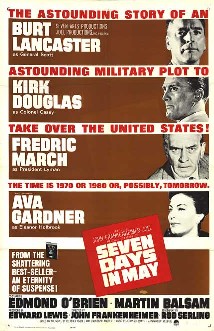
Seven Days in May
On Monday, May 12, 1970, during the Cold War, unpopular U.S. President Jordan Lyman has signed a nuclear disarmament treaty with the Soviet Union. This produces a wave of dissatisfaction among the opposition and the military, who believe the Soviets cannot be trusted. As the president's ratings plummet, violent protests erupt right outside the White House. The presidential physician warns him of a dangerous cardiac condition which he blithely disregards, too busy to take a prescribed two-week vacation. Meanwhile, Colonel Martin "Jiggs" Casey, the Director of the Joint Chiefs of Staff, learns that his superior, the highly decorated Air Force general James Mattoon Scott, is planning a coup d'etat with the Joint Chiefs. Disguised as a training exercise, the plan involves a secret army unit known as ECOMCON training at a secret Texas base, which will take control of the country's telephone, radio, and television networks and seize the president while he participates in a staged "alert". Scott, advancing his charismatic public persona through nationally televised anti-treaty rallies, will replace the president as head of a military junta. Although personally opposed to Lyman's policies, Casey is appalled by the plot and alerts Lyman. A skeptical Lyman gathers a circle of trusted advisors to investigate. Casey deduces the heads of all military branches but the Navy support Scott's coup, and Vice Admiral Barnswell, aboard an aircraft carrier in the Mediterranean, is apparently the only invited officer to decline. Lyman rescinds his commitment to participate in Scott's alert, pretending he will be away for a fishing weekend, then dispatches his Chief of Staff Paul Girard to Gibraltar to obtain Barnswell's confession. The alcoholic Senator Raymond Clark, Lyman's close friend of 21 years, goes to Texas to locate the secret base, and tasks Casey to gather dirt on the general's private life. The Secret Service surreptitiously films evidence of an attempt to kidnap the president during the phony fishing trip, removing all doubts about the existence of a plot. Girard successfully secures Barnswell's written confession, which is lost when he's killed in a plane crash in Spain. Clark is taken captive when he reaches the secret base and held incommunicado. Exploiting their longtime friendship, Clark convinces the base's deputy commander Colonel Henderson of the actual intent of the impending "alert". Henderson frees Clark and leads an escape back to Washington but is abducted and confined in a military stockade. In a radiophone conference call with the president, Barnswell denies knowledge of any conspiracy. Knowing he can't prove Scott's guilt, Lyman calls him to the White House to demand the conspirators resign. Scott refuses, denying the existence of a plot. Lyman argues that a coup would prompt the Soviets to launch a preemptive nuclear strike and Scott maintains the American people are behind him. Lyman challenges him to resign and run for office in order to seek power legitimately, but Scott is unmoved. Lyman restrains himself from confronting Scott with damning letters that Casey had obtained from Scott's former mistress Eleanor Holbrook. Casey, who has his own romantic interest in Holbrook, eventually returns them to her. Scott meets the other three Joint Chiefs, reasserts his intention to execute the coup, and plans a nighttime network broadcast, but Lyman plans an afternoon press conference to announce the firing of the four men. As the presser begins, Barnswell's confession, recovered from the plane crash, is handed to him and he pauses the proceeding to give time for copies of the confession to be delivered to Scott and the plotters. Scott, devastated, abandons the plan and returns home as Lyman announces the resignation of the other three conspirators on live air. Lyman delivers a speech on the state of the nation and its values, declaring that the nation gains strength through peace rather than by conflict. The press corps applauds.

The Remains of the Day
In 1958 postwar Britain, Stevens, the butler of Darlington Hall, receives a letter from the former housekeeper, Miss Kenton, now Mrs. Benn. Their past employer, the Earl of Darlington, has died a broken man, his reputation destroyed by his pre–Second World War support of Nazi Germany, and his stately country house has been sold to retired US Congressman Jack Lewis. Allowed to borrow the Daimler, Stevens sets off for the West Country to see Miss Kenton for the first time in decades. In the 1930s, Kenton arrives at Darlington Hall, where the ever-efficient but deeply repressed Stevens derives his entire identity from his profession. He butts heads with the warmer, strong-willed Kenton, particularly when he refuses to acknowledge that his father, now an under-butler, is no longer able to perform his duties. Displaying total professionalism, Stevens carries on as his father lies dying during Darlington's conference of like-minded fascist -sympathising British and European aristocrats. Also in attendance is U.S. Congressman Lewis, who admonishes the "gentleman politicians" as meddling amateurs, advising that "Europe has become the arena of Realpolitik " and warning of impending disaster. Exposed to Nazi racial laws, Darlington gets Stevens to dismiss two newly hired refugee German-Jewish maids. Kenton threatens to resign but has nowhere to go, and a regretful Darlington is later unable to rehire the maids. At another conference, Stevens is unable to answer an aristocratic guest's questions on global trade and politics, which the aristocrat claims demonstrates the lower classes' ignorance and inability to govern themselves. Relations thaw between Stevens and Kenton, and she clearly shows her feelings for him. But the outwardly detached Stevens remains dedicated solely to his role as butler. She catches him reading a romance novel, which he explains is to improve his vocabulary, asking her not to invade his privacy again. Lord Darlington's godson, journalist Reginald Cardinal, arrives on the day of a secret meeting at Darlington Hall between the British Prime Minister, Neville Chamberlain, and the German ambassador, Joachim von Ribbentrop. Appalled by his godfather's role in seeking appeasement for Nazi Germany, Cardinal tells Stevens that Darlington is being used by the Nazis, but Stevens feels it is not his place to judge his employer. Kenton forms a relationship with former co-worker Tom Benn and accepts his proposal of marriage. She informs Stevens as an ultimatum, but he will not admit his feelings and only offers his congratulations. Finding her crying, his only response is to call her attention to a neglected domestic task, and she leaves Darlington Hall before the start of the Second World War. En route to meeting Kenton in 1958, Stevens is mistaken for a gentleman at a pub. Doctor Carlisle, a local GP, helps him refuel the Daimler, deduces that he is actually a manservant, and asks his thoughts about Lord Darlington's actions. Initially denying having even met him, Stevens later admits to having served and respected him, noting that Darlington later confessed that his Nazi sympathies had been misguided and naive. Stevens tells Carlisle that, although Lord Darlington was unable to correct his error, he is attempting to correct his own. Stevens meets Kenton, who has separated from her husband and is staying at a boarding house on the coast. She and Stevens discuss how Lord Darlington died from a broken heart after suing a newspaper for libel, losing the suit and his reputation. Stevens mentions that Cardinal was killed in the war. Kenton declines to resume her position at Darlington Hall, wishing to remain near her pregnant daughter and, despite years of unhappiness, thinking about going back to her husband. Stevens supposes they may never meet again, and they part fondly but are both quietly upset, with Kenton visibly tearful as her bus pulls away. Stevens returns to Darlington Hall, where Lewis asks if he remembers what he had said at the conference in the 30s. Stevens replies that he was too busy serving to listen to the speeches. A pigeon flies into the fireplace from the chimney, and Lewis catches and sets it free. Stevens watches the bird as it flies away, leaving Darlington Hall far behind.

The Right Stuff
In 1947, over the Muroc Army Air Field in California, a number of test pilots are killed while flying high-speed aircraft such as the rocket-powered Bell X-1. After another pilot, Slick Goodlin, demands $150,000 (equivalent to $2,163,000 in 2025) to attempt to break the sound barrier, war hero Captain Chuck Yeager receives the chance to fly the X-1. Yeager becomes the first person to fly at supersonic speed, defeating the "demon in the sky." Six years later, Muroc, now Edwards Air Force Base, still attracts the best test pilots. Yeager (now a major) and friendly rival Scott Crossfield repeatedly break each other's speed records. They often visit the Happy Bottom Riding Club run by Pancho Barnes, who classifies the pilots at Edwards as either "prime" (such as Yeager and Crossfield) that fly the best equipment or newer "pudknockers" who only dream about it. Gordon "Gordo" Cooper, Virgil "Gus" Grissom and Donald "Deke" Slayton, captains of the United States Air Force, are among the "pudknockers" who hope to also prove that they have "the Right Stuff." The tests are no longer secret, as the military soon recognizes that it needs good publicity for funding. Cooper's wife, Trudy, and other wives are afraid of becoming widows but cannot change their husbands' ambitions and desire for success and fame. In 1957, the launch of the Soviet Sputnik satellite alarms the United States government. Politicians such as Senator Lyndon B. Johnson and military leaders demand that NASA help America defeat the Soviets in the new Space Race. The search for the first Americans in space excludes Yeager because he lacks a college degree. Grueling physical and mental tests select the Mercury Seven astronauts, including John Glenn of the United States Marine Corps, Alan Shepard, Walter Schirra and Scott Carpenter of the United States Navy, as well as Cooper, Grissom and Slayton; they immediately become national heroes. Although many early NASA rockets explode during launch, the ambitious astronauts all hope to be the first in space as part of Project Mercury. Although engineers see the men as passengers, the pilots insist for the Mercury spacecraft to have a window, a hatch with explosive bolts, and pitch-yaw-roll controls. However, the Soviet Union beats them into space on April 12, 1961, with the launch of Vostok 1 carrying Yuri Gagarin. The seven astronauts are determined to match and to surpass the Soviets. Shepard is the first American to reach space on the 15-minute sub-orbital flight of Mercury-Redstone 3 on May 5. After Grissom's similar flight of Mercury-Redstone 4 on July 21, the capsule's hatch blows open and quickly fills with water. Grissom escapes, but the spacecraft, overweight with seawater, sinks. Many criticize Grissom for possibly panicking and opening the hatch prematurely. Glenn becomes the first American to orbit the Earth on Mercury-Atlas 6 on February 20, 1962; he survives a possibly loose heat shield and receives a ticker-tape parade. He, his colleagues, and their families become celebrities, including a gigantic celebration in the Sam Houston Coliseum to announce the opening of the Manned Spacecraft Center in Houston, despite the fear of Glenn's wife, Annie, of public speaking because of a stutter. Although test pilots at Edwards mock the Mercury program for sending "spam in a can" into space, they recognize that they are no longer the fastest men on Earth, and Yeager states that "it takes a special kind of man to volunteer for a suicide mission, especially when it's on national TV." While testing the new Lockheed NF-104A, Yeager attempts to set a new altitude record at the edge of space but is nearly killed in a high-speed ejection when his engine fails. Though seriously burned after reaching the ground, Yeager gathers up his parachute and walks to the ambulance, which proves his worth. On May 15, 1963, Cooper has a successful launch on Mercury-Atlas 9, which ends the Mercury program. As the last American to fly into space alone, he "went higher, farther, and faster than any other American... for a brief moment, Gordo Cooper became the greatest pilot anyone had ever seen."