Genre: Drama (Page 11)
Browse 989 movies in the Drama genre.
All Genres
The Imitation Game
In 1951, mathematician Alan Turing is questioned by police after an apparent home break-in, and he obliquely refers to his work at Bletchley Park during World War II. In 1928, Turing, constantly bullied at boarding school, befriends Christopher Morcom, who sparks his interest in cryptography. Turing develops romantic feelings, but Christopher dies of bovine tuberculosis before he can confess. When Britain declares war on Germany in 1939, Turing is an established mathematician. He joins the cryptography team of Hugh Alexander, John Cairncross, Peter Hilton, Keith Furman, and Charles Richards in Bletchley Park, directed by Commander Alastair Denniston. Their main employment is analysis of the Enigma machine the Wehrmacht uses to send coded messages. Difficult to work with, and believing his colleagues to be inferior, Turing works alone to design a deciphering machine, which he names "Christopher". When Denniston refuses to fund the £100,000 construction cost, Turing contacts Prime Minister Winston Churchill who appoints him as team leader and provides the funds. Turing then fires Furman and Richards and places a difficult crossword in newspapers as a test to find replacements. Cambridge graduate Joan Clarke passes Turing's test but her family refuses her permission to work with the male cryptographers. Turing arranges for her to live and work with the women who intercept the messages, and shares his plans with her. Clarke helps Turing warm to the others, who begin to respect him. Turing's machine is constructed but cannot determine the Enigma encryption settings quickly enough, as the Germans reset them each day. Denniston orders it destroyed and Turing fired, and the other cryptographers threaten to leave. When Clarke plans to quit because of her parents, Turing proposes, which she accepts. During their engagement party, Turing confirms his homosexuality to Cairncross, who advises him to keep it a secret. Overhearing a clerk talking about messages received from the same German coder, Turing has an epiphany: he can program the machine to decode words he knows exist in certain messages. The theory is proven correct when the German coder consistently opens messages with a standard plaintext German script, which reveals enough of the daily Enigma code to permit decoding of that day's messages. The cryptographers celebrate this breakthrough. Discovering through decoded intercepts that a convoy is in danger of a German attack, Turing fears a sudden response will notify the Germans that Enigma is compromised and change it. The team concludes they cannot act on every decoded message, and they issue no warning about the attack on the convoy, even though Peter, whose brother is serving in the convoy, begs them. Turing creates a statistical model to select which intelligence to act on, to maximize effect on the enemy while minimizing the risk of German suspicion. Turing confronts Cairncross, who he has uncovered as a Soviet spy. Cairncross argues the Soviets are allies working for the same goals, and threatens to retaliate by disclosing Turing's sexuality. When MI6 agent Stewart Menzies appears to threaten Clarke, Turing shares his revelation about Cairncross. Menzies reveals in turn that he already knew, and is using Cairncross to leak misinformation to the Soviets for British benefit. Turing urges Clarke to leave Bletchley Park and admits his sexuality. She admits always being suspicious but insists they would have been happy together anyway. Fearing for her safety, Turing replies he never cared for her, and only used her for her cryptography skills. The heartbroken Clarke stays on, defying her parents and Turing. After the war, Menzies has the cryptographers destroy all traces of the project, as MI6 wants foreign governments to feel secure using their own code machines without fear of British interception. The team is instructed never to meet again or share what they have done. In 1952, Turing is convicted of gross indecency and undergoes chemical castration to be spared from prison so he can continue his work. Clarke visits him, witnesses his physical and mental deterioration, and tries to comfort him. The epilogue shows Turing committed suicide on June 7, 1954, after a year of government-mandated hormonal therapy. In 2013, Queen Elizabeth II granted him a posthumous Royal Pardon. Historians estimate that breaking Enigma shortened the war by over 2 years, saving over 14 million lives. Turing's work is now recognized as an essential step toward the development of modern computers.

Ship of Theseus
Aliya Kamal (Aida El-Kashef) is a visually impaired and celebrated Egyptian photographer in the process of undergoing a cornea transplant that will restore her vision. Though the surgery is a success and Aliya's vision is restored, she has trouble adjusting to her new found sense of sight and is dissatisfied with her resulting photography. Maitreya (Neeraj Kabi), an erudite Jain monk, is part of a petition to ban animal testing in India. When he is diagnosed with liver cirrhosis, his reluctance towards animal-tested medication is questioned and he must now depend on the people he's been fighting against – a path he refuses to take. A young Indian stockbroker, Navin (Sohum Shah), has just received a new kidney. He soon learns of a case of organ theft involving an impoverished bricklayer, Shankar. He initially fears that his new kidney was the one stolen from Shankar. When he learns that the recipient of the kidney lives in Sweden, he decides to go there to help Shankar get his kidney back – but is Shankar perhaps better helped by a large financial settlement instead of having two kidneys again? Ship of Theseus ends with the Platonic Allegory of the cave. The philosopher Plato argues that human beings are imprisoned in the cave of their own existence, falsely believing the temporary as having permanence. The job of a philosopher, he argues, is to help people find a way out of the cave. In the last scene of the film, we see the shadow of the man in the walls of the cave he is exploring. Those who received his organs (including Aliya, Maitreya and Navin) watch this short clip. The man who we see only as the shadow in this clip did not make it out of the allegorical prison-cave described by Plato.
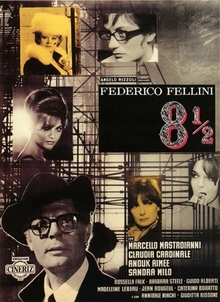
8½
Guido Anselmi, a famous Italian film director, is suffering from " director's block ". Stalled on his new science fiction film that includes thinly veiled autobiographical references, he has lost interest amidst artistic and marital difficulties. While attempting to recover from his anxieties at a luxurious spa, Guido hires a well-known critic to review his ideas for his film, but the critic blasts them. The film portrays Guido ambiguously floating in and out of surrealistic dreams and flashbacks to his childhood. Guido has recurring visions of an Ideal Woman, whom he sees as key to his story. His mistress Carla comes to visit him, but Guido puts her in a separate hotel. The film production crew relocates to Guido's hotel in an unsuccessful attempt to get him to work on the film. Guido admits to a cardinal that he is not happy. The cardinal offers little insight. Guido invites his estranged wife Luisa and her friends to join him. They dance, but Guido abandons her for his production crew. Guido confesses to his wife's best friend Rosella that he wanted to make a film that was pure and honest, but he is struggling with something honest to say. Carla surprises Guido, Luisa, and Rosella outside the hotel, and Guido claims that he and Carla ended their affair years earlier. Luisa and Rosella call him on the lie, and Guido slips into a fantasy world where he lords over a harem of women from his life, but a rejected showgirl starts a rebellion. The fantasy women attack Guido with harsh truths about him and his sex life. When Luisa sees how bitterly Guido represents her in the film, she declares that their marriage is over. Guido's Ideal Woman arrives in the form of an actress named Claudia. Guido explains that his film is about a burned-out man who finds salvation in this Ideal Woman. Claudia concludes that the protagonist is unsympathetic because he is incapable of love. Broken, Guido calls off the film, but the producer and the film's staff announce a press conference at which the filming will commence. Guido attempts to escape from the journalists and eventually imagines shooting himself in the head. Guido realizes he was attempting to solve his personal confusion by creating a film to help others, when instead he needs to accept his life for what it is. He asks Luisa for her assistance in doing so. Carla tells him that she figured out what he was trying to say: that Guido cannot do without the people in his life. As the production crew and cast begin to troop onto the set, Guido's passion revives and he begins to direct. The men and women of the cast and crew start holding hands and walk briskly around in a circle with Guido and Luisa joining them last. The production set is dismantled, Guido salutes the last of the crew members, and the set fades to black.
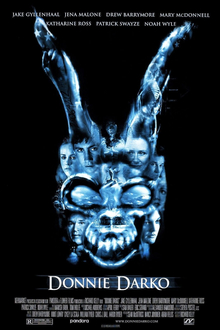
Donnie Darko
On October 2, 1988, troubled teenager Donald "Donnie" Darko sleepwalks outside, led by a mysterious voice. Once outside, he meets a figure named Frank in a monstrous rabbit costume. Frank tells Donnie that the world will end in 28 days, 6 hours, 42 minutes, and 12 seconds. Donnie wakes up the next morning on a local golf course and returns home to discover a jet engine has crashed into his bedroom. His older sister Elizabeth tells him the FAA investigators do not know its origin. Over the next several days, Donnie continues to have visions of Frank, and his parents, Eddie and Rose, send him to psychotherapist Dr. Thurman. Thurman believes Donnie is detached from reality and that his visions of Frank are " daylight hallucinations," symptomatic of paranoid schizophrenia. Frank asks Donnie if he believes in time travel, and Donnie in turn asks his science teacher, Dr. Kenneth Monnitoff. Monnitoff gives Donnie The Philosophy of Time Travel, a book written by Roberta Sparrow, a former science teacher at the school who is now a seemingly senile old woman living outside of town, known to the local teenagers as Grandma Death. Frank begins to influence Donnie's actions through his sleepwalking episodes, including causing him to flood his high school by breaking a water main, an act for which Donnie almost gets caught. Donnie later starts dating Gretchen Ross, who has recently moved into town with her mother under a new identity to escape her violent stepfather. Gym teacher Kitty Farmer begins teaching "attitude lessons" taken from local motivational speaker Jim Cunningham, but Donnie rebels against these, leading to friction between Kitty and Rose. Kitty arranges for Cunningham to speak at a school assembly, where Donnie insults him. He later finds Cunningham's wallet and address. Gretchen and Donnie go on a movie theater date, where Gretchen falls asleep and Frank reveals himself to be a teenager with his right eye hollow and bleeding. Frank then convinces Donnie to burn down Cunningham's house, which he does while Gretchen is at the theatre. Firefighters discover a hoard of child pornography at the burned remains. Cunningham is arrested, and Kitty, who wishes to testify in his defense, asks Rose to replace her as chaperone for their daughters' dance troupe on its trip to Los Angeles. With Rose in Los Angeles and Eddie away for business, Donnie and Elizabeth hold a Halloween costume party to celebrate Elizabeth's acceptance to Harvard. At the party, Gretchen arrives distraught as her mother has gone missing, and she and Donnie have sex for the first time. When Donnie realizes that Frank's prophesied end of the world is only hours away, he takes Gretchen and two other friends to see Sparrow. Instead of Sparrow, they find two high school bullies, Seth and Ricky, who are trying to rob Sparrow's home. Donnie, Seth, and Ricky fight in the road in front of her house just as Sparrow returns home. The bullies and Donnie's two friends leave when an oncoming car runs over Gretchen, killing her. The driver turns out to be Elizabeth's boyfriend, Frank Anderson, wearing the same rabbit costume from Donnie's visions. Angered, and realizing what is happening, Donnie shoots Frank in the right eye with his father's gun and walks home carrying Gretchen's body. Donnie returns home in the morning as a vortex forms over his house. He borrows one of his parents' cars, loads Gretchen's body into it, and drives to a nearby ridge that overlooks the town. There, he watches as the plane carrying Rose and the dance troupe home from Los Angeles gets caught in the vortex's wake, violently ripping off one of its engines and sending it back in time. Events of the previous 28 days unwind. Donnie wakes up in his bedroom, recognizes the date is October 2, and laughs as the jet engine falls into his bedroom, killing him. Around town, those whose lives Donnie would have touched wake up from troubled dreams. Gretchen rides by the Darko home the following day and learns of Donnie's death from his neighbor. Gretchen sees Rose, and the two wave at each other in a moment of déjà vu.
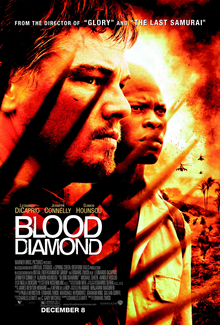
Blood Diamond
In 1999, Sierra Leone is ravaged by civil war. The Revolutionary United Front terrorizes the countryside and enslaves many locals to harvest diamonds, which fund their increasingly successful war effort. Solomon Vandy, a Mende fisherman from Shenge, is separated from his family and assigned to a workforce overseen by Captain Poison, a ruthless warlord. While mining a river, Vandy discovers an enormous pink diamond. Captain Poison tries to take the stone, but the area is suddenly raided by government troops. Vandy buries the stone before being captured. Vandy and Poison are incarcerated in Freetown with Danny Archer, a white Rhodesian gunrunner and Angola War veteran jailed for trying to smuggle diamonds into Liberia. The diamonds were intended for Rudolph van de Kaap, a corrupt Afrikaner mining executive from South Africa. Hearing of the pink diamond in prison, Archer arranges for him and Vandy to be freed. He travels to Cape Town to meet his employer: Colonel Coetzee, an Afrikaner formerly with the apartheid -era South African Defence Force (whom Archer also served under in the 32 Battalion), which now commands a private military company. Archer wants the diamond so he can sell it to Van de Kaap and retire, but Coetzee wants it as compensation for Archer's botched smuggling mission. Archer returns to Sierra Leone, locates Vandy, and offers to help him find his family if he will help recover the diamond. The RUF conquers Freetown, while Vandy's son Dia is captured to serve as a child soldier under a liberated Captain Poison. Archer and Vandy narrowly escape to Lungi, where they plan to reach Kono with the help of an American journalist, Maddy Bowen, in exchange for Archer providing evidence of the illicit diamond trade. Maddy helps Vandy locate his remaining family at a refugee camp in Guinea. While they travel, Archer reveals to Maddy that his parents were brutally killed by Black rebels after the fall of Rhodesia (now Zimbabwe). As a child, he fled to South Africa, where he eventually joined the military and served in Angola. Eventually, the trio arrive in Kono after a harrowing journey, where Coetzee and his private army—contracted by the Sierra Leone government—prepares to repulse the rebel offensive. While Maddy gets out with her story, the two men set out for Captain Poison's encampment. Dia, stationed with the RUF garrison there, is confronted by Vandy, but having been brainwashed he refuses to acknowledge his father. Archer radios the site's coordinates to Coetzee, who directs a combined air and ground assault on the camp. Vandy finds Captain Poison and beats him to death with a shovel as the mercenaries overwhelm the RUF defenders. Coetzee then forces Vandy to produce the diamond, but is killed by Archer, who realizes Coetzee would eventually kill them both. Dia briefly holds the pair at gunpoint, but Vandy confronts him again and renews their familial bond. Pursued by vengeful mercenaries, Archer discloses he has been mortally wounded and entrusts the stone to Vandy, telling him to take it for his family. Vandy and his son rendezvous with Archer's pilot, who flies them to safety while Archer makes a final phone call to Maddy; they share final farewells as he asks her to assist Vandy, and gives her permission to finish her article. Archer finally takes in the beautiful African landscape before dying. Vandy arrives in London and meets with a van de Kaap representative; he exchanges the pink diamond for a large sum of money and being reunited with his entire family. Maddy takes photographs of the deal to publish in her article on the diamond trade, exposing van de Kaap's criminal actions. Vandy appears as a guest speaker at a conference on " blood diamonds " in Kimberley, and is met with a standing ovation.

The Diving Bell and the Butterfly
The first third of the film is told from the main character's, Jean-Dominique Bauby, or Jean-Do as his friends call him, first person perspective. The film opens as Bauby wakes from his three-week coma in a hospital in Berck-sur-Mer, France. After an initial falsely positive description from one doctor, a neurologist explains that Bauby has locked-in syndrome, an extremely rare condition in which the patient is almost completely physically paralyzed, but remains mentally unchanged. At first, the viewer primarily hears Bauby's "thoughts" (he thinks that he is speaking but no one hears him), which are inaccessible to the other characters (who are seen through his one functioning eye). A speech therapist and physical therapist try to help Bauby become as functional as possible. Bauby cannot speak, but he develops a system of communication involving blinking his left eye as his therapist reads a list of letters; with this process, Bauby spells out messages one letter at a time. Gradually, the film's restricted point of view widens, and the viewer begins to see Bauby through scenes from his past as well as via the perspectives of those around him. The film shows a visit to Lourdes and conveys Bauby's fantasies about beaches, mountains, the Empress Eugénie and an erotic feast with one of his transcriptionists. We learn that Bauby had been editor of the popular French fashion magazine Elle, and that he had a deal to write a book reimagining The Count of Monte Cristo from a female perspective. He decides that he will still write a book, using his slow and exhausting communication technique. A woman from the publishing house with which Bauby had the original book contract takes dictation. The new book describes his current life, trapped in his body, which he sees as being suspended in murky water within an old-fashioned deep-sea diving bell with brass helmet, which is called a scaphandre in French. But those around him describe his still-vibrant spirit as a butterfly. The story of Bauby's writing is juxtaposed with his recollections and regrets prior to his stroke. We see his three children, their mother, his mistress, his friends, and his father. He encounters people from his past whose lives bear similarities to his own "entrapment": a friend who was kidnapped in Beirut and held in solitary confinement for four years, and his own 92-year-old father, who is confined to his own apartment, because he is too frail to descend four flights of stairs. Bauby eventually completes his memoir and hears the critics' responses. He dies of pneumonia ten days after its publication. The closing credits are accentuated by reversed shootings of breaking glacier ice (the forward versions are used in the opening credits), accompanied by the Joe Strummer & the Mescaleros song "Ramshackle Day Parade".

Magnolia
Los Angeles police officer Jim Kurring investigates a disturbance at a woman's apartment, finding a body in a closet. Dixon, a neighborhood boy, unsuccessfully tries to tell him who committed the murder. Jim goes to the apartment of Claudia Wilson, whose neighbors called the police after she argued with her estranged father, Jimmy Gator, and blasted music while snorting cocaine. Seemingly oblivious, Jim asks her on a date. Jimmy hosts a quiz show called What Do Kids Know?, where children and adults compete against each other, and is dying of cancer. The newest child prodigy on the show, Stanley Spector, is hounded by his father Rick for the prize money and demeaned by the adults, who prevent him from using the bathroom during a commercial break. When the show resumes, Stanley wets himself. As the show continues, a drunken Jimmy sickens, ordering the show to go on after he collapses. After Rick berates him, Stanley runs away. Former What Do Kids Know? champion Donnie Smith, whose parents took all his prize money, has been fired from his job and is in love with a male bartender with braces. Donnie wants to get braces himself, thinking the bartender will love him back. He hatches a plan to steal the money from his former boss for the surgery. The show's former producer, Earl Partridge, is also dying of cancer, only faster than Jimmy. Earl's trophy wife, Linda, collects his prescriptions while he is cared for by a nurse, Phil Parma. Earl asks Phil to find his estranged son, Frank Mackey, a coarse but charismatic motivational speaker and pickup artist. Frank is interviewed by a journalist who knows Frank took care of his dying mother after Earl left. Frank storms out of the interview, after which Phil tries to contact him. Linda goes to see Earl's lawyer, hoping to change his will. She married Earl for his money, but now genuinely loves him and does not want it. The lawyer suggests she renounce the will and decline the money, which would go to Frank. Linda rejects his advice and berates Phil for seeking out Frank, but later apologizes. She drives to a vacant parking lot and attempts suicide by drug overdose. Dixon finds Linda near death in the car, takes the money from her purse, and calls an ambulance. Jim loses his gun while trying to catch a suspect. When he meets Claudia, they promise to be honest with each other, so he confesses his ineptitude as a cop and admits he has not been on a date since he divorced three years earlier. Claudia says he will hate her because of her problems, but Jim assures her that her past does not matter. They kiss, but she leaves him. Jimmy goes home to his wife, Rose, and confesses that he cheated on her. She asks why Claudia does not talk to him, and Jimmy admits that Claudia believes he molested her. Rose demands to know if it is true, but Jimmy says he cannot remember. Disgusted, Rose leaves him and he too decides to commit suicide. Elsewhere, Donnie steals the money, but when he decides to return it due to his conscience, he cannot get back inside the office. While Donnie climbs a utility pole to the roof to try to return the money, Jim sees him and feels compelled to investigate. Suddenly, frogs begin falling from the sky. One of them hits Donnie, he falls from the pole, smashes his teeth and is pulled to safety by Jim. Linda's ambulance crashes near the hospital. As Jimmy is about to shoot himself, frogs fall through his skylight, causing him to shoot the television and cause a house fire. Rose crashes her car near Claudia's apartment but makes it inside and reconciles with her daughter. Earl is awakened and sees Frank beside him before dying. The next day, Jim's lost gun falls from the sky, after which he helps Donnie return the money. Frank goes to the hospital to be with Linda, who will recover. Stanley tells Rick that he needs to be nicer to him, but Rick just tells him to go to bed. Jim goes to see Claudia, telling her he wants to make things work between them. As Jim is explaining this, Claudia glances into the camera and smiles.

The Return
In contemporary Russia, Ivan and his older brother Andrei have grown a deep attachment to each other to make up for their fatherless childhood. Both their mother and grandmother live with them. After running home after a fight with each other, the boys are shocked to discover their father has returned after a 12-year absence. With their mother's uneasy blessing, Ivan and Andrei set out on what they believe will be a simple fishing vacation with him. Andrei is delighted to be reunited with their father and Ivan is apprehensive towards the man whom they know only from a faded photograph. At first, both brothers are pleased with the prospect of an exciting adventure, but they soon strain under the weight of their father's awkward and increasingly brutal efforts to make up for the missing decade. Ivan and Andrei find themselves alternately tested, rescued, scolded, mentored, scrutinized, and ignored by the man. Andrei seems to look up to his father while Ivan remains stubbornly defensive. As the truck stops and cafés give way to rain-swept, primeval wilderness coastline, Ivan's doubts give way to open defiance. Andrei's powerful need to bond with a father he's never known begins, in turn, to distance him from Ivan. For his part, Ivan resents his father's test of will. Eventually, the tension between them escalates into bitter hostility after the trio arrives at their mysterious island destination. At first, the three of them are busy settling in. The father wants to show the island to the two boys. Ivan and Andrei are keen to collect worms (as bait) in order to go fishing. Meanwhile, without telling the two boys, their father heads inland to an old, derelict house. Between the collapsed walls of the house, with a shovel, the father starts digging a deep pit. At the bottom of the pit, there is a large trunk. The father opens it. He takes out what looks like a strongbox, which appears to be heavy. Without opening the mysterious box and without checking its content, the father returns to the shoreline with it. Out of sight of the two boys, he places the strongbox inside a compartment under one of the wooden seats, on the small boat that brought them to the deserted island. The two boys re-appear and are ready to go fishing. Their father lends his wristwatch to Andrei and lets them go away from the shore, in the boat, to enjoy some fishing. But the two boys return much later than had been agreed and their father gets angry. He focuses his anger on Andrei, the elder, as he was notionally in charge of the fishing party. Ivan has an outburst of rage after witnessing his father strike Andrei. He shouts at his father, runs into the forest, and climbs to the top of the observatory tower. Andrei and their father run after him. The father tries to reason with Ivan, but this only stresses Ivan further. He then threatens to jump down from the top of the tower. The father tries to reach out to him, but falls to his death. Ivan and Andrei take the body across the forest, bring him on board the boat, and row back to where they came. While the boys are putting their gear in the car, the boat starts to drift away. Andrei screams, "Father!" and starts running towards the shore, followed by Ivan, but it is too late. The boat and the body are sinking. Unbeknown to the two boys, inside the boat is the strongbox. Ivan screams "Father!" for the last time from the bottom of his heart. The boat sinks to the bottom of the lake, with the father's corpse and the strongbox in it. The two boys get into the car and drive away. The film ends with photographs from their journey; since the father does not appear on any of them, there is no proof that Andrei and Ivan went on a trip with him.

The Hustler
"Fast Eddie" Felson is accompanied by his partner, Charlie, at a pool room in a small town. Pretending to be salesmen on their way to a convention, Eddie and Charlie convince onlookers that Eddie is a drunk blowhard, and induce them to bet on Eddie to lose a trick shot. He wins and takes their money. Eddie and Charlie arrive in New York City, where Eddie challenges the legendary player Minnesota Fats to play straight pool for $200 a game at Ames Billiards in Manhattan. After initially falling behind, Eddie surges back to being $1,000 ahead and suggests raising the bet to $1,000 a game. Eddie gets ahead $11,000 and Charlie tries to convince him to quit, but Eddie insists the game will end only when Fats says it is over. Fats agrees to continue after a spectator, the professional gambler Bert Gordon, labels Eddie a "loser". After 25 hours and an entire bottle of bourbon, Eddie is ahead over $18,000, but loses it all along with all but $200 of his original stake. Fats declares the game over. At their hotel later, Eddie leaves a sleeping Charlie without saying goodbye. Eddie stashes his belongings in a locker at a bus terminal, where he meets Sarah Packard, an alcoholic. They begin a relationship and he moves in with her. Charlie finds Eddie at Sarah's apartment and tries to persuade him to go back out on the road. Eddie refuses and Charlie realizes he plans to challenge Fats again. Eddie learns that Charlie had money he could have used to rebound and beat Fats. Eddie dismisses Charlie as a scared old man and tells him to "lay down and die by yourself". Eddie joins a poker game where Bert is playing. Afterward, Bert tells Eddie that he has talent as a pool player but no character. He figures that Eddie will need at least $3,000 to challenge Fats again. Bert calls him a "born loser" but nevertheless offers to stake him in return for 75% of his winnings; Eddie refuses. Eddie goes back to hustling to get the money he needs to play Fats. After hustling a local player at a pool room near the waterfront, Eddie is attacked after winning and his thumbs are broken. After Sarah helps Eddie convalesce, and when he's ready to play, he agrees to Bert's terms, deciding that a "25% slice of something big is better than a 100% slice of nothing". Bert, Eddie and Sarah travel to the Kentucky Derby, where Bert arranges a match for Eddie against a wealthy local socialite named Findley. The game turns out to be three-cushion billiards, not pool. When Eddie loses badly, Bert refuses to keep staking him. Sarah pleads with Eddie to leave with her, saying that the world he is living in and its inhabitants are "perverted, twisted, and crippled"; he refuses. Seeing Eddie's anger, Bert agrees to let the match continue at $1,000 a game. Eddie comes back to win $12,000. He collects his $3,000 share and decides to walk back to the hotel where he discovers that Sarah has committed suicide, because of Bert's sadism. Eddie returns to challenge Fats again, putting up his entire $3,000 stake on a single game. He wins game after game, beating Fats so badly that Fats is forced to quit. Bert demands half of Eddie's winnings and threatens to have him beaten unless he pays. Eddie says he will come back to kill Bert if he survives, shaming Bert into giving up his claim by invoking Sarah's memory. Instead, Bert orders Eddie never to walk into a big-time pool hall again. Eddie and Fats compliment each other as players, and Eddie walks out.

Mishima: A Life in Four Chapters
The film begins on November 25, 1970, the last day of Mishima's life. He finishes a manuscript and then puts on a uniform he designed for himself and meets with four of his most loyal followers from his private army, the Tatenokai. In flashbacks highlighting episodes from his past life, the viewer sees Mishima's progression from a sickly young boy to one of Japan's most acclaimed writers of the post-war era. In adulthood, Mishima trains himself into the acme of muscular discipline, owing to a morbid and militaristic obsession with masculinity and physical culture. His loathing for the materialism of modern Japan has him turn towards an extremist traditionalism. He establishes the Tatenokai and advocates for reinstating the emperor as head of government. The biographical sections are interwoven with short dramatizations of three of Mishima's novels: In The Temple of the Golden Pavilion, a stuttering aspirant sets fire to the famous Zen Buddhist temple because he feels inferior at the sight of its beauty. Kyoko's House depicts the ultimately fatal sadomasochistic relationship between a middle-aged woman and her young lover, who is in her financial debt. In Runaway Horses, a group of young fanatic nationalists plots to overthrow the government and zaibatsu, with its leader subsequently committing suicide. Dramatizations, frame story, and flashbacks are segmented into the four chapters of the film's title, named Beauty, Art, Action, and Harmony of Pen and Sword. The film culminates in Mishima and his followers taking hostage a General of the Japan Self-Defense Forces. He addresses the garrison's soldiers, asking them to join him in his struggle to reinstate the Emperor as the nation's sovereign. His speech is largely ignored and ridiculed. Mishima then returns to the General's office and commits seppuku.

Perfect Days
Hirayama works as a public toilet cleaner for The Tokyo Toilet project in Tokyo 's upscale Shibuya district, across town from his modest home in a middle-class neighbourhood east of the Sumida River. He repeats his structured, repetitive routine each day, starting at dawn. His pride in his work is apparent by its thoroughness and precision. He dedicates his free time to his passion for music cassettes, which he listens to in his van to and from work, and to his books (Faulkner, Kōda, Highsmith), which he reads every night before going to sleep. His dreams are shown in flickery impressionistic black-and-white sequences at the end of every day. Hirayama is also fond of trees and spends time gardening and photographing trees. He eats a sandwich every day in the shade under trees in the grounds of a shrine, and takes film photos of their branches and leaves and the 'Komorebi' (木漏れ日) – sunlight filtered by the leaves. Hirayama's love of trees is contrasted with the repeated appearance of the Tokyo Skytree during his drives and bike rides through the city. Hirayama's young assistant, Takashi, is often late, loud, and not as thorough. One day, a young woman named Aya calls on Takashi at the toilet he is cleaning, so he hurries to finish. He tries to leave with Aya, but his motorbike will not start, so he persuades Hirayama to let him use his van. When Aya says Takashi can stay with her as she works at a girls bar, he complains that he is broke. Unbeknownst to Hirayama, Takashi slips Hirayama's Patti Smith tape into Aya's purse. Takashi talks Hirayama into going into a shop to get some of his cassettes appraised. When Takashi discovers they are valuable, he urges Hirayama to sell but Hirayama refuses, giving him some cash so he can take Aya out. When Hirayama runs out of fuel, he is forced to sell a cassette for fuel money. Hirayama commences a tic-tac-toe game with a stranger after finding a piece of paper left hidden in a stall. The game continues over the course of the film. He exchanges furtive glances with a woman eating lunch one bench over. Aya catches up with Hirayama to return his cassette. She asks to play it in his van one last time, and then gives him a thank-you kiss on the cheek, leaving him visibly startled. On his free day, Hirayama does his laundry, takes the film with his tree photos to be developed, cleans his flat, buys a new book, and dines at a restaurant where the proprietor shares gossip with him. Niko, Hirayama's niece, shows up unannounced, having run away from his wealthy estranged sister Keiko's home. Hirayama lets Niko accompany him to work during the next two days. They photograph the trees in the park and ride bikes together. Eventually, Keiko comes to pick up Niko in a chauffeured car. Keiko tells him that their father's dementia has worsened and asks whether Hirayama will visit him in the nursing home where he lives. She says that he does not recognise anything anymore and will not behave the way he did before. Hirayama sorrowfully refuses but hugs his sister goodbye. Before she leaves, she asks him whether he really cleans toilets for a living, and he says yes. As they drive away, Hirayama begins to cry inconsolably. The next day, Takashi quits without giving notice, leaving Hirayama to cover his shift. Later, as Hirayama goes to his usual restaurant, he sees the female proprietor embracing a man. Hirayama hurries off, buying cigarettes and three bottled highballs to consume at a nearby riverbank. The man Hirayama saw at the restaurant approaches and asks him for a cigarette. The man tells him the restaurant proprietor is his ex-wife whom he had not seen in seven years, and that she opened her restaurant the year after divorcing him. He says he visited her to make peace before he dies of cancer, telling Hirayama to look after her. Hirayama lightens the mood by offering him a drink and inviting him to play shadow tag, and they eventually part ways. The following morning, Hirayama begins another workweek. As he drives his van and listens to Nina Simone sing " Feeling Good ", a range of powerful emotions wash over his face.
