Genre: Biography (Page 5)
Browse 242 movies in the Biography genre.
All Genres
The Right Stuff
In 1947, over the Muroc Army Air Field in California, a number of test pilots are killed while flying high-speed aircraft such as the rocket-powered Bell X-1. After another pilot, Slick Goodlin, demands $150,000 (equivalent to $2,163,000 in 2025) to attempt to break the sound barrier, war hero Captain Chuck Yeager receives the chance to fly the X-1. Yeager becomes the first person to fly at supersonic speed, defeating the "demon in the sky." Six years later, Muroc, now Edwards Air Force Base, still attracts the best test pilots. Yeager (now a major) and friendly rival Scott Crossfield repeatedly break each other's speed records. They often visit the Happy Bottom Riding Club run by Pancho Barnes, who classifies the pilots at Edwards as either "prime" (such as Yeager and Crossfield) that fly the best equipment or newer "pudknockers" who only dream about it. Gordon "Gordo" Cooper, Virgil "Gus" Grissom and Donald "Deke" Slayton, captains of the United States Air Force, are among the "pudknockers" who hope to also prove that they have "the Right Stuff." The tests are no longer secret, as the military soon recognizes that it needs good publicity for funding. Cooper's wife, Trudy, and other wives are afraid of becoming widows but cannot change their husbands' ambitions and desire for success and fame. In 1957, the launch of the Soviet Sputnik satellite alarms the United States government. Politicians such as Senator Lyndon B. Johnson and military leaders demand that NASA help America defeat the Soviets in the new Space Race. The search for the first Americans in space excludes Yeager because he lacks a college degree. Grueling physical and mental tests select the Mercury Seven astronauts, including John Glenn of the United States Marine Corps, Alan Shepard, Walter Schirra and Scott Carpenter of the United States Navy, as well as Cooper, Grissom and Slayton; they immediately become national heroes. Although many early NASA rockets explode during launch, the ambitious astronauts all hope to be the first in space as part of Project Mercury. Although engineers see the men as passengers, the pilots insist for the Mercury spacecraft to have a window, a hatch with explosive bolts, and pitch-yaw-roll controls. However, the Soviet Union beats them into space on April 12, 1961, with the launch of Vostok 1 carrying Yuri Gagarin. The seven astronauts are determined to match and to surpass the Soviets. Shepard is the first American to reach space on the 15-minute sub-orbital flight of Mercury-Redstone 3 on May 5. After Grissom's similar flight of Mercury-Redstone 4 on July 21, the capsule's hatch blows open and quickly fills with water. Grissom escapes, but the spacecraft, overweight with seawater, sinks. Many criticize Grissom for possibly panicking and opening the hatch prematurely. Glenn becomes the first American to orbit the Earth on Mercury-Atlas 6 on February 20, 1962; he survives a possibly loose heat shield and receives a ticker-tape parade. He, his colleagues, and their families become celebrities, including a gigantic celebration in the Sam Houston Coliseum to announce the opening of the Manned Spacecraft Center in Houston, despite the fear of Glenn's wife, Annie, of public speaking because of a stutter. Although test pilots at Edwards mock the Mercury program for sending "spam in a can" into space, they recognize that they are no longer the fastest men on Earth, and Yeager states that "it takes a special kind of man to volunteer for a suicide mission, especially when it's on national TV." While testing the new Lockheed NF-104A, Yeager attempts to set a new altitude record at the edge of space but is nearly killed in a high-speed ejection when his engine fails. Though seriously burned after reaching the ground, Yeager gathers up his parachute and walks to the ambulance, which proves his worth. On May 15, 1963, Cooper has a successful launch on Mercury-Atlas 9, which ends the Mercury program. As the last American to fly into space alone, he "went higher, farther, and faster than any other American... for a brief moment, Gordo Cooper became the greatest pilot anyone had ever seen."

Glory
During the American Civil War, Captain Robert Gould Shaw is injured at the Battle of Antietam and returns home to Boston on medical leave. Shaw accepts promotion to Colonel commanding the 54th Regiment Massachusetts Volunteer Infantry, one of the first black regiments in the Union Army. He asks his friend, Cabot Forbes, to serve as his second in command. Their first volunteer is a mutual friend, Thomas Searles, a bookish, free African-American. Other recruits include John Rawlins, Jupiter Sharts, Trip, and a mute boy drummer. After the Emancipation Proclamation, the men of the 54th are told the Confederacy will execute any black soldiers captured in Union uniform along with their white officers. Despite this threat, the 54th's recruits turn down an offer to be honorably discharged and undergo rigorous training under Sergeant-Major Mulcahy. Trip is arrested while AWOL. After having him flogged, Shaw learns Trip left camp to replace his worn out shoes. Shaw confronts the base's racist quartermaster, who is holding back their supplies. When the men realize the Federal government pays black soldiers about three-quarters the salary of white soldiers, Trip encourages the men to refuse their pay. Shaw tears up his pay stub in solidarity. In recognition of his mentorship of the younger soldiers, and his advice to Shaw regarding the thoughts and morale of the men, Rawlins is promoted to Sergeant-Major. Once trained, the 54th comes under the command of General Charles Harker and is ordered by Colonel James Montgomery to sack and burn Darien, Georgia. Shaw initially refuses, but agrees under threat of being relieved. Tired of seeing his men used for manual labor and raids on civilians he advises Harker and Montgomery he will report their profiteering to the war department unless the 54th is given a combat assignment. The regiment goes into battle at James Island, South Carolina and repels a Confederate attack. Thomas is wounded in the action but saves Trip's life. Shaw offers Trip the honor of bearing the regimental flag in battle. He declines, not believing the war will result in a better life for slaves. General George Crockett Strong informs his regimental commanders of a major campaign to secure a foothold at Charleston Harbor, and describes the initial attack at Morris Island which requires a frontal assault on Fort Wagner, whose only landward approach is a strip of open beach. Shaw volunteers the 54th. The night before the battle, the black soldiers conduct a religious service, give thanks and seek God's help. The next morning the 54th deploys for the assault to the cheers of white Union troops who had scorned them earlier. The 54th suffers heavy losses in a daytime assault, and takes cover in the dunes until sundown. Attempting to rally his stalled men, Shaw is killed. Trip lifts the flag, and leads survivors toward the fort, brandishing the flag until he is mortally wounded. Forbes leads a party into the fort's outer defenses where Charlie Morse is killed, and Thomas is wounded. A small number of survivors, including Forbes, Rawlins, Thomas, and Jupiter, come face to face with a Confederate gun and the screen fades to black, implying their deaths. After sun up the next day, Confederate soldiers remove the bodies of Union soldiers from the beach, raise the Confederate flag over the fort, and bury the corpses in a mass grave. Shaw's body slides into the excavation and comes to rest next to Trip's. An epilogue reveals that although Fort Wagner was never captured, the courage displayed by the 54th led to the Union Army accepting thousands of Black men for combat. President Abraham Lincoln credited the move with helping to turn the tide of the war.

The Insider
CBS producer Lowell Bergman convinces the founder of Hezbollah, Sheikh Fadlallah, to grant an interview to Mike Wallace for 60 Minutes. Wallace and Bergman firmly stand their ground against the Sheikh's armed and hostile bodyguards, who attempt to intimidate and disrupt their interview preparations. Later, Bergman approaches Jeffrey Wigand—a former executive at the Brown & Williamson tobacco company—for help explaining technical documents. Wigand agrees but intrigues Bergman when he insists that he will not discuss anything else, citing a confidentiality agreement. Brown & Williamson coerces Wigand into a more restrictive agreement, leading Wigand to accuse Bergman of betraying him. Bergman subsequently visits Wigand to defend himself and investigate the potential story. Although Wigand apparently possesses very damaging information, he hesitates to reveal anything, fearing that it will jeopardize his severance package from Brown & Williamson. Wigand's family moves into a more modest house, and Wigand begins working as a teacher. One night, Wigand finds evidence of trespass and receives a sinister phone call. Meanwhile, Bergman contacts Richard Scruggs, an attorney representing Mississippi in a lawsuit against the tobacco industry. Bergman suggests that if they depose Wigand, making his information public, it can give CBS cover to broadcast the information; Scruggs expresses interest. Wigand receives an emailed death threat and finds a bullet in his mailbox. He contacts the FBI, but the agents who visit him are hostile and confiscate his computer. Furious, Wigand demands that Bergman arrange an interview, during which Wigand states that he was fired after objecting to Brown & Williamson intentionally making their cigarettes more addictive. Bergman arranges a security detail for Wigand's home, and the Wigands experience marital stress. Wigand testifies in Mississippi, despite attempts of intimidation and legal suppression by Brown & Williamson attorneys. After returning home, he discovers that his wife Liane has left him and taken their daughters. Eric Kluster, the president of CBS News, decides not to broadcast Wigand's interview after CBS legal counsel Helen Caperelli warns that the network is at risk of legal action from Brown & Williamson. Bergman confronts Kluster, accusing him of sacrificing journalistic integrity to protect the impending sale of CBS to Westinghouse, which would enrich both Kluster and Caperelli. Wallace and their executive producer Don Hewitt both side with Kluster. Wigand, learning of this, is appalled and terminates contact with Bergman. Investigators probe Wigand's personal history and publish their findings in a 500-page dossier. Bergman learns that The Wall Street Journal intends to use it in a piece questioning Wigand's credibility. He convinces the Journal 's editor to delay publication and assign journalists to investigate the dossier, claiming that it falsely quotes its sources. After infighting at CBS over the Wigand segment, Bergman is ordered to take a "vacation" as the abridged 60 Minutes segment airs. Bergman contacts Wigand, who is both dejected and furious, accusing Bergman of manipulating him. Bergman defends himself and praises Wigand and his testimony. Scruggs urges Bergman to air the full segment to draw public support for their lawsuit, which is under threat from a lawsuit by Mississippi's governor. Bergman, frozen out, is unable to assist and privately questions his own motives pursuing the story. Bergman contacts an editor at The New York Times, disclosing the full story and events at CBS. The Times prints the story on the front page and condemns CBS in a scathing editorial. The Journal dismisses the dossier as character assassination and prints Wigand's deposition. Hewitt accuses Bergman of betraying CBS, but finds that Wallace now agrees that bowing to corporate pressure was a mistake. 60 Minutes finally airs the original segment, including the full interview with Wigand. Bergman tells Wallace that he has resigned, believing that 60 Minutes 's credibility and integrity are now permanently tarnished.

Aguirre, the Wrath of God
On Christmas Day, 1560, several scores of Spanish conquistadors under Gonzalo Pizarro and two hundred native slaves march down from the newly conquered Inca Empire into the Amazon rainforest in search of the fabled El Dorado. The men, clad in half armor, pull cannons down narrow mountain paths and through dense, muddy jungle. On New Year's Eve, Pizarro orders a group of forty men to build rafts and scout down the river. If they do not return to the main party within one week with news of what lies beyond, they will be considered lost. Pizarro chooses Don Pedro de Ursúa as the commander of the expedition, Don Lope de Aguirre as his second-in-command, portly nobleman Don Fernando de Guzmán to represent the Spanish crown, and Brother Gaspar de Carvajal to bring the word of God. Accompanying the expedition, against Pizarro's better judgment, are Ursúa's mistress, Doña Inés, and Aguirre's teenage daughter Flores. One of the four rafts gets caught in an eddy while traveling through river rapids, and the others are unable to help free it. That night, gunfire erupts on the trapped raft; in the morning, the men on board are found slain by arrows from Indigenous tribesmen, with three missing. Ursúa wants the bodies to be brought back to camp for burial. Knowing this would slow down the expedition, Aguirre suggests to a soldier, Perucho, that the cannon is rusty and needs firing. Perucho aims at the raft, destroying it and abandoning the bodies in the river. During the night, the remaining rafts are swept miles off course by the rising river. Time has run out for the scouting mission, and Ursúa decides that they must return to Pizarro's camp. Aguirre leads a mutiny against Ursúa, telling the men that untold riches await them ahead, and reminding them that Hernán Cortés won an empire in Mexico by disobeying orders. Ursúa orders Aguirre arrested but is shot and restrained by the mutineers. Aguirre nominates Guzmán as the new leader of the expedition and has his men renounce their loyalty to the Crown, proclaiming Guzmán "emperor" of El Dorado. Ursúa is sentenced to death in a show trial but Guzmán unexpectedly commutes the sentence. Aguirre remains the true leader of the mutiny, so oppressive and terrifying that few protest his leadership. Only Inés has the courage to speak out against him. Knowing that some of the soldiers are still loyal to Ursúa, Aguirre ignores her. The expedition breaks up the rafts to make a single large one and continues on downriver. An Indigenous couple approaching peacefully by canoe are captured by the explorers, and when the man expresses confusion upon being presented with a Bible, Carvajal personally kills them for blasphemy. Guzmán insists on being fed first while the other men starve and has the expedition's only remaining horse pushed off the raft because it annoys him; soon afterwards he is found dead near the raft's privy. Aguirre proclaims himself leader and has Ursúa taken ashore to be hanged. He orders an attack on an Indigenous village to obtain food, resulting in several men being killed. The distraught Inés walks into the jungle and disappears. On the raft, the group of slowly starving, feverish men begin disbelieving everything they see even as arrows are fired at them. The group stares in disbelief at a wooden ship perched in the highest branches of a tall tree. Aguirre orders that it be brought down and refurbished, but Carvajal refuses. In a series of attacks by unseen assailants, all of the remaining crew except Aguirre, including Flores, are shot dead with arrows. Monkeys overrun the raft as Aguirre deliriously imagines conquering the New World and founding an incestuous dynasty with his slain daughter. Picking up a monkey, he asks, "Who else is with me?"

Awakenings
In 1969, Dr. Malcolm Sayer is a dedicated and caring physician at a local hospital in the New York City borough of the Bronx. After working extensively with the catatonic patients who survived the 1919–1930 epidemic of encephalitis lethargica, Sayer discovers stimuli that will "awaken" the patients from their respective catatonic states. Actions such as catching a ball, hearing familiar music, being called by their name, and enjoying human touch each have unique effects on particular patients and offer a glimpse into their worlds. Patient Leonard Lowe seems to remain unmoved, but Dr. Sayer learns that Leonard is able to communicate with him by using a Ouija board. After attending a lecture at a conference on the drug L -DOPA and its success for patients with Parkinson's disease, Sayer believes that the drug may offer a breakthrough for his own group of patients. A trial run with Leonard yields astounding results; Leonard completely "awakens" from his catatonic state. This success inspires Sayer to ask for funding from donors, so that all the catatonic patients can receive the L -DOPA medication and gain "awakenings" to reality and the present. Meanwhile, Leonard is adjusting to his new life and becomes romantically interested in Paula, the daughter of another hospital patient. Leonard begins to chafe at the restrictions placed on him as a patient of the hospital, desiring the freedom to come and go as he pleases. He stirs a revolt by arguing his case to Sayer and the hospital administration. As Leonard becomes more agitated, Sayer notices that a number of facial and body tics begin to manifest, which Leonard has difficulty controlling. Although Dr. Sayer and the hospital staff are initially overjoyed by the success of L-DOPA in reviving a group of catatonic patients, they soon realize that the effects are only temporary. Leonard, the first to "awaken", is also the first to show signs of decline. His tics gradually worsen, his walk becomes a shuffle, and he begins to experience full-body spasms that severely limit his movement. Despite the pain, Leonard remains resolute. He asks Dr. Sayer to film him, hoping that his experience may one day contribute to research that helps others. Aware of his deteriorating condition, Leonard shares a final lunch with Paula. He tells her that he can no longer see her, but before parting ways, she invites him to dance. While they dance, Leonard's spasms cease for a brief, calming moment. Although Leonard and Sayer reconcile, Leonard soon returns to a catatonic state. One by one, the other patients follow, despite increasing doses of L-DOPA. Dr. Sayer speaks to a group of hospital donors, explaining that while the physical awakenings were fleeting, a deeper awakening had occurred, with most feeling a renewed sense of appreciation for life. Sayer also grows from the experience, finally overcoming his intense shyness to ask Nurse Eleanor Costello for coffee. The staff now treats the patients with greater empathy and dignity, and Paula continues to visit Leonard. Although Leonard is again unresponsive, he and Sayer maintain their connection through the Ouija board.

October Sky
In October 1957, the Soviet Union launches Sputnik 1, the first artificial satellite. Witnessing Sputnik as it passes over the mining community of Coalwood, West Virginia, 17-year-old Homer Hickam is inspired to build his own rockets. His family and friends are skeptical of his ambition, especially his father John Hickam, who wants Homer to work in the coal mine that he manages. Homer recruits his friends Roy Lee Cooke and Sherman O'Dell, as well as the social outcast Quentin Wilson, to his rocketry team. Their teacher, Freida J. Riley, supports their endeavors as they launch their first small rockets. When one rocket lands near John's office and nearly injures some workers, John warns Homer not to launch rockets on company property again. The boys begin launching rockets beyond the borders of the coal company's property with the help of Ike Bykovsky, the manager of the mine's machine shop. John continues to oppose Homer's rocketry and sends Bykovsky to work in the mine as punishment for helping the boys. After several of their rockets explode, the boys finally get a rocket to fly. The rocket launches attract the interest of the community, but the boys are forced to abandon their pursuits after they are accused of starting a wildfire with a stray rocket. After a mining accident injures John and kills Bykovsky, Homer is devastated, as he feels responsible for Bykovsky's death. However, John tells Homer that Bykovsky was not forced to stay in the mine, so Homer is not to blame for his death. Homer drops out of high school to work in the mine, contributing to his family's income as his father recovers. Homer is inspired by Miss Riley to read a book on applied rocket science, which teaches him how to calculate a rocket's trajectory. He and Quentin use this knowledge to locate their missing rocket and prove it could not have started the fire. The boys present their findings to Miss Riley and the school principal, Mr. Turner, who later determines that the fire was caused by a flare from a nearby airfield. Homer leaves the mines and returns to school and rocketry. The boys win the school science fair, which allows Homer to attend the National Science Fair in Indianapolis. Homer's presentation on rocketry is well received at the National Science Fair, but someone steals a key piece of his equipment—the de Laval nozzle. Homer makes an urgent call to his mother Elsie, who enlists the new machine shop manager, Mr. Bolden, to build a replacement nozzle. The nozzle is shipped overnight to Indianapolis. Homer wins the top prize in the competition, after which he is bombarded with college scholarship offers. He returns to Coalwood triumphant and visits Miss Riley, who is dying of Hodgkin lymphoma. Many Coalwood citizens come to watch the launch of the boys' final rocket, including John, who had not attended any of the previous launches. The rocket, named Miss Riley, reaches an altitude of 30,000 feet (9,100 m). During the closing credits, it is explained that Miss Riley died soon after the launch. It is revealed that all the boys went to college, and Homer went to work for NASA.

The Wind Rises
In 1918, a young Jiro Horikoshi longs to become a pilot, but his nearsightedness prevents it. Inspired by a magazine, he begins having recurring dreams of flying with his idol, Italian aircraft designer Giovanni Battista Caproni, aboard Caproni's aircraft. Caproni tells him that he has never flown a plane in his life, and that building planes is better than flying them. Five years later, following the failure of the Caproni Ca.60, Jiro is an aeronautical engineering student at Tokyo Imperial University. While travelling home from a visit with family, he meets a young girl, Nahoko Satomi, travelling with her maid Kinu. The Great Kantō earthquake suddenly hits, and Kinu's leg is broken. Jiro helps Nahoko carry her to Nahoko's family home, leaving without exchanging names. In 1925, Jiro graduates with his friend Kiro Honjo, and both are employed at aeroplane manufacturer Mitsubishi amidst the Great Depression. They are assigned to perfect a fighter plane, the Mitsubishi 1MF9, for the Imperial Army. During a test, it breaks apart in midair while attempting to pass 200 knots and is rejected. Pivoting their plans, Mitsubishi sends Jiro and Honjo to the Weimar Republic in 1929 to obtain a production licence for a Junkers G.38, intending to build a bomber. Although Hugo Junkers welcomes them, the two men are blocked from obtaining complete plans by the Sicherheitspolizei. With them and their coworkers discouraged by how far back Japan's aeronautics technology is from the rest of the world, Jiro returns to Japan, while Honjo stays and eventually develops the Mitsubishi G4M. In early 1932, Jiro is promoted to chief designer for a fighter plane competition sponsored by the Imperial Navy, but his design, the Mitsubishi 1MF10, fails testing in 1933 and is rejected. Disappointed, he takes a vacation at a summer resort in Karuizawa. There he reunites with an adult Nahoko, who has been searching for him since they first met. The two quickly develop a romance, assisted by a German tourist he calls Castorp. Critical of Nazi Germany, Castorp privately tells Jiro that Adolf Hitler has apprehended Junkers for resisting Nazism, and that Germany must be stopped from declaring another world war, this time allied with Japan. He then flees arrest from the Special Higher Police. Later, Nahoko is diagnosed with tuberculosis, so Jiro asks Nahoko's father for his blessing to marry her, and the two are engaged. However, Nahoko wishes to wait until she recovers to marry, and moves back in with her family. Wanted in connection with Castorp, Jiro hides at his supervisor Kurokawa's home while he works on a new fighter project for the Imperial Navy. Jiro briefly leaves when Nahoko suffers from a pulmonary haemorrhage. After Jiro briefly tends to her, Nahoko decides to check into a mountain sanatorium to recover, but cannot bear being apart from Jiro and returns to be with him. Kurokawa and his wife marry the two and allow the couple to stay in their home with Nahoko's father's permission. Jiro's sister Kayo, a doctor, warns Jiro that his marriage to Nahoko will end tragically as tuberculosis is incurable. Though Nahoko's health deteriorates, she and Jiro enjoy their fleeting time together. Jiro leaves for the test flight of his new prototype aeroplane, the Mitsubishi Ka-14. Knowing that she will die soon, Nahoko leaves farewell letters for Jiro, her family, and friends and discreetly leaves the house in a vain attempt to return to the sanatorium. At the test site, Jiro is distracted from his success by a gust of wind, suggesting Nahoko's passing. In 1945, after Japan has lost World War II, Jiro dreams of Caproni again, regretting that his plane was used for war. Caproni comforts him, saying that Jiro's dream of building beautiful aeroplanes was nonetheless realised, in the form of his masterpiece—the A6M 'Zero' fighter. Nahoko's spirit also appears, encouraging her husband to live on. After her spirit departs, Jiro and Caproni walk together into their shared kingdom of dreams.

The Social Network
In intercut frame stories, two ongoing depositions play out: in one, Mark Zuckerberg is being sued by his former friend Eduardo Saverin, and in the other, he is sued by twins Cameron and Tyler Winklevoss. On October 28, 2003, 19-year-old Zuckerberg, a Harvard University sophomore, is dumped by his girlfriend, Erica Albright. Returning to his dorm, Zuckerberg writes an insulting post about her on his LiveJournal blog. Zuckerberg creates a campus website called Facemash by hacking and downloading photos of female students from house face books, then allowing site visitors to rate their attractiveness. After traffic to the site crashes parts of Harvard's computer network, Zuckerberg is given six months of academic probation. Facemash's popularity attracts the attention of the Winklevoss twins and their business partner Divya Narendra. The trio invites Zuckerberg to work on Harvard Connection, a social network exclusive to Harvard students focused on dating. Soon after, Zuckerberg approaches Saverin with an idea for " TheFacebook ", a social networking website that would be exclusive to Ivy League students. As its CFO, Saverin provides $1,000 in seed funding to allow Zuckerberg to build the website, which quickly becomes popular. When they learn of TheFacebook, the Winklevoss twins and Narendra are incensed, believing that Zuckerberg stole their idea while misleading them by stalling development on the Harvard Connection. They raise their complaint with Harvard President Larry Summers, who is dismissive and sees no value in disciplinary action on TheFacebook or Zuckerberg. Saverin and Zuckerberg meet fellow student Christy Lee, who asks them to "Facebook me," a phrase that impresses them. As TheFacebook grows in popularity, Zuckerberg expands the network to Yale, Columbia, and Stanford. Saverin begins dating Lee, who arranges for him and Zuckerberg to meet Napster co-founder Sean Parker. Parker presents a "billion-dollar" vision for the company, impressing Zuckerberg. Saverin dismisses Parker as paranoid and delusional, except for his suggestion to rename TheFacebook to Facebook. Saverin deposits $18,000 into a new account as Zuckerberg relocates the company to Palo Alto on Parker's advice; Saverin remains in New York to work on business development while breaking up with Lee. Parker later moves into the house that Zuckerberg is using as a base of operations and becomes more involved with the company, much to Saverin's annoyance. After narrowly losing in the 2004 Henley Royal Regatta for Harvard against the Hollandia Roeiclub, the Winklevoss twins discover that, through Parker, Facebook has expanded to Europe with Oxford, Cambridge and LSE, and decide to sue the company for intellectual property theft. Meanwhile, Saverin objects to Parker's decision-making for Facebook and freezes the company's bank account in the resulting dispute. He relents when Zuckerberg reveals that they have secured $500,000 from angel investor Peter Thiel. Saverin is invited to the company's new headquarters in San Francisco on the pretense of attending a business meeting and "millionth user party," but is enraged when he discovers that the new investment deal dilutes his share of Facebook from 34% to 0.03%, without diluting the ownership percentage of any other owner. Furthermore, he is removed from the masthead as co-founder and CFO. He confronts Zuckerberg and Parker, vowing to sue as security removes him from the building. Shortly after, Parker is apprehended for cocaine possession with a minor at a party celebrating one million users. He attempts to blame Saverin, prompting Zuckerberg to cut ties with him. Marylin Delpy, a junior lawyer for Zuckerberg, informs Zuckerberg that they will settle with Saverin since the sordid details of Facebook's founding and Zuckerberg's callous attitude will make him unsympathetic to a jury. Alone, Zuckerberg sends a Facebook friend request to Albright and repeatedly refreshes the page. Closing text reveals both cases were settled out of court and Zuckerberg became the world's youngest billionaire.

Hidden Figures
Katherine Goble works at the West Area of Langley Research Center in Hampton, Virginia, in 1958 through 1961, alongside her colleagues Mary Jackson and Dorothy Vaughan, as lowly " computers ", performing mathematical calculations without being told what they are for. All of them are African-American women; the unit is segregated by race and sex. White supervisor Vivian Mitchell assigns Katherine to assist Al Harrison's Space Task Group, given her skills in analytic geometry. She becomes the first Black woman on the team; head engineer Paul Stafford is especially dismissive. Mary is assigned to the space capsule heat shield team, where she immediately identifies a design flaw. Encouraged by her team leader, Karl Zielinski, a Polish-Jewish Holocaust survivor, Mary applies for a NASA engineer position. She is told by Mitchell that, regardless of her degree in mathematics and physical science, the position requires additional courses. Mary files a petition for permission to attend all-white Hampton High School, despite her husband's opposition. Pleading her case in court, she wins over the local judge by appealing to his sense of history, allowing her to attend night classes. Katherine meets African-American National Guard Lt. Col. Jim Johnson, who voices skepticism about women's mathematical abilities. He later apologizes and begins to spend time with Katherine and her three daughters (from her marriage to her late husband James Goble). The Mercury 7 astronauts visit Langley, and astronaut John Glenn goes out of his way to greet the West Area women. Katherine impresses Harrison by solving a complex mathematical equation from redacted documents, as the Soviet Union 's successful launch of Yuri Gagarin increases pressure to send American astronauts into space. Harrison confronts Katherine about her "breaks," unaware that she is forced to walk half a mile (800 meters) to use the nearest restroom designated for "colored" people. She angrily explains the discrimination she faces at work, which leads Harrison to destroy the "colored" restroom signs and abolish restroom segregation. He allows Katherine to be included in high-level meetings to calculate the space capsule's re-entry point. Stafford instructs Katherine to remove her name from the reports, insisting that " computers " cannot be credited as authors, and her work is credited solely to Stafford. Informed by Mitchell that there are no plans to assign a "permanent supervisor for the colored group," Dorothy learns that NASA has installed an IBM 7090 electronic computer, which threatens to replace human computers. When a librarian scolds her for visiting the whites-only section, Dorothy sneaks out a book about Fortran and teaches herself and her West Area co-workers programming. She visits the computer room, successfully starts the machine, and is promoted to supervise the Programming Department; she agrees to do so if thirty of her co-workers are transferred as well. Mitchell finally addresses her as "Mrs. Vaughan". Making final arrangements for John Glenn's launch, the department no longer needs human computers; Katherine is reassigned to the West Area and marries Jim, becoming Katherine Johnson. On the day of the launch, discrepancies are found in the IBM 7090 calculations, and Katherine is asked to check the capsule's landing coordinates. She delivers the results to the control room, and Harrison allows her inside. After a successful launch and orbit, a warning indicates the capsule's heat shield may be loose. Mission Control decides to land Glenn after three orbits instead of seven, and Katherine supports Harrison's suggestion to leave the retro-rocket attached to help keep the heat shield in place. Friendship 7 lands successfully. An epilogue notes that Mary obtained her degree and became NASA's first female African American engineer; Dorothy continued on as NASA's first African American supervisor; and Katherine, whom Stafford accepted as a coauthor, performed calculations for the Apollo 11 and Space Shuttle missions. The epilogue also mentions that Katherine was awarded the Presidential Medal of Freedom in 2015, and NASA dedicated the Langley Research Center 's Katherine Johnson Computational Building in her honor the following year.
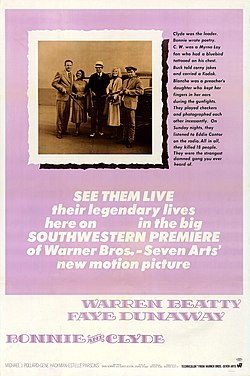
Bonnie and Clyde
During the Great Depression, Clyde Barrow and Bonnie Parker of Texas meet when Clyde tries to steal Bonnie's mother's car. Bored with her job as a waitress, Bonnie becomes intrigued by Clyde and decides to partner with him in crime. They pull off some holdups, but their amateur efforts, while exciting, are not very lucrative. Bonnie and Clyde turn from small-time heists to bank robbing. The duo's crime spree shifts into high gear once they hook up with a dim-witted gas station attendant, C.W. Moss. Their exploits also become more violent. After C.W. botches parking during a bank robbery and delays their escape, Clyde shoots the bank manager in the face when he jumps onto the slow-moving car's running board. Clyde's older brother, Buck, and his wife, Blanche, a preacher's daughter, also join them. The two women develop an immediate dislike for each other, which only intensifies over time. Blanche has nothing but disdain for Bonnie, Clyde, and C.W., while Bonnie sees Blanche's flightiness as a constant danger to the gang's survival. In Joplin, Missouri, local police show up at the gang's rented house after being alerted by a grocery delivery boy; two policemen are killed in a shootout. The gang is pursued by law enforcement, including Texas Ranger Frank Hamer, whom they capture and humiliate before leaving him adrift on a boat while handcuffed. The five outlaws then pull a heist, during which a police chase disables their vehicle. They steal Eugene Grizzard's car and take him and his girlfriend captive before quickly abandoning them when they learn he is an undertaker. Bonnie wants to visit her family in Texas and give them part of the heist funds, to which Clyde reluctantly acquiesces despite the risk. An ambush by law enforcement overnight catches the gang off guard, resulting in numerous casualties. Buck is mortally wounded by a shot to his head, and Blanche is injured in one eye, losing sight in it. Bonnie, Clyde, and C.W. barely escape alive, while Blanche falls into police custody. Hamer then tricks her into revealing C.W.'s name (until then he was only an "unidentified suspect"). C.W. takes the wounded Bonnie and Clyde to hide out at the house of his father, Ivan, who thinks the couple has corrupted his son (as evidenced by an ornate tattoo Bonnie convinced C.W. to get). The elder Moss makes a deal with Hamer: in exchange for mercy for C.W., he sets a trap for the outlaws. When Bonnie and Clyde stop on the side of the road to help Mr. Moss fix a flat tire, as a nearby flock of birds flies away, the posse in the bushes guns the couple down. Hamer and his men come out of hiding and gather around the couple's bodies.


The Theory of Everything
In 1963, Stephen Hawking, a postgraduate astrophysics student at the University of Cambridge, begins a relationship with literature student Jane Wilde. Although Stephen is intelligent, both his friends and fellow academics are worried about his lack of a thesis topic. After attending a lecture by Roger Penrose on black holes with his advisor, Prof. Dennis Sciama, Stephen speculates that these might have been part of the universe's creation and decides on his thesis. However, soon Stephen's muscles begin to fail, causing him to lose coordination. After a bad fall, he is diagnosed with early-onset progressive degenerative motor neurone disease (MND) that will eventually leave him unable to move, swallow, or even breathe. With no treatment options, he is given approximately two years to live. The doctor assures Stephen that his brain will not be affected, so his thoughts and intelligence will remain intact, but eventually, he will be unable to communicate with them. Stephen develops severe depression, becoming reclusive and focusing on his work. Jane confesses she loves him and that she intends to stay, even as his condition worsens. They marry and have their first son, Robert. Once his walking ability deteriorates, he begins using a wheelchair. Inspired by Penrose's work on spacetime singularities at the centre of black holes, Stephen presents his doctoral thesis viva, extrapolating that a black hole created the universe in a Big Bang and it will end in a Big Crunch. After the Hawkings have their daughter Lucy, Jane becomes frustrated having to focus on the children, as well as Stephen's slowly degenerating health while his fame increases, all at the expense of her academic work. Stephen tells her he will understand if she needs help. In the 1970s, Jane joins a church choir, where she meets and becomes close friends with Jonathan, a widower. She employs him as Robert's piano teacher, and Jonathan befriends the entire family, helping Stephen with his illness, supporting Jane, and playing with the children. When Jane gives birth to another son, Timothy, Stephen's mother asks her if the baby is Jonathan's. This causes outrage and Jonathan is appalled, but when he and Jane are alone, they admit the depth of their feelings for one another. He distances himself from the family, but Stephen tells him that Jane needs him. As the Lucasian Professor of Mathematics at Cambridge, Stephen goes on to develop a theory of the visibility of black holes that emit radiation, becoming a world-renowned physicist. In the 1980s, while on holiday in Bordeaux, Stephen falls ill and is rushed to a hospital. The doctor informs Jane that he has pneumonia and the tracheotomy he needs to survive will leave him mute. She agrees to the surgery. Stephen learns to use a spelling board and uses it to communicate with his new nurse, Elaine Mason. He receives a computer with a built-in voice synthesizer and uses it to write a book, A Brief History of Time, which becomes an international best-seller. In the late 1980s, Stephen tells Jane he has been invited to the United States to accept an award and will take Elaine with him. Jane faces the fact that the marriage has not been working, saying she "did her best", and they agree to divorce. While Stephen has fallen in love with Elaine, Jane and Jonathan reunite. Stephen goes to deliver a public lecture where he sees a student drop a pen. He imagines getting up to return it, almost crying at the reminder of how his disease has affected him. He then gives a speech telling audiences to pursue their ambitions despite the harsh reality of life: "While there is life, there is hope." On being made a member of the Order of the Companions of Honour in 1989, Stephen invites Jane to go with him to meet Queen Elizabeth II, where they share a happy day together with their three children. An extended closing series of select moments from the film, shown in reverse, back to the moment Stephen first saw Jane – the reversal is reminiscent of Stephen's research methodology of reversing time to understand the beginning of the universe. An epilogue reveals that A Brief History of Time has sold over ten million copies worldwide; Stephen declined an offer of a knighthood and has no plans to retire; Jane earned her PhD in medieval Spanish poetry and married Jonathan; and both Stephen and Jane remain friends, sharing three grandchildren.