Genre: Biography (Page 19)
Browse 242 movies in the Biography genre.
All Genres
Lords of Chaos
In 1984, young guitarist Euronymous forms black metal band Mayhem, the first of the genre in their country of Norway, with Necrobutcher on bass and Manheim on drums. Manheim leaves and is soon replaced by new drummer Hellhammer, and they recruit a vocalist from Sweden called Dead. Dead exhibits self-destructive behavior; during their live shows, he cuts himself, bleeds on the audience, and throws pig heads at the " posers ". At a show filmed by their friend Metalion, the band meets a timid fan named Kristian, whom Euronymous initially undermines and patronizes. Euronymous also meets Ann-Marit, a girl from the metal community, and is instantly attracted to her. While home alone, Dead slits his wrists and throat with a knife, then uses Euronymous' shotgun to shoot himself in the forehead, leaving behind a suicide note. Euronymous returns to find Dead's body; instead of calling the police, he repositions and takes photos of the corpse. After Dead's body is taken to the morgue, Euronymous makes necklaces out of pieces of Dead's skull and gives them to the other members. Horrified and disgusted at Euronymous' flippant response to their friend's death, Necrobutcher leaves the band. Soon after, Euronymous starts his own black metal record label and opens a record shop called Helvete ("Hell"), which becomes a social hub for black metal fans, including Kristian, who is now calling himself Varg Vikernes. They become known as the "Black Circle". After being mocked by Euronymous, Varg burns down a local church. When challenged by Varg regarding his status as the leader of the Black Circle, Euronymous burns down a church with Faust and Varg accompanying. Not long after, Ann-Marit and Euronymous enter a relationship. Euronymous recruits Varg as bassist, along with a guitarist called Blackthorn and Hungarian vocalist Attila Csihar, to record Mayhem's first album, De Mysteriis Dom Sathanas. A power struggle between Varg and Euronymous soon arises. After a wave of church burnings and the murder of a gay man by Faust, police begin to link members of the local black metal scene to the crimes, sending Euronymous into paranoia. Helvete is shut down, and Varg is arrested as prime suspect after an interview with a Bergen newspaper in which he boasts about his responsibility for the crimes, though he is soon released due to a lack of evidence. Afterwards, Varg tells Euronymous that he is leaving Mayhem with plans to start his own record label. In the ensuing conversation, Euronymous admits that the skull piece necklaces were fake and that his violent, anti-authority mindset is merely a persona he adopted for the sake of promoting the band, which angers Varg. While packing up the shop, Euronymous angrily rants to a peer about Varg, blaming Varg for the deterioration of the black metal community and expressing a desire to kill him in retaliation. After taking advice from Ann-Marit, Euronymous calms down, sends Varg a contract releasing Burzum 's music rights to him, and decides to continue with Mayhem. When Varg hears of Euronymous' death threats, he travels to Oslo to confront him. He convinces Euronymous to let him enter the apartment by stating he wants to sign the contract. However, once inside, Varg stabs him after a brief conversation. Varg chases Euronymous to the stairwell outside, where he stabs him to death, ignoring him as he pleads for his life. News of Euronymous' murder spreads throughout Norway and Varg is soon arrested. He is convicted of both the murder of Euronymous and the burning of several churches and sentenced to a maximum of 21 years in prison. In a voice-over, Euronymous tells the audience not to mourn his death, as he lived a successful life and accomplished many things.

Whiskey Tango Foxtrot
In 2003 New York City, Kim Baker is a struggling television journalist covering low-profile stories. To help her career, she takes a short assignment as a war correspondent in Afghanistan during Operation Enduring Freedom, to the disappointment of her boyfriend Chris. Assigned to modest living quarters with other international journalists, Kim befriends noted BBC correspondent Tanya Vanderpoel and lecherous Scottish freelance photographer Iain MacKelpie. She adjusts to her new duties aided by her Afghan " fixer " Fahim Ahmadzai. She elicits frank remarks on camera from soldiers questioning the value of their assignment and puts herself in harm's way to capture combat incidents on video. Marine General Hollanek sees her as an inexperienced nuisance. Despite the danger, Kim stays in Afghanistan for years beyond her original assignment. She catches Chris with another woman during a middle-of-the-night video call, ending their relationship and her sexual flirtation with Iain develops into something more meaningful. Although Afghan Islamic society places restrictive roles on women, she uses her sex to her advantage and gains access to female villagers who have been sabotaging the US-built well because they welcome the daily walk to the river away from the men. She uses her own sexuality to develop Afghan Attorney General Ali Massoud Sadiq as a news source. Fahim, who treated opium addicts before the war, cautions her that danger can be as dangerous as a drug. Despite their mutual friendliness, Kim competes with other journalists for stories and resources from their employers. After three years in Afghanistan, Kim flies to New York to argue for more support from her network's new boss, and discovers Tanya is slated to take over her Afghan assignment. Iain is kidnapped for ransom while covering a developing story he had offered to share with Kim. She returns to Afghanistan and blackmails Ali for information about Iain's whereabouts, impressing on Hollanek the political value of rescuing Iain. The mission is a success, militarily and journalistically but Kim becomes disillusioned with her tentative relationship with Iain and her station. She returns to the United States for good, and looks up a Marine whose on-camera comments to her might have led to his transfer and subsequent loss of his legs to an IED. She tries to apologize to him but he refuses to let her take the blame. Kim takes an on-camera desk job and finds herself interviewing Iain, who will be in New York as part of a new book tour. He invites her to meet him for coffee.

The Lost City of Z
In 1905, Percy Fawcett is a young British major who participates in a stag hunt on an Irish baronial estate for the visiting Archduke Franz Ferdinand ’s benefit. A skilled horseman and marksman, he brings down the stag swiftly, but is snubbed at the after-hunt party. A year later, Fawcett meets officials of the Royal Geographical Society (RGS) in London, where he is informed that the governments of Bolivia and Brazil are nearly at war over the location of their mutual boundary. Directly affecting the region’s extremely lucrative rubber trade, they have asked the British government to survey it. Fawcett leads the survey party, meeting Corporal Henry Costin, who is familiar with the Amazon rainforest, aboard the ship to Brazil. At a large rubber plantation in the jungle owned by Portuguese nobleman Baron de Gondoris, they meet Lance Corporal Arthur Manley, who tells them the British government advises against further exploration. Nevertheless, Fawcett and Costin, along with several guides and Amazonian scout Tadjui, complete the mission. Tadjui tells him stories about a legendary jungle city covered in gold and full of people. Fawcett dismisses this as insane ravings, but he soon discovers highly advanced broken pottery and some small stone statues in the jungle, convincing him of the story’s veracity. Upon his return, Fawcett is praised, and his wife, Nina (Sienna Miller), has given birth to their second son. In the Trinity College Library of Dublin, she discovers a conquistador text telling of a city deep in the Amazonian jungle, which Fawcett names “the Lost City of Z ”. He also meets renowned biologist James Murray, who agrees to back his Amazon expedition to find that lost city. Attempting to convince RGS members for backing, he is initially ridiculed, but ultimately they concede to further exploration. Murray, unfamiliar with the rigors of the deep jungle, greatly slows them down. Fawcett’s party is attacked along the river, but he makes peace with the natives. Murray’s leg injury becomes severely infected, and he begins to succumb to madness. Fawcett sends him off with a native guide and their last pack animal to find aid. However, the rest of the team abandons the expedition after discovering that Murray had poured paraffin on their supplies. Fawcett arrives home and is introduced to his daughter. Murray survives and, in front of RGS trustees, accuses Fawcett of abandoning him in the jungle, demanding an apology. Fawcett opts to resign from the society rather than do so. When World War I breaks out in Europe, Fawcett fights in France. Manley dies in the trenches at the Battle of the Somme and Fawcett is temporarily blinded in a chlorine gas attack whilst leading an infantry attack. His estranged eldest, Jack, who had long accused Fawcett of abandoning them, reconciles with him as he recovers. In 1923, Fawcett is living in obscurity in Britain. American interest in exploring the Amazon has escalated, mostly due to Fawcett’s stories of the lost city. John D. Rockefeller Jr. and a consortium of U.S. newspapers finance a new Fawcett expedition. The RGS co-funds it at the last moment to maintain British pride. Fawcett shows Sir John Scott Keltie a compass, telling him that he will send it back to him once he finds the lost city. Fawcett and his son go alone this time, travelling as light as possible for up to three years to find “Z”. Costin declines an invitation to join them. The Fawcetts are attacked by natives and run off, only to be stopped by a second tribe, who say that the Englishmen's spirits aren’t wholly of their own world. They declare their spirits “must belong” somewhere, so they will help them find their rightful place. The Fawcetts are drugged during a ceremony and carried away. Years later, Nina Fawcett has a meeting with Keltie at the RGS, claiming she has heard that Fawcett and Jack are still alive and living with tribespeople. The RGS, having sent over a hundred people to search for Fawcett over the years, refuses to do another search; Keltie advises Nina to accept her husband’s death. She refuses, showing him the compass Fawcett had promised to send once he found the lost city. As Nina leaves, her reflection in a mirror shows her walking out into what looks like the Amazonian jungle.
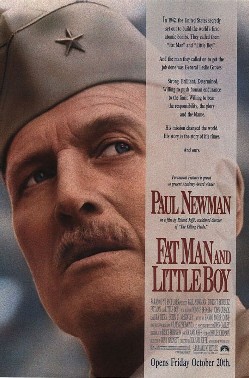
Fat Man and Little Boy
In September 1942, U.S. Army Corps of Engineers Colonel Leslie Groves, who oversaw the construction of the Pentagon, is assigned to head the ultra-secret Manhattan Project, to beat the Germans, who have a similar nuclear weapons program. Groves picks University of California, Berkeley, physicist J. Robert Oppenheimer to head the project team. Oppenheimer was familiar with northern New Mexico from his boyhood days when his family owned a cabin in the area. For the new research facility, he selects a remote location on top of a mesa adjacent to a valley called Los Alamos Canyon, northwest of Santa Fe. The different personalities of the military man Groves and the scientist Oppenheimer often clash in keeping the project on track. Oppenheimer in turn clashes with the other scientists, who debate whether their personal consciences should enter into the project or whether they should remain purely researchers, with personal feelings set aside. Nurse Kathleen Robinson and young physicist Michael Merriman question what they are doing. As Michael works with no protection from radiation during an experiment dubbed Tickling the Dragon's Tail, a probe he is holding slips from an apparatus and he is instantly bathed in a blue light, which is a visible result of a lethal dose of radiation. In the base hospital, nurse Kathleen can only watch as he develops massive swelling and deformation before dying a miserable death days later. While the technical problems are being solved, investigations are undertaken to thwart foreign espionage, especially from communist sympathizers who might be associated with socialist organizations. The snooping reveals that Oppenheimer has had a young mistress, Jean Tatlock, and he is ordered by Groves to stop seeing her. After he breaks off their relationship without being able to reveal the reasons why, she is unable to cope with the heartache and is later found dead, apparently a suicide. As the project continues in multiple sites across America, technical problems and delays cause tensions and strife. To avoid a single point of failure plan, two separate bomb designs are implemented: a large, heavy plutonium bomb imploded using shaped charges (" Fat Man "), and an alternative design for a thin, less heavy uranium bomb triggered in a shotgun or gun-type design (" Little Boy "). The bomb development culminates in a detonation in south-central New Mexico at the Trinity Site in the Alamogordo Desert (05:29:45 on July 16, 1945), where everyone watches in awe the first mushroom cloud with roaring winds, even miles away. Both bombs, Fat Man and Little Boy, are successful, ushering in the Atomic Age.

Where the Buffalo Roam
The film opens in the Rocky Mountains on the Colorado ranch of Dr. Hunter S. Thompson, a journalist furiously trying to finish a story about his former attorney and friend, Carl Lazlo, Esq. Thompson then flashes back to a series of exploits involving the author and his attorney. In 1968, Thompson leaves hospital, later, Lazlo fights to stop a group of San Francisco youngsters from receiving harsh prison sentences for possession of marijuana. He convinces Thompson to write an article about it for Blast Magazine. Thompson's editor, Marty Lewis, reminds Thompson that he has 19 hours to deadline. The judge hands out stiff sentences to everyone; the last client is a young man who was caught with 1 pound of marijuana and receives a five-year sentence. Lazlo reacts by attacking the prosecuting attorney and is then jailed for contempt of court. The magazine story about the trial is a sensation, but Thompson does not hear from Lazlo until four years later, when Thompson is on assignment covering Super Bowl VI in Los Angeles. Lazlo appears at Thompson's hotel and convinces him to abandon the Super Bowl story and join his band of freedom fighters, which involves smuggling weapons to an unnamed Latin American country. Thompson goes along with Lazlo and the revolutionaries to a remote airstrip where a small airplane is to be loaded with weapons, but when a police helicopter finds them, Lazlo and his henchmen escape on the plane while Thompson refuses to follow. Thompson's fame and fortune continue. He is a hit on the college lecture circuit and covers the 1972 presidential election campaign. After being thrown off the journalist plane by The Candidate 's press secretary, Thompson takes the crew plane and gives strait-laced journalist Harris from the Post a strong hallucinogenic drug and steals his clothes and press credentials. At the next campaign stop, in the airport bathroom, Thompson is able to use his disguise to engage The Candidate in a conversation about the "Screwheads" and the "Doomed". Thompson, still posing as Harris, returns to the journalist plane. Lazlo then appears, striding across the airport tarmac in a white suit. He boards the plane and tries to convince his old friend to join his socialist paradise somewhere in the desert. After causing a disturbance, Thompson and Lazlo are thrown off the plane, and Lazlo's papers that describe the community are blown across the airport runway. Lazlo, presumably, is not heard from again. The action then returns to Thompson's cabin, just as the writer puts the finishing touches on his story, explaining that he didn't go along with Lazlo—or Nixon—because "it still hasn't gotten weird enough for me."

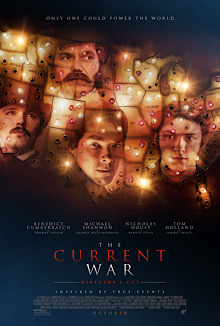
The Current War
In 1880, Thomas Edison has unveiled his electric lightbulb. He plans to distribute power to American neighborhoods using Direct Current (DC), which is cheaper and cleaner than gaslight, but is limited in range and needs an expensive wiring infrastructure. George Westinghouse, a successful business man and inventor himself, wishes to learn more, and invites Edison to dinner. After being snubbed by Edison, Westinghouse sets out to prove alternating current (AC) is the better technology, as it can work over greater distances and at significantly lower cost. Edison and Westinghouse compete to get cities across the United States to use their system. Westinghouse does an AC demonstration at Great Barrington in March 1886. Inventor Nikola Tesla arrives in the United States and begins working with Edison, but is disappointed by Edison's unwillingness to reconsider his ideas and to fulfill what Tesla thought was a financial promise which Edison passes off as just a joke. Tesla then leaves Edison's team. Edison fiercely guards his patents and sues Westinghouse. Edison suggests that AC is dangerous and engages in a publicity war, while Westinghouse stands behind its technical merits. As Edison struggles to find ways to make DC more affordable, Westinghouse attempts to get the high-voltage AC system to work with motors. Edison's wife dies, and Westinghouse is also struck by personal tragedy when his friend Franklin Pope dies in an electrical accident. Both face significant financial risk. To generate funds Edison commercially sells his speaking machine " The Phonograph ". To damage the reputation of AC, Edison shows that it easily electrocutes animals, and secretly works to help the creators of the electric chair, despite his previous objections to manufacturing weapons or other machines of death. The first person to die by electrocution is William Kemmler, and newspapers label the event as "Far Worse Than Hanging". Westinghouse discovers Edison's involvement and reveals it to the press. After an unsuccessful attempt to strike out on his own, Tesla is approached by Westinghouse to work together, and build a practical AC motor. Edison is increasingly marginalized and J. P. Morgan merges Edison Electric into General Electric. The competing systems come to a head as they both put forward proposals to illuminate the 1893 World's Columbian Exposition in Chicago. Samuel Insull presents the bid on behalf of Edison, and Westinghouse presents his competing bid. The fair is abundantly lit, and Westinghouse is successful. At the fair Westinghouse and Edison meet briefly. Edison discusses what it was like to achieve a great invention, and suggests that his next invention (motion pictures) could be so incredible that people might forget his name was ever associated with electricity.

Genius
In 1929, in New York City, Maxwell Perkins is a successful editor at Scribner's and discoverer of great authors such as F. Scott Fitzgerald and Ernest Hemingway. He lives in a "cottage"—actually, a mansion—just outside the city with his wife and five daughters. One day, in his office, he reads the drafts of O Lost, a novel by Thomas Wolfe. Struck by the content, Perkins decides to publish it and begins to collaborate with the author. It is eventually published as Look Homeward, Angel and proves to be a commercial success: 15 thousand copies sold in a month. Perkins and Wolfe become best friends, while Wolfe's relationship with Aline Bernstein, a married woman 20 years his senior, is severely tested after the novel's publication. Max manages to publish Wolfe's successful second novel, Of Time and the River, after several years of exhausting revision. Wolfe is in Paris where he follows the events remotely, thanks to news received from Perkins. On his return to New York, he immediately goes to work, writing his new book. His turbulent character leads him to quarrel with Perkins, destroying the relationship between them, resulting in Wolfe turning to another editor. Aline finally leaves Wolfe, because she feels he needs to experience how to be truly alone. After Perkins has reconciled himself with Wolfe's absence, a phone call comes from Wolfe's mother: he has contracted miliary tuberculosis. Despite surgery, Wolfe shows no signs of improving. After a few weeks he dies but before dying he writes a letter to Max, expressing his immense affection for him.

Dangerous Minds
LouAnne Johnson, a veteran of the U.S. Navy and Marine Corps, applies for a high school teaching job and is surprised and pleased to be offered the position with immediate effect, even though it is a low paying job. Showing up the next day to begin teaching, however, she finds herself confronted with a classroom of tough, sullen teenagers, all from low-income working-class backgrounds, involved in gang warfare and drug pushing, flatly refusing to engage with anything. They immediately coin the nickname "White Bread" for LouAnne, due to her race and apparent lack of authority, to which LouAnne responds by returning the next day in a leather jacket and teaching them karate. The students show some interest in such activities, but withdraw when LouAnne tries to teach the curriculum. Desperate to reach the students, LouAnne devises classroom exercises that teach similar principles to the prescribed work but using themes and language that appeal to the students. She also tries to motivate them by giving them all an A grade from the beginning of the year and arguing that the only thing required of them is that they maintain it. In order to introduce them to poetry, LouAnne uses the lyrics of Bob Dylan 's " Mr. Tambourine Man " to teach symbolism and metaphor; once this is achieved, she progresses on to Dylan Thomas 's " Do not go gentle into that good night ", inspired by a conversation with her co-worker Hal Griffith about his favorite poet, confusing Bob Dylan (his reply) with Dylan Thomas. LouAnne rewards the students liberally, using candy bars, reward incentives, and a trip to a theme park. Her methods draw the attention of the school authorities, George Grandey and Carla Nichols, who try to force her to remain within the curriculum. A few particular students attract LouAnne's interest for their personal problems. Raul Sanchero is a boy who is frequently involved in gang warfare and street crime. LouAnne tries to encourage him to focus by paying a special visit to his family to congratulate him on his work and going to dinner with him as a way of instilling confidence and self-respect. Emilio Ramirez is her most troublesome personal "project", as he believes strongly in a sense of personal honor that prevents him from asking for help. When LouAnne discovers that his life is in danger because of a personal grudge held by a recently released thug, she advises him to seek help from Principal George Grandey. The next day, Emilio visits Grandey, but Grandey (not realizing that Emilio is in serious danger) instantly dismisses him because he neglected to knock on the door before entering his office. Feeling rejected, Emilio leaves the school and is subsequently killed by his rival. Heartbroken by her failure to protect Emilio and angry at the indifferent school system for contributing to his death, LouAnne announces to the class her intention to leave the school at the end of the academic year. The students immediately break down, begging her not to leave. Overwhelmed by their unbridled display of emotion, she decides to stay.

The Informant!
Mark Whitacre, a rising star at the Archer Daniels Midland (ADM) office in Decatur, Illinois, during the early 1990s, blows the whistle on the company's price-fixing tactics at the urging of his wife Ginger. One night in November 1992, Whitacre confesses to FBI special agent Brian Shepard that ADM executives—including Whitacre himself—had routinely met with competitors to fix the price of lysine, an additive used in the commercial livestock industry. Whitacre secretly gathers hundreds of hours of video and audio over several years to present to the FBI. Whitacre assists in gathering evidence by clandestinely taping the company's activity in business meetings at various locations around the globe. These include locations in Tokyo, Paris, Mexico City, and Hong Kong. He eventually collects enough evidence of collaboration and conspiracy to warrant a raid of ADM. Whitacre's good deed dovetails with his own major infractions, while his internal, secret struggle with bipolar disorder seems to take over his exploits. Whitacre's meltdown results from the pressures of wearing a wire and organizing surveillance for the FBI for three years, instigated by Whitacre's reaction, in increasingly manic overlays, to various trivial magazine articles he reads. In a stunning turn of events immediately following the covert portion of the case, headlines worldwide report Whitacre had embezzled $9 million from his own company. This happened simultaneously while he was covertly working with the FBI and taping his co-workers. Whitacre also aims to be elected as ADM CEO following the arrest and conviction of the remaining upper management members. In the ensuing chaos, Whitacre appears to shift his trust and randomly destabilize his relationships with Special Agents Shepard and Herndon and numerous attorneys in the process. Authorities at ADM begin investigating the forged papertrail Whitacre had built to cover his own deeds. After being confronted with evidence of his fraud, Whitacre's defensive claims begin to spiral out of control, including an accusation of assault and battery against Agent Shepard and the FBI, which had made a substantial move to distance their case from Whitacre entirely. Due to this major infraction and Whitacre's bizarre behavior, he is sentenced to a prison term three times as long as that meted out to the white-collar criminals he helped to catch. In the epilogue, Agent Herndon visits Whitacre in prison as he videotapes a futile appeal to seek a presidential pardon. Overweight, balding and psychologically beaten after his years long ordeal, Whitacre is eventually released from prison, with Ginger awaiting to greet him.

Fire in the Sky
On November 5, 1975, in Snowflake, Arizona, logger Travis Walton, and his five co-workers—Mike Rogers, Allan Dallis, David Whitlock, Greg Hayes and Bobby Cogdill—head to work in the White Mountains. Driving back towards town that night, the loggers see unearthly red light in the distance through the treeline. Investigating, they encounter an unidentified flying object. Curious, Walton gets out of the truck to examine more closely, but is struck by a bright beam of light and is thrown several feet backwards. Fearing Walton has been killed, the terrified loggers flee. Rogers decides to go back to retrieve Walton, but he is nowhere to be found. In reporting the incident in town, the loggers are met with skepticism by investigators Sheriff Blake Davis and Lieutenant Frank Watters. Watters, learning that there was a great deal of tension between Dallis and Walton and that Dallis has a criminal record, suspects foul play. That suspicion spreads in town and the loggers become social outcasts. After a large search party turns up no sign of Walton, the police offer the loggers the chance to take a lie detector test. They take the test in the hopes of proving their innocence. Watters says that the tests were inconclusive and that they will have to return the next day to retake it. Rogers is outraged and angrily declines, the other loggers follow suit. The test's administrator reveals to Watters and Davis that, with the exception of Dallis (whose test results were inconclusive), the loggers seem to be telling the truth. Five days later, Rogers receives a call from someone claiming to be Walton. He is found at a Heber gas station, alive but naked, dehydrated and severely traumatized. A ufologist questions Walton but is sent away and Walton is taken to a hospital. Rogers visits Walton while he's in the emergency room. He says that the team left but Rogers returned to try to retrieve Walton. Apparently enraged, Walton turns away from Rogers. He in turn chastises Walton for getting out of the truck in the first place. During a welcome home party, Walton suffers a mental breakdown and flashback to the abduction by the extraterrestrials. In his flashback, he awakens inside a slimy cocoon. Breaking out of its membrane, a bewildered Walton finds himself adrift in a zero-gravity alien environment inside a cylindrical enclosure, whose walls contain other similar cocoons. Struggling in the low gravity, he accidentally breaches a nearby cocoon, horrified to discover that it contains decomposing human remains. Exploring further, he drifts towards a neighbouring area, seeing several humanoid figures below him. Drifting uncontrollably towards them, he investigates, surmising that the immobile figures are spacesuits, one of which is still occupied by an extraterrestrial creature. Walton attempts to escape, but is apprehended by two aliens who drag him down corridors full of terrestrial detritus such as shoes and keys before arriving in an examination chamber. The aliens hold the struggling Walton to a platform in the centre of the chamber, stripping him of his clothes and covering him with an elastic material that completely restrains him. Despite Walton's terrified screams, the aliens clinically subject him to a torturous experiment in which a gelatinous substance is forced into his mouth, a tube is inserted down his throat, his jaw is locked open and a device is stabbed into his neck. Overhead equipment then begins lowering towards him. As a needle-like ocular probe extends towards his exposed eye, Walton suddenly reawakens from his flashback in a doctor's office. While interviewing Walton, Lieutenant Watters expresses his doubts about the abduction, dismissing it as a hoax. He notes that Walton's new celebrity status resulted from the tabloids' attempts to profit from his tale. He believes that Walton faked the abduction. Given that the investigation is officially closed, Watters is forced to abandon his pursuit and leaves town. Two and a half years later, Walton visits Rogers, now a hermit, and the two men reconcile. The closing titles inform that in 1993, Walton, Rogers, and Dallis were resubmitted to additional polygraph examinations, which they passed, apparently corroborating their innocence.

Where's Jack?
The film recounts the exploits of notorious 18th-century criminal Jack Sheppard and London "Thief-Taker General" Jonathan Wild. The ending of the film is ambiguous, and suggests that Sheppard may have survived his execution and escaped to the Americas.