← All Movies
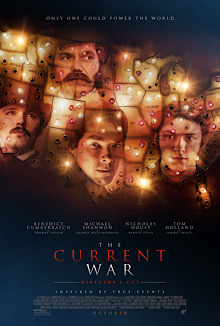
The Current War
In 1880, Thomas Edison has unveiled his electric lightbulb. He plans to distribute power to American neighborhoods using Direct Current (DC), which is cheaper and cleaner than gaslight, but is limited in range and needs an expensive wiring infrastructure. George Westinghouse, a successful business man and inventor himself, wishes to learn more, and invites Edison to dinner. After being snubbed by Edison, Westinghouse sets out to prove alternating current (AC) is the better technology, as it can work over greater distances and at significantly lower cost. Edison and Westinghouse compete to get cities across the United States to use their system. Westinghouse does an AC demonstration at Great Barrington in March 1886.
Inventor Nikola Tesla arrives in the United States and begins working with Edison, but is disappointed by Edison's unwillingness to reconsider his ideas and to fulfill what Tesla thought was a financial promise which Edison passes off as just a joke. Tesla then leaves Edison's team. Edison fiercely guards his patents and sues Westinghouse.
Edison suggests that AC is dangerous and engages in a publicity war, while Westinghouse stands behind its technical merits. As Edison struggles to find ways to make DC more affordable, Westinghouse attempts to get the high-voltage AC system to work with motors. Edison's wife dies, and Westinghouse is also struck by personal tragedy when his friend Franklin Pope dies in an electrical accident. Both face significant financial risk. To generate funds Edison commercially sells his speaking machine " The Phonograph ". To damage the reputation of AC, Edison shows that it easily electrocutes animals, and secretly works to help the creators of the electric chair, despite his previous objections to manufacturing weapons or other machines of death. The first person to die by electrocution is William Kemmler, and newspapers label the event as "Far Worse Than Hanging". Westinghouse discovers Edison's involvement and reveals it to the press.
After an unsuccessful attempt to strike out on his own, Tesla is approached by Westinghouse to work together, and build a practical AC motor. Edison is increasingly marginalized and J. P. Morgan merges Edison Electric into General Electric. The competing systems come to a head as they both put forward proposals to illuminate the 1893 World's Columbian Exposition in Chicago. Samuel Insull presents the bid on behalf of Edison, and Westinghouse presents his competing bid. The fair is abundantly lit, and Westinghouse is successful. At the fair Westinghouse and Edison meet briefly. Edison discusses what it was like to achieve a great invention, and suggests that his next invention (motion pictures) could be so incredible that people might forget his name was ever associated with electricity.