Genre: Biography (Page 13)
Browse 242 movies in the Biography genre.
All Genres
The Sessions
In Berkeley, California, in 1988, Mark O'Brien is a 38-year-old poet who is forced to live in an iron lung due to complications from polio. Due to his condition, he has never had sex. After unsuccessfully proposing to his caretaker Amanda, and sensing he may be near death, he decides he wants to lose his virginity. After consulting his priest, Father Brendan, he gets in touch with Cheryl Cohen-Greene, a professional sex surrogate. She tells him they will have no more than six sessions together. They begin their sessions, but soon it is clear that they are developing romantic feelings for each other. Cheryl's husband, who loves her deeply, fights to suppress his jealousy, at first withholding a love poem that Mark has sent by mail to Cheryl, which she eventually finds. After several attempts, Mark and Cheryl are able to have mutually satisfying sex, but decide to cut the sessions short on account of their burgeoning feelings. One day sometime later, the power goes out in the building in which Mark lives, causing the iron lung to stop functioning and making it necessary for Mark to be rushed to the hospital. However, he survives and meets a young woman named Susan Fernbach. The film then cuts to Mark's funeral, held sometime later in 1999, and attended by four of the women he came to know and care for, including Cheryl. Father Brendan gives the homily and Susan reads the poem he had previously sent Cheryl.

The Report
In early 2009, Senator Dianne Feinstein selects Senate staffer Daniel J. Jones, who has just spent two years investigating the 2005 destruction of CIA interrogation videotapes, to lead a review of six million pages of CIA materials related to the agency's use of enhanced interrogation techniques (EITs). Jones and his team of six get to work in a sensitive compartmented information facility at a covert CIA site in Virginia. Intelligence psychologists Bruce Jessen and James Elmer Mitchell were contracted in 2002 to instruct the CIA in EITs. They started their work on Abu Zubaydah, for whom the FBI initially used the CIA rapport-building, where they started using EITs. Jones learned from an FBI agent that he gathered crucial intelligence from Zubaydah before the CIA took over the interrogations, though the agency claims that most valuable intel came from EITs. He shows evidence from the CIA's own records that prove that the agency falsely claimed that Zubaydah was a high-ranking member of Al-Qaeda to received authorization to start using EITs on him. A physician assistant with the Office of Medical Services who works at a CIA black site secretly reveals to Jones that he and other medical professionals had complained that the EITs were torture. However, they only got told to stop putting their objections in writing by the Director. Among files provided by the CIA, Jones finds the Panetta Review, a critical internal CIA review of the EIT program that was prepared in 2009 but never shared. A pundit on the news later claims that EITs had yielded good intelligence and prevented terrorist attacks. Jones stays up all night to disprove the claims, and the CIA's own records show that crucial information it is claiming to have obtained by subjecting a terrorist to torture was obtained by other means. Jones finishes the 6,200-page report, and it is approved by the Senate Intelligence Committee, chaired by Feinstein, on December 13, 2012, and sent to the CIA for final comments. Two months later, John Brennan is sworn in as the new director of the CIA. Brennan sets up meetings with CIA personnel and Jones to try to get the committee to change elements of the report. However, Jones repeatedly provides evidence to back up everything they want to change. Feinstein decides to stop this discussion with the CIA and keep the report as it is. Frustrated, Jones reveals the Panetta Review to Senator Mark Udall of the Intelligence Committee. During a Senate Intelligence Committee hearing on the nomination of the CIA general counsel, Udall asks why both the committee's reports and the Panetta Review conflict with the CIA's official position. The CIA, humiliated by Udall's revelation, conducts an illegal search and threaten to prosecute Jones for "stealing" the Panetta Review from the CIA's computers. Jones hints the search to the New York Times national security reporter, which ultimately leads Feinstein to formally accuse the CIA of unlawfully searching the Senate's computers in violation of the separation of powers. Brennan and the CIA are forced to back down, and the charges against Jones are dropped. Feinstein tells Jones that she is prepared to release a shorter summary of the report, but President Barack Obama grants the CIA broad authority to redact it first. When it becomes uncertain if the released document will have any useful information after redaction, Jones again meets with the Times reporter, but ultimately decides not to leak the report to the media. The Republican Party wins control of the Senate in the November 2014 midterm elections, meaning that the report will likely be buried forever when the new Congress is sworn in January 2015. Faced with this deadline, the Senate agrees to release the summary of the report. Feinstein gives a speech summarizing the report and its implications, and then Senator John McCain, who was tortured as a prisoner of war during the Vietnam War, gives an impassioned speech supporting the report. Jones leaves his job as a Senate staffer after the report summary released. No CIA officers are criminally charged in connection with the actions outlined in the report, with many promoted, and one later becomes the agency director.

The Flight of the Eagle
After Andrée must abort a first attempt in August 1896 to reach the North Pole with the hydrogen balloon Örnen ("the eagle"), he returns from Spitsbergen to Stockholm to prepare for a new attempt the following year. In the wake of this failure, he faces criticism from both societal and scientific circles, openly expressed by expedition participant Nils Ekholm. Andrée dispels all doubts and tirelessly advances plans for another attempt. Ekholm is replaced by Knut Frænkel. The balloon is inspected in Paris at the workshop of Henri Lachambre, while the third expedition member, Nils Strindberg, becomes engaged to his girlfriend, Anna Charlier. In the summer of 1897, the polar explorers set off again for Spitsbergen, where after some waiting for favorable winds, they manage to launch. However, problems arise soon after, and the journey does not proceed as planned. After a while, the balloon becomes difficult to keep aloft, forcing them to land on the pack ice. The three men are compelled to undertake a grueling trek back over the ice with heavy sledges, which increasingly pushes them to their physical and mental limits. When they finally reach the uninhabited and inhospitable island of Kvitøya, they are nearly at the end of their strength. After Strindberg, exhausted, has died and been buried, Frænkel also loses his life due to an attack by a polar bear. Disillusioned, Andrée remains alone in the barren ice desert.

Unbroken
Louis "Louie" Zamperini is a bombardier in the United States Army Air Forces in World War II. An April 1943 bombing mission against Japanese installations on Nauru exposes him to danger. His B-24 Liberator is hit by enemy fire, a crewman is badly wounded, and the pilot, Phil, nurses the damaged aircraft to a stop just short of the end of the runway. In a flashback to his youth in Torrance, California, Louie misbehaves by stealing, drinking alcohol and smoking. He is often bullied by others for his Italian ethnicity. His brother Peter trains him to be an athlete and Louie becomes a disciplined distance runner, earning the nickname "The Torrance Tornado". He finishes 8th in the 1936 Summer Olympics and sets a record in the final lap for the 5,000-meter race. In his 1943 combat service, Louie flies on a search-and-rescue mission in a war-weary plane which loses engine power and crashes into the ocean. Louie, Phil and Mac are the only survivors. After 27 days adrift on two rafts, they're strafed by a Japanese fighter plane. Mac dies six days later. On the 47th day, Japanese sailors capture Louie and Phil. They become prisoners of war on Kwajalein Atoll and are interrogated for technical information on aircraft models and the Norden bombsight. Louie successfully navigates the interrogation without revealing important information, and the pair are transferred to Japan and split up. Louie goes to camp Ōmori, in Tokyo. Japanese corporal Mutsuhiro Watanabe is especially hard on Louie, beating him often. Louie is given an opportunity to broadcast a message home after learning the U.S. government classified him as KIA. He refuses to broadcast anti-American propaganda and returns to camp where Watanabe has each prisoner punch him. After two years, Watanabe leaves the camp, but when the prisoners are transferred to Naoetsu prison camp, Sergeant Watanabe is again in command. When Louie pauses during work of loading coal barges, he is punished by Watanabe, who makes him lift a large wooden beam and hold it over his head. The sergeant orders a guard to shoot Louie if he drops it, but the American defiantly holds it up despite his exhaustion. The enraged Watanabe beats Louie for defiantly staring into his eyes. The prisoners are liberated when the Americans occupy Japan at the end of the war. Louie looks in Watanabe's quarters, finding he's fled, and is transfixed by a photo of Watanabe as a child. Louie returns to America and kisses the ground, happy to be home. The film ends with a slideshow of contemporary photos showing the post-war lives of the characters. Louie married and had two children. Phil married. Mutsuhiro "The Bird" Watanabe went into hiding and evaded prosecution despite being on the top 40 most-wanted Japanese war criminals list compiled by General Douglas MacArthur 's staff. Louie lived out his promise to convert to Christianity, to devote his life to God and to forgive his wartime enemies. Louie met with many of his Japanese captors but Watanabe refused. Louie was honored by running a leg of the Olympic Torch relay for the 1998 Winter Olympics in Nagano, Japan, four days short of his 81st birthday. His leg was near one of the POW camps where he was held. The closing titles reveal that Louie Zamperini died on July 2, 2014, at 97.

The Founder
In 1954, struggling Prince Castle salesman Ray Kroc travels to San Bernardino, California to meet Dick and Mac McDonald at their eponymous restaurant after the brothers purchase eight of his milkshake machines. Kroc lauds the brothers' success over dinner. Mac and Dick explain the restaurant's origins and success after a complete redesign of the store in 1948, eliminating unnecessary overhead and cutting costs. Eager to cash in, Kroc presses the brothers to expand franchising. After an initial refusal, the brothers agree to a business deal with stringent contract terms and a lengthy approval process for potential changes. Kroc breaks ground in Des Plaines, putting up his home as collateral. Hungry for more growth, Kroc pursues wealthy local connections for investment in franchising and recruits Fred L. Turner as his business partner. After early struggles with franchise operators not being involved, which had doomed the brothers' previous franchise attempts, Ray hit on the model of the local operator: putting the franchisee directly into the workspace and working alongside their staff. Kroc sees rapid gains and continues to expand, traveling to St. Paul to oversee the first opening in the Twin Cities. There, Kroc meets Rollie Smith, and his wife, Joan, who are interested in franchising; Kroc immediately becomes infatuated with Joan. At the same time, Kroc is stressed out over rising pressure from financial operating costs and falls behind on his payments. Kroc is unsuccessful at renegotiating his contract with the McDonald brothers, and, when his bank forecloses on his home, Kroc's wife, Ethel, discovers her husband put the house up as collateral without her knowledge. Kroc subsequently files for divorce from Ethel. Kroc visits his bank for help with his lease terms and is approached by former Tastee-Freez Finance VP Harry Sonneborn, who offers to review Kroc's books. Sonneborn explains to Ray that the business operator model will fail under the restrictions imposed by the McDonald brothers' contract terms. Sonneborn guides Kroc towards the evolution of McDonald's into a real-estate model with financial investor backing. In 1955, Franchise Realty Corporation is incorporated and begins an aggressive expansion of the McDonald's franchise. When the brothers are informed of the new company and Kroc's intent to buy the land, Dick and Mac are taken aback, but are powerless against the power Kroc now has. Emboldened, Kroc approaches his attorney for help getting out of his contract and implements further changes to the franchises without Dick and Mac's approval, including the introduction of a powdered milkshake mix to reduce costs. When Kroc officially rebrands Franchise Realty Corporation as the McDonald's Corporation, Mac collapses from diabetic shock and is hospitalized. Kroc visits the brothers at the hospital and offers them a blank check to buy them out. Realizing that Kroc can't be defeated, the brothers agree to sell for $2.7 million, the rights to the San Bernardino location and 1% of future profits. Kroc agrees to their terms except for the future profits and offers to pay these under a handshake agreement. The brothers reluctantly agree, and Kroc becomes the sole owner of the McDonald's Corporation. Dick asks Kroc why he didn't just take the idea and run with it. Kroc admits that he always wanted the restaurant for himself because of the brothers' last name. He laments his own Slavic last name as not "American" enough for American consumers, while McDonald's represents American values. The brothers are forced to change the name of their original location, and Kroc begins construction of a new McDonald's immediately across the street in San Bernardino. In 1970, Kroc, now married to Joan, prepares for a public speech that California Governor Ronald Reagan will attend. He heavily plagiarizes a speech he listened to earlier, arguing his success came from persistence. An epilogue reveals several facts about the company: Kroc's secretary, June Martino, became a part owner in the McDonald's Corporation. Sonneborn was made president and CEO but quit after falling out with Kroc a few years later, never speaking of McDonald's again for the rest of his life. Turner succeeded Kroc as senior chairman, expanding the company worldwide. Kroc and Joan remained married until Kroc's death in 1984. Kroc's San Bernardino McDonald's drove the McDonald brothers' original restaurant out of business in a few years. Kroc did not honor his handshake deal―the McDonald brothers were never paid their royalties, which would eventually have been over $100 million a year. McDonald's feeds about 1% of the world's population every day.
The Madness of King George
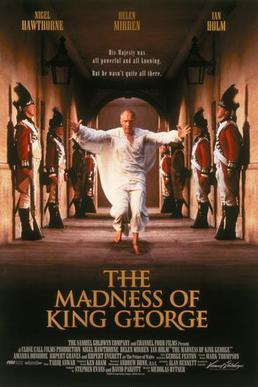
King George III's bout of madness in 1788 touched off the Regency Crisis of 1788 and triggered a power struggle between factions of Parliament under the Tory Prime Minister William Pitt the Younger and the reform-minded Leader of the Opposition Charles James Fox. At first, the King's behaviour appears mildly eccentric. He is deeply concerned with the wellbeing and productivity of Great Britain and exhibits an encyclopaedic knowledge of the families of even the most obscure royal appointments. He is devoted to his loving wife, Queen Charlotte, and their large brood of 15 children. However, he is growing more unsettled, partly over the loss of America. His memory fails, his behaviour becomes erratic and hypersexual, he talks and talks, and his urine turns blue. George, Prince of Wales, aggravates the situation, knowing that he will be named regent if the King becomes incapacitated. George chafes under his father's relentless criticism, and yearns for greater freedom, particularly when it comes to choosing a wife. He married the woman everyone believes to be his mistress, Mrs. Fitzherbert, in a secret ceremony in 1785. Without his father's consent, the marriage is illegal. Even with consent, it would remove him from the succession, because Fitzherbert is a Catholic. He knows that he has the moral support of Fox, whose agenda includes abolition of the slave trade and friendlier relations with America. Knowing how to exacerbate the King's behaviour, the Prince arranges a concert of music by Handel. The King reacts as expected, interrupting the musicians, speaking lasciviously to Lady Pembroke, and finally assaulting his son. In a private moment, the King tells Charlotte that he knows something is wrong. They are brutally interrupted when the Prince has them separated, supposedly on the advice of physicians. Led by the Prince of Wales' personal physician, Dr. Warren, the King is treated using the medical practices of the time, which focus on the state of his urine and bowel movements and include painful cupping and purgatives. Lady Pembroke recommends Dr. Francis Willis, who cured her mother-in-law. Willis uses novel procedures. At his farm in Lincolnshire, patients work to gain "a better opinion of themselves." He observes to an equerry "To be curbed, thwarted, stood up to, exercises the character." When the King insults him, foully, he is strapped into a chair and gagged. He will be restrained whenever he "swears and indulges in meaningless discourse" and "does not strive every day and always towards his own recovery". When the Prince has the King transferred to Kew, Charlotte watches as her beloved, bearded and wearing a soiled diaper and a straitjacket, struggles against being put in the coach. "Until you can govern yourself, you're not fit to govern others. And until you do so, I shall govern you," Willis says. At Kew, the King spits soup at Willis, but gains control under the physician's intractable gaze. Later, the King, properly dressed, feeds himself to a round of applause from staff—but the delusions persist. The Whig opposition confronts Pitt's increasingly unpopular Tory government with a proposal that would give the Prince powers of regency. Baron Thurlow, the Lord Chancellor, obtains and suppresses proof of the marriage. Fox wins, and the Regency Bill is printed. Thurlow comes to see the King and joins in a moving reading of King Lear. "I have remembered how to seem..." the King muses. "What, what!" an expression he has not used in six months. His urine is yellow. Thurlow and the King arrive at Parliament in time to thwart the bill. The King forces the Prince to admit his marriage and to put away Fitzherbert. With the crisis averted, all those who have witnessed his suffering are summarily dismissed, including Captain Greville, the King's equerry. Fitzroy, another equerry, observes to the sacked Greville: "To be kind does not commend you to kings." Cheering crowds welcome the royal family to St. Paul's Cathedral. Willis stands by, but the King dismisses him. "We must be a model family," he declares; George wants "something to do." "Smile at the people, wave at them. Let them see that we're happy. That's why we're here." Saluting, Willis disappears into the crowd, where Mrs. Fitzherbert also smiles, wistfully.
Meetings with Remarkable Men
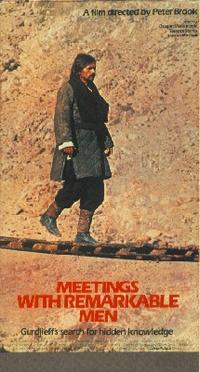
The plot involves Gurdjieff and his companions' search for truth in a series of dialogues and vignettes, much as in the book. Unlike the book, these result in a definite climax—Gurdjieff's initiation into the mysterious Sarmoung Brotherhood. The film is noteworthy for making public some glimpses of the Gurdjieff movements.

American Me
The film spans 30 years of Chicano gang life in Los Angeles. The story opens with the Zoot Suit Riots of 1943 and depicts a young Latino couple, Esperanza and Pedro Santana, being racially targeted by sailors. Pedro is beaten alongside other Latin-Americans, while Esperanza is gang-raped by the sailors. Years later, in 1959, the Santana family's teenaged son, Montoya, forms a street gang called La Primera along with his friends J.D. and Mundo. The three friends soon find themselves committing crimes and are therefore arrested. In juvenile hall, Santana murders a fellow inmate who raped him. As a result, his sentence is extended, and he is moved to Folsom State Prison after he turns 18. Years later, Santana has become the leader of a powerful prison gang, La Eme. Upon his release from prison in 1977, he tries to relate his life experiences to the society that has changed so much since he was incarcerated. La Eme has become a feared criminal organization beyond Folsom, selling drugs and committing murder. Santana begins a romantic relationship with a woman named Julie, but she becomes repulsed by his violent tendencies and by La Eme's negative influence on their community. After a drug lord refuses to give control of distribution to La Eme, La Eme retaliates by brutally raping and murdering the drug lord's son in prison. In response, the drug lord targets Santana's community by distributing pure heroin to local users. The pure heroin causes mass overdoses, and one of the overdose victims is Julie's brother. Santana visits his mother's grave, where his father reveals that he always resented Montoya because he might have been the son of his mother's rapist. Santana starts to see the error of his ways. Before he can take action, however, he is sent back to Folsom for drug possession. When J.D. visits, Santana tells him that he is no longer interested in leading La Eme. However, following a precedent set by Santana himself earlier in the film, his men—including Mundo—murder him to show the other prison gangs that La Eme is not weak and will not tolerate departures from its ranks. Santana is fatally stabbed and thrown off a balcony to his death. Julie receives a letter from Santana thanking her for opening his eyes. The letter contains his necklace of St. Dismas. Julie gives the necklace to Santana's teen brother Paulito, who then inducts a young boy into the street gang, La Primera by having him commit a drive-by shooting.


Alive
A group of photographs of the Stella Maris College 's Old Christians Rugby Team are seen as Carlitos Páez points out several members of the team and reflects on the accident in a brief monologue. Uruguayan Air Force Flight 571 flies over the Andes on October 13, 1972. The raucous rugby players and a few of their relatives and friends are eagerly looking forward to an upcoming match in Chile. Upon emerging from clouds, the plane encounters turbulence and collides with a mountain. The wings and tail are separated from the fuselage, which slides down a mountain slope before coming to a stop. Six passengers and one flight attendant are ejected from the plane and die. Antonio, the team captain, coordinates efforts to help the injured. Roberto Canessa and Gustavo Zerbino, both medical students, aid the injured. Another six passengers soon die, including both pilots and Nando's mother, Eugenia. Nando, who sustained a head injury, falls into a coma, and his sister Susana has suffered severe internal injuries. As the sun sets, the survivors make preparations for the night. Canessa discovers that the seat covers can be unzipped and used as blankets. The survivors go inside the fuselage and curl up beside one another to stay warm. Antonio, Roy Harley, and Rafael Cano plug the gaping hole at the end of the fuselage with luggage to keep out the wind. Two passengers die overnight. With nothing to hunt or gather on the mountain, Antonio declares they will use rationing when the survivors find a tin of chocolates and a case of wine. After seeing a plane fly past, they think it dipped its wings, and the survivors celebrate. Expecting to be rescued the next day, everyone except Javier, his wife Liliana, and Antonio finish the remaining chocolates. This causes a quarrel among Antonio and several others. Nando regains consciousness. After learning of his mother's death, Nando watches over Susana vigilantly. Knowing she will die of her injuries within a few days, he vows to set off on foot and find a way out of the mountains. When Carlitos reminds him that he will need food, Nando jokingly suggests eating the flesh of the deceased pilots to give him the strength to survive the journey to find help. Susana dies from her injuries. The survivors listen to a radio for word of their rescue but are devastated to hear that the search is to be called off after nine days. After great debate, the starving passengers decide to eat the flesh of their dead relatives and friends. Zerbino, Rafael, and Juan Martino set off to search for the tail of the plane in hopes of finding batteries for the plane's radio to transmit their location. Among pieces of the wreckage, the teammates find additional corpses, but return to the group with news that the tail of the plane is likely a little further away. Later in the week, an avalanche strikes the plane and fills much of the interior with snow. Eight of the survivors, including Antonio and Liliana, are smothered to death by the snow. The remaining 19 survivors are forced to stay inside the plane when they realize there is a blizzard outside. A second team, made up of Nando, Canessa, and Antonio "Tintin" Vizintin, sets out and finds the tail of the plane. Unable to bring the batteries to the fuselage, they return to the fuselage to get Roy, who is thought to have experience with electrical equipment. They bring him to the tail of the plane to see if he can fix the radio. When Roy is unsuccessful, the team decides to return to the fuselage. Federico and Alberto die from their injuries, as does Rafael, leading Nando to convince a reluctant Canessa to search for a way out of the mountains, taking Tintin with them. Two days into the journey, they send Tintin back to the fuselage so they can appropriate his rations and continue on their own. After a 12-day trek, the two escape the mountains and alert the authorities to their companions' location. Two helicopters, one of which has Nando and Canessa on board, appear overhead of the survivors on the mountain, leading the remaining 14 survivors to celebrate their impending rescue. In the present, Carlitos describes how a group later returned to the site of the crash and buried the corpses under a pile of stones, marked with a cross. The memorial to the 29 deceased and 16 survivors is shown.

