Movies (Page 121)
Browse 2,069 movies from the database, mentioned on Hacker News, ranked by rating or popularity.

The Ballad of Narayama
The film is set in a small rural village in 19th century Japan. According to tradition, once a person reaches the age of 70, he or she must travel to a remote mountain to die of starvation, a practice known as ubasute. The story concerns Orin, who is 69 and in sound health. However, she notes that a neighbor had to drag his father to the mountain, so she resolves to avoid clinging to life beyond her term. She spends a year arranging all the affairs of her family and village, severely punishing a family hoarding food and helping her younger son lose his virginity. The film contains harsh scenes depicting the brutal conditions faced by the villagers. Interspersed between episodes in the film are brief vignettes of nature—birds, snakes, and other animals hunting, watching, singing, copulating, or giving birth.

Gettysburg
The film begins with a narrated map showing the Confederate Army of Northern Virginia, commanded by Robert E. Lee, crossing the Potomac River to invade the North in June 1863, marching across Maryland and into Pennsylvania. On June 30, Confederate spy Henry Thomas Harrison reports to Lt. Gen. James Longstreet, commander of the First Corps, that the Union Army of the Potomac is moving in their direction, and that Union commander Joseph Hooker has been replaced by George Meade. Longstreet reports the information to General Lee, who is concerned that the army is moving "on the word of an actor", as opposed to that of his cavalry chief, J. E. B. Stuart. Nonetheless, Lee orders the army to concentrate near the town of Gettysburg. At the Union encampments near Union Mills, Maryland, Col. Joshua Lawrence Chamberlain of the 20th Maine is ordered to take in 120 men from the disbanded 2nd Maine who had resigned in protest, with permission to shoot any man who refuses to fight. Chamberlain speaks to the men, and is able to persuade all but six to take up arms. In Gettysburg, Brig. Gen. John Buford and his cavalry division spot elements of Henry Heth 's division of A. P. Hill 's Third Corps approaching the town and deduce that the main body of the Confederate army is not far behind. Buford recognizes that, with precedent from previous battles, the Confederates will arrive at Gettysburg first and entrench in strong positions, forcing the Union to charge them and suffer heavy casualties. To prevent this, he opts to stand and fight where he is, judging the terrain to be "lovely ground" for slowing the Confederate advance. Buford sends word to I Corps commander Maj. Gen. John F. Reynolds to bring up reinforcements. Heth's troops engage Buford's cavalry the following morning, July 1, with Richard S. Ewell 's Second Corps moving in to flank them. Reynolds brings his corps forward, but is killed by a Confederate sharpshooter. The Union army is pushed out of Gettysburg to Cemetery Ridge, and Lee—rejecting Longstreet's suggestion to redeploy south of Gettysburg and go on the defensive—orders Ewell to take the Union position "if practicable". However, Ewell hesitates and does not engage. The armies concentrate at their chosen positions for the remainder of the first day. At Confederate headquarters at Seminary Ridge, Maj. Gen. Isaac R. Trimble angrily denounces Ewell's inaction to Lee, and requests another assignment. On the second day, July 2, Col. Strong Vincent 's brigade from the Union V Corps is deployed to Little Round Top, and Vincent places the 20th Maine at the end of the line, warning Chamberlain that he and his regiment are the flank, and that if they retreat, the Confederate army can swing around behind them and rout the Union forces. Chamberlain speaks to the six remaining men of the 2nd Maine, and three of them decide to fight. Lee orders Longstreet to deploy his two available divisions to take Little Round Top and the neighboring Big Round Top. As Longstreet's corps deploys, Maj. Gen. John Bell Hood, commanding one of the divisions, protests to Longstreet; with the Union holding the high ground, he would lose half his forces if he attacked as ordered. Longstreet, despite his own protests to Lee, orders Hood to attack; Hood is later wounded fighting at Devil's Den. At the summit of Little Round Top, Chamberlain and the 20th Maine fight off wave after wave of advancing Confederates, and begin running out of ammunition. Colonel Vincent is mortally wounded, and none of the other three regiments in his brigade are able to provide support. Chamberlain orders his men to fix bayonets, and charge in a right wheel down the slope against the attacking Confederates, which Chamberlain describes as "we'll swing it down; we swing like a door." The attack successfully drives the Confederate assault back, and the Union flank holds. That evening, Stuart finally arrives, and Lee reprimands him for his being out of contact. At the same time, Longstreet's remaining division, under Maj. Gen. George Pickett, arrives on the field. For the third day, July 3, Lee decides to send three divisions—Pickett's, Trimble's, and J. Johnston Pettigrew 's—to attack the center of the Union line at Cemetery Ridge. Longstreet expresses his belief to Lee that the attack will fail, as the movement is a mile over open ground, and that the Union II Corps under Maj. Gen. Winfield Scott Hancock is deployed behind a stone wall, just as Longstreet's men had been at Fredericksburg. Lee nonetheless orders the attack to proceed. Longstreet then meets with the three division commanders and details the plan, beginning first with Colonel Edward Porter Alexander 's artillery clearing the Union guns off the ridge, before deploying the men forward. Despite heavy Confederate fire, Alexander is unable to make an impact upon the Union guns. When Pickett asks to move forward, Longstreet simply nods. The Confederate divisions march across the open field, and Hancock is wounded as he commands from the front line. One of Pickett's brigades, commanded by Brig. Gen. Lewis Armistead, makes it over the stone wall, but Armistead is wounded and captured by Union troops. The Confederates retreat due to high casualties. Seeing a despondent General Pickett, General Lee implores him to "look to your division," to which Pickett replies "General Lee, I have no division." Pickett's Charge ultimately fails. Meeting with Longstreet that evening, Lee finally decides that they will withdraw. The film ends with the fates of the major figures of the battle.

Groundhog Day
On February 1, Cynical television weatherman Phil Connors reassures his Pittsburgh viewers that an approaching blizzard will miss Western Pennsylvania. Alongside his new producer Rita Hanson and cameraman Larry, Phil travels to Punxsutawney for his annual coverage of the Groundhog Day festivities. He makes no secret of his contempt for the assignment, the small town, and the "hicks" who live there, asserting that he will soon leave his station for a new job. On February 2, Phil awakens in the Cherry Street Inn to Sonny & Cher 's " I Got You Babe " playing on the clock radio. He gives a half-hearted report on the groundhog Punxsutawney Phil and the festivities. Contrary to his prediction, the blizzard strikes the area, preventing all travel, and although he desperately searches for a way to leave, he is forced to spend the night in the town. The next morning, Phil again awakens to "I Got You Babe" and the same DJ banter on the radio in his room at the Cherry Street Inn. He experiences the previous day's events repeating exactly and believes he is experiencing déjà vu. He again unsuccessfully attempts to leave the town and retires to bed, only to awaken on February 2 once more. Phil realizes that he is trapped in a time loop of which no one else is aware. He confides his situation to Rita, who directs him to a neurologist, who in turn directs him to a psychologist; neither can explain his experiences. He gets drunk with locals Gus and Ralph and then leads police on a high-speed car chase before being arrested and imprisoned; the next morning, Phil awakens in the Cherry Street Inn once again. Realizing that there are no consequences for his actions, Phil begins to spend his loops indulging in binge eating, one-night stands, and robbery, using his growing knowledge of the day's events and the town's residents to manipulate circumstances to his advantage. He eventually focuses on seducing the sweet-natured Rita, using the loops to learn more about her and exploit that knowledge. No matter what steps he takes, Rita rebuffs his advances, particularly when Phil tells her he loves her; she asserts that he does not even know her. Phil gradually becomes depressed and desperate for a way to escape the loop. He commits suicide in a variety of ways, including kidnapping Punxsutawney Phil and driving them both off a cliff. Each time, he reawakens on February 2. He tries to explain his situation to Rita again, using his detailed knowledge of the day to predict events accurately. Convinced, Rita spends the day with him and encourages him to view the loop as a blessing rather than a curse. As they lie on the bed together at night, Phil realizes that his feelings for Rita have become sincere. He wakes alone on February 2. He decides to use the loop to change himself and help others: he saves people from deadly accidents and misfortunes and learns to play the piano, sculpt ice, and speak French. Despite his efforts, however, he is haunted by his inability to prevent a homeless old man from dying of natural causes. During one iteration of the loop, Phil reports on the Groundhog Day festivities with such eloquence that other news crews stop working to listen, amazing Rita. Phil continues his day helping the people of Punxsutawney. That night, Rita witnesses Phil's expert piano-playing as the adoring townsfolk regale her with stories of his good deeds. Impressed by his apparent overnight transformation, Rita successfully bids for him at a charity bachelor auction. Phil carves an ice sculpture in Rita's image and tells her that no matter what happens, even if he is trapped in the loop forever, he is finally happy because he loves her. They share a kiss and retire to his room. Phil wakes the next morning to find Rita still in bed with him; it is now February 3. He tells Rita he wants to live in Punxsutawney with her.

The Big Hit
Melvin Smiley has a good life thanks to his talents as a contract-killer, but has a very working class mentality going about his life, in combination with his constant struggles to maintain two romantic relationships. One is with the demanding and demeaning Chantel, who does not accept his work, and the other with Pam, who knows nothing of his job. Melvin is somewhat of a pushover, trying to appease all of Chantel's demands, even her most expensive wishes, as well as rolling over whenever one of his co-workers takes credit for his achievements. Perhaps as a result of his helplessness in asserting himself, throughout the early scenes, Melvin is often seen drinking Maalox to relieve a developing stress-induced ulcer. Feeling underpaid for their work for mob boss Paris, the assassin team of Smiley, Cisco, Crunch, Vince and Gump take an independent job, kidnapping Keiko Nishi, the teenage daughter of local electronics magnate Jiro Nishi, for a hefty ransom. Unfortunately, the team does not realize that Nishi has recently gone bankrupt over his failed foray into films and furthermore, their boss Paris is the girl's godfather. Enlisted by the group to hold Keiko, Melvin has to hide the bound and gagged schoolgirl on his property, attempting to keep her presence hidden from Pam and her parents, who are coming for dinner. Melvin feels sorry for Keiko and relieves her from her bondage. In the ensuing hours they build up a rapport preparing dinner together, an act which leads into a love scene reminiscent of the pottery scene from Ghost, but which is cut short when Keiko attempts to escape. Ordered by Paris to discover the kidnappers of his goddaughter, a panicked Cisco kills Gump, but not before coaxing him into also implicating Melvin for the kidnapping. A team of assassins crash Melvin's dinner with Pam's family, leading to a shootout during which Melvin realizes Pam was going to break up with him over pressure from her mother, a hardcore Jew who is severely against her being with Melvin, a Gentile. Melvin and Keiko's growing feelings for each other lead them to forming an awkward romance, and she and Melvin attempt to escape from the fiasco, pursued by Cisco. In the chaos, Melvin happens to run into Chantel and finally takes the opportunity to stand up to her and end their relationship. A fight ensues between Cisco and Melvin, culminating at a video store where the ever-honest Melvin stops to return an overdue tape of King Kong Lives. Melvin kills Cisco by stabbing him in the chest, but not before Cisco arms an explosive device. Melvin leaves the building and is confronted by Keiko, her father and Paris. He re-enters the building, which explodes. Paris and Nishi, believing Melvin to be dead, call off the manhunt. Soon Melvin is revealed to have survived, sheltered from the blast by an enormous solid gold film stand-up made for the flop that destroyed Nishi's career. Melvin and Keiko are reunited and ride off together, while Nishi recoups his losses by making a film out of the story of his daughter's kidnapping.

Forrest Gump
In 1981, a feather lands at a bus stop in Savannah, Georgia; Forrest Gump collects it, then recounts his life story to strangers on a bus bench. In 1950s Alabama, Forrest is fitted with leg braces to correct a curved spine. His mother runs a boarding house out of their home. Among their tenants is Elvis Presley, who incorporates Forrest's jerky dance movements into his performances. On his first day of school, Forrest befriends a girl named Jenny Curran. Forrest is often bullied because of his physical disability and low intelligence. While fleeing from several bullies, his leg braces break off, revealing Forrest to be a very fast runner. This talent allows him to receive a football scholarship at the University of Alabama in 1963, where he is coached by Bear Bryant, and witnesses Governor George Wallace 's Stand in the Schoolhouse Door, during which he returns a dropped book to Vivian Malone Jones. Forrest becomes a top kick returner, is named to the All-American team, and meets President John F. Kennedy at the White House. After graduating college in 1966, Forrest enlists into the U.S. Army where he befriends Benjamin Buford "Bubba" Blue, who convinces Forrest to go into the shrimping business with him after their service. They arrive in Vietnam in 1967 and serve with the 9th Infantry Division in the Mekong Delta. Their platoon is ambushed during a patrol. Despite being shot, Forrest saves several wounded platoon mates – including his lieutenant, Dan Taylor, who has suffered severe leg injuries – but Bubba is killed. Forrest is awarded the Medal of Honor for his heroism by President Lyndon B. Johnson. At the anti-war March on the Pentagon rally, Forrest meets Abbie Hoffman and briefly reunites with Jenny, who has been living a hippie life. While healing from his injury, Forrest develops a talent for ping-pong, and becomes a sports celebrity as he competes against Chinese teams in ping-pong diplomacy, earning him an interview alongside John Lennon on The Dick Cavett Show, influencing the song " Imagine ". He spends the 1971 New Year's Eve in New York City with Dan, who lost his legs as a result of his injuries and has become a deeply embittered alcoholic. Forrest meets President Richard Nixon, who arranges a room for Forrest in the Watergate Hotel, where he unwittingly exposes the Watergate scandal. Discharged from the Army, Forrest returns to Alabama and endorses a ping-pong paddle manufacturer, using the earnings to buy a shrimping boat in Bayou La Batre, fulfilling his promise to Bubba. Dan joins Forrest in 1974, and their lack of success changes when their boat becomes the sole survivor of Hurricane Carmen. They create the Bubba Gump Shrimp Company; Dan reconciles himself to his disabilities, and finally thanks Forrest for saving his life. Forrest returns home to his mother as she dies of cancer. Dan invests their money in Apple Computer, and the two become millionaires. Forrest shares his earnings with the community and Bubba's family. Jenny returns to stay with Forrest in 1976, recovering from years of abuse, drugs, and prostitution. Forrest proposes marriage, but Jenny turns him down. After a night of sexual intercourse, Jenny leaves the next morning. Heartbroken, Forrest spends the next three years in a relentless cross-country run. In 1981, Forrest reveals that he is waiting at the bus stop because he received a letter from Jenny inviting him to visit. She introduces him to their son, Forrest Gump Jr. Jenny tells Forrest she is sick with an unknown incurable virus, and the three move back to Forrest's home in Alabama. Jenny and Forrest marry, but she dies a year later. Forrest sends his son off on his first day of school as the feather from the movie's opening floats on the wind.

The Boy in the Striped Pajamas
Bruno, an eight-year-old German boy living in Berlin, is uprooted to occupied Poland with his family after his father Ralf, an SS officer, is promoted. The boy notices an extermination camp from his bedroom window, but believes it to be a farm. His mother Elsa forbids him from going in the back garden. Ralf arranged for Herr Liszt, a private tutor, to home school Bruno and his elder sister, Gretel. Liszt's anti-semitic teachings and Gretel's crush on her father's subordinate, Lieutenant Kurt Kotler, make her a fanatical Nazi supporter. Bruno struggles to absorb the racist rhetoric after Pavel, a doctor-turned-family slave, tends to a minor injury Bruno suffers. Bruno's explorations of nearby woods takes him to a barbed wire fence surrounding the camp where he befriends Shmuel, a boy his age. They meet at the fence regularly, and Bruno learns Shmuel is a Jew brought to the camp with his parents. Bruno sneaks him food. Kurt inadvertently reveals to Elsa that the smell from the camp is from the crematoria, and she angrily confronts her husband. When Kurt reveals his father left Germany for Switzerland to avoid national service, Ralf berates him, and Kurt in turn beats Pavel for spilling a glass of wine. Ralf later informs his family of Kurt's transfer to the Eastern Front but Elsa realises the real reason for his transfer was his refusal to renounce his father. Bruno sees Shmuel working in his home and offers him cake. Kurt finds them talking and berates Shmuel. After seeing him eating, Shmuel informs Kurt that Bruno offered the cake, which he fearfully denies. Later, Bruno tries to apologise to Shmuel, but he does not reappear at the fence for several days. A short time after, Bruno clandestinely watches his father and other officers reviewing a propaganda film depicting the camp's conditions as positive. Shmuel eventually reappears at the fence, but with visible injuries. Bruno apologises to Shmuel, who forgives him. Ralf's mother Nathalie, who disapproves of the Nazi regime, is killed by an Allied bombing raid on Berlin. At the funeral, Elsa tries to remove a wreath from the Führer out of respect for Nathalie and her beliefs. Ralf stops her, and they quarrel. Elsa informs Ralf she does not want the children living in the vicinity of the camp and Ralf tells Bruno and Gretel their mother is taking them to live with their extended family until the war is over. Bruno visits Shmuel before he leaves, and on learning Shmuel's father has disappeared from a work party, decides to help Shmuel find him. Shmuel provides Bruno with a prisoner's striped outfit and cap, but they're captured by the guards after Bruno digs into camp under the fence. Gretel and Elsa burst into Ralf's office during a meeting when they realise Bruno is missing. A search dog tracks Bruno's scent to his discarded clothing by the wire. Ralf enters the camp as a group of prisoners are processed in a gas chamber for extermination by pesticide gas. Bruno and Shmuel have been killed, leaving Ralf, Elsa, and Gretel devastated.

Four Weddings and a Funeral
At the wedding of Angus and Laura in Somerset, the perpetually late best man Charles, his flatmate Scarlett, his aristocratic friend Fiona and her brother Tom, Gareth and his partner Matthew, and Charles's deaf brother David, all gather. All are unmarried. At the reception, Charles meets Carrie, an American woman working in England. They spend the night together. In the morning, Carrie, who is returning to the U.S., laments that they may have "missed a great opportunity". Three months later, at the London wedding of Bernard and Lydia, Tom is the best man. At the reception, Charles runs into Carrie, who has returned to the UK. With Carrie is Hamish, her older, wealthy Scottish fiancé. Meanwhile, a pretty young woman, Serena, is attracted to David. During the reception, Charles is humiliated by several ex-girlfriends, including the distraught Henrietta, who claims Charles is a " serial monogamist " fearful of commitment. Charles retreats to an empty hotel suite and notices Carrie and Hamish departing by taxi, though Carrie returns to the reception shortly after; she and Charles spend a second night together. A month later, Charles receives an invitation to Carrie and Hamish's wedding. Charles runs into Carrie while searching for a wedding gift. He then helps Carrie choose a wedding dress. After, Charles awkwardly confesses he loves her, which Carrie gently rebuffs. A month later, Charles and his friends attend Carrie and Hamish's wedding. Scarlett meets Chester, a Texan, at the reception. Henrietta introduces her new boyfriend to Charles. Fiona, aware of Charles's unhappiness over Carrie, admits she loves him. Charles, though sympathetic, does not reciprocate her feelings. During Hamish's speech, Gareth suffers a fatal heart attack. At Gareth's funeral, Matthew delivers a heartfelt farewell to his love by reciting W. H. Auden 's " Funeral Blues ". Carrie and Charles share a brief moment, while Charles and Tom then ponder that, despite their clique's pride in being single, Gareth and Matthew were like a married couple. They wonder whether seeking "one true love" is futile. Ten months later, it is Charles and Henrietta's wedding. While seating guests, Tom meets his distant cousin, Deirdre, whom he has not seen since childhood; they are immediately smitten with each other. Scarlett and Chester are overjoyed to meet again. Carrie arrives and tells Charles that she and Hamish have separated following a difficult marriage. Charles has an emotional crisis inside the church's back room. After David and Matthew counsel him, Charles decides to proceed with the ceremony. When the vicar asks whether anyone has a reason why the couple should not marry, David uses British Sign Language to say the groom has doubts and loves someone else. After Charles confirms this, a furious Henrietta punches him at the altar, knocking him out and ending the ceremony. Later at his flat, Charles and the group are discussing the fiasco when Carrie arrives to apologise for causing trouble. Charles again says he loves her and proposes a lifelong commitment without marriage, which Carrie accepts. As they kiss, a thunderbolt flashes across the sky. In an ending photo montage, Henrietta has married an Army officer; David married Serena; Scarlett has married Chester, the Texan; Tom married Deirdre; Matthew has found a new partner; Fiona is with Prince Charles; and Charles and Carrie have had their first child.
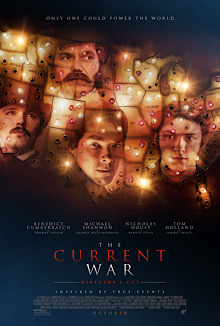
The Current War
In 1880, Thomas Edison has unveiled his electric lightbulb. He plans to distribute power to American neighborhoods using Direct Current (DC), which is cheaper and cleaner than gaslight, but is limited in range and needs an expensive wiring infrastructure. George Westinghouse, a successful business man and inventor himself, wishes to learn more, and invites Edison to dinner. After being snubbed by Edison, Westinghouse sets out to prove alternating current (AC) is the better technology, as it can work over greater distances and at significantly lower cost. Edison and Westinghouse compete to get cities across the United States to use their system. Westinghouse does an AC demonstration at Great Barrington in March 1886. Inventor Nikola Tesla arrives in the United States and begins working with Edison, but is disappointed by Edison's unwillingness to reconsider his ideas and to fulfill what Tesla thought was a financial promise which Edison passes off as just a joke. Tesla then leaves Edison's team. Edison fiercely guards his patents and sues Westinghouse. Edison suggests that AC is dangerous and engages in a publicity war, while Westinghouse stands behind its technical merits. As Edison struggles to find ways to make DC more affordable, Westinghouse attempts to get the high-voltage AC system to work with motors. Edison's wife dies, and Westinghouse is also struck by personal tragedy when his friend Franklin Pope dies in an electrical accident. Both face significant financial risk. To generate funds Edison commercially sells his speaking machine " The Phonograph ". To damage the reputation of AC, Edison shows that it easily electrocutes animals, and secretly works to help the creators of the electric chair, despite his previous objections to manufacturing weapons or other machines of death. The first person to die by electrocution is William Kemmler, and newspapers label the event as "Far Worse Than Hanging". Westinghouse discovers Edison's involvement and reveals it to the press. After an unsuccessful attempt to strike out on his own, Tesla is approached by Westinghouse to work together, and build a practical AC motor. Edison is increasingly marginalized and J. P. Morgan merges Edison Electric into General Electric. The competing systems come to a head as they both put forward proposals to illuminate the 1893 World's Columbian Exposition in Chicago. Samuel Insull presents the bid on behalf of Edison, and Westinghouse presents his competing bid. The fair is abundantly lit, and Westinghouse is successful. At the fair Westinghouse and Edison meet briefly. Edison discusses what it was like to achieve a great invention, and suggests that his next invention (motion pictures) could be so incredible that people might forget his name was ever associated with electricity.

Flubber
Absentminded professor Philip Brainard is developing a new energy source, hoping to save Medfield College from closure. His preoccupation with his research has caused him to miss two wedding dates, much to the ire of his fiancée, college president Sara Jean Reynolds. On their third attempted wedding day, Brainard is approached by his former partner Wilson Croft of rival Rutland College, who has profited from stealing his ideas and now intends to steal Sara. While preparing for the wedding, Brainard has a breakthrough with the help of his robot assistant Weebo, who is secretly in love with him. Their experiment results in a sentient green goo with enormous elasticity and kinetic energy, which wreaks havoc on the neighborhood before the professor recaptures it. Weebo classifies the substance as "flying rubber", leading Brainard to christen it "Flubber". Working on Flubber into the following morning, Brainard realizes too late that he has again missed his own wedding. He unsuccessfully attempts to explain his absence to a heartbroken Sara, leaving Brainard determined to prove Flubber's worth and win her back. Medfield College's wealthy sponsor Chester Hoenicker, who is threatening to close the school, sends his henchmen Smith and Wesson to persuade Brainard to give Hoenicker's entitled son Bennett a better grade. Brainard, too busy experimenting with Flubber, unknowingly subdues the goons with a Flubber-coated golf ball and bowling ball. Brainard also uses Flubber to enable his vintage Ford Thunderbird to fly, and overhears Wilson make a flirtatious bet with Sara about Medfield's upcoming basketball game against Rutland. Struggling to confess her feelings for the professor, Weebo creates a holographic human version of herself and tries to kiss a sleeping Brainard, but he awakens with another idea for Flubber. Sneaking into the vacant basketball arena, he tests the effects of Flubber on a basketball and his shoes, allowing him to bounce incredibly far. At the game, he secretly applies Flubber to the abysmally unskilled Medfield team, enabling them to beat Rutland, but his attempt to win back Sara fails. Meanwhile, a mischievous Weebo releases Flubber to dance around the house. Returning home, Brainard talks to Weebo, declaring that his absentmindedness is due to his love for Sara. Weebo, putting the professor's happiness before her own, shows Sara footage of Brainard's declaration, and the couple reconciles. Brainard demonstrates Flubber's abilities to Sara, but Hoenicker has discovered Flubber's profitable potential, offering to buy it and forgive the college's debt. Brainard and Sara refuse, making a deal with the Ford Motor Company instead and saving the college. Hoenicker sends Smith and Wesson to raid Brainard's house, where Weebo attempts to fend them off but is destroyed as they steal Flubber. Mourning the loss of his beloved robot, Brainard discovers a farewell video from Weebo along with a backup of herself, her "daughter" Weebette. Brainard and Sara confront Hoenicker under the guise of selling him additional Flubber, and discover he is in league with Wilson. Unleashing Flubber, Brainard and Sara defeat Wilson, the Hoenickers, and their henchmen. Sometime later, Brainard saves Medfield from closing with Flubber and the happy couple finally have a successful wedding and embark on their honeymoon to Hawaii in the flying Ford Thunderbird with Weebette and Flubber.

The Creeping Garden
The film describes the life and development of the various types of slime molds with the aid of experts and artists involved in their study. The directors involved Mark Pragnell, an amateur observer of slime mold who studies them in their natural element in the forest. Pragnell appears in several scenes in the film offering his observations. Also appearing in the film are a visual artist, a computer scientist, a composer and others who describe the creative use of slime molds in their fields. Eduardo Reck Miranda, a composer, is seen playing the piano, while "jamming" with sounds produced by the slime mold as it gets electrically stimulated. Mycologists, myxomycologists and robotics engineers also appear. Amongst other things, the film shows that the growth patterns of the molds have similarities to the development of highways connecting cities together.

The Hourglass Sanatorium
Joseph (Jan Nowicki) travels through a dream-like world, taking a dilapidated train to visit his dying father, Jacob, in a sanatorium. When he arrives at the hospital, he finds the entire facility is going to ruin and no one seems to be in charge or even caring for the patients. Time appears to behave in unpredictable ways, reanimating the past in an elaborate artificial caprice. Though Joseph is always shown as an adult, his behavior and the people around often depict him as a child. He befriends Rudolf, a young boy who owns a postage stamp album. The names of the stamps trigger a wealth of association and adventure in Joseph. Among the many occurrences in this visually potent phantasmagoria include Joseph re-entering childhood episodes with his wildly eccentric father (who lives with birds in an attic), being arrested by a mysterious unit of soldiers for having a dream that was severely criticized in high places, reflecting on a girl he fantasized about in his boyhood and commandeering a group of historic wax mannequins. Throughout his strange journey, an ominous blind train conductor reappears like a death figure. He also has a series of reflections on the Holocaust that were not present in the original texts, reading Schulz's prose through the prism of the author's death during World War II and the demise of the world he described.

The Enigma of Kaspar Hauser
The film follows Kaspar Hauser, who has lived the first seventeen years of his life chained in a tiny cellar with only a toy horse to occupy his time, devoid of all human contact except for a man wearing a black overcoat and top hat, who feeds him. One day, in 1828, the same man takes Hauser out of his cell, teaches him a few phrases, and how to walk, before leaving him in the town of Nuremberg. Hauser becomes the subject of much curiosity, and is exhibited in a circus before being rescued by Professor Georg Friedrich Daumer, who patiently attempts to transform him. Hauser soon learns to read and write, and develops unorthodox approaches to logic and religion; but music is what pleases him most. He attracts the attention of academics, clergy and nobility. He is then physically attacked by the same unknown man who brought him to Nuremberg. The attack leaves him unconscious with a bleeding head. He recovers, but is again mysteriously attacked; this time, stabbed in the chest. Hauser rests in bed describing visions he has had of nomadic Berbers in the Sahara, and then dies. An autopsy reveals an enlarged liver and cerebellum.