Movies (Page 172)
Browse 2,069 movies from the database, mentioned on Hacker News, ranked by rating or popularity.

Dark Waters
In 1998, Robert Bilott, from Cincinnati, is a corporate defense lawyer at law firm Taft Stettinius & Hollister. Wilbur Tennant, a farmer and friend of Bilott's grandmother, asks him to investigate the deaths of numerous dairy cattle at his farm in Parkersburg, West Virginia. Tennant connects the deaths to chemical manufacturing corporation DuPont and gives Robert a large case of videotapes related to the case. Robert visits the Tennants' farm, where he learns that 190 cows have died after exhibiting unusual medical conditions, including bloated organs, blackened teeth, and tumors. DuPont attorney Phil Donnelly says he is not aware of Tennant's concerns, but will help in any way he can. Bilott files a small suit to gain information through legal discovery of the chemicals dumped at a nearby landfill. When he finds nothing useful in the EPA report, he realizes the chemicals might be unregulated. Bilott confronts Donnelly at an industry event, leading to an angry exchange. In response to Bilott's request to broaden discovery, DuPont sends hundreds of boxes. Bilott finds numerous references to something called "PFOA", and with difficulty learns that it is perfluorooctanoic acid, which DuPont uses to manufacture Teflon, a substance widely used in nonstick frying pans and carpeting. The company has been running tests of the effect of PFOA for decades, finding that it causes cancer and congenital disabilities, but kept the findings private. Dupont dumped several tons of toxic sludge in a landfill uphill from Tennant's farm. PFOA and similar compounds are forever chemicals, which slowly accumulate and never leave the bloodstream. The local community shuns Tennant for suing their most significant employer. Bilott encourages him to accept DuPont's settlement, but he refuses, wanting justice, and reveals that both he and his wife have cancer. Bilott sends a summary and supporting documentation of the DuPont issues to the EPA and United States Department of Justice, among others. The EPA fines DuPont $16.5 million. Bilott is unsatisfied, as he realizes the residents of Parkersburg will continue to suffer the effects of the PFOA and more will likely die from disease. He seeks an agreement for DuPont to pay for medical monitoring for all residents of Parkersburg in one large class-action lawsuit. However, DuPont sends a deceptive letter notifying residents of the presence of PFOA, thus starting the statute of limitations running, giving any further legal action only 12 months to begin. Since PFOA is unregulated, Robert's team argues that the corporation is liable, as the amount in contaminated waters was 6 times higher than the 1 part per billion deemed safe by DuPont's internal documents. In court, DuPont claims that the West Virginia Department of Environmental Protection has recently found that 150 parts per billion are safe (contradicting DuPont's scientific findings since the 1970s). The locals protest, and the story becomes national news. DuPont agrees to settle for benefits valued at over $300 million. It is agreed in mediation that the company will carry out medical monitoring only if it is proven that PFOA caused the ailments, and an independent science panel is set up. To gather data, Robert's team tells locals they can get their settlement money after they donate blood samples for testing. Nearly 70,000 people donate to the study. Seven years pass with no results from the science panel. Tennant dies, and Bilott suffers financially following several pay cuts, since the case is not providing revenue. His marriage and health are strained. Finally, the science panel contacts Bilott and tells him that they have linked PFOA exposure to an increased incidence of two types of cancer and four other diseases in Parkersburg. His celebration is short-lived, however, as DuPont decides to withdraw from the mediated agreement. Bilott defiantly decides to sue the company separately for each Parkersburg resident with an illness that would have been covered by the medical monitoring (which currently includes over 3,500 individuals), and juries award his first three clients multi-million dollar settlements. In response, DuPont settles the remaining cases for $671 million.

Pi
Unemployed number theorist Max Cohen, who lives in a drab apartment in Chinatown, Manhattan, believes everything in nature can be understood through numbers. He suffers from cluster headaches, extreme paranoia, hallucinations, and schizoid personality disorder. His only social interactions are with his mathematics mentor, Sol Robeson (now disabled from a stroke), and those who live in his building: Jenna, a little girl fascinated by his ability to perform complex calculations, and Devi, a young woman living next door who sometimes speaks with him. Max tries to program his computer, named Euclid, to make stock predictions. Euclid malfunctions, printing out a seemingly random 216-digit number, as well as a single stock pick at one-tenth its current value, then crashes. Disgusted, Max throws away the printout. The next morning, he learns that Euclid's pick was accurate but cannot find the printout. When Max mentions the number, Sol becomes unnerved and asks if it contained 216 digits. He reveals that he came across the same number years ago and urges Max to take a break from his work. Max meets Lenny Meyer, a Hasidic Jew who does mathematical research on the Torah. Lenny demonstrates some simple Gematria, the correspondence of the Hebrew alphabet to numbers, and explains that some people believe the Torah is a string of numbers forming a code sent by God. Intrigued, Max notes that some of the concepts parallel other mathematical concepts, such as the Fibonacci sequence. Agents of a Wall Street firm approach Max. One of them, Marcy Dawson, offers him a classified computer chip called "Ming Mecca" in exchange for the results of his work. Using the chip, Max has Euclid analyze mathematical patterns in the Torah. Once again, Euclid displays the 216-digit number before crashing. As Max writes down the number, he realizes that he knows the pattern, undergoes an epiphany, and loses consciousness. After waking up, Max appears to become clairvoyant and visualizes the stock market patterns he sought. His headaches intensify, and he discovers a vein-like bulge protruding from his right temple. Max has a falling-out with Sol after Sol urges him to quit his work. Dawson and her agents grab Max on the street and try to force him to explain the number, having found the printout Max threw away. Attempting to use the number to manipulate the stock market, the firm instead caused the market to crash. Driving by, Lenny rescues Max, but takes him to his companions at a nearby synagogue. They ask Max to give them the 216-digit number, believing it was meant for them to bring about the Messianic Age, as the number represents the unspeakable name of God. Max refuses, insisting the number has been revealed to him alone. Max flees and visits Sol, only to learn from his daughter, Jenny, that he died from another stroke. He finds a piece of paper with the number in his study. At his own apartment, Max experiences another headache but does not take his painkillers. Believing the number and the headaches are linked, Max tries to concentrate on the number through his pain. After passing out, Max goes to the bathroom where he stares at himself in the mirror before lighting a match and burning the piece of paper with the number. Max then takes a power drill to his own head, trepanning himself in an effort to find relief. Sometime later, Jenna approaches Max in a park and asks him to do several calculations, including 748 ÷ 238 (an approximation for pi). Max smiles and says that he does not know the answer, seemingly at peace.

Surrogates
In 2017, widespread use of remotely controlled androids called "surrogates" enables people to operate an idealized body (a more youthful version of their own, or a wholly different one) from the safety of their homes, becoming slovenly and housebound as a consequence. Protected from harm, a surrogate's operator can indulge in risky behaviour, and they can make their surrogate perform acrobatics beyond human capability. In Boston, FBI agent Tom Greer has been estranged from his wife Maggie since their son's death in a car crash several years before. He never sees her outside of her surrogate and she criticizes his desire to interact via their real bodies. Tom and his partner, Agent Jennifer Peters, investigate the death of two people who were killed when their surrogates were destroyed at a Fort Point club. Jared Canter, one of the victims, is the son of Dr. Lionel Canter, the inventor of surrogates and the former head of their manufacturing company, Virtual Self Industries (VSI). The two determine that a human, Miles Strickland, used a new type of weapon to overload the surrogates' systems and kill their operators. After locating Strickland, Tom attempts to bring him into custody. Strickland uses the weapon, killing six police officers, and injures Tom during the chase; Tom inadvertently crash-lands into an anti-surrogate zone known as the Dread Reservation (one of many throughout the US). A mob helps Strickland and destroys Tom's surrogate. The Dread leader, a man known as the Prophet, kills Strickland and confiscates the weapon. With his surrogate destroyed, Tom is forced to interact in the world without one. He learns that VSI originally produced the weapon, designed to load a virus that overloads a surrogate's systems, thus disabling it, under a government contract. Unexpectedly, the weapon also disabled the fail-safe protocols protecting operators. The project was promptly scrapped and all prototypes supposedly destroyed. Tom also learns that Andrew Stone, his FBI superior, supplied the weapon to Strickland and ordered Dr. Canter's assassination, upon VSI's request, for his criticism of surrogate use. Jared, who had, unbeknownst to the assassin, been using one of his father's many surrogates, was killed instead. An unknown man murders Jennifer in her home and then hijacks her surrogate, and the Prophet orders the weapon delivered to her. During a military raid on the reservation, the Prophet is shot, revealing he was actually a surrogate, with audience learning that Canter himself was its operator. Tom steals the code that activates the weapon from Stone, but "Jennifer" escapes with the codes. Immediately travelling to Canter's home, Tom discovers that Canter has been controlling not only the Prophet, but also Jennifer and the surrogate he used to kill Jennifer as well. Using Jennifer's surrogate in FBI Headquarters, Canter uses the weapon to kill Stone. Considering all surrogate users irredeemable, he proceeds to upload the virus to all surrogates, which will destroy them and kill their operators. Canter reveals that he only wanted to empower the disabled to live normal lives, but after he was fired from VSI, they capitalized on surrogacy for profit. Convinced his plan is unstoppable, Canter disconnects from Jennifer's surrogate and swallows a cyanide pill. Tom takes control of Jennifer's surrogate and, with the assistance of the network's system administrator, Bobby Saunders, insulates the virus so the operators will survive, but a second step is required to save the surrogates. After a moment of consideration, Tom chooses to let the virus permanently disable surrogates worldwide. With all the surrogates disabled, people emerge from their homes, confused and afraid. Returning home, Tom shares an emotional embrace with Maggie in her real form. The film ends with an aerial view of the collapsed surrogates along with overlapping news reports of downed surrogates all over the world and how people are now "on their own" again.

Primer
Two engineers, Aaron and Abe, supplement their day jobs with entrepreneurial tech projects, working out of Aaron's garage. During one such research effort involving electromagnetic reduction of objects' weight, the two men accidentally discover an 'A-to-B' causal loop side-effect: objects left in the weight-reducing field exhibit temporal anomalies, proceeding normally (from time 'A,' when the field was activated, to time 'B,' when the field is powered off), then backward (from 'B' back to 'A') in a continuously repeating sequence, such that objects can leave the field in the present, or at some previous point. Abe refines this proof-of-concept and builds a stable time-apparatus ("the box"), sized to accommodate a human subject. Abe uses this box to travel six hours into his own past—as part of this process, Abe stays in a hotel room, isolating himself from any communication with the outside world, so as not to interact or interfere with the outside world, after which he enters the box then waits inside for six hours (thus going back in time six hours). Once he exits the box, Abe travels across town, explains the proceedings to Aaron, and brings Aaron back to the self-storage facility housing the box. At the facility, they watch the earlier version of Abe enter the box. Abe and Aaron repeat Abe's six-hour experiment multiple times over multiple days, making profitable same-day stock trades armed with foreknowledge of the market's performance. The duo's divergent personalities – Abe cautious and controlling, Aaron impulsive and meddlesome – put subtle strain on their collaboration and friendship. Additionally, the time travel is taxing on Abe and Aaron's bodies: effectively their days become 36 hours long when including the extra time afforded by the box. As the film progresses, the two men begin to notice alarming side effects of time travel which take the form of earbleeds. Later, they notice their handwriting progressively worsening. The tension between Abe and Aaron comes to a head after a late-night encounter with Thomas Granger (father to Abe's girlfriend, Rachel), who appears inexplicably unshaven and exists in overlap with his original suburban self. Granger falls into a comatose state after being pursued by Aaron; Aaron theorizes that, at some unknown point in the future, Granger entered the "box", with timeline-altering consequences. Abe concludes that time travel is simply too dangerous and enters a secret second box (the "failsafe box", built before the experiment began and kept continuously running), traveling back four days to prevent the experiment's launch. Cumulative competing interference wreaks havoc upon the timeline. Future-Abe sedates Original-Abe (so he will never conduct the initial time travel experiment) and meets Original-Aaron at a park bench (so as to dissuade him), but finds that Future-Aaron has gotten there first (armed with pre-recordings of the past conversations, and an unobtrusive earpiece), having brought a disassembled "third failsafe box" four days back with his own body. Future-Abe faints at this revelation, overcome by shock and fatigue. The two men briefly and tentatively reconcile. They jointly travel back in time, experiencing and reshaping an event where Abe's girlfriend Rachel was nearly killed by a gun-wielding party crasher. After many repetitions, Aaron, forearmed with knowledge of the party's events, stops the gunman, becoming a local hero. Abe and Aaron ultimately part ways; Aaron considers a new life in foreign countries where he can tamper more broadly for personal gain, while Abe states his intent to remain in town and dissuade/sabotage the original "box" experiment. Abe warns Aaron to leave and never return. Multiple "box-aware" versions of Aaron circulate—at least one Future-Aaron has shared his knowledge with Original-Aaron, via discussions, voice-recordings, and an unsuccessful physical altercation. Future-Abe watches over Original-Abe, going to painstaking extremes to keep him unaware of the future. An Aaron directs French-speaking workers in the construction of a warehouse-sized box.

In Time
In 2169, people are genetically engineered to stop aging on their 25th birthday, when a one-year countdown on their forearm begins. When it reaches zero, the person "times out" and dies instantly.Time has thus become the universal fiat currency, transferred directly between people or stored on flashdrive type devices, some in secure bank vaults. Distinct socioeconomic caste "Time Zones" exist; Dayton is the poorest, a manufacturing hub and "ghetto" where people rarely have over 24 hours on their clocks, whereas in New Greenwich, the affluent Zone of plutocrats, people have enough time to be essentially immortal. Will Salas (Timberlake) is a 28-year-old Dayton factory worker who lives with his mother, Rachel. One night, he rescues a drunken 105-year-old Henry Hamilton, from Fortis and his Minutemen gangsters, a group of time-robbing thugs. Hamilton, who has 116 years on his clock, reveals to Will that the people of New Greenwich hoard most of the time, while constantly increasing prices to impoverish people in less prosperous districts. The next morning, he transfers all but 5 minutes of his time to a sleeping Will, then times out before Will can stop him. Raymond Leon, the leader of police-like "Timekeepers", erroneously assumes Will robbed Hamilton. Heeding his friend Borel's warning against possessing excess time in Dayton, Will donates 10 years (the length of their friendship) to him before departing, planning to relocate to New Greenwich with Rachel.However, that night, Rachel suddenly finds herself with insufficient bus fare to return to Dayton, having exhausted her earnings from two days' work in the Garment District to liquidate a two-day loan. The ambivalent driver advises her to run, but she arrives a few seconds too late for Will to rescue her and times out in his arms. The next morning, he furiously decides to avenge her death by visiting New Greenwich, internalizing Hamilton's words regarding the inequity of the Time System. Arriving in New Greenwich in style, Will meets Philippe Weis, a time-loaning businessman, and his daughter Sylvia at a casino. While playing poker, Will nearly times out but eventually wins a millennium. Sylvia invites him to a party that night at her father's. Will then purchases a classic Jaguar E-Type convertible for 59 years of his time (plus tax, the salesman tells him) and drives it to the party. Will dances with Sylvia and convinces her to swim in the ocean, something that, out of fear, the rich never do. Timekeepers later arrive and detain Will, who claims his innocence in Hamilton's death. Rather than attempting to prove Will's guilt, Raymond simply confiscates all but two hours of Will's time, explaining it does not belong in Dayton. Will escapes, taking Sylvia hostage and driving back to Dayton in the Jag. Fortis's gang sets up a roadblock which causes Will to crash into a flood control channel, knocking them unconscious. The gang arrives and steals most of their time, leaving Will and Sylvia with only 30 minutes each. They abandon the wrecked car and visit Borel's residence to retrieve some spare time but, his wife Greta tearfully explains that he has drunk himself to death. As their time is running out, the two obtain a day each by pawning Sylvia's diamond earrings. Will then calls Philippe to request a 1,000-year ransom to be paid into the time-mission for the desperate, releasing Sylvia when he declines. Raymond encounters Will, but when Sylvia accidentally shoots him in the shoulder, Will transfers two hours to Raymond, allowing him to survive long enough for his squad to retrieve him, and purloins his car. Now committed to crashing the system, Will and Sylvia rob Weis time banks, donating the extra capsules to the destitute, but soon realize that prices are simply increased to compensate for the extra time. Wanted and on the lam they rent out an entire hotel to hide.Fortis's gang finds them, but Will successfully times out Fortis in a wrist wrestling match by using his deceased father's technique and kills his Minutemen. He and Sylvia then decide to rob Philippe's vault of a 1,000,000-year capsule. Raymond pursues them from New Greenwich to Dayton, where he was born but eventually escaped, but fails to stop them from distributing the stolen time. Having neglected to collect his per diem, he times out. Will and Sylvia nearly time out themselves, but survive by taking Raymond's salary. Television reports show factories in Dayton shutting down as everyone abandons their jobs due to possessing sufficient time to sustain themselves. Having witnessed the consequences of Raymond's obsession with the pair, his colleague Jaeger orders the Timekeepers to return home. Will and Sylvia progress to larger banks, still attempting to level the system.

Antitrust
Working with his three friends at their new software development company Skullbocks, Stanford graduate Milo Hoffman is recruited by Gary Winston, the CEO of the software corporation NURV. Milo is offered an attractive programming position with a large paycheck, an almost-unrestrained working environment, and extensive creative control over his work. After accepting, Hoffman and his girlfriend, Alice Poulson, move to NURV headquarters in Portland, Oregon. Despite development of the flagship product (Synapse, a worldwide media distribution network) being well on schedule, Hoffman soon becomes suspicious of the excellent quality source code that Winston personally provides to him, seemingly when needed most, while refusing to divulge the code's origin. After his best friend and fellow computer programmer, Teddy Chin, is murdered, Hoffman discovers that NURV is stealing the code they need from programmers around the world—including Chin—and then killing them. NURV not only employs an extensive surveillance system to observe and steal code, the company has infiltrated the Justice Department and most mainstream media. Even Hoffman's girlfriend is a plant, an ex-con hired by the company to spy on and manipulate him. In a secret NURV database of employee surveillance dossiers, Hoffman discovers highly-sensitive personal information about Lisa Calighan, a friendly co-worker. When he says he knows the company has this information about her, she agrees to help him expose NURV's crimes. Coordinating with Brian Bissel, Hoffman's old start-up friend, they plan to use a local public-access television station to hijack Synapse and globally broadcast their charges against NURV. However, Calighan is actually Winston's accomplice and foils Hoffman. When the plan fails, and as Winston prepares to kill Hoffman, a backup plan is put into motion. Off-screen, Hoffman had previously confronted and convinced Poulson to turn against NURV; she, the fourth member of Skullbocks, and NURV's incorruptible security contractors usurp one of NURV's own work centers—"Building 21"—and transmit incriminating evidence with the Synapse code. Calighan, Winston, and his entourage are arrested by the FBI for their crimes. After amicably parting ways with the redeemed Poulson, Hoffman rejoins Skullbocks.
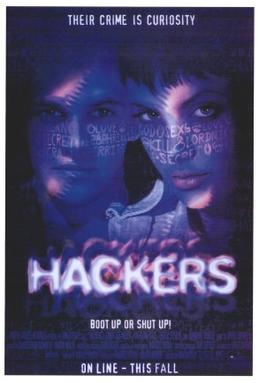
Hackers
In 1988, 11-year-old Dade "Zero Cool" Murphy is banned from owning or operating computers and telephones until his 18th birthday, after his family is fined US$ 45,000 for his crashing of 1,507 computer systems, causing a 7-point drop in the NYSE. On his 18th birthday, Dade has moved to New York City with his mother, and his ban is lifted. While he hacks into a local TV station, another hacker by the handle of "Acid Burn" counters Dade's attack and eventually kicks him out. At school, Dade joins a group of hackers: Ramon "The Phantom Phreak" Sanchez, Emmanuel "Cereal Killer" Goldstein, Paul "Lord Nikon" Cook, Joey Pardella (a novice hacker without an alias and the youngest member), and Kate "Acid Burn" Libby—the hacker who kicked him out of the TV station earlier. Joey, out to prove his skills, breaks into a "Gibson" supercomputer owned by the Ellingson Mineral Corporation. While he is downloading a garbage file as proof of his feat, his mother disconnects his computer, leaving him with a fragmented file. His intrusion has been noticed and brought to the attention of computer security officer Eugene "The Plague" Belford, a former hacker. Plague realizes that the downloaded garbage file is a worm he himself inserted to defraud Ellingson. Claiming the file is the code to the "Da Vinci" computer virus that will capsize the company's oil tanker fleet, and pretending the hackers are to blame, he enlists the U.S. Secret Service to recover the file. In fact, Plague had inserted the "Da Vinci" virus as a red herring to cover for his worm. Joey is arrested and his computer is searched, but he had hidden the disk containing the file. Dade and Kate make a bet: Dade chooses a date with Kate if he wins, and Kate has Dade be her slave if she does. The hacking duel targets Secret Service Agent Richard Gill, who was involved in Joey's arrest. After various hacks, including canceling Gill's credit cards, fabricating a criminal record, and changing his payroll status to "deceased", the duel remains a tie. Released on bail, Joey reveals the disk to Phreak, who is arrested the next day, and informs Kate that the disk is hidden in a bathroom at school. Dade refuses to help Kate and Cereal Killer as he has a record, but copies the disk so they have untampered evidence. Determining that Dade did not hack into Ellingson, Plague sends him a powerful laptop and asks Dade to join him. He later threatens to have Dade's mother incarcerated with a manufactured criminal record, forcing Dade to deliver a copy of the disk. Kate, Lord Nikon, Cereal Killer, and Dade learn that the code is a worm designed to steal $25 million from Ellingson transactions, and that the Da Vinci virus is set to capsize the oil tanker fleet the next day to provide cover and distract from the worm. Dade confesses that he gave Plague a copy of the disk and reveals his hacking history as "Zero Cool". Dade and Kate seek out Razor and Blade, producers of Hack the Planet, a hacker-themed TV show. Lord Nikon and Cereal Killer learn that warrants for their arrest are to be executed at 9 a.m. the next day. The next morning, Dade, Kate, Nikon, and Cereal roller-blade from Washington Square Park, evading the Secret Service by hacking the traffic lights. Meeting up with Joey at Grand Central Terminal, they use payphones and acoustic couplers to hack the Gibson. At first, their attempts are easily rebuffed by Plague, who calls Dade to taunt him. Razor and Blade have contacted hackers around the world, who lend their support and distract Plague long enough for Joey to download the file. After crashing the Gibson, Dade and company are arrested. Dade cryptically informs Cereal Killer that he has tossed the disk in a trash can. As Dade and Kate are being interrogated, Razor and Blade jam TV signals and broadcast live video of Cereal Killer revealing the plot and Plague's complicity. Plague is arrested by Gill on board a flight while attempting to flee to Japan. Their names cleared, Dade and Kate begin a relationship.

The Congress
Robin Wright is an aging actress whose career suffered because of her erratic behavior and reputation for being fickle and unreliable. Her son, Aaron, suffers from Usher syndrome, which is slowly destroying his sight and hearing. Aided by Dr. Barker, Robin barely manages to stave off the worst effects of Aaron's decline, although his condition is sliding into its terminal stage. Robin's longtime agent, Al, takes her to meet Jeff Green, the CEO of Miramount Studios, a film studio that offers to buy her likeness and digitize her into a computer-animated version of herself. Realizing that she may be unable to find future work with the emergence of this new technology, Robin agrees to do it for a hefty sum of money. The contract also requires that she never act again. After her body is digitally scanned, the studio can make films starring her, using only computer-generated characters. Twenty years later, Robin travels to Abrahama City, where she will speak at the "Futurological Congress", Miramount's entertainment conference. Abrahama City is an animated, surreal utopia that is created from figments of people's imaginations, where anyone can become an animated avatar of themselves but must use hallucinogenic drugs to enter a mutable illusory state. In the decades since she was scanned, Robin's virtual persona has become the star of a popular film franchise, Rebel Robot Robin, making her and Tom Cruise the only remaining movie stars. While discussing her new contract with Jeff, Robin learns that Miramount developed a new technology that will allow anyone to devour her or possibly transform themselves into her with the hallucinogen. Robin agrees to the deal, but has a crisis of conscience, believing that no one should be turned into a product. When asked to speak to the public at the Congress, Robin publicly voices her contrary views, upsetting everyone there before being taken by security guards. The Congress is then interrupted by rebels opposed to the technology industry. They seemingly assassinate the head of the Congress. During the attack, Robin is rescued by Dylan Truliner, who was Miramount's lead animator for her films. They escape, but she is soon captured by "Miramount Police". Robin is seemingly executed by Jeff as a punishment for rebelling against Miramount and the Congress. Robin is shown on a hospital bed while doctors discuss her case. One doctor reveals that Robin's execution was her hallucinating, that her rescuers were from Miramount. The doctors decide that Robin has become so intoxicated by the hallucinogen that she must be frozen until a treatment for her condition can be found. Twenty years later, Robin is revived while still hallucinating an animated world. She reunites with Dylan, who says that the hallucinogenic technology is now widespread. People can take on whatever form they wish through it and as a result many negative aspects of humanity no longer exist. Dylan and Robin fall in love and take a journey through a colorful imaginary world. However, Robin is still desperate to return to the real world and be with Aaron. The only way to do that is by using a capsule that blocks all hallucinogenic effects. It is, in the animated world, equivalent to a suicide capsule. Dylan negotiated for one as part of his forced retirement package from Miramount, and he gives it to Robin. Re-entering the real world, Robin finds herself in a dystopian environment. A tiny elite hovers over ruined cities in large airships. Most people have left for an existence in the animated world. Aaron did it only six months earlier when his condition left him virtually blind and deaf and he had given up hope of Robin's return. Because Aaron likely created a new identity for himself in the animated world, there is no way for anyone to find him. Dr. Barker gives Robin an inhalation ampoule that will allow her to return to the animated world, though as her experiences have changed, her hallucinations will as well, and she will never be able to re-enter the same world she had left. Taking the drug, Robin sees Aaron's entire life flash before her eyes. She eventually discovers Aaron in the middle of an animated desert.

Sneakers
In 1969, student hackers and long-time friends Martin Brice and Cosmo use their skills to reallocate money from causes they consider evil to underfunded ones that help the world. When Martin steps out to get pizza, the police arrive and arrest Cosmo, forcing Martin into hiding. Decades later in San Francisco, Martin, now living under the alias Martin Bishop, leads a penetration testing security team that includes former CIA operative Donald Crease, technician and conspiracy theorist Darren "Mother" Roskow, hacking prodigy Carl Arbogast, and blind phone phreaker Irwin "Whistler" Emery. NSA agents approach Martin and reveal they know his true identity. They offer to clear his record if he recovers a Russian-funded black box device, codenamed Setec Astronomy, from mathematician Gunter Janek. With help from ex-girlfriend Liz, Martin and his team steal the device, only to discover it is a codebreaker capable of penetrating even the most secure networks. Realizing that "Setec Astronomy" is an anagram of "too many secrets", Crease locks everyone in the office until it can be handed over to the NSA. The next day, Martin delivers the box to the agents but flees after learning Janek was murdered the night before. The team realizes the box was actually funded by the NSA and that the supposed agents are impostors. Martin's friend Gregor, a Russian consulate spy, identifies one as a former NSA agent now working for a crime syndicate. Men posing as FBI agents arrive, kill Gregor with Martin's gun to frame him, and abduct Martin. He awakens in an unknown location, where the impostors are revealed to be working for Cosmo. Released early from prison for his hacking skills, Cosmo was recruited by the syndicate to manage its illicit finances. He wants the box to complete what he and Martin began in 1969: erasing financial and ownership records to make the rich and poor equals. He invites Martin to join him, but Martin rejects the plan as too extreme. In retaliation, Cosmo uses the box to access FBI systems, exposing Martin's identities and branding him a fugitive once more. Martin and his team contact NSA operations director Bernard Abbott, who agrees to help if they can recover the box. Using sounds Martin recalls from his abduction, Whistler pinpoints Cosmo's office inside the PlayTronics toy company. While researching the building's security, the team identifies employee Werner Brandes and manipulates a dating service to pair him with Liz. During their date, she steals his access codes, allowing Martin to infiltrate PlayTronics. Brandes grows suspicious and takes Liz to his office, where Cosmo realizes her link to Martin. He locks down the facility and takes her hostage. Martin surrenders and hands over the box, but again rejects Cosmo's plea to join him. The group escapes and exits the building, only to be confronted by Cosmo again. Unable to kill his old friend, Cosmo lets Martin and the team leave, only to discover Martin has given him an empty box. Back at their office, Martin's team is confronted by Abbott and his agents. Martin realizes the box could be used by the NSA to infiltrate U.S. systems such as the FBI and the White House. To secure their silence, Abbott agrees to their demands: clearing Martin's record, funding a vacation for Crease and his wife, buying Mother a Winnebago, and giving Carl the phone number of an attractive NSA agent. After the agents depart, Martin reveals the box is useless; he has removed its core component. A news report announces the sudden bankruptcy of the Republican National Committee and the simultaneous receipt of large anonymous donations to Amnesty International, Greenpeace, and the United Negro College Fund.

Brazil
In a dystopian, polluted, hyper- consumerist, overbearing, bureaucratic, totalitarian future based on elements of the 20th century, Sam Lowry is a low-level government employee who frequently dreams of himself as a winged warrior saving a damsel in distress. One day, shortly before Christmas, an insect becomes jammed in a teleprinter, which misprints a copy of an arrest warrant it was receiving. This leads to the arrest and death during interrogation of cobbler Archibald Buttle instead of suspected terrorist Archibald Tuttle. Sam discovers the mistake when he finds that the wrong bank account has been debited for the arrest. He visits Buttle's widow to give her the refund where he catches a glimpse of her upstairs neighbour Jill Layton, a truck driver, and is astonished to discover that she resembles the woman from his dreams. He frantically tries to approach Jill, but she disappears before he can find her. Jill has been trying to help Mrs Buttle establish what happened to her husband, but her efforts have been obstructed by bureaucracy. Unbeknownst to her, she is now considered a terrorist accomplice of Tuttle for attempting to report the wrongful arrest of Buttle. Meanwhile, Sam reports a fault in his apartment's air conditioning. Central Services are uncooperative, but Tuttle unexpectedly comes to his assistance. Tuttle explains that he used to work for Central Services but left because of his dislike of the tedious and repetitive paperwork, and now illegally works as a freelance heating engineer. Tuttle repairs Sam's air conditioning, but when two Central Services workers, Spoor and Dowser, arrive, Sam has to stall to avoid Tuttle's. Sam discovers that Jill's records have been classified and the only way to access them is to be promoted to Information Retrieval. He had previously turned down a promotion arranged by his well-connected mother Ida, who is obsessed with the rejuvenating plastic surgery of cosmetic surgeon Dr Jaffe. Sam retracts his refusal by speaking with Deputy Minister Eugene Helpmann at a party hosted by Ida. After obtaining Jill's records, Sam tracks her down before she can be arrested. Sam clumsily confesses his love to Jill, and they cause mayhem as they escape government agents. They stop at a mall and are frightened by a terrorist bombing (part of a campaign that has been occurring around the city). Following an altercation with the government agents which arrived to the scene of the bombing, he awakens in a prisoner transport vehicle. At work, Sam is chastised by his new boss Mr Warrenn for his lack of productivity. He returns home to find that Spoor and Dowser have repossessed his apartment. Tuttle appears in secret and helps him exact revenge on the two Central Services workers by filling their environment suits with raw sewage. Jill finds him outside his apartment, and the two take refuge in Ida's unoccupied home, where they share their first kiss. He falsifies government records to indicate her death, allowing her to escape pursuit. The two spend the night together, but in the morning are apprehended by the government at gunpoint. Sam learns that Jill was killed during his arrest. Charged with a number of crimes, he is restrained in a chair in a large, empty cylindrical room, to be tortured by his old friend Jack Lint. As Jack is about to start the torture, Tuttle and other members of the resistance break into the Ministry, shooting Jack, rescuing Sam and blowing up the Ministry building. Sam and Tuttle flee together, but Tuttle mysteriously disappears amid a mass of scraps of paperwork from the destroyed building. Sam stumbles into the funeral of Ida's friend, who has died following botched cosmetic surgery. He discovers that his mother now resembles Jill and is too busy being fawned over by young men to care about her son's plight. Government agents disrupt the funeral, and he falls into the open casket. Through a black void, he lands in a street from his daydreams and tries to escape police and monsters by climbing a pile of flex-ducts. Opening a door, he passes through it and is surprised to be in a truck driven by Jill. The two leave the city together. However, this "happy ending" is a delusion: it is revealed that Sam is still strapped to the torture chair. Realising that he has been permanently driven insane, Jack and Mr Helpmann declare him a lost cause and leave the room. He remains in the chair, smiling and humming " Aquarela do Brasil " to himself.

Office Space
Peter Gibbons is a frustrated and unmotivated programmer who works at software company Initech. Unable to stand up to his overcritical girlfriend, Anne, he is in love with local waitress Joanna, but is afraid to speak to her. He is friends with co-workers Samir Nagheenanajar, who hates that no one can pronounce his last name, and Michael Bolton, who hates having the same name as the famous singer. Other co-workers include Milton Waddams, a meek collator who mumbles to himself and is mostly ignored by the rest of the office; and Tom Smykowski, a jaded product manager who is routinely scared of being fired. The staff suffers under top-heavy, callous management, especially from vice president Bill Lumbergh, a tedious micromanager who regularly humiliates Milton and makes Peter work almost every weekend. Peter hates Lumbergh but avoids confronting him. Anne persuades Peter to attend an occupational hypnotherapy session led by Dr. Swanson. Swanson hypnotizes Peter and tells him to feel relaxed and stop caring about his job until he snaps his fingers. However, Swanson suddenly dies of a heart attack before snapping Peter out of it. Peter sleeps soundly through the next day, ignoring phone calls from Lumbergh and Anne, who angrily breaks up with him while confirming his suspicions that she has been cheating on him. Two business consultants are brought in to help the company downsize, and Peter begins dating Joanna. She works at a chain restaurant where she is required to wear "pieces of flair": buttons allowing employees to "express themselves". Her boss hassles her for not wearing more than the required minimum. Peter eventually shows up to work and casually disregards office protocol, stealing Lumbergh's parking space, violating the dress code, and removing a cubicle wall that blocks his view out the window. Impressed by Peter's frank insights into Initech's problems, the consultants promote him despite Lumbergh's misgivings; however, they lay off Michael, Samir, and Tom. While attempting to do the same to Milton, they learn that he had already been laid off five years prior but had not been notified and was still receiving his salary due to a payroll glitch. They fix the glitch and stop Milton's salary payments without telling him, while Lumbergh continues to mistreat him by confiscating his beloved red stapler and repeatedly relocating his desk, eventually down to the basement. Tired of their own mistreatment, Peter, Michael, and Samir decide to take revenge by infecting Initech's accounting system with a computer virus designed by Michael to divert huge numbers of fractions of pennies into a bank account. Peter successfully installs the virus, and on Michael and Samir's last day, he steals a frequently malfunctioning printer, which the three proceed to destroy in a field. They also learn that Tom attempted suicide prior to being laid off, but then changed his mind, and in the process got into an accident that resulted in him winning a large amount of money in damages from a lawsuit. At a party at Tom's house, Peter hears rumors from a colleague that Joanna had slept with Lumbergh. When Joanna confirms this, a heated exchange leads to them breaking up. Frustrated with her job, Joanna quits in response to another lecture about her lack of "flair", giving her boss the middle finger as she does so. On Monday, Peter discovers that a bug in Michael's code has caused the virus to steal over $300,000 across the weekend, which guarantees they will be caught and sent to federal prison. Unable to conceal the crime, Peter decides to accept full responsibility, writing a confession and slipping it under Lumbergh's office door after hours, along with traveler's checks for the stolen money. Peter learns that the 'Lumbergh' with whom Joanna slept was Ron Lumbergh, another software engineer unrelated to Bill Lumbergh. He meets Joanna, who has started a new job at another restaurant, to apologize, and they reconcile. The next morning, Peter drives to Initech to turn himself in, but the problem has solved itself: Milton has committed arson and burned down the building as an act of revenge against the company. With the evidence of his crime destroyed, Peter begins his new job working in construction with his neighbor Lawrence, while Samir and Michael join Initech's rival, Initrode. Having found the traveler's checks, Milton escapes to Mexico but continues to be denied respect.

The Lives of Others
In 1984 East Germany (GDR), Stasi Hauptmann Gerd Wiesler, code name HGW XX/7, is ordered by his friend and superior, Lt. Col. Anton Grubitz, to spy on playwright Georg Dreyman, whose pro- communist politics and international recognition have so far kept the state from directly monitoring him. Dreyman's apparent life as a model East German mystifies Wiesler; the playwright has no known vices or record of disloyalty or dissent at all. At the request of Minister of Culture Bruno Hempf, Wiesler and his team bug Dreyman's apartment, set up surveillance equipment, and report Dreyman's activities. Wiesler is disappointed to discover that Hempf is having Dreyman observed not for suspicions of disloyalty or dissent, but for his own lustful interest in Dreyman's girlfriend, actress Christa-Maria Sieland. After an intervention by Wiesler leads to Dreyman discovering Hempf's coercive relationship with Sieland, he implores her not to meet Hempf again and to be true to herself. She returns to Dreyman's apartment without seeing Hempf. Dreyman's friend Albert Jerska, a blacklisted theatrical director, gives him sheet music for Sonate vom Guten Menschen (Sonata about Good People). Shortly afterwards, Jerska hangs himself. Dreyman realises that the GDR has not published its suicide rates since 1977, and decides to publish an article in Western media. To determine whether or not his flat is bugged, Dreyman and his friends feign a defection attempt. A sympathetic Wiesler does not report it and the conspirators believe they are safe. Since all East German typewriters are registered and identifiable, an editor of prominent West German newsweekly Der Spiegel smuggles Dreyman a Groma Büromaschinen Kolibri, an ultra-flat typewriter, which he hides under a floorboard. It has only a red ribbon, which stains his fingers. Dreyman publishes an anonymous article in Der Spiegel accusing the state of concealing the country's elevated suicide rates. The article angers the East German authorities but the Stasi cannot link it to a registered typewriter. Rejected by Sieland, Hempf orders Grubitz to arrest her. She is blackmailed into revealing Dreyman's authorship of the article, although the Stasi do not find the typewriter. Grubitz, suspicious of Wiesler, has him conduct the follow-up interrogation of Sieland. Wiesler makes Sieland reveal the typewriter's location. When the Stasi return to Dreyman's apartment, Sieland realises that Dreyman will know she betrayed him and runs into the street in front of a passing truck. Dreyman runs after her and Sieland dies in his arms. Grubitz finds nothing beneath the floorboard; he ends the investigation with a perfunctory apology to Dreyman. Grubitz informs Wiesler that while the investigation is over, so is Wiesler's career; his remaining years with the Stasi will be steam-opening letters for inspection in Department M, a dead-end assignment for disgraced agents. The same day, Mikhail Gorbachev is elected leader of the Soviet Union. Two years after the fall of the Berlin Wall, Hempf and Dreyman meet at a performance of Dreyman's play, each reflecting on life before and after German reunification. Dreyman asks why he was never monitored by the Stasi, to which Hempf replies that he had been: "We knew everything." Dreyman finds the abandoned listening devices in his apartment and rips them from the walls. Dreyman reviews his Stasi files at the Stasi Records Agency, reading that Sieland was released just before the second search and could not have removed the typewriter. He is confused by other contradictions until, seeing a red fingerprint in the final report, he realises that the officer in charge of his surveillance – Stasi officer HGW XX/7 – had removed the typewriter from his apartment and concealed his activities, including his authorship of the suicide article. He tracks down Wiesler, who now works as a mailman, but ultimately decides not to approach him. Two years later, Wiesler passes a bookstore window display promoting Dreyman's new novel, Sonate vom Guten Menschen ("Sonata about a Good Person"). He opens a copy of the book, discovering that it is dedicated "To HGW XX/7, in gratitude". As he buys a copy, Wiesler is asked if he would like it giftwrapped. He replies: "No, it's for me."