Movies (Page 140)
Browse 2,069 movies from the database, mentioned on Hacker News, ranked by rating or popularity.

Merry Christmas Mr. Lawrence
In 1942, Captain Yonoi is the commander of the POW camp in Lebak Sembada in Japanese-occupied Java. A strict adherent to the bushido code, his only connection to the prisoners are the empathetic Lieutenant-Colonel John Lawrence, the only inmate fluent in Japanese, and the abrasive spokesman Group Captain Hicksley, who repeatedly resists Yonoi's attempts to find weapons experts among the prisoners. Lawrence has befriended Sergeant Gengo Hara but remains at odds with the rest of the staff. Summoned to the military trial of the recently captured Major Jack Celliers, Yonoi is fascinated by his resilience and has him interned at the camp. Yonoi confides in Lawrence that he is haunted with shame due to his absence during the February 26 incident, believing he should have died alongside the rebels, implying his focus on honour stems from this. Sensing a kindred spirit in Celliers, Yonoi's fascination grows into a romantic obsession. When the inmates are made to fast as punishment for insubordination during the forced seppuku of a guard, Celliers is caught sneaking them food. They discover a smuggled radio during the subsequent investigation, forcing Celliers and Lawrence to accept blame. Yonoi's batman, realizing the hold Celliers has on him, attempts to kill Celliers in his sleep that night, but fails after he wakes up and escapes, freeing Lawrence too. Yonoi catches Celliers and challenges him to a duel in exchange for his freedom, but Celliers refuses; the batman returns and kills himself for his failure, urging Yonoi to kill Celliers before his feelings overpower him. At the funeral, Lawrence learns that he and Celliers will be executed for the radio to preserve order in the camp. Enraged, he trashes the funeral altar and is forced back into his cell. That night, Celliers reveals to Lawrence that as a teenager, he betrayed his younger brother, long bullied for his hunchback, by refusing to spare him a humiliating and traumatizing initiation ritual at their boarding school. He describes the lifelong shame it caused, paralleling Yonoi's predicament. The pair are released by a drunken Hara after another prisoner confesses to delivering the radio. As they leave, Hara calls out in English, "Merry Christmas, Lawrence!" Although angry at Hara for exceeding his authority, Yonoi only mildly reprimands him. Realizing that Yonoi wants to replace him with Celliers as spokesman, Hicksley confronts him and they argue about withholding information from each other. Enraged, Yonoi orders the whole camp to form up outside the barracks, including the sick bay's ailing patients, resulting in one's death. Hicksley, who refused to bring out the patients, is to be executed on the spot for his insubordination but before he can be killed, Celliers breaks rank and kisses Yonoi on each cheek. Caught between a desire for vindication and his feelings for Celliers, a distraught Yonoi collapses and is relieved of duty. The guards beat Celliers and drag him away. Yonoi's sterner replacement has Celliers buried in the sand up to his neck. Yonoi sneaks into his pen and cuts a lock from his hair, moments before his death. Four years later, Lawrence visits Hara, now a prisoner of the Allies. Hara has learned English and reveals he'll be executed the following day for war crimes. Expressing confusion over the harshness of his sentence given how commonplace his actions were among both sides of the war, he and Lawrence conclude that while the Allies officially won, morally "we are all wrong." They reminisce about Celliers and Yonoi, the latter of whom was reported to have been killed after the war, before bidding each other goodbye. As he is leaving, Hara calls out, "Merry Christmas, Mr. Lawrence!"

Miracle Mile
Harry Washello and Julie Peters meet at the La Brea Tar Pits and immediately fall in love. They spend the afternoon together and arrange to meet again at midnight. However, due to a freak accident, a power failure results in Harry's alarm not going off until much later. Julie cannot reach Harry, so she leaves for home. When Harry awakes that night, he realizes what has happened and rushes to Julie's workplace, arriving at 4 a.m. Harry tries calling Julie on a payphone but only reaches her answering machine, where he leaves an apology. The phone rings again and Harry answers, hearing a frantic man named Chip urgently warning that nuclear war will break out in less than 70 minutes. When Harry asks who is calling, Chip realizes he has dialed the wrong area code. He pleads with Harry to call his father and apologize for some past wrong before he is interrupted and presumably shot dead. An unfamiliar voice picks up the phone and tells Harry to forget everything he heard before disconnecting. Harry, confused and not entirely convinced of the authenticity of the information, wanders back into the diner and tells the other customers what he has heard. As the patrons scoff at his story, one of them, a businesswoman named Landa places calls to politicians in Washington and finds that they are all suddenly heading for "the extreme Southern Hemisphere ". She verifies that the launch codes Chip mentioned are real and, convinced of the danger, immediately charters private jets out of Los Angeles International Airport to a compound in a region in Antarctica with no rainfall. Most customers and staff leave with her in the owner's delivery van. When the owner refuses to make any stops, Harry, unwilling to leave without Julie, arranges to meet the group at the airport and jumps from the truck. Harry is helped and hindered by various strangers, who are initially unaware of the impending apocalypse. In the process, he inadvertently causes several deaths, which leaves him deeply shaken. When he finds Julie and tells her what is happening, she notes that there has been no confirmation of the attack. Desperate to reach the airport and not having a car, Harry finds a helicopter pilot and tells him to meet them on the roof of the Mutual Benefit Life Building, where Landa orders a helicopter and a large amount of supplies to be delivered. Julie has also tried to find a pilot on her own, and in the moments it takes to find her, Los Angeles descends into violent chaos. There is still no confirmation any of this is real, and Harry wonders if he has sparked a massive false panic in the example of Chicken Little. However, when he uses a phone booth to contact Chip's father, he reaches a man who says his son is a soldier. Harry tries to pass on the message he was given, but the man hangs up before Harry finishes. When they reach the top of the Mutual Benefit building they find the pad empty, with only Landa's drunk co-worker on the roof. Any doubts about a false alarm are eliminated when a missile can be seen streaking across the sky. As they fear the end, the helicopter suddenly returns with the pilot badly wounded but fulfilling his promise to come back for them. After they lift off from the roof, several warheads hit and the nuclear E.M.P. from the detonations causes the helicopter to crash into the La Brea Tar Pits. As the helicopter sinks and the cabin fills with natural asphalt tar, Harry tries to comfort a hysterical Julie by saying someday their fossils will be found and they will probably be put in a museum, or that they might take a direct hit and be turned into diamonds. Julie, accepting her fate, calms down and takes comfort in Harry's words, and the movie fades out as the tar fills the compartment. A final explosion seems to imply a direct hit has taken place.

Money Train
Foster brothers John and Charlie Robinson are decoy transit cops patrolling the New York City Subway. Chasing muggers into a subway tunnel, John and Charlie are furious when one of the teenage thieves is gunned down by officers guarding the money train, hauling subway revenue. A brawl ensues, and transit captain Donald Patterson blames the brothers for delaying the money train. Charlie owes $15,000 in gambling debts to mobster Mr. Brown, who nearly has him thrown off a building before John intervenes, promising to pay the money his brother owes. John and Charlie both take a liking to Grace Santiago, a newly assigned decoy officer. When a serial arsonist known as Torch sets a token booth on fire, the decoy squad rescues the booth attendant, but Torch escapes after a struggle with Grace. The squad is temporarily assigned to the money train, where another brawl earns Grace and the brothers Patterson’s displeasure. John rejects Charlie's plan to rob the train on New Year's Eve, with less security and up to $4 million on board. He gives Charlie the money to settle his debt, but Charlie is pickpocketed by an old lady on the train. Grace and John give in to their mutual attraction, while Charlie is badly beaten by Brown’s men, and is saddened to spot Grace and John sleeping together. Grace poses as a token booth attendant in a sting operation to apprehend Torch, who recognizes her and realizes the trap. Distracting the police by pushing a man in front of a train, Torch sprays Grace with gasoline but Charlie alerts the other officers, who open fire. Chasing Torch to the street, Charlie saves two children from a runaway carriage. John pursues the killer to another station, where Torch is burned by his own gasoline and killed by an oncoming train. Patterson fires Charlie and John over the failed operation, leading to a falling out between the brothers. Mr. Brown warns Charlie that he will have John killed if his debt is not paid by New Year's Day, and a desperate Charlie prepares to rob the money train. John storms into Brown's strip club and fights off the mobsters, threatening Brown not to harm his brother. On New Year’s Eve, Charlie sneaks aboard the money train through a floor panel, throwing out the driver and reaching a maintenance ladder to Central Park, but is unable to escape due to mounted cops nearby. Realizing Charlie’s plan, Grace convinces John to intervene. John reaches the train and helps Charlie avoid arrest, disabling the brakes and smashing through a steel barricade. Patterson recklessly diverts the train onto a track occupied by another train, willing to put the passengers in danger to secure the money train. The runaway money train rams into the passenger train, threatening to derail both trains. With no brakes and the throttle jammed, the brothers throw the money train into reverse to save the other train, leaping onto the roof of the passenger train as the money train derails. Slipping into the crowd at the station, the brothers come face to face with Patterson, who spits in John’s face. Fed up with his abuse, they both punch Patterson, who is arrested by Grace for endangering the passengers' lives. The brothers emerge in Times Square as the new year begins, but their celebration turns to bickering as John realizes Charlie has kept over $500,000 from the money train.

Memento
The film starts with a Polaroid photograph of a dead man. As the sequence plays backward, the photo reverts to its undeveloped state, entering the camera before the man is shot in the head. The film continues, alternating between black-and-white and color sequences. The black-and-white sequences begin with Leonard Shelby, a former insurance investigator, in a motel room speaking to an unseen and unknown caller. Leonard has anterograde amnesia and is unable to store recent memories, the result of an attack by two men. Leonard explains that he killed the attacker who raped and strangled his wife Catherine, but a second clubbed him and escaped. The police did not accept that there was a second attacker, but Leonard believes the attacker's name is "John G" or "James G". Leonard investigates using notes, Polaroid photos, and tattoos to keep track of the information he discovers. Leonard recalls Sammy Jankis, another anterograde amnesiac, from his insurance industry days. After tests confirmed Sammy's inability to learn tasks through repetition, Leonard believed that his condition was at best psychological and turned down his insurance claim. Sammy's distraught wife repeatedly asked Sammy to administer her insulin shots for her diabetes, hoping he would remember having recently given her a shot and avoid giving her a fatal overdose. However, Sammy administered each injection, and his wife died. The color sequences are shown reverse-chronologically. In the story's chronology, Leonard self-directively gets a tattoo of John G's license plate. Finding a note in his clothes, he meets Natalie, a bartender who resents Leonard because he wears the clothes and drives the car of her boyfriend, Jimmy Grantz. After understanding Leonard's condition, she uses it to get Leonard to drive a man named Dodd out of town and offers to run the license plate as a favor through the Department of Motor Vehicle's database. Meanwhile, Leonard meets with a contact, Teddy, who helps with Dodd, but warns about Natalie. Leonard finds that he had previously annotated his Polaroid of Teddy, warning himself not to trust Teddy. Natalie provides Leonard with the driver's license for a John Edward Gammell, Teddy's full name. Confirming Leonard's information on "John G" and his warnings, Leonard drives Teddy to an abandoned building, leading to the opening where he shoots him. In the final black-and-white sequence, prompted by the caller, Leonard meets with Teddy, an undercover officer, who has found Leonard's "John G", Jimmy, and directs Leonard to the abandoned building. When Jimmy arrives, Leonard strangles him fatally and takes a Polaroid photo of the body. As the photo develops, the black-and-white transitions to the final color sequence. Leonard swaps clothes with Jimmy, hearing him whisper "Sammy". As Leonard has only told Sammy's story to those he has met, he suddenly doubts Jimmy's role in his wife's murder. Teddy arrives and asserts that Jimmy was John G, but when Leonard is undeterred, Teddy reveals that he helped him kill the real attacker a year ago, and Teddy has been using Leonard since. Teddy points out that since the name "John G" is common, Leonard will cyclically forget and begin his search again and that even Teddy himself has a "John G" name. Further, Teddy reveals that Sammy's story is Leonard's own story, a memory Leonard has repressed to escape feelings of guilt. After hearing Teddy confess all of this, Leonard burns the photograph of the dead Jimmy and the photo of himself right after killing the real attacker a year ago, pointing to his chest where he would get a tattoo to document his successful revenge. In a monologue, Leonard explains that he is willing to lie to himself in order to get justice against anyone who has wronged him. He targets Teddy by ordering a tattoo of Teddy's license plate number and writing a note to himself that Teddy is not to be trusted so that he will mistake Teddy for John G and kill him. Leonard drives off in Jimmy's car, confident that, despite this lie, he will retain enough awareness of the world to know that his actions have consequences.

Moneyball
The Oakland Athletics of Major League Baseball have difficulty fielding competitive teams due to low revenue and owners who are reluctant to spend money. General manager Billy Beane drafts and develops cheap, young, and talented players, but the Athletics lose the 2001 American League Division Series (ALDS) to the New York Yankees, baseball's richest and most successful team. For the 2002 season, Beane is given a paltry $41 million budget. Through free agency, three richer teams poach three of Beane's best players: Jason Giambi, Johnny Damon, and Jason Isringhausen. Adding insult to injury, Giambi joins the Yankees. Beane is skeptical about traditional baseball scouting methods after the New York Mets drafted him in the first round of the 1980 draft —prompting Beane to decline a Stanford scholarship—only for Beane to have an unimpressive playing career. Beane tries to trade for the Cleveland Indians ' Karim García, but Cleveland refuses on the advice of team advisor Peter Brand, a Yale economics graduate who privately complains to Beane that Cleveland rarely takes his advice, and expresses a belief that baseball teams focus too much on individual players to have success. Intrigued, Beane asks whether Brand would have drafted him in 1980. After Brand reluctantly admits that he would not have drafted Beane until the ninth round, Beane hires Brand. Beane and Brand study sabermetrics, an unconventional scouting philosophy. Unable to afford more talented, expensive players, Beane and Brand focus on maximizing the team's on-base percentage (OBP) and compromise on skills like base stealing, defense, and batting average. They acquire undervalued players like aging David Justice, injured catcher Scott Hatteberg, and submariner Chad Bradford. Beane fires head scout Grady Fuson, who refuses to abandon his traditional scouting methods. A poor start to the season prompts the media and the team to question Beane's philosophy. Manager Art Howe, who is angling for a contract extension, disregards Brand's advice to put the players with the best OBP at the top of the batting order. Howe resists playing Hatteberg at first base, so Beane forces Hatteberg into the lineup by trading away Howe's favored first baseman Carlos Peña. Although Jeremy Giambi has good on-base skills, Beane decides that Giambi lacks the intangible qualities to succeed and trades him as well. Beane persuades team owner Stephen Schott to trust in the plan. With Cleveland performing poorly, Beane devises a trade for the Indians' star reliever Ricardo Rincón. The Athletics' performance improves, placing them on the verge of an AL -record-breaking 20th consecutive win. Although Beane rarely attends games, his daughter Casey persuades him to attend the next game against the Kansas City Royals. Oakland leads 11–0 when Beane arrives, but the Royals mount a furious comeback and tie the game. Hatteberg hits a walk-off home run to the Oakland fans' delight. Despite the celebration, Beane tells Brand he will not be satisfied until they have changed baseball by winning the World Series. The Athletics are the 2002 American League West champions but lose to the Minnesota Twins in the first round of division playoffs. A media analyst asserts that the Athletics lost because they lacked intangible qualities that cannot be measured with statistics. Later, Boston Red Sox owner John W. Henry offers Beane the largest contract for a general manager in history to take over the Red Sox organization. Beane discloses Henry's offer to Brand and says that their strategy failed. Brand shows Beane a video of batter Jeremy Brown, who hits a home run, but does not realize it. Sensing the meaning of the video and what Brand is trying to say, Beane thanks Brand. Beane drives while listening to a burned CD of Casey singing " The Show ", prompting him to cry. An epilogue reveals that Beane turned down the $12.5 million offer by the Red Sox, who used sabermetrics to win the 2004 World Series, while Beane has yet to win a World Series.

Mercy
In 2029 Los Angeles, the Mercy Capital Court responds to a surge in crime by using artificial intelligence (AI) judges to try defendants for violent offenses. To assemble evidence, all devices are also registered to the municipal cloud to allow the AI judge to pass judgement. The AI judge also gives the defendants all available resources to find and provide all the evidence needed to prove their innocence in 90 minutes, or be executed via a sonic blast. Los Angeles Police Department Detective Christopher "Chris" Raven, a strong proponent of the court, is strapped to a chair, put on trial for his wife Nicole's murder, and is given 90 minutes to persuade the AI judge of his innocence. Presiding over his case is the AI Judge Maddox. All the evidence points to Chris having killed his wife, as her blood was found on his clothing and doorbell camera footage places him at their home shortly before her murder. Chris's guilt probability is 97.5%, which qualifies him for execution unless his evidence lowers it to 92% for reasonable doubt and 80% for a Mercy Trial. Since AIs are not allowed to take a human life, the chair is set on a 90 minute timer not controlled by the AI, and it is the defendant’s responsibility to lower their score and this allows the AI to unlock the chair before the timer runs out. Via Maddox's unrestricted access and abilities, Chris learns that Nicole was seeing another man, Patrick Burke. Chris's partner Jacqueline "Jaq" Diallo finds Patrick who confides that Nicole felt unable to communicate her troubles to Chris about work. Her work email records show reports of missing chemicals. Recalling hosting a work barbecue with Nicole, Chris reviews footage to better identify her co-workers. While looking for evidence, Chris confronts his relapse in sobriety following the murder of his former partner, Ray Vale, and regrets not shooting the suspect who was later acquitted. Relapsing into alcoholism led to Chris's aggression toward Nicole, and she began to consider a divorce. Maddox shows Chris records of one co-worker, Holt Charles, who had financial issues and had discussed the chemical disappearance with Robert "Rob" Nelson, Chris's sobriety sponsor. Suspecting Holt may have killed Nicole, Chris tries to contact Rob. Holt instead answers the phone and he explains that Rob is responsible for the missing chemicals. Chris reviews his daughter Britt's social media posts, which reveal that a stranger had been hiding in their basement since the barbecue. His neighbor's security cameras display a rustling in the bushes, and Rob is seen exiting the neighbor's trunk in parking lot surveillance footage. Chris sends Jaq to Rob's house, warning her and her team that he might be armed. The SWAT team arrive at Rob's house, finding it empty, but uncover detailed plans in the shed to craft a bomb. Maddox discovers that Rob's brother, David Webb, who was separated from him after Rob was adopted and given a new name, was the first person Mercy Court executed for murder. Chris realizes that Rob is orchestrating revenge against him and the Court. Chris is officially acquitted for the murder, but refuses to end the trial to exploit Maddox's unrestricted access. He tries to contact Britt, but footage from her grandparents' front door shows Rob kidnapping her and taking her into a stolen semi-truck. A bomb goes off in the shed killing most of the SWAT team. Jaq pursues Rob, who is transporting explosives toward Mercy Court to destroy the building with Chris inside. The police divert Rob away from Mercy Court, and Jaq, assuming command, orders the task force to blow up the truck. Chris pleads with Jaq but she refuses to yield to him. The bomb fails to detonate and Jaq attempts to shoot Rob directly. Rob arrives at Mercy Court, crashing into the building and causing a network glitch that requires a system reset. Maddox reboots in time to release Chris from the chair before the trial ends with his execution. Chris confronts Rob, working with Maddox to distract Rob by having Mercy Court reopen David Webb’s case and demanding Rob to submit his new evidence immediately. Chris then disarms Rob as he speaks and wants to kill him, but is talked down by Britt. Jaq arrives and shoots Rob. Rob provides new evidence that he was on the phone with David when the murder took place, but the police would not listen. Maddox confirms the call's timing and location which placed the phone away from the crime scene. Then Maddox retrieved footage that showed Jaq retrieving that phone from David, removing it from evidence, and dumping it in the river. Jaq explains she wanted to ensure that David was found guilty in the first judgement issued by an AI court to prove the system worked. Jaq and Rob are both taken into custody while Britt reconciles with Chris, whose case is formally dismissed. Maddox and Chris admit mistakes were made by humans and AI and they must learn from their mistakes.

Mr. Jones
In 1933, Gareth Jones is an ambitious young journalist, who has gained some renown for his interview with Adolf Hitler. The son of an English teacher in the Welsh colony of Hughesovka in Soviet Ukraine, Jones is troubled by the question of how Stalin 's Soviet Union can be having a spending spree, as the numbers do not add up. Jones works as a political advisor to David Lloyd George, the former British prime minister, but with funding limited owing to the economic difficulties, and after failing to make his case in a critical meeting, he is made redundant. Trading on his connections in Britain and in Russia, Jones manages to obtain a Russian visa with the intention of setting up an interview with Stalin. Upon arrival in Moscow, he meets Eugene Lyons, a Russian-American journalist, who is with a party of British engineers from Metropolitan-Vickers; they take him to a party at the home of Walter Duranty and give him cryptic hints that the Soviets are not as enlightened as they make out, and that Stalin's ability to pay for British engineers or new factories may not rest on the famed efficiency of the Ukrainian farms as they have claimed. He is also informed that journalists are forbidden to venture outside of Moscow. Through a chance meeting with fellow British journalist Ada Brooks—who is under close observation by the OGPU, the Soviet secret police—he learns that his contact in Moscow was murdered by the authorities while investigating the supposed Ukrainian agricultural revolution. Armed with this information, Jones alters his documents to make him appear to be still employed by Lloyd George and obtains an invitation to Ukraine by the Soviet foreign minister Maxim Litvinov. On the train journey south, Jones takes advantage of a brief stop to leave his train and sneak onto another train, which is taking starving peasant workers to Hughesovka—now renamed Stalino. At Stalino, he finds that all of the grain shipments are being immediately sent to Moscow, but he is labelled a foreign spy and forced to flee into the woods. After escaping, he witnesses almost abandoned villages, with the remaining peasants dying in their own homes. After travelling for several days, he is told by locals that the famine has been started deliberately by Moscow. He is then caught by the OGPU. Taken to a Soviet prison, Jones briefly encounters the engineers whom he met in Moscow, who have now also been accused of espionage. Under interrogation, he is told that he will be sent back to London without charges, with an expectation that he will repeat to the press the story the Soviets wish to be heard: that Ukraine is the breadbasket of the USSR and any stories of a famine are rumours. Only if he does this, will the Russians agree to release the engineers. Back in London, his publisher introduces him to George Orwell, who persuades Jones to tell the truth for the greater good. In response to Jones's claims, Duranty—who through bribery is using his position to act as a propaganda mouthpiece for Stalin—mobilises his contacts to rebut any stories of famine in Ukraine. Litvinov similarly puts pressure on Lloyd George to force Jones to retract his claims. He refuses, but becomes a pariah as the public turns on him. Out of desperation, he returns to his father's home in Wales, but later hears that the American media mogul William Randolph Hearst is at a nearby stately home that he owns. Jones manages to reach him and persuades him to use his publications to revive the accusations of induced famine. The extra publicity revives public belief in the truth of the Holodomor. The film ends by recording that Jones died two years later while reporting in Inner Mongolia. Travelling with a fellow journalist who was also a member of the Comintern, he was kidnapped by bandits and executed.
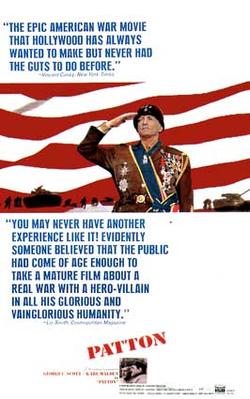
Patton
During World War II, the II Corps suffers a severe defeat at the Battle of Kasserine Pass in North Africa. Hard-charging General George S. Patton is sent to take command; he reorganizes the corps, and imposes strict but necessary discipline. Frustrated by what he perceives as British commander Bernard Montgomery monopolization of the Allied effort—Montgomery's forces had chased Rommel's forces and thus relieved pressure on the Americans following Kasserine—Patton leads the corps to redemption at the Battle of El Guettar. Following Allied victory in North Africa, Patton and Montgomery propose competing plans for the Allied invasion of Sicily. Patton recommends landing his U.S. Seventh Army near Palermo. Commanding officer Harold Alexander opts for Montgomery’s more cautious plan, landing Patton’s forces at Gela. Although initially intended to support Montgomery, Patton pushes northwest, taking Palermo and racing to Messina before the British. During the campaign, he visits a field hospital and slaps a soldier for cowardice, sparking public outrage and requiring a formal apology. Patton is then sidelined by Eisenhower for the Allied invasion of France and placed in command of the fictitious First United States Army Group in London, a decoy to mislead the Germans about the main invasion location. At a public gathering in Knutsford, Patton remarks that the postwar world will be dominated by Anglo-Americans, alarming Allied leaders. George Marshall must decide whether Patton’s outspoken comments warrant sending him home in disgrace. Weeks after the Normandy landings, Patton takes command of the Third Army, reporting to his former subordinate, Omar Bradley. Under his leadership, the Third Army sweeps across France, but is forced to halt before entering Germany due to fuel and supply allocations to Montgomery’s forces. Frustrated, Patton confronts Bradley, who warns him again about the dangers of speaking freely. During the Battle of the Bulge, Patton’s staff plans a bold operation to relieve the trapped 101st Airborne Division in Bastogne. After Germany capitulates, Patton’s candid comparisons of American politics to Nazism create further controversy, and he is relieved of command of the Third Army. He is retained to help oversee the occupation of Germany. In the film’s closing sequence, Patton narrowly avoids a fatal accident while walking with his bull terrier, and his voiceover reflects on the fleeting nature of glory, especially that achieved through military conquest: For over a thousand years, Roman conquerors returning from the wars enjoyed the honor of a triumph —a tumultuous parade. In the procession came trumpeters and musicians and strange animals from the conquered territories, together with carts laden with treasure and captured armaments. The conqueror rode in a triumphal chariot, the dazed prisoners walking in chains before him. Sometimes his children, robed in white, stood with him in the chariot, or rode the trace horses. A slave stood behind the conqueror, holding a golden crown, and whispering in his ear a warning that all glory... is fleeting.

Night Crossing
A brief summary of conditions in East Germany and the border zone shows stock footage such as Conrad Schumann 's jump over barbed wire in Berlin as the Berlin Wall is constructed. In April 1978, in the small town of Pößneck, Thuringia, teenager Lukas Keller attempts to escape East Germany by riding a bulldozer through the Inner German border zone, but is shot by automatic machine guns and left for dead by the guards. His family is informed while on a picnic with their friends the Strelzyks and the Wetzels, and the entire Keller family are taken by the police. Aggravated with life under the GDR regime, Peter Strelzyk proposes a daring plan to his friend Günter Wetzel: they will build a balloon to carry themselves and their families (a total of eight people) over the border to West Germany. They purchase 1,255 sq yd (1,049 m 2) of taffeta, claiming that it is for a camping club, and Günter sews the fabric together with a sewing machine in his attic while Peter experiments for months with devising a burner for the hot-air balloon. They face setbacks such as fires while trying to inflate the balloon, a lack of power for the burner, extremely suspicious neighbors and doubts about the plan's feasibility by Günter's wife Petra. Peter and Günter then stop seeing each other in order to avoid suspicion that may arise when the Strelzyks escape. Peter and his eldest son Frank complete the burner and, after extensive testing, manage to inflate the balloon. On July 3, 1979, the four members of the Strelzyk family attempt to fly the balloon. They successfully lift off but they are spotted by a border guard. However, a cloud dampens the balloon and the burner, and they crash within the border zone only a few hundred feet from the fences, and the balloon floats away. Miraculously, they escape the zone, return to their car and drive home. Meanwhile, the border guard finds the balloon and the Stasi, led by Major Koerner, begins an investigation to identify the balloon's creators in order to prevent them from carrying out a second escape attempt. Initially distraught over his failure, Peter is convinced by his sons to try again, knowing that the Stasi may soon uncover the plot. Peter convinces Günter to help him and both families begin work on a larger balloon to carry them all out of East Germany. Petra agrees to the plan, especially because her mother in West Berlin is very sick and the East German government has repeatedly denied her request to visit her. Having identified the initial launch area, the Stasi begins closing in on Pößneck. The Strelzyks and Wetzels purchase smaller quantities of taffeta from various stores to avoid suspicion, but they are running out of time. Peter tries to buy taffeta, claiming it is for his group of Young Pioneers, but the store manager secretly notifies the Stasi. The men eventually finish the balloon, but have no time to test it. On 15 September 1979, the families prepare to act on the plan while the Stasi finds blood-pressure medicine belonging to Peter's wife Doris where the first balloon had landed. The Stasi contacts the pharmacy and is able to identify the owner of the pills as Doris. The families' neighbor, a member of the Stasi, reports that they had been acting suspiciously. The families leave only minutes before the Stasi arrives at their homes. They reach their launch point while the border is placed on emergency alert. The balloon is inflated and the burner is lit. Both families climb into the balloon's basket and cut their ropes. A fire is started in the cloth, but it is quickly extinguished by Günter. They later notice a hole in the balloon and hope that it will hold. While in flight, the balloon is spotted and Koerner pursues them in a helicopter. Eventually, the burner's propane supply is expended and the balloon descends, and the border guard is mobilized to find them. The balloon lands in a clearing with all eight people unharmed. Peter and Günter attempt to determine where they are as they are discovered by a police car. Peter asks the police if they are in the West, and the police officer confirms. Overjoyed, Peter and Günter light their signal flare. The families happily embrace.

Outland
Federal Marshal William O'Niel is assigned to a tour of duty at the titanium ore mining outpost Con-Am 27, operated by the company Con-Amalgamated on the Jovian moon of Io. Conditions on Io are difficult; gravity is 1/6 that of Earth's with no breathable atmosphere, and spacesuits are cumbersome with limited air. Shifts are long but significant bonuses are paid. The general manager, Mark Sheppard, boasts that productivity has broken all records since he took over. Carol, O'Niel's wife, feels she cannot raise their son Paul on Io and leaves with him to the Jupiter space station to await a shuttle back to Earth. Cane, a miner, enters an elevator without his spacesuit during a psychotic episode and dies from decompression. Tarlow, another miner, suffers an attack of stimulant psychosis — he sees spiders and rips open his spacesuit — resulting in death by explosive decompression. With the reluctant assistance of Dr. Lazarus, O'Niel investigates the deaths. Another incident involves a worker, Sagan, who takes a prostitute hostage and threatens to kill her with a knife. O'Niel attempts to calm the man while Montone, his sergeant, sneaks in via the air duct and kills Sagan with a shotgun. O'Niel and Lazarus discover that Sagan had traces of polydichloric euthimal, a powerful amphetamine -type drug in his bloodstream, which would allow a miner to work continuously for days at a time until they burn out and turn psychotic after approximately ten months of use. O'Niel uncovers a drug distribution ring run by Sheppard and sanctioned by now repentant Montone. Using surveillance cameras, O'Niel finds and captures Nicholas Spota, one of Sheppard's dealers, who is murdered before he can be questioned. Montone is found garrotted. In a meat locker, O'Niel finds the latest shipment of drugs, which was shipped from the space station. He is attacked there by another dealer, Russell Yario. O'Niel, wearing an anti-garrotting collar, knocks him out, then destroys the shipment of drugs. When Sheppard finds out, he threatens O'Niel and contacts his drug distributor, asking him to send in professional hitmen. O'Niel is prepared, having hacked into Sheppard's communications. O'Niel waits for the arrival of the hitmen on a supply shuttle from the other side of Jupiter. Realizing what is coming and with only Dr. Lazarus willing to help him, O'Niel sends a message to his family promising to return to Earth when his "job is done". O'Niel ambushes the assassins one by one. Lazarus helps him kill the first by trapping him in a pressurized corridor; O'Niel activates a bomb, causing an explosive decompression that kills the man. The second is killed in a glass greenhouse structure of the outpost when O'Niel tricks him into shooting a window, causing it to break open and blow him out to his death. O'Niel is then confronted and attacked by Sheppard's inside man — one of his own deputies, Sgt. Ballard. The two fight outside the outpost near the satellite structure until O'Niel pulls Ballard's oxygen hose, suffocating him as he pushes him into an electrical generation station, vaporizing him on impact. O'Niel then confronts the surprised Sheppard inside the outpost's recreation bar, knocking him out with one punch. It is implied Sheppard will now be brought to justice or murdered by his own associates. O'Niel, however, has already contacted his superiors about Sheppard's associates, some of whom are Con-Am executives, and shortly before his departure receives a communication that warrants have been issued for their arrests. O'Niel bids farewell to Lazarus and leaves on the shuttle to join his wife and son on the journey back to Earth.

Other People's Money
Lawrence "Larry the Liquidator" Garfield is a corporate raider who has become wealthy by acquiring companies and selling off their assets. With the help of a computerized stock-analysis program called Carmen, he identifies the family-owned New England Wire & Cable Company as his next target. Although the Rhode Island company remains profitable overall, its aging Wire and Cable division is struggling, leading Lawrence to conclude that the company's assets are worth more than its market value. After failing to persuade company chairman Andrew "Jorgy" Jorgenson to sell the division, Lawrence begins acquiring shares in an effort to gain control of the company. Desperate to prevent a hostile takeover, Jorgy is persuaded by his wife Bea, and company president Bill Coles to hire his stepdaughter, corporate lawyer Kate Sullivan, who is not fond of Jorgy or his business. Lawrence becomes attracted to Kate and aggressively pursues her romantically. The pair agrees to a temporary truce, but both continue working behind the scenes to advance their positions: Kate encourages the board and its allies to acquire additional shares, while Lawrence continues purchasing stock through a front organization. Kate later obtains a temporary restraining order preventing Lawrence from buying further shares. Despite their professional rivalry, the relationship between Lawrence and Kate becomes increasingly flirtatious. Lawrence proposes exchanging his shares in the company for the Wire and Cable division, allowing him to profit from its assets while leaving Jorgy in control of the remaining business, but Jorgy refuses to sacrifice the jobs of the division's employees or surrender his family business to a man like Lawrence. Concerned about the company's future and his own financial security, Bill pressures Jorgy to accept a compromise. Instead, Jorgy decides to let the shareholders determine the company's future at the annual meeting, believing it is the only course he can accept. Kate persuades Lawrence to let the shareholders settle the matter. During their negotiations, Lawrence argues that he and Kate are alike, both caring more about winning than the people affected by the outcome. Seeking to protect his and his family's interests, Bill secretly approaches Lawrence and offers him the voting rights to his shares in exchange for compensation. Bea later meets with Lawrence herself, offering him $1 million to abandon the takeover, but he refuses. She chastizes him for his callous attitude towards the people affected by his actions. Afterward, Lawrence confronts Kate outside her apartment and unexpectedly proposes marriage, confessing that he has fallen in love with her and fears losing her once the takeover battle ends. Overwhelmed, Kate leaves without answering. On the day of the shareholders' meeting, Jorgy confides in Bea that he fears his values and methods have become outdated. Addressing the shareholders, Jorgy argues that businesses have responsibilities to their employees and the community, and warns against dismantling companies solely for financial gain. Lawrence responds that technological change has rendered the Wire and Cable division obsolete and urges shareholders to prioritize their own financial interests. When the votes are counted, Lawrence is given control of the company. Kate leaves, and the company is soon shuttered. Back in Manhattan, Lawrence finds little satisfaction in his victory. Kate telephones him with a new proposal: she has secured a long-term agreement with a Japanese company to manufacture stainless-steel wire cloth used in airbags, providing a potential future for Wire and Cable. She asks Lawrence to sell the company back to the employees so that they can modernize the plant and pursue the new opportunity. Intrigued, Lawrence excitedly agrees to discuss the proposal over dinner.

Phone Booth
Stuart Shepard is an arrogant and dishonest New York City publicist who has been planning an affair with a client, Pamela McFadden, behind the back of his wife Kelly. While in Times Square, Stuart uses a public phone booth to contact Pamela, allowing him to avoid detection by Kelly. During the call, he is interrupted by a pizza delivery man who attempts to deliver a free pizza to him, but Stuart aggressively turns him away. As soon as Stuart completes his call, the phone rings. Stuart answers; a man on the other end, who knows his name, warns him not to leave the booth, threatening to tell Kelly about Pam. The caller tells Stuart that he has tested two previous individuals who have committed crimes (pedophilia and corporate corruption) using the same process, giving each a chance to reveal the truth to those they wronged. In both cases, they refused and were killed. Stuart must confess his feelings to both Kelly and Pam to avoid the same fate. To demonstrate the threat, the caller fires a suppressed sniper rifle with pinpoint accuracy. The caller then contacts Pam and connects her to Stuart, who admits he is married. The booth is approached by three prostitutes demanding to use the phone, but Stuart refuses to leave, without revealing his dilemma. Leon, a pimp, breaks the glass side of the booth, grabs Stuart and pummels him while the prostitutes cheer. The caller offers to "make him stop" and in Stuart's confusion, he inadvertently asks for this; the caller shoots Leon dead. The prostitutes immediately blame Stuart, accusing him of having a gun, as the police and news crews converge on the location. NYPD Captain Ed Ramey seals off the area and negotiates to make Stuart leave the booth, but he refuses. Stuart tells the caller that there is no way they can incriminate him, but the caller draws his attention to a handgun planted on the roof of the phone booth. As Kelly and Pam both arrive on the scene, the caller demands that Stuart tell Kelly the truth, which he does. The caller then orders Stuart to choose between Kelly and Pam, and the woman he does not choose will be shot. Stuart secretly uses his cell phone to call Kelly, allowing her to overhear his conversation with the caller; she quietly informs Ramey of this. Meanwhile, Stuart continues to confess to everyone that his whole life is a lie, to make himself look better than he really is. Stuart's confession provides sufficient distraction to allow the police to trace the payphone call to a nearby building. Stuart warns the caller that the police are on the way, and the caller replies that if he is caught, he will kill Kelly. Desperate, Stuart grabs the handgun and leaves the booth, begging for the sniper to kill him instead. The police fire upon Stuart, while a SWAT team breaks into the room that the caller was tracked to, only to find a rifle and a man's corpse. Stuart regains consciousness; the police had fired only rubber bullets, stunning but not harming him. Stuart and Kelly happily reconcile. As the police bring down the body, Stuart identifies it as the pizza delivery man from earlier. Stuart gets medical treatment at a local ambulance. After getting a shot from a paramedic, he starts losing consciousness. The real caller passes by, warning Stuart that if his newfound honesty does not last, he will return, before disappearing into the crowd, while the pay phone rings again.