← All Movies
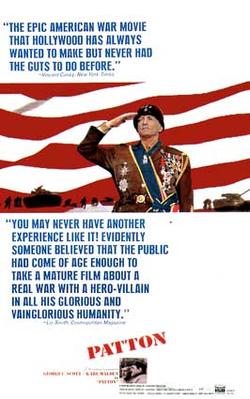
Patton
During World War II, the II Corps suffers a severe defeat at the Battle of Kasserine Pass in North Africa. Hard-charging General George S. Patton is sent to take command; he reorganizes the corps, and imposes strict but necessary discipline. Frustrated by what he perceives as British commander Bernard Montgomery monopolization of the Allied effort—Montgomery's forces had chased Rommel's forces and thus relieved pressure on the Americans following Kasserine—Patton leads the corps to redemption at the Battle of El Guettar.
Following Allied victory in North Africa, Patton and Montgomery propose competing plans for the Allied invasion of Sicily. Patton recommends landing his U.S. Seventh Army near Palermo. Commanding officer Harold Alexander opts for Montgomery’s more cautious plan, landing Patton’s forces at Gela. Although initially intended to support Montgomery, Patton pushes northwest, taking Palermo and racing to Messina before the British. During the campaign, he visits a field hospital and slaps a soldier for cowardice, sparking public outrage and requiring a formal apology.
Patton is then sidelined by Eisenhower for the Allied invasion of France and placed in command of the fictitious First United States Army Group in London, a decoy to mislead the Germans about the main invasion location. At a public gathering in Knutsford, Patton remarks that the postwar world will be dominated by Anglo-Americans, alarming Allied leaders. George Marshall must decide whether Patton’s outspoken comments warrant sending him home in disgrace.
Weeks after the Normandy landings, Patton takes command of the Third Army, reporting to his former subordinate, Omar Bradley. Under his leadership, the Third Army sweeps across France, but is forced to halt before entering Germany due to fuel and supply allocations to Montgomery’s forces. Frustrated, Patton confronts Bradley, who warns him again about the dangers of speaking freely.
During the Battle of the Bulge, Patton’s staff plans a bold operation to relieve the trapped 101st Airborne Division in Bastogne. After Germany capitulates, Patton’s candid comparisons of American politics to Nazism create further controversy, and he is relieved of command of the Third Army. He is retained to help oversee the occupation of Germany. In the film’s closing sequence, Patton narrowly avoids a fatal accident while walking with his bull terrier, and his voiceover reflects on the fleeting nature of glory, especially that achieved through military conquest:
For over a thousand years, Roman conquerors returning from the wars enjoyed the honor of a triumph —a tumultuous parade. In the procession came trumpeters and musicians and strange animals from the conquered territories, together with carts laden with treasure and captured armaments. The conqueror rode in a triumphal chariot, the dazed prisoners walking in chains before him. Sometimes his children, robed in white, stood with him in the chariot, or rode the trace horses. A slave stood behind the conqueror, holding a golden crown, and whispering in his ear a warning that all glory... is fleeting.