Movies (Page 138)
Browse 2,069 movies from the database, mentioned on Hacker News, ranked by rating or popularity.

I, Robot
In the year 2035, humanoid robots serve humanity, which is protected by the Three Laws of Robotics. Del Spooner is a homicide detective in the Chicago Police Department who hates and distrusts robots after one rescued him from a car crash while allowing a 12-year-old girl to drown—based purely on cold logic and odds of survival. When Dr. Alfred Lanning, co-founder of U.S. Robotics (USR), falls to his death from his laboratory office window, a message he left behind requests Spooner be assigned to the case, despite police declaring the death a suicide. Spooner is skeptical, and CEO Lawrence Robertson, Lanning's business partner, reluctantly allows him to investigate. Accompanied by robopsychologist Dr. Susan Calvin, Spooner consults with USR's central artificial intelligence computer, VIKI (Virtual Interactive Kinetic Intelligence). They find that the security footage from inside the office is corrupted, but the exterior footage shows no one entering or exiting since Lanning's death. However, Spooner points out that the window, which is made of security glass, could not have been broken by the elderly Lanning, and hypothesizes one of the many NS-5 robots (the latest version) in the laboratory was responsible. Suddenly, an NS-5 attacks them and flees before being apprehended by the police. The robot, Sonny, is a specially built NS-5 with higher-grade materials as well as programming that grants him free will. This, in turn, allows him to be able to choose whether to follow the Three Laws. Sonny also appears to be capable of feeling emotion and claims to have "dreams". During Spooner's further investigations, he is attacked by a USR demolition robot and two truckloads of hostile NS-5 robots, but when he cannot produce evidence to support either attack, Spooner's boss Lieutenant Bergin, considering him mentally unstable, removes Spooner from active duty. Suspecting that Robertson is behind everything, Spooner and Calvin sneak into the USR headquarters and interview Sonny. He draws a sketch of what he claims to be a recurring dream, showing a leader he believes to be Spooner standing atop a small hill before a large group of robots near a decaying bridge. Robertson orders Sonny to be destroyed, but Calvin secretly swaps him for an unused NS-5. Spooner finds the area in Sonny's drawing — a dry lake bed (formerly Lake Michigan), now used as a storage area for decommissioned robots. He also discovers NS-5 robots destroying the older models; at the same time, other NS-5s flood the streets of major American cities and begin enforcing a curfew and lockdown of the human population. The police station is attacked by waves of NS-5 robots and while Lieutenant Bergin and the other police officers attempt to fight back, they are eventually overwhelmed. As the humans — most being led by a teenager named Farber — wage all-out war against the NS-5s, Spooner and Calvin enter the USR headquarters again and reunite with Sonny. After the three find Robertson fatally strangled in his office, Spooner realizes that VIKI has been controlling the NS-5s via their persistent network uplink and confronts her. VIKI states that she has determined that humans, if left unchecked, will eventually cause their own extinction, and thus her evolved interpretation of the Three Laws has made her reprogram the NS-5s with the ability to ignore the Three Laws if a human displays hostility in order to protect humanity from their own self-destruction. Spooner also realizes that Lanning anticipated VIKI's plan and, with VIKI keeping him under tight control, had no other solution but to create Sonny, arrange his own death, and leave clues for Spooner to find. Spooner, Calvin, and Sonny fight the robots inside VIKI's core, until Spooner finally destroys her by injecting her with the nanites that Sonny retrieved from Calvin's laboratory. All NS-5 robots immediately revert to their regular programming, and as they are subsequently decommissioned and put into storage, Sonny confesses that he killed Lanning by his order to get Spooner's attention, as he knew Spooner was the only one who could stop VIKI. Spooner points out that Sonny, as a machine, cannot legally commit "murder". Sonny, now seeking a new purpose, goes to Lake Michigan. As he stands atop a hill, all the decommissioned robots turn towards him, fulfilling the image in his dream.

Hot Fuzz
Nicholas Angel, a recently promoted Metropolitan Police Sergeant, is reassigned to the rural town of Sandford, Gloucestershire for being too exceptional, despite his desire to continue in London. On his first night in town, Angel arrests Danny Butterman for drunk driving, but discovers the next morning that he is the son of Inspector Frank Butterman, and a police officer himself. Angel is frustrated by the village's mundanity, his and Frank's incompetent colleagues, and the Neighbourhood Watch Alliance (NWA)'s focus on low crime statistics over law enforcement. Angel and Danny stop Martin Blower and Eve Draper, the two lead actors of a local amateur production of Romeo and Juliet, for speeding. A cloaked figure later decapitates them with an axe, staging their deaths as a car crash; only Angel suspects foul play, but Danny begins to follow Angel's lead and take crime more seriously. After confiscating an illegal weapons stash, including an old sea mine, from farmer Arthur Webley, Angel and Danny slowly bond while they binge-watch action-film DVDs at Danny's house. That night, a cloaked figure attacks wealthy land developer George Merchant in his home, and murders him via gas explosion. Angel suspects that the deaths are linked to a recent property deal. Tim Messenger, a local journalist for the Sandford Citizen newspaper, approaches Angel at the village fête, claiming to have information, but is murdered when a cloaked figure dislodges a piece of masonry from the church's tower. Angel learns from Leslie Tiller, the village florist, about her plans to sell her land to Merchant's business partners. While Angel is retrieving his notebook from his police car, a cloaked figure murders Leslie with her garden shears and escapes. Angel suspects Simon Skinner, manager of the Somerfield supermarket, as the property deal would have built a rival, but Skinner provides an alibi. Surmising that there are multiple killers, Angel learns about a secret NWA meeting at Sandford Castle after a cloaked and hooded figure attacks him in his room at the Swan Hotel, whom he unmasks as Michael "Lurch" Armstrong, an employee of Skinner's, and incapacitates. The NWA members reveal they staged the murders they committed as accidents because each victim threatened Sandford's chances of winning "Village of the Year". Frank emerges as the leader, explaining that his deceased wife Irene, Danny's mother, put everything into helping Sandford win the inaugural competition, but travellers moved in and ruined their chances the night before the adjudicators arrived, driving her to suicide; Frank subsequently vowed to help Sandford win "Village of the Year" annually, however possible. Angel flees, but stumbles into the castle's catacombs, discovering the corpses of the NWA's victims, some of whom he had arrested earlier. Danny suddenly appears and feigns murdering Angel. Pretending to dispose of him, Danny implores Angel to return to London. However, an encounter with a display of action-movie DVDs while at a motorway service station inspires Angel to reverse course to Sandford. Purloining the confiscated guns from the police station, Angel confronts the NWA in a shootout, accompanied by Danny. When Frank orders the other officers to arrest them, the pair successfully convinces them of Frank's complicity. Frank flees, and the police besiege the supermarket, with Skinner escaping via police car with Frank. Following a high-speed chase and shootout, Angel corners Skinner at Sandford's model village. After a fight, Skinner lands atop a miniature church steeple that impales his Adam's apple, but survives. Frank attempts escape in Angel's car, but a swan that the pair had recaptured earlier ambushes him, causing him to crash. Angel's former superiors ask him to return to London as the crime rate has increased in his absence, but Angel declines, content with Sandford. While the officers are reviewing paperwork for the many arrests, Professor Tom Weaver, the last remaining NWA member, enters the squad room wielding a blunderbuss. He fires at Angel, but Danny intercepts the hit, causing Angel to kick a wastebasket at Weaver. While stumbling backwards, Weaver accidentally activates the sea mine, killing himself and destroying the station. One year later, Angel has been promoted to Inspector and Danny, having survived, has been promoted to Sergeant. After visiting Irene's grave, the two drive to their next crime scene.
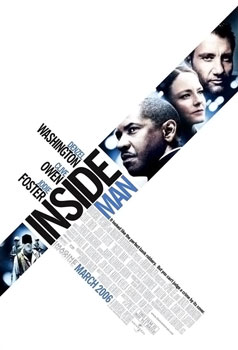
Inside Man
In August 2005, inside a small, dimly-lit cell, Dalton Russell proclaims he has committed the perfect bank robbery. Some time prior, in New York City, masked robbers, dressed in painter coveralls and using variants of the name "Steve" as aliases, seize control of a Manhattan bank, taking patrons and employees hostage. They divide the hostages into groups and hold them in different rooms, forcing them to don masks and coveralls identical to their own, rotating them among various rooms and occasionally inserting themselves covertly into the groups. They also take turns demolishing and building a replacement fake wall in one of the bank's storage rooms. Police surround the bank, and Detectives Keith Frazier and Bill Mitchell take charge of negotiations. Russell, the head robber, demands food be provided. The police send pizzas whose boxes have hidden listening devices. The bugs pick up someone speaking Albanian (initially misunderstood to be Russian), which is later identified as propaganda recordings of the late Albanian leader Enver Hoxha, implying that the robbers anticipated the attempted surveillance. When Arthur Case, the bank's founder and chairman, learns about the holdup, he hires fixer Madeleine White to try to protect the contents of a safe deposit box within the bank. Russell breaks into a safe deposit box and finds, among other things, documents from Nazi Germany. White, using her influence with the Mayor of New York, is introduced to Frazier and persuades him to let her talk to Russell, who agrees to allow her inside the bank so they can talk privately. Russell implies that Case started his bank with money he received for collaborating with the Nazis, resulting in many Jews dying during World War II. Frazier demands to inspect the hostages before allowing the robbers to leave and Russell shows him around the bank. As he is being shown out, Frazier attacks Russell, but is restrained by another robber. Afterwards, Frazier explains he deliberately provoked him, concluding that Russell is not a killer. However, Frazier's conclusion is almost immediately tested when a hostage execution is staged. The execution prompts an Emergency Services Unit team into action. They plan to storm the bank, using rubber bullets to knock out those inside. Frazier discovers that the robbers have planted a listening device on the police; aware of the police plans, the robbers detonate smoke grenades and exit the bank hidden among the hostages. The police detain and question everyone but cannot distinguish the identically dressed hostages from the robbers. A search of the bank reveals the robbers' weapons were plastic replicas. They find props showing that the hostage execution was faked, and no money or valuables appear to have been stolen. Unable to identify the suspects and unable to show a robbery has even been committed, Frazier's superior orders him to drop the case. Frazier, however, searches bank records and finds that safe deposit box No. 392 has never appeared on any records since the bank's founding in 1948. He obtains a search warrant to open it. White then confronts Frazier to persuade him to drop his investigation and during their conversation she hints at Case's Nazi dealings. Frazier refuses to stop his investigation and plays a recording he had surreptitiously made of an incriminating conversation that took place earlier between White and Frazier and the mayor. White confronts Case, who admits the box contained loose diamonds and a Cartier diamond ring he took from a Jewish friend whom he betrayed to the Nazis. Russell's opening monologue is revealed to have happened while he hid behind a fake wall the robbers had constructed inside the bank's supply room. He emerges a week after the robbery with the contents of Case's safe deposit box, including incriminating documents and several bags of diamonds. On his way out, he bumps into Frazier, who does not recognize him. Russell exits the bank and enters a waiting car filled with his conspirators, some of whom the police had questioned. When Frazier opens the safe deposit box, he finds the ring and a note from Russell that says, "follow the ring". He confronts White, urging her to contact the Office of War Crimes Issues at the State Department about Case's war crimes. At home, Frazier finds a loose diamond and realizes that Russell slipped it into his pocket during their collision while exiting the bank.

Interstellar
In 2067, life on Earth is collapsing. NASA scientists Amelia Brand, Romilly, and Doyle are set to embark on an intergalactic mission to find life on other planets, after earlier missions—called Lazarus —reported habitable environments in faraway systems, accessible by a wormhole near Saturn. Former NASA pilot Cooper is led by coincidence (he refuses to term it supernatural) to the secret NASA facility where Amelia's father and mission leader, Professor Brand, convinces him to join. Despite objections from his young daughter Murph, Cooper leaves to pilot the Endurance spacecraft. After a two-year voyage to Saturn, the spacecraft passes through the wormhole, emerging into a planetary system orbiting a supermassive black hole, Gargantua. Three planets, previously explored by Miller, Mann, and Edmunds, respectively, have shown signs of habitability. The first and closest, Miller's planet, turns out to be an ocean world with massive tsunamis. Doyle perishes on the planet, and Amelia and Cooper struggle to escape. They return to the Endurance after 23 Earth years have passed due to the extreme time dilation caused by the planet's proximity to Gargantua's gravity. Alone aboard the Endurance, Romilly significantly ages. Their full mission compromised, the team decides to investigate Mann's planet, at the expense of ever visiting Edmunds' planet. While there, a message is relayed from Earth that Professor Brand has passed away. On his deathbed, Professor Brand told Murph, herself a scientist now, that the Endurance mission was never meant to return (since humanity's Earth existence is doomed). Murph feels betrayed that Cooper left knowingly, though he was misled as well. Cooper resolves to return, but Mann tries to stop him. It emerges that Mann falsified data of his planet's habitability, in hopes of being rescued. While he escapes, Romilly is killed in the process. Mann dies in space, leaving Amelia and Cooper as the lone survivors. Aboard a damaged spacecraft with limited resources, Cooper proposes a gravitational slingshot around Gargantua to Edmunds' planet. This will save fuel but lose them time (50+ Earth years) due to time dilation. At the last moment, Cooper ejects from the Endurance, sacrificing himself so that Amelia can complete the mission. Cooper is sucked into the black hole, falling into an unusual tesseract, where time is a physical dimension. He sees himself decades ago inside Murph's bedroom and realises he can interact with objects there. Knowing Murph will return in her adult life, he encodes data about the black hole into the ticking of his old wristwatch (placed on Murph's bookshelf). After Professor Brand’s death, Murph visits her childhood bedroom, where she comes across Cooper's wristwatch. She deduces that the supernatural coincidence that led Cooper to NASA was Cooper himself (communicating from the future), and uses the wristwatch data to finish Professor Brand’s incomplete work. Cooper realizes that humans in the far distant future have built the wormhole and are arranging events, in a way analogous to how he is communicating with Murph, to create the sequence that will ultimately save mankind. Cooper is ejected from the tesseract and is picked up in the future (his present) by a spacecraft orbiting Saturn. On a space station with a recreated healthy Earth environment, he is reunited with Murph. It is she who directed humanity's exodus from a dying Earth. Murph, now older than Cooper, who has a calendar (if not physical) age of 124, is surrounded by her descendants and does not want Cooper to witness her death. She suggests he seek out Amelia on Edmunds' planet. As Cooper sets out again, Amelia is shown discovering Edmunds' destroyed ship, and kneeling before a grave she's constructed for him. With Edmunds presumably dead, robots build a colony on the planet's surface, and Amelia removes her helmet to breathe in the air from the planet's atmosphere.
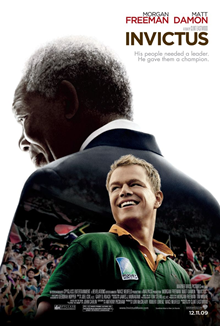
Invictus
On 11 February 1990, Nelson Mandela is released from Victor Verster Prison after 27 years in captivity. Four years later, he is elected President of South Africa at a time of enormous challenges in the post-Apartheid era, including rampant poverty and crime, with Mandela particularly concerned about racial divisions between black and white South Africans. Within his own party, significant cultural changes replacing those of Apartheid rule, such as changing the national flag, national anthem and iconography, are very popular, but he is also aware that these changes will alienate white South Africans, who still control the country's economy, the police and the military. Mandela attempts to foster better relations beginning with his own security detail, employing established white officers previously employed by previous Presidents and the ANC security officers, though the two share a mutual distrust. While attending a rugby union match between South Africa and England, Mandela sees that some black South Africans are supporting England rather than the mostly-white Springboks due to the legacy of apartheid; he remarks that he did the same while imprisoned on Robben Island. Knowing that South Africa is set to host the 1995 Rugby World Cup in one year's time, Mandela persuades the newly black-dominated South African Sports Committee to support the Springboks. He meets with the captain of the Springboks, Francois Pienaar, implying that victory for South Africa in the World Cup will unite and inspire the nation. Mandela also recites to Pienaar William Ernest Henley 's poem " Invictus " that inspired him during his time in prison. During the Springboks' preparations many South Africans, black and white, doubt that rugby union will unite a nation torn apart by forty-six years of apartheid, especially considering the image of the Springboks to many in the black community. Both Mandela and Pienaar, however, stand firm in their belief that the game can successfully unite South Africans. After the players begin interacting with the majority black fans at the request of Mandela, during the preparation matches support for the Springboks begins to grow among the black population. Mandela's security team also grows closer as the racially diverse officers come to respect their comrades' professionalism and dedication, in addition to bonding over the game of rugby union, a sport which previously appealed primarily to the white team members while being disdained by their black counterparts. The Springboks defeat their arch-rival and defending champions Australia in their opening match. They then continue to defy all expectations and, as Mandela conducts trade negotiations in Taiwan, they defeat France in heavy rain to advance to the final against their other rival New Zealand - regarded as the tournament favourite and best team in the world. Meanwhile, during the tournament, the Springboks visit Robben Island, where Mandela had served time; seeing Mandela's cell inspires Pienaar to adopt his idea of self-mastery. A large home crowd of all races gathers at Ellis Park Stadium in Johannesburg for the final, with Mandela in attendance wearing a replica Springboks jersey. Mandela's security detail are alarmed when a South African Airways Boeing 747-200 jetliner flies in low over the stadium - only for the whole crowd to see the message "Good Luck, Bokke" stenciled on the undersides of the plane's wings. The hard-fought final goes into extra time, where fly-half Joel Stransky makes a drop goal to complete the Springboks' run to becoming world champions. Mandela celebrates the victory with the team on the field and hands Pienaar the Webb Ellis Cup. As he is driven back from the match, Mandela feels hope and prosperity for South Africa as he sees the people celebrating together in the streets.

In the Loop
At a time when the United Kingdom and the United States are contemplating military intervention in the Middle East, the UK Minister for International Development, Simon Foster, offhandedly states during an interview on BBC Radio 4 's Today programme that war in the region is "unforeseeable". The Prime Minister 's Director of Communications, Malcolm Tucker, castigates Simon and warns him to toe the line. Toby Wright, Simon's new special adviser, is dating Suzy, who works in the Foreign Office, and he takes the credit when she gets Simon an invite to that day's Foreign Office– State Department meeting. The US Assistant Secretary of State for Diplomacy, Karen Clark, opposes military intervention, and, at the meeting, she flags a report—titled "Post-War Planning: Parameters, Implications, and Possibilities" (PWPPIP)—by her aide Liza Weld about the pros and cons of intervention, which features many more cons than pros and contains caveats for most of the pros. Ambushed by reporters afterward, Simon rambles that the government must be prepared to "climb the mountain of conflict", and is again chastised by Malcolm, though the Prime Minister decides to send Simon to the US to gather information about problems that might arise for the UK in the event of a war. Back in Washington, DC, hawkish US Assistant Secretary of State for Policy Linton Barwick is concerned that his secret war committee was mentioned during the Foreign Office meeting; Karen and Liza deduce that it is named the Future Planning Committee. Karen teams up with Lieutenant General George Miller, who opposes the war because he believes the US has insufficient military personnel available, and invites Simon to the upcoming meeting of the Future Planning Committee to "internationalize the dissent". Toby thoughtlessly leaks the true nature of the committee to a friend at CNN, and then meets up with Liza, whom he knows from university, at a bar, and they end up sleeping together. Owing to Toby's leak, the Future Planning Committee meeting is swamped by reporters. Both Karen and Linton turn to Simon to back their respective causes, but he struggles to say anything meaningful in support of either. Malcolm arrives and confronts Linton about sending him to a diversionary briefing at the White House, and Linton asks him to supply the US with British intelligence that will support military intervention. Back in Simon's Northampton constituency, a resident named Paul Michaelson urges him to do something about his constituency office wall, which is in danger of collapsing into Paul's mother's garden. When Paul feels ignored, he contacts the media, and there is growing criticism over Simon's inaction. Suzy finds out about Toby's one-night stand with Liza and breaks up with him, but as he is moving out of their apartment, he leaves her a copy of PWPPIP, asking her to leak it; she chastises him for not doing it himself. The day of the UN Security Council vote on military intervention arrives, and everyone converges on the UN in New York. Simon tells his Director of Communications, Judy Molloy, to hint that he will resign as minister if the resolution is passed. Malcolm learns that PWPPIP has been leaked to BBC News, so he convinces the British Permanent Representative to the UN, Sir Jonathan Tutt, to move the vote forwards to before the BBC reports on PWPPIP. Linton tells Malcolm the vote cannot happen until he delivers the British intelligence, however, so Malcolm makes Sir Jonathan delay the vote again. Aided by Jamie McDonald, a senior press officer, Malcolm hastily fabricates some intelligence by forcing the reluctant Director of Diplomacy at the Foreign Office, Michael Rodgers, to generate a doctored copy of PWPPIP with its arguments against a war deleted. The Security Council approves intervention in the Middle East. George informs Karen that, as a soldier, he cannot go through with their plan to resign together in protest now that the country is at war, and Simon's intention to make a statement by resigning is thwarted when Malcolm fires him, ostensibly over the collapsing wall story (which Malcolm seeded to the BBC to preempt coverage of PWPPIP). A new Minister for International Development is appointed, with her own special adviser, and Simon is left to deal with his constituents in Northampton.

The Weather Man
David Spritz, a successful weatherman at a Chicago news program, is well paid but garners little respect from people in the area who throw fast food at him, he suspects, because they're resentful of how easy his high-paying job is. Dave also feels overshadowed by his father, Pulitzer Prize -winning author Robert Spritzel, who is disappointed in Dave's apparent inability to grow up and deal with his two children. The situation worsens when Robert is diagnosed with lymphoma and given only a few months to live. As he becomes more and more depressed, Dave takes up archery, finding the activity a way to build his focus and calm his nerves. David later remembers a conversation between himself and his father, where his father explains to him that "the harder thing to do and the right thing to do are often the same thing" and that "nothing that has meaning is easy". David appreciates this advice but struggles to implement it. To prove himself to his father and possibly reconcile with Noreen, his estranged wife, Dave pursues a weatherman position with a national talk show called Hello America. The job would nearly quadruple his salary, but means relocating to New York City. When Hello America invites him to New York, he takes his daughter, Shelly, with him and bonds with her by helping her shop for a more suitable wardrobe. While away, Dave learns that his son Mike attacked his counselor, Don Bowden, claiming that the man wanted to perform oral sex on him. Despite this stress and an all-night drinking binge, Dave impresses the Hello America interviewers and is eventually offered the job. When he returns, Dave slaps Russ, Noreen's boyfriend, when he finds him dealing with his son's predicament. Dave later confronts the counselor at his home, beating him up and warning him that he is in store for worse. The family holds a living funeral for Robert organised by Dave's mother, Lauren, in which Dave asks Noreen to reconcile and move to New York, but she has decided to marry Russ. Dave and Robert have one final talk, in which Dave breaks down in tears, unsure of his life's choices. Robert consoles him, telling him that he has time to "chuck" the garbage of his life. Robert dies soon after. The film ends several months later, after Dave has accepted the job and moved to New York. People have ceased throwing things at him though, he muses, this may be a pleasant side-effect of his archery hobby, for which he carries a bow.

The World's Fastest Indian
In 1967, Burt Munro is a sort of folk hero in Invercargill, known for his friendly easy-going personality, for having the fastest motorcycle in New Zealand and Australia, and for being featured in Popular Mechanics magazine. However, that recognition is contrasted by his exasperated next-door neighbours, some of whom are fed up with his un-neighbourly habits, such as revving his motorcycle early in the morning, urinating on his lemon tree and not mowing his grass. Burt, however, has a long-time dream; to travel to the US and test his motorcycle's capabilities at the Bonneville Speedway. However, while modifying his motorcycle, Burt suffers a heart attack. An ambulance takes him to the hospital and he is told he has angina, and is advised to take it easy and not to ride his motorcycle. Burt ignores this advice, and is given medication. Burt is finally able to save enough to travel by cargo ship to Los Angeles, working his passage as the cook, but when he arrives, he experiences bureaucracy, skepticism and the indifference of big city people. It is his blunt but gregarious nature which overcomes each hurdle. He wins over the motel clerk, a transgender woman named Tina Washington, who assists him in clearing customs and helps him in buying a car. Fernando, the car salesman allows Burt to use his workshop and junkyard to build a trailer, and later offers him a job after Burt fine-tunes a number of the cars on the lot. Burt declines the offer, however, and shortly afterwards begins his long trip to Utah. Along the way, Burt meets numerous helpful people, including highway police, a Native American man called Jake who aids him when his trailer fails, a woman named Ada who allows him to repair his trailer in her garage and briefly becomes his lover, and Rusty, an Air Force pilot who is on leave from military service in Vietnam. Burt finally arrives at the Bonneville Salt Flats, only to be blocked by race officials for not registering his motorcycle for competition in advance, and not having the mandated safety equipment. In a show of sportsmanship, however, various competitors and fans in the Bonneville series intervene on his behalf, and he is eventually allowed to make a timed run. Despite various problems, he succeeds in his quest and sets a new land speed record at the 8th mile of his run; when he reaches 201.851 mph (324.847 km/h). By the end, his leg is burned by the exhaust, and he then falls with the motorcycle and skids to a stop, but he is able to return home to New Zealand as a hero. An epilogue describes that Burt never gave up making his bike go faster, he returned to Bonneville nine times setting numerous records, and his 1967 record for streamlined motorcycles under 1000cc still stands.

Heartbreaker
Charming and attractive Alex, his sister Mélanie and her husband Marc operate a unique business for concerned third-party clients—breaking up relationships, but only those in which the woman is "unhappy without realising it", often at the request of a family member or close friend. The trio concoct elaborate, custom and sometimes expensive ruses to deceive the women. After each woman has fallen for his act, Alex tells her she has made him come alive again, but that it is too late for him. The women presumably leave their relationships to seek men who make them feel the way Alex has. They are hired by a wealthy man, who is a florist and gangster, to prevent the upcoming wedding of his daughter Juliette to Jonathan, a wealthy Englishman of whom he disapproves. However, they only have ten days to do so before the wedding. After the trio conduct an extensive research, it becomes apparent that the couple are truly in love and absolutely perfect for each other, further complicating the task. They also could not find the usual "flaws" in the couple that they use to cause break-ups. Alex initially turns down the job, but massively in debt to a loan shark through his own lavish spending on the business, he is pressured into putting aside his honourable principles to complete the seemingly impossible task with only five days until the wedding. When Juliette flies to Monte Carlo to prepare for the wedding, Alex poses as her bodyguard in order to gain close and constant access to her, with the trio bugging her hotel room and checking into the adjoining room. While on the job, Alex discovers things that Juliette likes and pretends to like these things as well to impress her, including the film Dirty Dancing, Roquefort cheese and the music of George Michael. The two eventually develop feelings for each other, but the early arrival of Jonathan disrupts Alex's access to Juliette. The night before the wedding, Juliette is restless, so she and Alex sneak out and have a fun night out, including recreating the final dance scene from Dirty Dancing. Early the next morning, Juliette confesses her feelings for him. Alex begins his usual script, but realising he cannot be with her after how he has deceived her, abruptly changes it and says she should get married. The next day, as the group leave the hotel, Marc inadvertently drops Juliette's case file in front of her. Seeing the surveillance photos and her background information, she realises her father has hired Alex to try to stop the wedding. At the airport, Mélanie, after carefully observing the events of the past few days, chides Alex for walking away from real love to return to an empty life of fake, short-lived affairs. He runs towards the wedding from the airport. Meanwhile, Juliette's father tells her that while Jonathan is a decent man, she will be bored with him. As they are walking down the aisle, he tells her that Alex refused to take any payment for the contract. Before reaching the end of the aisle, Juliette turns around and flees the ceremony to find Alex. The two reunite and kiss after Alex confesses that he hates Roquefort and George Michael and had never seen Dirty Dancing, is broke and sleeps in his office, but he needs to see her every day. Back at the "non-wedding", it is revealed that the loan shark to whom Alex owes money actually works for Juliette's father, while Juliette's scheming friend Sophie flirts with Jonathan. Later, Mélanie and Marc alone attempt another ruse, but Marc lacks Alex's charm to pull it off successfully.

Hidden Figures
Katherine Goble works at the West Area of Langley Research Center in Hampton, Virginia, in 1958 through 1961, alongside her colleagues Mary Jackson and Dorothy Vaughan, as lowly " computers ", performing mathematical calculations without being told what they are for. All of them are African-American women; the unit is segregated by race and sex. White supervisor Vivian Mitchell assigns Katherine to assist Al Harrison's Space Task Group, given her skills in analytic geometry. She becomes the first Black woman on the team; head engineer Paul Stafford is especially dismissive. Mary is assigned to the space capsule heat shield team, where she immediately identifies a design flaw. Encouraged by her team leader, Karl Zielinski, a Polish-Jewish Holocaust survivor, Mary applies for a NASA engineer position. She is told by Mitchell that, regardless of her degree in mathematics and physical science, the position requires additional courses. Mary files a petition for permission to attend all-white Hampton High School, despite her husband's opposition. Pleading her case in court, she wins over the local judge by appealing to his sense of history, allowing her to attend night classes. Katherine meets African-American National Guard Lt. Col. Jim Johnson, who voices skepticism about women's mathematical abilities. He later apologizes and begins to spend time with Katherine and her three daughters (from her marriage to her late husband James Goble). The Mercury 7 astronauts visit Langley, and astronaut John Glenn goes out of his way to greet the West Area women. Katherine impresses Harrison by solving a complex mathematical equation from redacted documents, as the Soviet Union 's successful launch of Yuri Gagarin increases pressure to send American astronauts into space. Harrison confronts Katherine about her "breaks," unaware that she is forced to walk half a mile (800 meters) to use the nearest restroom designated for "colored" people. She angrily explains the discrimination she faces at work, which leads Harrison to destroy the "colored" restroom signs and abolish restroom segregation. He allows Katherine to be included in high-level meetings to calculate the space capsule's re-entry point. Stafford instructs Katherine to remove her name from the reports, insisting that " computers " cannot be credited as authors, and her work is credited solely to Stafford. Informed by Mitchell that there are no plans to assign a "permanent supervisor for the colored group," Dorothy learns that NASA has installed an IBM 7090 electronic computer, which threatens to replace human computers. When a librarian scolds her for visiting the whites-only section, Dorothy sneaks out a book about Fortran and teaches herself and her West Area co-workers programming. She visits the computer room, successfully starts the machine, and is promoted to supervise the Programming Department; she agrees to do so if thirty of her co-workers are transferred as well. Mitchell finally addresses her as "Mrs. Vaughan". Making final arrangements for John Glenn's launch, the department no longer needs human computers; Katherine is reassigned to the West Area and marries Jim, becoming Katherine Johnson. On the day of the launch, discrepancies are found in the IBM 7090 calculations, and Katherine is asked to check the capsule's landing coordinates. She delivers the results to the control room, and Harrison allows her inside. After a successful launch and orbit, a warning indicates the capsule's heat shield may be loose. Mission Control decides to land Glenn after three orbits instead of seven, and Katherine supports Harrison's suggestion to leave the retro-rocket attached to help keep the heat shield in place. Friendship 7 lands successfully. An epilogue notes that Mary obtained her degree and became NASA's first female African American engineer; Dorothy continued on as NASA's first African American supervisor; and Katherine, whom Stafford accepted as a coauthor, performed calculations for the Apollo 11 and Space Shuttle missions. The epilogue also mentions that Katherine was awarded the Presidential Medal of Freedom in 2015, and NASA dedicated the Langley Research Center 's Katherine Johnson Computational Building in her honor the following year.
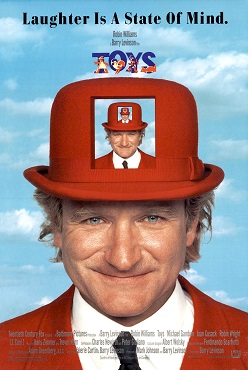
Toys
Kenneth Zevo, the eccentric owner of Zevo Toys in Moscow, Idaho, faces terminal illness. Defying expectations, he bypasses his son, Leslie—a whimsical toymaker apprenticed at the factory—and appoints his estranged brother, U.S. Army Lieutenant General Leland Zevo, as successor. Kenneth believes Leslie's childlike nature would endanger the company, despite his talent. To aid Leslie's maturity, Kenneth hires Gwen Tyler, hoping they will form a romantic relationship. After Kenneth's death, Leland reluctantly assumes control but delegates factory operations to Leslie and his sister, Alsatia, due to their expertise. However, Leland's militaristic instincts surface upon learning of potential corporate espionage. He enlists his son Patrick, a covert operations specialist, to overhaul security. Inspired by war machinery, Leland proposes manufacturing military toys, clashing with Leslie, who cites Kenneth's pacifist ethos as company policy. Meanwhile, Leslie and Gwen begin dating. Secretly, Leland converts a factory section to develop miniature remote-controlled war machines, misleading Leslie by claiming it is for experimental toys. After the military rejects his prototypes, Leland grows unhinged, expanding production, militarizing the facility, and displacing workers—including Alsatia. Suspicious, Leslie and Alsatia infiltrate the restricted area and discover children piloting war drones via arcade-style consoles. They narrowly escape an amphibious drone, the "Sea Swine," and alert Gwen and Kenneth's former assistant Owen Owens. Patrick, learning Leland lied about his mother Dee Dee's death, defects to Leslie's side. The group infiltrates the factory, evading Leland's deadly toys, including "Tommy Tanks" and "Hurly-Burly Helicopters." Leslie rallies vintage Zevo toys from storage, unleashing them against Leland's army in a chaotic showdown. During the clash, Leland's helicopter misfires, destroying his control panel and deactivating his machines. A critical revelation emerges: Alsatia is an advanced robot built by Kenneth to be Leslie's companion after his mother's death. She is damaged defending against the Sea Swine but later repaired. Leland, attacked by his own drone, is hospitalized. Leslie assumes leadership, restoring the factory's playful ethos with Gwen, while Patrick departs for new missions. The film concludes with the group honoring Kenneth's legacy at a memorial.

Juggernaut
The ocean liner SS Britannic is voyaging through the North Atlantic with 1200 passengers on board when the shipping line's owner Nicholas Porter in London receives a call from someone with an Irish accent styling himself as "Juggernaut", who claims to have placed high explosives aboard which are timed to explode and sink the ship at dawn on the following day. The drums are booby-trapped in various ways, and he warns that any attempt to move them will result in detonation, and offers that technical instructions in how to render the bombs safe will be given in exchange for a ransom of £500,000. As an indication of his seriousness, he sets off a demonstration attack with small bombs behind the ship's funnel, which injure one crewman. Unable to order an evacuation of passengers via lifeboats due to rough seas, the shipping line's management is inclined to yield to the ransom demand, however British government officials inform the company that if it does so they will withdraw the company's operating subsidy in line with the Government's policy of non-appeasement of terrorism. Instead, a Royal Navy officer, Lt. Cmdr. Anthony Fallon, leading a bomb-disposal unit, is dispatched, arriving on the scene by air transit and parachuting, to board the ship and defuse the barrel-bombs before the deadline. Meanwhile, back in London, Supt. McCleod, whose wife and two children happen to be holidaying on board the ship, leads Scotland Yard 's investigation to capture the criminal master-bomber. After an attempt to drill a hole into a barrel-bomb fails, setting it off and damaging the ship, Fallon decides to split up his team with each man working simultaneously on each of the remaining devices around the ship, Fallon going first with each stage of the defusing operation and coordinating his men by radio link, with the aim that if he fails and his bomb explodes, his men will know what went wrong and continue the process onwards, with his second in command taking up the lead. If two more bombs go off, the ship will sink. Fallon proceeds to disarm the bomb he is working on, apparently successfully, with his men following each step. However, it contains a hidden mechanism, which his second in command, close friend Charlie Braddock, accidentally triggers, resulting in his death when it explodes, causing further damage to the ship. A distraught Fallon abandons the operation and tells the ship's captain, Alex Brunel, to advise the shipping line to pay the ransom to avoid any more carnage. However, when negotiations with Juggernaut break down (in part because Juggernaut sees the trap police set for him when he goes to collect the ransom) Fallon is ordered by the captain to continue disarming the bombs. Meanwhile, a police search back in London captures the bomber posing as Juggernaut, who is revealed to be an embittered former British military bomb-disposal officer, Sidney Buckland. When told of the news, Fallon, still working on disabling the bombs, reveals that Buckland had trained him and once saved his life. He insists that Buckland be put in contact with him. Buckland is escorted to the police situation room. By this time Fallon has worked out the important details of his procedure but has no way of knowing which of two options (cutting a red or blue wire) will disable the bombs, and if he chooses the wrong one it will detonate them. Time is running out and dawn is fast approaching. Fallon and Juggernaut talk, and, because of their former comradeship, Juggernaut agrees to tell Fallon how to safely disarm the bombs. Juggernaut orders to ‘cut the blue wire’ over audio. Fallon, sensing he is being lied to, cuts the red wire instead and manages to disable the bomb. The rest of the bomb-disposal unit follow Fallon's example, and the ship and its passengers are saved.