← All Movies
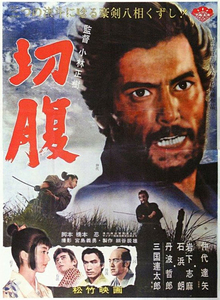
Harakiri (Seppuku)
The film takes place in Edo in the year 1630. A rōnin called Tsugumo Hanshirō arrives at the estate of the Iyi clan and says that he wishes to commit seppuku within the courtyard of the palace. To deter him, Saitō Kageyu, the daimyō ' s senior counselor, tells Hanshirō the story of another rōnin, Chijiiwa Motome — formerly of the same clan as Hanshirō.
Saitō scornfully recalls the practice of rōnin requesting the chance to commit seppuku on the clan's land, but in fact hoping to be turned away and given alms. Motome had arrived at the palace a few months earlier and made the same request as Hanshirō. Infuriated by the rising number of "suicide bluffs", the three most senior samurai of the clan—Yazaki Hayato, Kawabe Umenosuke, and Omodaka Hikokuro—persuaded Saitō to force Motome to follow through and kill himself, ignoring his request for a couple of days delay. Upon examining Motome's swords, his blades were found to be made of bamboo. Enraged that any samurai would "pawn his soul", the House of Iyi forced Motome to disembowel himself with his own bamboo blade, making his death slow, agonizingly painful, and deeply humiliating.
Despite this warning, Hanshirō insists that he has never heard of Motome and says that he is sincere in wanting to commit seppuku. Just as the ceremony is about to begin, Hanshirō is asked to name the samurai who shall behead him when the ritual is complete. To the shock of Saitō and the Iyi retainers, Hanshirō successively names Hayato, Umenosuke, and Hikokuro — the three samurai who coerced the suicide of Motome. When messengers are dispatched to summon them, all three decline to come, with each claiming to be too ill to attend.
While waiting for the messengers to return, Hanshirō recounts his life story to the assembled samurai, starting with the admission that he did know Motome. In 1619, his clan was abolished by the Shōgun. His lord decided to commit seppuku and, as his most senior samurai, Hanshirō planned to die alongside him. To prevent this, Hanshirō's closest friend took his place instead, leaving Hanshirō responsible for his teenage son, Motome. In order to support Motome and his own daughter Miho, Hanshirō rented a hovel in the slums of Edo, taking up work as a fan and umbrella craftsman while Motome became a teacher. Realizing the love between Motome and Miho, Hanshirō arranged for them to marry. Soon after, they had a son, Kingo.
When Miho became ill with tuberculosis, Motome could not bear the thought of losing her and did everything to raise money to hire a doctor. When Kingo also fell ill, Motome left one morning, saying he planned to take out a loan from a moneylender. Later that evening, Hayato, Umenosuke, and Hikokuro brought home Motome's mutilated body, and described and mocked his death before leaving. It is now clear that Motome had requested a delay so he could visit his family and put his affairs in order. A few days later, Kingo died, and Miho lost the will to live and died, leaving Hanshirō with nothing. Finishing his story, Hanshirō explains that his sole desire is to join Motome, Miho, and Kingo in death. He explains, however, that they have every right to ask him whether justice has been exacted for their deaths. Therefore, Hanshirō asks Saitō if he has any statement of regret to convey to Motome, Miho, and Kingo. He explains that, if Saitō does so, he will die without saying another word. Saitō refuses, calling Motome an "extortionist" who deserved to die.
After provoking Saitō's laughter by calling the samurai moral code bushido a facade, Hanshirō reveals the last part of his story. Before coming to the Iyi estate, he tracked down Hayato and Umenosuke and cut off their topknots. Hikokuro then visited Hanshirō's hovel and, with great respect, challenged him to a duel. After a brief but tense sword fight, Hikokuro suffers a double disgrace: his sword is broken and his topknot is taken as well. As proof, Hanshirō removes their labelled topknots from his kimono and casts them upon the palace courtyard. He mocks the Iyi clan, saying that if the men he humiliated were true samurai, they would not be hiding out of shame. He also questions the clan's honor and bushido itself, pointing out that they should not have ignored Motome's request for a delay to his seppuku without investigating the reason why he asked, but they were too preoccupied with their supposed honor to care.
Having badly lost face, an enraged Saitō calls Hanshirō a madman and orders the retainers to kill him. In a fierce battle, Hanshirō kills four samurai, wounds eight, and contemptuously smashes into pieces the antique suit of armor which symbolizes the glorious history of the House of Iyi. Finally, the clan corners Hanshirō and prepares to kill him not with swords, but with three matchlock guns. As Hanshirō commits seppuku, he is simultaneously shot by all three gunmen.
Terrified that the Iyi clan will be abolished if word gets out that "a half starved rōnin" killed so many of their retainers, Saitō announces that all deaths caused by Hanshirō shall be explained by "illness". At the same time, a messenger returns reporting that Hikokuro had killed himself the day before, while Hayato and Umenosuke are both faking illness. Saitō angrily orders that Hayato and Umenosuke be forced to commit seppuku as atonement for losing their topknots. Those three deaths are also to be attributed to "illness".
As the suit of armor is cleaned and re-erected, a new entry in the official records of the House of Iyi is read by a voiceover. Hanshirō is declared to have been mentally unstable, and he and Motome are both listed as having died through harakiri. The Shōgun is said to have issued a personal commendation to the lord of the Iyi clan for how his councilors handled the suicide bluffs of Motome and Hanshirō. At the end of his letter, the Shōgun praises the House of Iyi and their samurai as exemplars of bushido. As workers scrub the blood from the ground of the clan's estate, one of them finds a severed topknot and places it in his work bucket.