Genre: War (Page 5)
Browse 64 movies in the War genre.
All Genres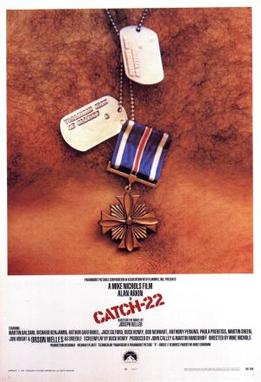
Catch-22
Captain John Yossarian, a U.S. Army Air Force B-25 bombardier, is stationed on the Mediterranean base on Pianosa during World War II. Along with his squadron members, Yossarian is committed to flying dangerous missions, but after watching friends die, he seeks a means of escape. While most bomber crews are rotated out after 25 missions, Yossarian's commanding officer, Colonel Cathcart, keeps raising the minimum number of missions for this base before anyone can reach it, eventually to an unobtainable 80 missions, a figure resulting from Cathcart's craving for publicity, primarily a mention in the nationally syndicated Saturday Evening Post magazine. Futilely appealing to Cathcart, Yossarian learns that even a mental breakdown is no release when Doc Daneeka explains the "Catch-22" the Army Air Force employs: An airman would have to be crazy to fly more missions, and if he were crazy, he would be unfit to fly.Yet, if an airman were to refuse to fly more missions, this would indicate that he is sane, which would mean that he would be fit to fly the missions. The airman is thus in an impossible "damned if you do, damned if you don't" situation. Yossarian is haunted, in several recurring flashbacks during the film, by the bloody death of Snowden, the young turret gunner on his B-25. After Snowden's death, Yossarian temporarily refuses to wear his uniform, which Snowden bled on. He shows up at a medal ceremony naked, and later morosely sits naked in a tree, where he is visited by Lieutenant Milo Minderbinder, who rapidly progresses from squadron supply officer to a capitalistic tycoon involved in black-market money-making schemes. The bomber squadron is populated by many other comically strange characters. Major Major, the squadron's operations officer, is promoted to a squadron commander without ever having flown in a plane and refuses to see anyone in his office while he is in, instructing Sergeant Towser that people can see him when he's out. The person has to wait in the waiting room until Major Major is gone, then can go right in. Trapped by this convoluted logic, Yossarian watches as individuals in the squadron resort to unusual means to cope; Milo concocts elaborate black market schemes while crazed Captain "Aarfy" Aardvark commits murder to silence a woman he has raped. Lieutenant Nately falls for a sex worker, Major Danby delivers goofy pep talks before every bomb run, and Captain Orr keeps crashing at sea. Meanwhile, Nurse Duckett occasionally beds Yossarian. Nately dies as a result of an agreement between Milo and the Germans, trading surplus cotton in exchange for the squadron bombing its own base. While on a pass, Yossarian shares this news with Nately's romantic partner, who then tries to kill him. Because of Yossarian's constant complaints, Cathcart and Lieutenant Colonel Korn eventually agree to send him home, promising him a promotion to major and awarding him a medal for the fictitious saving of Cathcart's life; the only requirement being that Yossarian agrees to "like" the colonels and praise them when he gets home. Immediately after agreeing to Cathcart's and Korn's plan, Yossarian survives an attempt on his life when stabbed by Nately's partner, who had disguised herself as a janitor. Once recovered, Yossarian learns from Danby and Chaplain Tappman that Orr's supposed death was a hoax and that Orr's repeated "crash" landings had been a subterfuge for practicing and planning his own escape from the madness. Yossarian is informed that Orr ditched the plane and paddled a rescue raft all the way to Sweden on his last run. Yossarian decides to abandon the deal with Cathcart, leaps out of the hospital window, takes a raft from a damaged plane and, while a marching band practices for the ceremony to award Yossarian the promotion and medal, he hops into the sea, climbs into the raft and starts paddling.

The Year of Living Dangerously
Guy Hamilton, a novice foreign correspondent for an Australian radio network, arrives in Jakarta on assignment. He meets the close-knit members of the foreign correspondent community, including journalists from the UK, the US, and New Zealand; diplomatic personnel; and Billy Kwan, a photo-journalist and outlier in the journalist community. A Chinese-Australian man with dwarfism, high intelligence, and moral seriousness, Kwan is deeply involved with and concerned for the people of Jakarta and their tribulations, even regularly providing for a destitute woman and her young son. Guy is initially unsuccessful as a journalist because his predecessor, tired of life in Indonesia, had departed without introducing Guy to his contacts. He receives limited sympathy from the journalist community, which competes for scraps of information from Sukarno 's regime, the Communist Party of Indonesia (PKI), and the conservative, Muslim-dominated Indonesian military. However, Billy takes a liking to Guy and arranges interviews for him with key political figures. Billy introduces Guy to Jill Bryant, a beautiful young assistant at the British Embassy. Billy and Jill are close friends, yet Billy subtly manipulates her encounters with Guy. Since she is returning to the UK shortly, Jill initially resists Guy's attentions, but eventually they fall in love. When Jill discovers that the Chinese communists are arming the PKI in preparation for civil war, she passes this information to Guy, informing him that all foreigners will be in danger. She advises him to leave the country, but he uses the information to write about the communist rebellion that will occur when the arms shipment reaches Jakarta. Upset with Guy's lack of discretion and concerned it will lead back to Jill as the informant, Billy and Jill cut off contact with Guy; he is left with the American journalist Pete Curtis and his own assistant and driver Kumar, who is secretly a member of the PKI. Kumar, however, remains loyal to Guy, and tries to open his eyes to all that is going on. After the boy Billy had been caring for becomes ill and dies, Billy becomes despondent and disillusioned over Sukarno's failure to meet the needs of the Indonesian people. He hangs a banner with "Sukarno feed your people" from the Hotel Indonesia to express his outrage, but he is thrown from the window by security men and dies in Guy's arms. His death is also witnessed by Jill. Still pursuing his civil war scoop, Guy attempts to access the presidential palace where, having learned of the communist shipment, the army generals have taken over and unleashed executions. Struck down by an army officer, Guy suffers a serious eye injury. Resting alone in Billy's bungalow, Guy recalls a passage from the Bhagavad Gita, "all is clouded by desire", which Billy had recited to him. Kumar visits him and tells him about the failed coup attempt. Risking permanent damage to his eye, a bandaged Guy implores Kumar to drive him to the airport, where he boards the last plane out of Jakarta and is reunited with Jill.

Ship of Fools
The ship's medical officer, Dr. Schumann, takes a special interest in La Condesa, a Spanish countess with an opiate addiction, being deported from Cuba to a Spanish prison in Tenerife for illegally aiding the rebel cause in the Cuban Revolution of 1933. The 600 field workers in steerage, being deported to Spain due to the low market price of Cuban sugar, cheer the Condesa as she boards the ship under police escort. She tells the doctor she was motivated by seeing the impoverished conditions in which 5,000 laborers lived, under patronage of the man with whom she lived in luxury. She manipulates the doctor for drugs, but her activism aligns with the doctor's humanitarian ideals that the laborers in steerage be treated like human beings rather than cargo. Their shared sympathies soon evolve into love, though both realize it is a hopeless situation. The doctor conceals his heart condition from her. Selected passengers, mostly Aryan Germans, are invited to dine each night at the captain's table. Some are amused and others offended by the anti-Jewish rants of a German businessman, Rieber, who begins an affair with Lizzi, a blonde woman who admires him for his vitality and mind, until she learns he is married. Austrian-born Rieber extols the virtues of German nationalism and eugenics. The captain is reassured by Rieber's rants, believing that nobody can ever take the Nazi Party seriously. Though Jews and a dwarf are excluded from the table, the Hutten's dog, Baby, is allowed. When Baby is thrown overboard by children from steerage, the dog is saved, but an animal-loving laborer drowns in the rescue, despite the doctor's ministrations. The Huttens fuss over the dog, oblivious that its rescuer has died, even when informed by the doctor. The Jewish Lowenthal is seated at a side table with a dwarf named Glocken, and the two bond over their social exclusion. Later Freytag, a German passenger, is moved to this table when Rieber learns Freytag's wife is Jewish. Eventually Freytag discloses that he is separated from his Jewish wife due to pressure from his family and his employer as result of Nazi Rassenschande rhetoric. Revealing his Iron Cross 2nd class he earned in World War I, Lowenthal discusses with Glocken what it means to be German, including the Nazi Party and its anti-Jewish sentiment, which Lowenthal hopes to be temporary saying Jews have been good for Germany. Lowenthal is ultimately positive about the future of Jews in Germany, while Glocken is diametrically opposed in his pessimism. Glocken tells Lowenthal that he may be the biggest fool on the ship. An American artist couple, David and Jenny, have a passionate but tumultuous relationship. David is disconsolate at his lack of success as a socially committed artist; the independent Jenny dislikes his "unsellable" art and does not wish to compete with it in the relationship. He is dismissive of her artistic talent, which she herself undervalues. David expresses that whoever shares his life will need to accept that his art will always supersede her. Jenny fears that their life together will be endlessly fighting, with neither willing to put the other's needs before their own. Passengers are entertained nightly by a troupe of flamenco musicians and dancers, whose leader pimps the women in the troupe. Johann, an unpaid caregiver to Herr Graf, his invalid uncle, ignores the wholesome and insecure Elsa, who is traveling with her parents. Instead, Johann is attracted to one of the dancers, who rejects him for inability to pay. Johann threatens his stingy uncle if he does not give him money which has been promised to him in his uncle's will. He loses his virginity to one of the dancers, who treats him with gentleness when he pays. Mary Treadwell, a divorced fading beauty hoping to recapture her youth in Paris, is too mature to interest the captain. She disdains the lieutenant who shows interest, dismissing him first as doing his duty to unattended women and later as insignificant. When former baseball player and fellow American Bill Tenny is seated at her table, she finds him crass and ignorant. Tenny expresses surprise at the open hostility toward the Jews on board; she sarcastically replies that maybe he was too busy "lynching Negroes" to focus on Jews. Tenny pesters one of the flamenco dancers, believing that buying a magnum of champagne entitles him to have sex with her. She gives him the cabin number of Mrs. Treadwell. In a drunken stupor, Tenny barges into the cabin and accosts Mrs. Treadwell, who momentarily responds passionately until she realizes that he has mistaken her for a prostitute; she then hits him repeatedly and expels him from the cabin. The ship arrives in Tenerife, where the deported workers from steerage disembark. The doctor briefly considers staying with the Condesa, but the captain calls him foolish, contending that she manipulated him for drugs. After an emotionally painful farewell with the doctor, the Condesa is forced to exit the ship under Civil Guard escort. When the captain tells the distraught doctor she is not worth his anguish, the doctor explodes in a fit of pique, throwing cognac in his face and rebuking him, expressing that the Condesa took action against injustice, while they just carry out the orders they are given. Apologetic, the captain advises the doctor that he looks ill and should not respond to a call from a passenger for medical attention. The doctor ignores this and dies of a heart attack. Upon arrival in Bremerhaven his body is unloaded in a coffin with his estranged wife and sons in attendance. At disembarkation the passengers are shown descending in turn, going back to their ordinary lives. The last passenger to leave the ship is Glocken, who breaks the fourth wall and says he can hear the audience saying, " What has all this to do with us?...Nothing ", he chuckles and walks off.

The Ministry of Ungentlemanly Warfare
In late 1941, during World War II, the United Kingdom struggles to halt Nazi Germany 's attempts to take over Europe, with London regularly bombed by the Luftwaffe and supply and aid ships constantly sunk by German submarines. Brigadier Colin Gubbins initiates Operation Postmaster, a covert sabotage mission to disrupt U-boat resupply operations on Spanish-controlled Fernando Po. SOE agents Marjorie Stewart and Richard Heron depart by train while Gubbins enlists Gus March-Phillipps to assemble a ground team to destroy the Italian supply ship Duchessa d'Aosta and two tugboats. Gus and his allies Henry Hayes, Freddy Alvarez, and Danish Army officer Anders Lassen sail to Fernando Po on the neutral Swedish fishing trawler Maid of Honor. They divert to a German-controlled section of La Palma to rescue SOE saboteur Geoffrey Appleyard from the Gestapo. Gubbins had sent Appleyard ahead hoping Gus would want him on the team. Marjorie and Heron use an 'illegal' gambling hall on Fernando Po to recruit backup for Gus's team. Marjorie seduces Heinrich Luhr, the SS commander in charge. Learning that the Duchessa intends to depart three days early, Gus sails through a British naval blockade of Nazi-occupied West Africa knowing they'll be arrested if their unauthorised mission is discovered. Marjorie and Heron learn that Luhr has had the Duchessa's hull reinforced despite the Italian attache's reservations. Gus and Appleyard decide their best course of action is to hijack the ships and use them for barter after a mole in Gubbins's staff reveals the mission to senior command. Luhr catches on when Marjorie's act begins to 'slip' but the raid is successful, and Marjorie shoots Luhr in the head. Delivering the boats to a British fleet outside Lagos, the team is arrested. They are spared court-martial when Winston Churchill adds them to his 'Ministry of Ungentlemanly Warfare'. A montage before the end credits reveal the later activities of several protagonists: Gus became a war hero helming similar raids and married Marjorie at the start of her acting career; Appleyard received commendations for his role in the mission, much to the king's amusement; Hayes became an accomplished spy notable for surviving a year of Nazi torture; Lassen took part in raids outside the group until his death in 1945; Ian Fleming, part of Gubbins's inner circle, used Operation Postmaster as inspiration for his James Bond novels.

Victory
A team of Allied prisoners of war (POWs), coached and led by English Captain John Colby, a professional footballer for West Ham United before the war, agree to play an exhibition match against a German team, only to find themselves involved in a German propaganda stunt. Colby is the captain and essentially the manager of the team and thus chooses his squad of players. Another POW, Robert Hatch, an American who is serving with the Canadian Army, is not initially chosen, but eventually nags the reluctant Colby into letting him on the team as the team's trainer, as Hatch needs to be with the team to facilitate his upcoming escape attempt. Colby's superior officers repeatedly try to convince him to use the match as an opportunity for an escape attempt, but Colby consistently refuses, fearing that such an attempt will only result in getting his players killed. Meanwhile, Hatch has been planning his unrelated escape attempt, and Colby's superiors agree to help him if he in return agrees to journey to Paris, contact the French Resistance and try to convince them to help the football team escape. Hatch succeeds in escaping the prison camp and finding the Resistance in Paris. The Resistance initially believes it will be too risky to aid the team's escape, but once they realise the game will be at the Colombes Stadium, they plan the escape using a tunnel from the Parisian sewer system to the showers in the players' changing room. They convince Hatch to let himself be recaptured so that he can pass this information back to the leading British officers at the prison camp. Hatch is indeed recaptured. However, he is placed in solitary confinement, and thus the prisoners do not know if the French underground will help them. Colby tells the Germans that he needs Hatch on the team because Hatch is the backup goalkeeper and the starting goalkeeper has broken his arm. Colby himself actually has to break the starting goalkeeper's arm because the Germans want proof of the injury before they will allow Hatch to join the Allied lineup. In the end, the POWs can leave the German camp only to play the match; they are to be imprisoned again afterward. The resistance's tunnelers break through to the Allied dressing room at halftime with the POWs trailing, 4–1. However, the team persuades Hatch to return to the pitch for the second half rather than lead the escape as planned. Despite the match officials being heavily biased towards the Germans, and the German team causing several deliberate injuries to the Allied players, a 4–4 draw is achieved after great performances from Luis Fernandez, Carlos Rey and Terry Brady. Hatch plays goalkeeper and makes excellent saves, including a save of a penalty kick as time expires to deny the Germans the win. An Allied goal had been blatantly disallowed earlier in the match, so the POWs should have won, 5–4. After Hatch preserves the draw, the crowd storms the field and swarms the players. Some of the spectators help the Allied players disguise themselves in the chaos so that they can escape, and they all burst through the gates to freedom.

Operation Mincemeat
Lieutenant Commander Ewen Montagu, a Jewish barrister, remains in England during World War II while his wife Iris and their children travel to safety in the United States. Montagu is appointed to the Twenty Committee and takes his secretary, Hester Leggett, with him. Prime Minister Winston Churchill has promised the US that the Allies will invade Sicily by July of that year. Admiral John Godfrey suggests that Britain deceive Nazi Germany into believing the Allies will invade Greece to prevent a heavy Wehrmacht presence on Sicily. Charles Cholmondeley proposes an operation from the Trout Memo, which would entail planting false documents on a corpse where German intelligence could find them. Montagu and Cholmondeley plan the operation with Lieutenant Commander Ian Fleming. The body of a vagrant named Glyndwr Michael, who died by possible suicidal poisoning, is obtained and given the false identity of Major William Martin, Royal Marines, with identification papers revealing a detailed backstory. A widowed secretary in the office, Jean Leslie, offers a photo of herself to serve as Martin's fake fiancée, "Pam". Theatre tickets, personal bills and a love letter from "Pam" written by Hester are added for verisimilitude. Cholmondeley has a crush on Jean, but soon realises that Montagu and Jean share romantic feelings. This causes Cholmondeley to grow jealous and occasionally lash out at Montagu. Complications ensue when Michael's sister arrives to claim his body, but she is turned away. Godfrey suspects that Montagu's brother, Ivor, is a spy for the USSR. Godfrey incentivises Cholmondeley to spy on Montagu and, in return, Godfrey will locate and return the remains of Cholmondeley's brother, who was killed in action in Chittagong, Bengal. Cholmondeley reluctantly agrees. Specialist MI5 driver St John "Jock" Horsfall transports Montagu, Cholmondeley and the corpse to the submarine base at Holy Loch where it is loaded onto HMS Seraph. The submarine drops the corpse into the ocean in the Gulf of Cádiz and it is located by fishermen in Huelva, Spain. The mission is hampered by bad luck, as the Spanish have resisted Nazi influence more than expected. Captain David Ainsworth, the British naval attaché in Madrid, meets with Colonel Cerruti of the Spanish secret police in one last attempt to get the papers to the Germans. When Martin's personal items are returned to London, a specialist determines the documents have been tampered with, giving the Operation Mincemeat staff hope that Germany retrieved the false information. The team then intercept an encrypted communication from General Jodl who believes the Allies will invade Greece. Jean is threatened by Teddy, a waiter at a club the team has frequented, claiming to be a spy for a German anti-Hitler plot. She tells him that Major Martin was travelling under an alias but the classified information was genuine. After Teddy leaves, Jean informs Montagu and Cholmondeley. They come to believe that Colonel Alexis von Roenne, who controls intelligence in the German Army High Command, sent Teddy to verify information so Roenne could undermine Hitler but they have no way of being sure. Montagu takes Jean to his home for protection, but she accepts a job in SOE and leaves London. The Allied invasion of Sicily proceeds with limited casualties, and a viable beachhead is quickly formed. Cholmondeley admits he received his brother's remains in return for spying on Montagu. Feeling sympathetic and relieved that Operation Mincemeat was a success, Montagu offers to buy Cholmondeley a drink even though it is eight in the morning. The epilogue says that Montagu reunited with Iris after the war, Jean married a soldier, Hester continued as Director of the Admiralty Secretarial Unit and Cholmondeley remained with MI5 until 1952, later married and travelled widely. Major William Martin's identity was revealed to be Glyndwr Michael in 1997 when an epitaph, with his real name, was added to Martin's headstone in Spain.

Voyage of the Damned
Based on historic events, this dramatic film concerns the 1939 voyage of the German-flagged MS St. Louis, which departed from Hamburg carrying 937 Jews from Germany, bound for Havana, Cuba. The passengers, having seen and suffered rising anti-Semitism in Germany, realized this might be their only chance to escape. The film details the emotional journey of the passengers, who gradually become aware that their passage was planned as an exercise in Nazi propaganda, and that Germany had never intended that they disembark in Cuba. Rather, they were to be set up as pariahs, to set an example before the world. As a Nazi official states in the film, when the whole world has refused to accept the Jews as refugees, no country can blame Germany for their fate. The Cuban government refuses entry to the passengers while the ship is on its way, and next the liner heads to the United States. As it waits off the Florida coast, the passengers learn that the United States also has rejected them, as Canada subsequently does, leaving the captain no choice but to return to Europe. The captain tells a confidante that he has received a letter signed by 200 passengers saying they will join hands and jump into the sea rather than return to Germany. He states his intention to run the liner aground on a reef off the southern coast of England, to allow the passengers to be rescued and reach safety there. Shortly before the film's end, it is revealed that the governments of Belgium, France, the Netherlands, and the United Kingdom have each agreed to accept a share of the passengers as refugees. As they cheer and clap at the news, footnotes disclose the fates of some of the main characters, suggesting that more than 600 of the 937 passengers who did not resettle in Britain but in other European nations instead were ultimately deported and murdered in Nazi concentration camps.

C.S.A.: The Confederate States of America
During the Civil War, Judah P. Benjamin, CSA Secretary of State and chief advisor to Jefferson Davis, successfully convinces France and Britain to aid the CSA militarily by framing the issue as one of "states' rights", not slavery. The combined troops defeat the Union at Gettysburg, and Ulysses S. Grant surrenders to Robert E. Lee in 1865. Abraham Lincoln attempts to flee the country with the help of Harriet Tubman, who disguises him in blackface, but the two are arrested by CSA troops in Michigan. Tubman is executed, while Lincoln is convicted of war crimes, imprisoned, and eventually exiled to Canada, where he stays until his death in 1905. The CSA annexes the North, Dixie becomes the nation's national anthem, and northern cities are burned and pillaged. Lee becomes remorseful when seeing the atrocities and advocates for emancipation, but Virginia congressman and wealthy slaveowner John Ambrose Fauntroy successfully campaigns for the continuation of slavery. The Davis Plan, which is overseen by Fauntroy and quickly revives the institution of slavery in the former Union, levies an income tax on all non-slaveowning northerners. Slave status is legally extended to all individuals of mixed-race descent per the one-drop rule. William Lloyd Garrison convinces 20,000 abolitionists to flee for Canada, including Harriet Beecher Stowe, Walt Whitman, Henry David Thoreau, Mark Twain, Wendell Phillips, and Susan B. Anthony, who will help lead Canada toward women's suffrage in 1912. After a slave murders two white children and runs away, doctor Samuel A. Cartwright uses his theory of drapetomania to encourage torture for potential runaway slaves. Fauntroy receives the Democratic presidential nomination in 1880, but suffers a stroke and dies two years later. Nevertheless, his family will become such a powerful influence in CSA politics that many will consider them royalty. In response to a gaunt period known as the "American Holocaust", Garrison and Frederick Douglass form the NAACP (National Association for the Advancement for Chattel People), which smuggles hundreds of slaves into Canada. The CSA demands Canada return all 'property', but Douglass's rhetoric sways Parliament into refusing, though many Confederates still demand reparations to this day. Native Americans are crushed in the 30-year Plains Indian Wars and their children sent to boarding schools; meanwhile, Congress in the 1890s legalizes the enslavement of Asian immigrants and bans all religions not based in Christianity (Catholicism will fall under Christianity after 'much debate'). Davis, close to death, strongly opposes the act because of Sec. Benjamin and his pleas convince young congressman Fauntroy II to add a clause allowing a small number of Jews to stay on the 'reservation' of Long Island. Literature of the time aims to reconcile and romanticize relations between the North and South by minimizing the desire to preserve slavery and the suffering of the enslaved in favor of the 'heroism' of both sides' white soldiers and the quest for the states' freedom. Seeking a 'tropical empire', the CSA conquers the Caribbean in 1900, then Mexico. The former reinstates a slave-based plantation economy, while the latter institutes apartheid. The CSA then exposes existing divisions within South America to conquer the entire continent, marking its bloodiest event since the Civil War. ' Manifest destiny ' becomes associated with a God-given right to dominate the entire world, not just the American West. By 1929, the entire Western Hemisphere, except Canada (and potentially Alaska), is under CSA rule, with the captured territories now named Mexican America, Southern America, and the Confederate Islands. The Great Depression cripples the Confederate economy and sends the nation into isolationism until Fauntroy II, now a senator, revives the slave trade with African nations, though it is implied these nations only participate on the basis that the CSA will now otherwise leave them alone. Meanwhile, the CSA builds friendly relations with Adolf Hitler, who invites the nation to collaborate with him to implement the Final Solution, though Secretary of State Fauntroy III tries to convince Hitler to enslave the Jews instead. While Hitler declines, he nonetheless becomes a good friend of the Fauntroy family. While the CSA remains neutral regarding World War II's European Theatre, they are the ones who bomb Japan on December 7, 1941, not the other way round, as they deem its empire a threat to CSA territorial expansion. The casualty rate of the Pacific War is so high that the enslaved are recruited to fight, starting with enslaved Japanese-Americans in the west and later extending to African-Americans under the promise of freedom. The 129th Fighting Bucks are assigned to the war's most dangerous missions and fight valiantly, but once the CSA declares victory, they are returned to their owners. The CSA enjoys a peaceful postwar boom until the John Brown Underground, a splinter group of the NAACP, wages 'a war against slavery' by attacking major cities across the CSA. The CSA demands that all JBU members be extradited, which Canada refuses. The events spur a nationwide paranoia against abolitionism and the construction of the Cotton Curtain, a wall against the Canadian border. When the JBU supposedly assassinates Fauntroy IV, the CSA launches an airstrike on Canada. The Summit Nations institutes a global embargo on the CSA to prevent further aggression against Canada (only South Africa remains an ally), causing the economy to contract and nationwide support of slavery to dip to less than 30%. As a result, Republican John F. Kennedy defeats Democrat Richard M. Nixon in the 1960 presidential election, becoming the first president from the North since the CSA's founding. He promises a progressive new frontier for the CSA likely to include emancipation and women's suffrage, but is too distracted with international affairs, notably a cold war with Canada and the Vietnam War (which is deemed an 'expansion effort'), to enact many of these reforms. Meanwhile, Black Canadians prosper, and Canada becomes a hotbed of Black-inspired literature, music, and art, with talents like Elvis Presley and James Baldwin residing there rather than being censored and arrested in the CSA, whose culture has evolved little beyond 'government-inspired propaganda'. Canada also outperforms the CSA in the Olympic Games thanks to Black athletes. As close as social reform may seem, JFK's assassination shatters all progress, and violent slave rebellions flare up in L.A. and Newark. The Family Values Initiative of the 1980s and early 1990s, sponsored by Ronald Reagan 's Commerce Secretary Fauntroy V, attempts to steer the nation's moral track back toward trust in slavery, patriarchy, and heterosexuality, and modernizes the institution of slavery with innovations such as online slave shopping, which popularizes slave ownership amongst younger generations and generates $500,000,000 for the CSA annually. Fauntroy uses the momentum to launch a bid for the 2002 Democratic presidential nomination and invites BBS interviewers to boost his public image. However, the reporters are secretly given instructions to a rendezvous organized by JBU leader "Big Sam". There, the reporters are met by Horace, whose family has been enslaved by the Fauntroys for generations. He reveals on tape that Fauntroy I had an affair with Horace's great-great-grandmother, and that Fauntroy V is a descendant of the affair, making him mixed. The tape is published, and Fauntroy denies the accusations, claiming, " my great-granddaddy did not have sexual relations with that woman ", but declines to submit to a DNA test. The allegations cost Fauntroy the election, and he commits suicide on December 12, 2002. A mandatory DNA test is ordered and released days later; the results prove negative.

Good Kill
Major Thomas Egan is an officer with the U.S. Air Force stationed at an Air Force Base near Las Vegas, Nevada. He is a former F-16 Falcon pilot, married, with two children who live with him in a suburban house off-base. His current assignment involves flying armed MQ-9 Reaper drones in foreign air space in support of the U.S. war on terror. He is admired by his commanding officer and support staff for his calm demeanor, precise flying, and adaptability. Privately, he is concerned about the assignment, which he took after being informed there was reduced call for and increased competition among fighter pilots in the Air Force. His previous CO informed him that a tour flying unmanned aerial vehicles (UAVs) would look good on his record and would increase his chances of being posted back to a flying assignment. At first, the new assignment seems stressful but relatively benign. He is assigned to attack more clear-cut terrorist cells, vehicles, and facilities in Afghanistan. He flies these assignments during daylight hours over his targets, which is night-time in Las Vegas, leaving his days free for his sleep period, and to spend time with his wife and children. However, the high-tempo assignment – he is attacking targets on almost a daily basis – begins taking its toll. His wife notices the stress he's under and he begins drinking when off-duty. Still, his performance is excellent and his crew is rated among the highest in the squadron, so, on the orders of his commanding officer, he is assigned to more challenging missions under the direction of CIA controllers. Many of these targets are in Yemen and Somalia, places where the U.S. has no acknowledged military mission. The targets themselves are increasingly morally ambiguous: crowds the CIA controller calls terrorist cells, public buildings the controller says are sleeping spots for high level terrorist leaders or factories for making explosives. Collateral damage goes from being a rare occurrence to a routine one. On several occasions, the CIA controller orders strikes on obvious civilian targets – including women and children – describing these casualties as unfortunate but necessitated by terrorist leaders using them as human shields. Egan's performance declines and his drinking intensifies. He narrowly avoids being arrested for drunk driving, and starts avoiding home commitments, not wanting to inflict the stress he's under on his wife. He relishes a rare overwatch assignment protecting U.S. troops as they sleep, but must break a promise to his wife in order to perform the mission. On another overwatch mission, the troops are killed by an improvised explosive device that Egan could not protect them from. After a stress-induced violent episode at home, Egan's wife demands to know the details of Egan's work, and Egan tells her. She appears appalled. Soon after, she says she is leaving him and taking the children to Reno, Nevada, blaming his drinking and violent behavior. Finally, Egan cracks. His CIA controller orders a strike on a small group of civilians responding to an explosion at a building Egan had previously destroyed. Rather than obey the order, Egan simulates a glitch in the UAV control system and the targets escape. His CO has no choice but to demote him away from the attack role into a surveillance one. While on a surveillance mission, Egan notices a man whom he had previously watched rape a woman several times approaching her home. His Mission Intelligence Coordinator had previously described this man as "a bad guy. But not our bad guy." Egan conspires to send his support staff on a break, then uses the surveillance UAV to attack and kill the rapist. He then leaves the base without orders and is seen driving away from Las Vegas toward Reno.

Good
The story begins in 1930s Germany, against the backdrop of the Third Reich's ascendancy. John Halder is a German university professor who lives with his overly anxious wife, 2 children and a mother with senile dementia. He writes a paper called, "The Case for Mercy Death on the Grounds of Humanity", to explore his personal predicament and the justification of euthanasia. His paper catches the attention of the Nazi party, who send a high-ranking Nazi officer, Reichsleiter Philipp Bouhler, to help them push their agenda and offer him a job. After publishing the paper his career and social status advance, but he does not realise the consequences his work will have. Halder is set on a path that will lead to him divorcing his wife, marrying a young Nazi sympathiser, Anne, and gaining an honorary SS commission. Halder's best friend, a Jewish psychologist called Maurice who fought alongside him in World War I, voices his concerns about Halder's choices. As it becomes more dangerous for Jews in Germany, Maurice approaches Halder to gain exit papers, but Halder is unwilling to risk his own standing and status to help save his best friend. By the time he is willing to do so, it is too late as Maurice has been turned into the SS by his wife. Halder dons an SS uniform and visits a concentration camp where he is confronted by the reality that his choices and actions helped put into motion.

The Men Who Stare at Goats
In a short prelude, U.S. Army General Dean Hopgood is painfully thwarted in an attempt to pass paranormally through a solid wall by simply running into it. Ann Arbor Daily Telegram reporter Bob Wilton's wife leaves him for his editor. To prove himself, Bob flies to Kuwait to report on the Iraq War. He stumbles onto the story of a lifetime when he meets retired U.S. Army Special Forces operator Lyn Cassady, who claims he was part of a unit called the "New Earth Army" training "psychic" spies in parapsychological skills including invisibility, remote viewing, and phasing. Lyn explains the origins of his unit: in 1972, Army officer Bill Django, after falling out of a helicopter in Vietnam, found his newly recruited men unable or unwilling to fire on a Viet Cong soldier before being shot in the chest himself. He experienced a vision of a female Viet Cong soldier who said "their gentleness is their strength," prompting him to go to Northern California to explore how gentleness could make better soldiers. He participated in various activities across California including "naked hot tub encounter sessions" in Santa Rosa, "primal arm wrestling" in Sacramento, and the "beyond jogging movement" in Stockton. Django returned to Fort Bragg in 1980 immersed in the New Age movement, with long braided hair and a tattoo of an All-seeing Eye surmounting a pyramid on his chest. Facilitated by the credulous General Hopgood, Django led the training of a New Earth Army, with Lyn Cassady and Larry Hooper as his top students. The two developed a rivalry over their opposing views on implementing the New Earth Army's philosophy. Lyn wanted to emphasize the teachings' positive side, such as resolving conflict peacefully, whereas Larry was interested in the "dark side" of its military application. Lyn takes Bob into Iraq. Kidnapped by armed locals, who want to sell them to insurgents, they escape with fellow hostage Mahmud Daash and are rescued by a private security detail led by Todd Nixon. Fleeing when the detail is caught in a friendly fire engagement with another American security detail, Bob and Lyn continue their mission prompted by Lyn's vision of Bill Django. After their car is disabled by an IED, Bob and Lyn wander in the desert. Lyn reveals he had stopped a goat's heart to test the limit of his mental abilities, and believes this evil deed has cursed him and the New Earth Army. It is also revealed that Hooper conducted an unauthorized LSD experiment in which a soldier killed himself, forcing Django out of the Army. Bob and Lyn are rescued and taken to a camp run by PSIC, a private research firm engaged in cruel "psychic" and psychological experiments on captured locals and a herd of goats. To Lyn's dismay, Larry runs the firm and employs Django, now a depressed alcoholic. Bob learns the ways of the New Earth Army, and they spike the base's food and water with LSD. Attempting to free themselves of the curse, they free the goats and captured locals. Lyn and Django fly off in a helicopter, disappearing into the sky "like all shamans ". Returning to work as a reporter, Bob writes an article about his experience with Lyn but is frustrated that the only portion to be aired is a segment about the captives being forced to listen to the Barney & Friends theme song for 24 hours, diluting his story to a mere joke. Bob vows to continue trying to get the bigger story out and, following intense concentration, seemingly runs through a solid wall in his office.

Days of Glory
In the wintry Russian countryside of the early 1940s, Vladimir (Gregory Peck) leads a squad of partisan fighters operating behind German lines. The group's routines are disrupted when Nina (Tamara Toumanova), a ballerina, is brought to their hideout after becoming separated from her troupe. She confesses she has neither handled a gun nor learned to fight, cook, mend, or clean. Vladimir doubts she will be of any use. Later, a German soldier stumbles upon the group's lair but is captured. That night, he attempts an escape, but, at gunpoint, Nina shoots him, winning the approval of her new comrades. The next night, when the guerrillas carry out the sabotage of a German munitions train, Vladimir takes Nina along to be initiated. The operation is a success. Yet although she and Vladimir are becoming close, Nina is put off by his ruthlessness. He explains that before the war he, as an engineer, had to destroy the very hydroelectric power plant he had helped build in order to keep the enemy from using it. The couple's budding romance threatens the stability of the squad. At one point, when Vladimir must enlist someone to pass through Naxi lines to relay a coded message to his superior, he decides a woman would less likely be caught. He chooses the veteran Yelena (Maria Palmer), the only woman in the group besides Nina. When Yelena's horse returns to their hideout with blood on the saddle, Nina volunteers to take her place. Vladimir reluctantly accedes, sending the teen-aged boy Mitya (Glen Vernon) along with her. Upon delivering the message, she is given a coded reply: "The snow will fall tomorrow." This indicates that an anticipated massive Russian counterattack will begin the next day. Vladimir's superiors put him in charge of a merged partisan operation. Before the fighting begins, however, he orders Nina to take Mitya's younger sister, Olga (Dena Penn), to safety. Fighting bravely, the group's members are killed one by one, but Nina returns to Vladimir. As they fight on, he administers her the partisan oath of allegiance just before a German tank rolls atop their machine-gun nest and explodes.