Genre: Thriller (Page 4)
Browse 275 movies in the Thriller genre.
All Genres
I Saw the Devil
Jang Kyung-chul, a school bus driver, encounters a woman named Jang Joo-yun and offers to fix her flat tire. After beating her unconscious and bringing her to his house, Kyung-chul methodically dismembers her, unaware of her ring falling into a floor drain. Kyung-chul scatters the body parts into a local river, where it is discovered, prompting the police to conduct a search led by Squad Chief Jang, Joo-yun's father, and Squad Chief Oh. Joo-yun's fiancée, Kim Soo-hyun, an NIS agent, vows to exact revenge on the perpetrator. After learning of the four suspects from Jang (Joo-yun's father), Soo-hyun privately interrogates two of them. The violent encounter (part torture) of the first two suspects absolves them as his wife's killer. But they are not without fault, one suspect turns himself in for killing multiple schoolgirls in fear of Soo-hyun's return and seeks help from the police in the hospital. Upon searching the home of Kyung-chul (the third suspect), Soo-hyun finds Joo-yun's ring which confirms Jang Kyung-chul to be his fiancé's killer. A short time later, Kyung-chul brings a schoolgirl home and begins to rape her. Soo-hyun interrupts and knocks him unconscious. Instead of killing Kyung-chul, Soo-hyun forces him to swallow a GPS tracking transmitter, allowing him to track Kyung-chul's movements and listen to his conversations while also fracturing his left arm. Waking up, Kyung-chul is offered a ride by a taxi, which already carries a passenger. The taxi had a license with a profile picture of the taxi's owner, which Kyung-chul notice is not the one driving this taxi. He has stepped into a hijacked vehicle and the occupants are acting strange. Kyung-chul attacks them seconds before they attack and murders them. Kyung-chul checks the trunk of the taxi and finds a murder victim (presumably the taxi driver) and a bag of fresh clothes. He leaves their bodies on the side of the road, and cleans up in a nearby river. Kyung-chul drives to a clinic to have his wounds looked at. After being treated, Kyung-chul proceeds to rape a nurse. Soo-hyun arrives, subdues him, and slashes his achilles tendon before leaving. At this point, Soo-hyun's intention becomes clear: he wants to torture Kyung-chul as long as possible. Kyung-chul visits the home of his friend Tae-joo, a cannibalistic murderer and meets his girlfriend Se-jung who seems nonchalant about the meeting. After learning of the situation, Tae-joo remarks that his tormentor must be related to one of his victims. Kyung-chul deduces Soo-hyun's identity after recalling that his wedding ring matched that of Joo-yun. Soo-hyun arrives and incapacitates Kyung-chul, Tae-joo, and his girlfriend Se-jung. The next day, Tae-joo and Se-jung, still unconscious, are arrested by the police and sent to the hospital. Soo-hyun and Kyung-chul receive treatment for their wounds, aided by Soo-hyun's trusted subordinate, who helps them evade the cops. Kyung-chul wakes up and overhears Soo-hyun and the subordinate talking about the transmitter. After being released, Kyung-chul steals and uses laxatives to excrete the transmitter, where he plants it on a taxi driver at a truck stop. Soo-hyun enters Tae-joo's hospital room to question him and learns that Kyung-chul is going after Jang (Joo-yun's father) and his other daughter, Jang Se-yun. Enraged by Tae-joo telling him the details of Joo-yun's murder, Soo-hyun rips his mouth open. Kyung-chul arrives at Jang's house, brutally assaults him, and kills Se-yun. Kyung-chul attempts to avoid Soo-hyun's revenge by surrendering himself to the police, but Soo-hyun abducts Kyung-chul in a car before the police can apprehend him. Soo-hyun drives to Kyung-chul's house, where he tortures him, places him under Kyung-chul's makeshift guillotine and leaves him holding a rope between his teeth to keep the blade from falling. Though he mocks Soo-hyun, Kyung-chul begins to panic when he learns that his son and elderly parents, whom he had abandoned some time ago, have arrived and are trying to visit him. As his family opens the door, the guillotine blade is Booby-trapped to fall and beheads Kyung-chul. Listening to the family's anguish through the transmitter which he placed next to Kyung-chul's head, Soo-hyun breaks down and begins crying hysterically as he walks away from the scene.
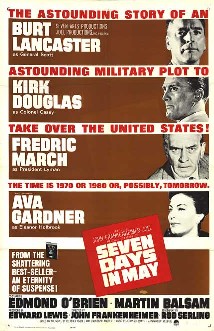
Seven Days in May
On Monday, May 12, 1970, during the Cold War, unpopular U.S. President Jordan Lyman has signed a nuclear disarmament treaty with the Soviet Union. This produces a wave of dissatisfaction among the opposition and the military, who believe the Soviets cannot be trusted. As the president's ratings plummet, violent protests erupt right outside the White House. The presidential physician warns him of a dangerous cardiac condition which he blithely disregards, too busy to take a prescribed two-week vacation. Meanwhile, Colonel Martin "Jiggs" Casey, the Director of the Joint Chiefs of Staff, learns that his superior, the highly decorated Air Force general James Mattoon Scott, is planning a coup d'etat with the Joint Chiefs. Disguised as a training exercise, the plan involves a secret army unit known as ECOMCON training at a secret Texas base, which will take control of the country's telephone, radio, and television networks and seize the president while he participates in a staged "alert". Scott, advancing his charismatic public persona through nationally televised anti-treaty rallies, will replace the president as head of a military junta. Although personally opposed to Lyman's policies, Casey is appalled by the plot and alerts Lyman. A skeptical Lyman gathers a circle of trusted advisors to investigate. Casey deduces the heads of all military branches but the Navy support Scott's coup, and Vice Admiral Barnswell, aboard an aircraft carrier in the Mediterranean, is apparently the only invited officer to decline. Lyman rescinds his commitment to participate in Scott's alert, pretending he will be away for a fishing weekend, then dispatches his Chief of Staff Paul Girard to Gibraltar to obtain Barnswell's confession. The alcoholic Senator Raymond Clark, Lyman's close friend of 21 years, goes to Texas to locate the secret base, and tasks Casey to gather dirt on the general's private life. The Secret Service surreptitiously films evidence of an attempt to kidnap the president during the phony fishing trip, removing all doubts about the existence of a plot. Girard successfully secures Barnswell's written confession, which is lost when he's killed in a plane crash in Spain. Clark is taken captive when he reaches the secret base and held incommunicado. Exploiting their longtime friendship, Clark convinces the base's deputy commander Colonel Henderson of the actual intent of the impending "alert". Henderson frees Clark and leads an escape back to Washington but is abducted and confined in a military stockade. In a radiophone conference call with the president, Barnswell denies knowledge of any conspiracy. Knowing he can't prove Scott's guilt, Lyman calls him to the White House to demand the conspirators resign. Scott refuses, denying the existence of a plot. Lyman argues that a coup would prompt the Soviets to launch a preemptive nuclear strike and Scott maintains the American people are behind him. Lyman challenges him to resign and run for office in order to seek power legitimately, but Scott is unmoved. Lyman restrains himself from confronting Scott with damning letters that Casey had obtained from Scott's former mistress Eleanor Holbrook. Casey, who has his own romantic interest in Holbrook, eventually returns them to her. Scott meets the other three Joint Chiefs, reasserts his intention to execute the coup, and plans a nighttime network broadcast, but Lyman plans an afternoon press conference to announce the firing of the four men. As the presser begins, Barnswell's confession, recovered from the plane crash, is handed to him and he pauses the proceeding to give time for copies of the confession to be delivered to Scott and the plotters. Scott, devastated, abandons the plan and returns home as Lyman announces the resignation of the other three conspirators on live air. Lyman delivers a speech on the state of the nation and its values, declaring that the nation gains strength through peace rather than by conflict. The press corps applauds.

A Few Good Men
At Guantanamo Bay Naval Base in Cuba, United States Marine Private William Santiago dies after being tied up and beaten in the middle of the night. Lance Corporal Harold Dawson and Private First Class Louden Downey face court-martial, accused of murder. Their defense is assigned to United States Navy JAG Corps Lieutenant Daniel Kaffee, who has a record of expedient plea bargains but no courtroom experience. Santiago died after breaking the chain of command to ask for a transfer. The base's second-in-command, Lieutenant Colonel Matthew Markinson advocated for it, but the base commander, Colonel Nathan Jessep, ordered Santiago's platoon commander, First Lieutenant Jonathan Kendrick, to "train" Santiago on the grounds that the entire platoon is at fault for Santiago's substandard performance. Kaffee's co-counsel, Lieutenant Commander Joanne Galloway, suspects Dawson and Downey carried out a "code red": a violent extrajudicial punishment. Galloway is bothered by Kaffee's blasé approach, and Kaffee resents Galloway's interference. Kaffee and Galloway question Jessep and others at Guantanamo Bay and are met with contempt. Kaffee negotiates a plea bargain with the prosecutor, US Marine Judge Advocate Captain Jack Ross. Dawson and Downey would be sentenced to two years for involuntary manslaughter, including six months of confinement, enabling them to avoid a possible life sentence if convicted at trial. Dawson is openly disrespectful of Kaffee, and Dawson and Downey refuse the "dishonorable" deal, insisting Kendrick gave them the "code red" order and that they never intended to kill Santiago. Initially intending to be removed as defense counsel, Kaffee unexpectedly enters not guilty pleas at the arraignment. Markinson secretly meets Kaffee and says Jessep never ordered Santiago's transfer. The defense establishes that Dawson had a motive to implement the order; he previously received a negative performance review from Kendrick and was denied promotion after disobeying an order and smuggling food to a confined marine who was restricted to water and vitamins. Through Downey, Kaffee proves that illegal "code reds" had previously been ordered. Under cross-examination, Downey admits he was not present when Kendrick gave the supposed "code red" order, so he cannot verify Dawson's account. Ashamed that he failed to protect Santiago and unwilling to testify against Jessep, Markinson commits suicide. Kaffee laments the loss of Markinson's testimony and his decision to risk long sentences for Dawson and Downey. Co-counsel Lieutenant (junior grade) Sam Weinberg recommends not calling Jessep as a witness but Galloway encourages Kaffee to put him on the stand, despite the possibility of a court-martial if he challenges a high-ranking officer without evidence. After Weinberg and Galloway leave, Kaffee has an epiphany while looking into his closet. He runs outside to tell them he will call Jessep as a witness. In court at the Washington Navy Yard, Jessep is unnerved when Kaffee points out an inconsistency in his testimony – that Guantanamo marines would never disobey his order to "not touch Santiago" yet he ordered Santiago off the base because he feared for Santiago's safety. Kaffee also questions Jessep's claim that Santiago was to be put on a flight to the US because Kaffee's realization was that the uniforms and personal effects in Santiago's wall locker were not packed on the night he died despite Santiago supposedly being scheduled to depart at six o'clock in the morning. Frustrated by the exposure of his lies and the intensity of Kaffee's questions, Jessep extols the military's – and his – importance to national security, angrily exclaiming, "You can't handle the truth!" Kaffee pointedly asks if Jessep ordered the "code red", which Jessep heatedly admits. Jessep is arrested, then tries to assault Kaffee. He is restrained by military police and is read his rights. Dawson and Downey are cleared of murder and conspiracy but convicted of " conduct unbecoming " and will be dishonorably discharged. Downey does not understand what they did wrong; Dawson says they failed to defend those who were unable to fight for themselves. Kaffee tells Dawson it is not necessary to wear rank insignia on one's arm to have honor. Dawson demonstrates newfound respect for Kaffee and acknowledges his status as an officer by rendering a salute. Kaffee and Ross exchange pleasantries before Ross departs to arrest Kendrick for perjury and conspiracy.
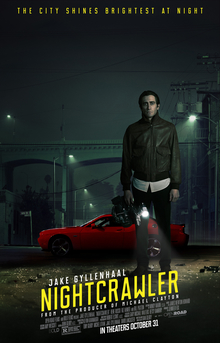
Nightcrawler
At a Los Angeles rail yard, petty thief Louis "Lou" Bloom attacks a guard, taking his watch and stealing manhole covers, fencing, and other materials. While trying to sell the stolen materials at a scrap yard, Lou asks the foreman for a job. The foreman, knowing everything is stolen, refuses to hire a thief. While driving home, Lou spots a car crash and pulls over. Stringers —freelance photojournalists —arrive and record the burning wreckage and police response. One stringer, Joe Loder, explains to Lou how they sell film footage to local news stations. Joe declines Lou's request for a job. Lou steals an expensive bicycle and pawns it for a camcorder and a police radio scanner. After two unsuccessful attempts at recording incidents, Lou records the aftermath of a fatal carjacking and sells the footage to KWLA 6. The morning news director, Nina Romina, says the station is especially interested in "graphic" footage of accidents and violent crime in affluent, predominantly white areas. Lou hires Rick, a young homeless man desperate for money, as his assistant. To create more dramatic film footage, Lou tampers with crime scenes, in one case moving a body for a better camera angle. As Lou's work gains traction, he buys better equipment and a faster car. Lou is a quick learner and establishes a working relationship with Nina at KWLA6. Knowing Nina's two-year contract is nearly up and that she needs higher ratings to keep her job, he threatens to sell his footage to other stations unless she agrees to a sexual relationship, higher payment, and on-air credit for his footage. Recognizing Lou as a competitor, Joe offers to hire him as his second van to cover the whole LA area, but Lou declines. Joe beats him to an important plane crash story and gloats to Lou. Nina berates Lou, demanding he get better footage to keep their bargain. In the daytime, Lou drives to Joe's house and tampers with his van which is parked outside. Joe is later severely injured in a car crash, and Lou records the aftermath. Lou and Rick arrive before the police at the site of a triple-homicide home invasion in Granada Hills. Lou films the gunmen leaving in a Cadillac Escalade as well as the victims in the house. He presents the footage to the station after editing out the perpetrators. The news staff frets over the ethics of using the footage, but Nina is eager to break the story. In exchange, Lou demands public credit, more money, and that Nina unhesitatingly meet his sexual demands. Police detective Frontieri questions Lou regarding his connection to the home invasion. Lou gives her edited footage of the incident that omits the gunmen. That night, Lou and Rick track one gunman to his house, staking it out. Uneasy, Rick negotiates a raise and promotion, which helps salve his worry. Lou delays calling the police, wanting a more public area for recording the arrest, predicting it will be violent. Alarmed at possible innocents being hurt, Rick reopens negotiation, irritating Lou. He demands half the $50,000 reward money for locating the gunman and threatens to tell the police about Lou withholding evidence. Under duress, Lou is forced to acquiesce. The gunman then leaves and picks up his partner. Lou and Rick follow them to a crowded diner, where Lou calls the police, warning them the suspects are armed. The police arrive, where they shoot and kill one of the gunmen after a police officer is shot, and the other escapes in the Escalade. Lou and Rick follow close behind the pursuing police, filming it, which culminates in a long multiple-car collision. Lou approaches the gunman's crashed vehicle and peers inside, then instructs Rick to film the aftermath, claiming the gunman is dead. Lou sets up for a wide shot. As Rick peers inside the car, he is shot by the gunman. The gunman attempts to flee on foot but is shot dead by arriving police. As Rick lies dying, he accuses Lou of knowing the gunman was alive. Lou, filming Rick, says he cannot work with an untrustworthy employee. Nina is awed by the chase footage and expresses devotion to Lou. The news team discovers that the home invasion was actually the criminals breaking in to steal the homeowner's cocaine stash. Nina holds the story until the following night's news to maximize the story's dramatic impact. Police try to confiscate Lou's footage as evidence, but Nina defends her legal right to withhold it and immediately airs it. Lou voluntarily speaks with Detective Frontieri and fabricates a story about the men in the Escalade following him. Frontieri accuses Lou of lying but lacks evidence. Later, Lou now has two vans (as Joe had) and hires a team of interns to expand his film business, telling them that he will not ask them to do anything he is unwilling to do himself.

Brazil
In a dystopian, polluted, hyper- consumerist, overbearing, bureaucratic, totalitarian future based on elements of the 20th century, Sam Lowry is a low-level government employee who frequently dreams of himself as a winged warrior saving a damsel in distress. One day, shortly before Christmas, an insect becomes jammed in a teleprinter, which misprints a copy of an arrest warrant it was receiving. This leads to the arrest and death during interrogation of cobbler Archibald Buttle instead of suspected terrorist Archibald Tuttle. Sam discovers the mistake when he finds that the wrong bank account has been debited for the arrest. He visits Buttle's widow to give her the refund where he catches a glimpse of her upstairs neighbour Jill Layton, a truck driver, and is astonished to discover that she resembles the woman from his dreams. He frantically tries to approach Jill, but she disappears before he can find her. Jill has been trying to help Mrs Buttle establish what happened to her husband, but her efforts have been obstructed by bureaucracy. Unbeknownst to her, she is now considered a terrorist accomplice of Tuttle for attempting to report the wrongful arrest of Buttle. Meanwhile, Sam reports a fault in his apartment's air conditioning. Central Services are uncooperative, but Tuttle unexpectedly comes to his assistance. Tuttle explains that he used to work for Central Services but left because of his dislike of the tedious and repetitive paperwork, and now illegally works as a freelance heating engineer. Tuttle repairs Sam's air conditioning, but when two Central Services workers, Spoor and Dowser, arrive, Sam has to stall to avoid Tuttle's. Sam discovers that Jill's records have been classified and the only way to access them is to be promoted to Information Retrieval. He had previously turned down a promotion arranged by his well-connected mother Ida, who is obsessed with the rejuvenating plastic surgery of cosmetic surgeon Dr Jaffe. Sam retracts his refusal by speaking with Deputy Minister Eugene Helpmann at a party hosted by Ida. After obtaining Jill's records, Sam tracks her down before she can be arrested. Sam clumsily confesses his love to Jill, and they cause mayhem as they escape government agents. They stop at a mall and are frightened by a terrorist bombing (part of a campaign that has been occurring around the city). Following an altercation with the government agents which arrived to the scene of the bombing, he awakens in a prisoner transport vehicle. At work, Sam is chastised by his new boss Mr Warrenn for his lack of productivity. He returns home to find that Spoor and Dowser have repossessed his apartment. Tuttle appears in secret and helps him exact revenge on the two Central Services workers by filling their environment suits with raw sewage. Jill finds him outside his apartment, and the two take refuge in Ida's unoccupied home, where they share their first kiss. He falsifies government records to indicate her death, allowing her to escape pursuit. The two spend the night together, but in the morning are apprehended by the government at gunpoint. Sam learns that Jill was killed during his arrest. Charged with a number of crimes, he is restrained in a chair in a large, empty cylindrical room, to be tortured by his old friend Jack Lint. As Jack is about to start the torture, Tuttle and other members of the resistance break into the Ministry, shooting Jack, rescuing Sam and blowing up the Ministry building. Sam and Tuttle flee together, but Tuttle mysteriously disappears amid a mass of scraps of paperwork from the destroyed building. Sam stumbles into the funeral of Ida's friend, who has died following botched cosmetic surgery. He discovers that his mother now resembles Jill and is too busy being fawned over by young men to care about her son's plight. Government agents disrupt the funeral, and he falls into the open casket. Through a black void, he lands in a street from his daydreams and tries to escape police and monsters by climbing a pile of flex-ducts. Opening a door, he passes through it and is surprised to be in a truck driven by Jill. The two leave the city together. However, this "happy ending" is a delusion: it is revealed that Sam is still strapped to the torture chair. Realising that he has been permanently driven insane, Jack and Mr Helpmann declare him a lost cause and leave the room. He remains in the chair, smiling and humming " Aquarela do Brasil " to himself.

The French Revolution
The first part focuses on the events of the early days of the French Revolution. The film opens in 1774 with a young Maximillien Robespierre reading a document in front of King Louis XV 's carriage in the College Louis le Grand. He is splashed with mud after a horse's hoof smacks the muddy ground, prompting his classmates to laugh at him. Robespierre's classmate, Camille Desmoulins, comforts and reassures Robespierre. The film jumps 15 years later at the calling of the Estates General of 1789, which proves to be a disaster as many members of the Third Estate had sworn an oath on 20 June 1789 to not stop convening as a committee until they are given more rights. In response, King Louis XVI closes the assembly. In a private lunch following the incident, Marie Antoinette gives Louis a few ideas, such as using force should the people refuse the King's demands. Meanwhile, many orators rouse the people to demand for change. The situation only worsens after King Louis XVI accepts the resignation of finance minister Jacques Necker, a friend and popular figure of the people, who then returns to Switzerland. Desmoulins arrives at the Palais-Royal and delivers the news on 12 July, along with an impassioned call to arms to the crowd to defend themselves against Swiss and German troops who would attack them. When Desmoulins' friend and colleague Georges Danton hears the news and then learns of troops already attacking citizens during efforts to get them to disperse, he delivers a fiery speech at Paris' Cordeliers Convent asking every man in the district to volunteer to fight and proclaiming that they will not allow tyranny to triumph over liberty. On 14 July 1789, revolutionaries gather at the Bastille prison, seeking weapons and gunpowder for their revolutionary cause. A battle ensues between Revolutionary forces and the prison's garrison, headed by the Marquis de Launay, where the Revolutionaries emerge victorious after a bloody struggle and tense negotiations. Launay is lynched and his head stuck on a pike, the revolutionaries dancing " La Carmagnole " around it in celebration. Louis XVI arrives at Paris while the Marquis de Lafayette reads the Declaration of the Rights of Man and of the Citizen out to the National Assembly as people from all corners of France read it for themselves or hear it. At the start of October, in the middle of a severe bread shortage, Versailles holds a welcoming banquet for Flanders Regiment officers after they arrive to defend the palace as a precaution. When word reaches Paris, Danton is enraged, and on 4 October, dictates a leaflet in the presence of Desmoulins to be printed and posted on the city walls, which calls the banquet an insult to liberty and also calls for insurrection. The day after the missive is sent, thousands of women march to demand bread and then turn towards Versailles, and male revolutionaries also join after Danton exhorts them to do so as a matter of honor and to protect what they have won. The women storm the palace, overpowering the guards but stopping short of the King and Queen, protected by guards and soldiers. After the mob demands that the King appear on the balcony to prove he hasn't left and abandoned the people, Louis XVI appears on the balcony, followed by his wife, Marie Antoinette. As the mob prepares to shoot her, she kneels down, pleading forgiveness, and the mob relents, shouting "God save the Queen!". Afterward, Louis meets with inventor Joseph-Ignace Guillotin, and is presented with a model of a new execution device he names the Guillotine. At first, Guillotin proposes a crescent-shaped blade, but Louis, who claims he is experienced with mechanics, proposes a triangular blade instead, and designed like a saw, to Guillotin's delight. Meanwhile, Danton starts his own political newspaper. A few days later, a celebration is held at the Champ de Mars, known today as the Fête de la Fédération. Some of those in the masses are Danton, Maximilien Robespierre, and many other revolutionaries. Lafayette and the people swear an oath of faith and loyalty to France. Soon afterwards, a mutiny in the Nancy garrison is quickly put down, many being beaten publicly to death or hanged. In a speech before the National Assembly, Danton demands the resignation of the Interior Minister, Minister of War, the Monsieur de la Tour du Pin, and many others, to the support and agreement from many delegates present. Soon afterwards, riots against the clergy are incited due to their continued monarchist sentiment, and many attacks against clergymen, churches, cathedrals, and monasteries occur across France. Baptism is mocked, and organists are forced to play revolutionary music on the organ. Subsequently, Lafayette signs an edict demanding the arrest of all Revolutionaries in the National Assembly. Meanwhile, the royal family flees Paris, hoping to reach the Austrian Netherlands disguised as servants. However, they are identified by an innkeeper at Varennes, and returned to Paris. Speakers around France demand that Louis XVI be stripped of his royal title as King of France and be reduced to merely "Citizen Louis Capet". The Mayor of Paris, Jean Sylvain Bailly, is forced to declare martial law after Danton and his supporters gather at the Champ de Mars. Initially dispersed by the National Guard, they return on 17 July 1791, gathering souvenirs, banners and flags. However, the National Guard also returns, and after the soldiers fire a warning shot above the heads of the civilians, the crowd begins to throw stones and other objects at the soldiers. Taking this as a sign of hostility, Bailly orders his troops to open fire, despite Lafayette's efforts to maintain peace between both sides. The resulting massacre is a bloodbath, with dozens dead or wounded. The survivors quickly scatter, and this only worsens the situation. A few weeks later, Louis XVI and the National Assembly declare war on the great powers of Europe, but Robespierre knows that the campaign will be a disaster, and his prediction initially proves to be true. French troops march on the Belgian frontier, but are quickly annihilated by forces of Prussia and Austria, and a French general is killed by his own soldiers. Jean-Paul Marat demands that "ten thousand heads must fall here in France." The Duke of Brunswick issues a manifesto demanding that France surrender, or he will "burn Paris to the ground." Another call to action is given at the National Assembly, with Robespierre again certain that the next campaign will be a disaster. While French soldiers make their way to the front, they are given provisions in the towns they enter, and sing a new song: " La Marseillaise ". On 10 August, thousands of Revolutionaries surround the Tuileries Palace. Initially, the National Guard are ordered to defend the palace, but unwilling to fire upon their fellow brethren, they switch sides and point cannons at the palace. An armed standoff takes place, where Louis XVI, Marie Antoinette, and the rest of the nobility are escorted out of the Palace for refuge in the meeting place of the National Assembly, where the children watch the proceedings. Back at the Tuileries, the insurrectionists break through the Palace gates, and an intense firefight ensues between the Swiss Guards and the revolutionaries. Despite the Swiss Guards' best efforts, and heavy losses sustained by the Revolutionaries, the Palace is taken. Louis then tells his son that "there is no longer a King in France". The second part focuses on the aftermath of the 10 August Insurrection and the Reign of Terror. On 13 August, 1792 Louis XVI and his family arrive at the Temple, a fortress and prison, where they would remain as prisoners until their sentence. With the King deposed and Danton serving as Justice Minister, Desmoulins believes that everything they have done in the Revolution is over and they can finally rest, but Robespierre overrules this by pointing out it could only be the beginning. Lafayette then is forced to step down from his position as commander of the Army of the North and is later taken prisoner by the Allies. As Prussian forces advance closer to Paris, desperate measures are taken by Danton and his associates. Death warrants are issued against purported enemies of the Revolutionary forces, with many thronging the steps pleading for Danton to spare a relative, or a friend. Meanwhile, Prussian troops ransack cities and continue to annihilate the French armies in the field. The September Massacres slaughter thousands of nobles and anyone suspected of loyalty to the monarchy. Not even Marie Antoinette's lady-in-waiting, the Princesse de Lamballe, is spared, and her head is shown to Marie Antoinette, who collapses on the floor, sobbing. On 20 September, French forces fight and emerge victorious over the Prussians at the Battle of Valmy, and celebrations ring out throughout France and the National Assembly. Louis XVI is brought before the National Assembly to stand trial for treason after Louis Antoine de Saint-Just demands his execution. Louis denies the charges brought against him, and when the topic of the Swiss Guards is brought up, Louis responds that he doubled the guards for his own safety, then denying that he caused the bloodshed on August 10 and that there were no armories in the Tuileries at the time. The next day, Louis declares before the assembly that his conscience is clear, and that the worse thing that wounded his heart were the accusations that he had shed the blood of the people. Later that night, the court votes to execute Louis. On 2 January, Louis is brought to the scaffold in a closed carriage. He attempts to make a speech to the crowd, but is drowned out mid-speech by drums ordered to sound by the commander. Louis is then beheaded by the guillotine to cheers from the previously-silent crowd. Shortly afterwards, his own son, Louis Charles, is taken by soldiers to be tutored by a man named Citizen Simon, much to the dismay of Marie Antoinette. Robespierre confers with Danton and considers a new Revolutionary Tribunal, despite them being branded as dictators. Marat is brought before the tribunal on charges of inciting public hysteria and is acquitted, as Danton knew he would be. However, Danton drives out the Girondins from his office, including Brissot. In another conference with Robespierre, Danton announces that he wants Brissot executed. Armed citizens surround the Convention and drive out Brissot and his supporters. Soon after, a young woman named Charlotte Corday hears a speech criticizing and denouncing Marat, and decides to act. She manages to get into Marat's room and stabs him whilst he is writing for a newspaper in his bathtub, killing him instantly. During Marat's funeral, Robespierre proposes new granaries for the starving populace to resounding support (Corday is afterward executed offscreen). On 15 October 1793, Marie Antoinette is escorted by her guards to the Revolutionary Tribunal for her trial. She is asked by the court on who provided the carriage for their flight to Varennes, where she replies with Count Alex von Fersen. Jacques Hébert then testifies before the court that whilst he was interrogating Citizen Simon, the latter had said he had seen the boy do "indecent and harmful acts", and then questioned him on who had taught him these things, to the young Capet admitting it was his mother and aunt, also admitting he had been forced to sleep with both of them, and that they "committed acts of debauchery", to which Marie Antoinette responds with an emotional appeal to all mothers in the room, crying out that "Nature itself reels from such an accusation". Antoinette is then convicted and condemned to death, and is executed the next day on October 16. Marie maintains great dignity and courage during her execution. Saint-Just makes a speech before the Convention and declares that "Terror is the order of the day." The next day, Saint-Just and Robespierre witness the execution of Brissot and his supporters. Danton is remarried (after the death of his old wife a few months earlier). Danton later gives a speech in front of the Convention, calling it a "den of faction, lies, and insanity", seeing churches desecrated outside, and asks, "is this the Republic we wanted to create?" He then demands that a "Committee of Clemency" be established, and receives support and applause from many in the audience and in the Convention, even from Robespierre himself, to the surprise of those near him. Hébert has great concern for the possible comeback of Danton, and expresses his need to "use every weapon against him". Hébert then denounces Danton via newspaper, and later to a crowd, accusing him of treason and having betrayed the Revolution. Robespierre then appears and asks for a Committee to investigate Danton's career and integrity, and declares the accusations false and fraudulent, saving Danton's life in the process. Hébert then incites his followers to insurrection. The Committee of Public Safety then unanimously votes for the arrest of Hébert, and he is arrested (later executed, also offscreen). The Committee of Public Safety debates on Danton's situation, and decide on his immediate arrest. Danton later tells one of his associates that even if there were a trial, he would win. Danton and Camille are both arrested. Danton's trial is chaotic, with the stands and seats full of his supporters, as well as the jury being hand-picked to ensure he is convicted. At a local play, Robespierre is discovered by the actors and the audience quickly shouts for his downfall. Saint-Just finds a letter uncovering a conspiracy between Desmoulins' wife Lucile with some aristocrats to free Camille and Danton. The Committee decides to present it as a testimony of Desmoulins and Danton's treachery, and Camille's wife is arrested. The next day, the evidence is presented, and Danton and his supporters are condemned to death and executed. As they are led out of the courtroom, the audience, who is supportive of Danton, sings La Marseillaise. Desmoulins' wife is also executed a few days later. Robespierre holds the Festival of the Supreme Being on 8 June 1794. Initially, the festival is triumphant and majestic, but it proves to be a disaster. Robespierre speaks for so long that some in the crowd start sleeping. Some even murmur that Robespierre thinks he's either the Pope or God Himself. When Robespierre declares that the Supreme Being's religion is Virtue, someone in the crowd yells that Robespierre's is Murder. As Robespierre's speech goes on, the crowd starts to be more aggressive to him and many begin to leave, either discontented with the contents of Robespierre's speech or simply bored of the entire thing. The Committee starts denouncing Robespierre, saying that he has "executed more people in the last two months than in the last two years", although he is defended by ardent supporters such as Saint-Just. The Committee decides that things have gone too far and plot to bring an end to Robespierre. At the Convention, Robespierre makes a speech detailing his situation, from his perspective, to his hearers, whilst his political enemies decide to stop him in his tracks on that day. Robespierre's opponents then demand that he read out the names of those he accused as Robespierre finishes his speech. When Robespierre refuses, the Convention denounces him a tyrant and unanimously votes for his execution. Robespierre and his supporters take refuge in the Hôtel de Ville, Paris and organize a defense of the building. The Convention musters a large force to storm the building and take Robespierre prisoner, whilst Robespierre's followers, led by a drunken general, barricade themselves in the building. A cannon brings down the barricaded door, and a brief skirmish ensues between forces of the National Guard and Robespierre. The doors to the main room are broken down and a large scuffle ensues, with Robespierre himself accidentally shooting himself in the jaw after being tackled to the floor, following an attempt to shoot a soldier targeting him. Robespierre and his supporters are all arrested and await execution. The next day, Robespierre, Saint-Just, and other prominent Robespierrists are taken to the Place de la Révolution and guillotined, effectively marking the end of the Reign of Terror. In the closing scene, family members of some of the leading revolutionaries light candles in a church, before leaving.

The Conversation
Harry Caul, a surveillance expert in San Francisco, specializes in audio recordings. He and his team are hired by a client known as "the Director" to eavesdrop on a couple, whom they record walking in circles in Union Square. Despite the background noise, Harry filters and merges the tapes to create a clear recording with ambiguous meaning. Harry is intensely private, obsessively guarding his personal life; though he insists that he is not responsible for how his clients use the surveillance he creates, he is haunted by guilt from a past job that resulted in three deaths. He meets with Martin Stett (Ford) who meets with Harry instead of the Director, who told Harry to give the tapes only to him. Harry wrests them away and Stett warns him about the contents of the tapes. When he discovers a potentially dangerous phrase in the recording, "He'd kill us if he got the chance," Harry becomes increasingly anxious. His attempt to deliver the recording is thwarted, and he is both followed and threatened. After a party at his workshop, Harry spends the night with a woman he has just met and the tapes are stolen. He receives a call from Martin Stett, the Director's assistant, informing him that the Director could not wait any longer and they have the tapes. Harry is tasked with delivering the pictures taken and collecting his money in a meeting with the Director that afternoon. There he learns that the woman in the recording is the Director's wife, involved in an affair. Harry, suspecting murder, books a hotel room next to the one the couple had mentioned for a planned rendezvous in the recording, and sees a bloody altercation from the balcony. Convinced there was a murder, Harry breaks into the room; he initially finds the room spotless, but when he flushes the toilet it is clogged and overflowing with blood. Attempting to confront the Director, Harry discovers the wife is alive and unharmed, as is her lover. A newspaper headline reports that an executive has supposedly died in a car accident. Harry realizes that the couple actually murdered the Director, having missed the emphasis on the word "us" in the recording, which not only expressed the couple's fear of being killed by the Director if he discovered the affair, but was also an attempt to justify killing him first as a defensive move. Stett calls Harry at his apartment, and warns him not to investigate. He plays a freshly made recording of Harry playing his saxophone to prove they are listening. Harry frantically searches for bugs in his apartment, destroying nearly everything in it. Having failed to locate the bug, Harry sits alone amid the wreckage, playing his saxophone.
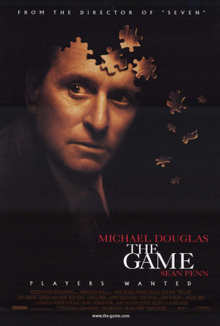
The Game
Nicholas Van Orton is an investment banker in San Francisco. He is very successful and wealthy, but also cold and condescending, as well as lonely and reclusive. He remains haunted by the death of his father, who committed suicide on his 48th birthday by jumping off the roof of the family mansion. Therefore, Nicholas is feeling grim on his 48th birthday. On the day, he is surprisingly visited by his estranged younger brother, Conrad, who gifts him an unusual present—a voucher for a "game" offered by Consumer Recreation Services (CRS). Though skeptical, Nicholas cannot help but be interested and he goes to the CRS office to apply; the time-consuming psychological and physical examinations required irritate him. He is later informed that his application has been rejected. This angers him. Nicholas returns home one evening to find a wooden clown in his driveway, which he drags inside. While watching the Cable Financial Network (CFN), the anchor begins talking to Nicholas through his TV screen. The anchor tells Nicholas that he is being watched by a tiny camera in the clown's head and provides him with the telephone number for a CRS 24-hour emergency hotline. He warns Nicholas not to call the hotline asking about the object of the game, as "figuring that out is the object of the game." More bizarre events continue; Nicholas initially thinks CRS is simply staging elaborate pranks, but he comes to believe it is real when his business, reputation, and safety are endangered. He meets a waitress, Christine, who also becomes involved. A panic-stricken Conrad visits Nicholas and apologizes, claiming CRS has attacked him. An argument breaks out between the two brothers, resulting in Conrad running away—leaving Nicholas on his own. Nicholas gets into a taxi; after locking the doors, the driver jumps out before the car crashes into San Francisco Bay. Nicholas manages to escape the sinking car, using a tool mysteriously left for him a day before. He reaches the surface and contacts police, but they find the CRS office abandoned. With no one else to turn to, Nicholas finds Christine's home and discovers she is a CRS employee. When she tells him they are being watched, Nicholas attacks a nearby camera, and armed CRS personnel swarm the house. When they fire at the two of them, they flee to a Van Orton home outside of the city. Christine has told Nicholas that CRS has drained his bank accounts by guessing his passwords using the psychological tests he completed, but a call to his lawyer suggests the money remains intact. Nicholas then begins to feel dizzy and realizes Christine has drugged him. As he loses consciousness, she admits she is part of the scam and says he made a fatal mistake in giving his card security code over the phone. Nicholas wakes entombed alive in a Mexican cemetery. He sells his watch (a gift from his mother) to return to San Francisco, only to find his mansion foreclosed and most of his possessions removed. He contacts the hotel where Conrad was staying, and is told his brother has been committed to a mental institution following a nervous breakdown. Nicholas retrieves a hidden gun and finds his ex-wife to ask for help. While apologizing to her for his emotional neglectfulness, he learns that Jim Feingold, the CRS employee who conducted his tests, is an actor working in television advertisements. He finds Jim and forces him to find the real CRS office, finds Christine there and takes her hostage, demanding to be taken to the head of CRS. Pursued by CRS guards, Nicholas takes Christine to the roof. Christine, realizing Nicholas's gun is not a prop, frantically tells him it is only a game; his finances are intact, and his family and friends are waiting on the other side of the door. He refuses to believe her, and Nicholas shoots the first person to emerge—Conrad, bearing a bottle of champagne. Devastated, Nicholas tries to commit suicide by leaping off the roof, but lands on a giant air cushion in a banquet hall. He is greeted by Conrad and the rest of the actors from the game, revealing that the gun was a prop. Everything had been staged by Conrad for Nicholas's birthday present. After a birthday party with friends, Christine (whose real name is Claire) declines Nicholas's offer of a date because she has another job lined up in Australia. She instead suggests they have coffee together at the airport, ending the final scene with Nicholas looking half-tempted, half-cautious.
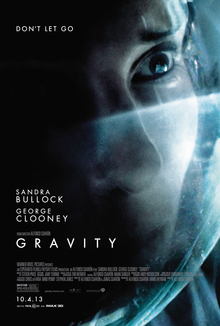
Gravity
The Space Shuttle Explorer, commanded by veteran astronaut Matt Kowalski, is in Earth orbit to service the Hubble Space Telescope. Dr. Ryan Stone is aboard on her first space mission, to perform hardware upgrades on the telescope. During a spacewalk, Mission Control in Houston warns Explorer ' s crew about a rapidly expanding cloud of space debris caused by the Russians shooting down a defunct spy satellite, and orders the crew to return to Earth immediately. Communication with Mission Control is lost shortly after, as more communication satellites are disabled by debris. Debris strikes Explorer and Hubble, tearing Stone from the shuttle. Kowalski, using a Manned Maneuvering Unit (MMU), rescues her and they return to Explorer, discovering that it has suffered catastrophic damage and the rest of the crew are dead. Kowalski decides they should use the MMU to reach the International Space Station (ISS), which is in orbit about 1,450 km (900 mi) away. He estimates that they have 90 minutes before the debris field completes an orbit and threatens them again. On their way to the ISS, the two discuss Stone's home life and her daughter, who died young in an accident. As they approach the station, they see that the ISS's crew has evacuated using one of its two Soyuz spacecraft, with the remaining craft exhibiting damage and unable to return to Earth. Kowalski suggests using it to travel to the nearby Chinese Tiangong space station, 100 km (60 mi) away, to board its similar Shenzhou spacecraft and return to Earth. They try to grab onto the ISS, but only make tenuous connection to the Soyuz's parachute cords, which are not strong enough for them both. Despite Stone's protests, Kowalski detaches himself to save her from drifting away with him. Stone enters the ISS as Kowalski floats away. Unable to establish communication with him, she concludes that she is the mission's sole survivor. Inside the station, a fire breaks out, forcing Stone to rush to the Soyuz. As she maneuvers it away from the ISS, the tangled parachute tethers snag, preventing the spacecraft from leaving. She performs a spacewalk to cut the cables, succeeding just as the debris field returns, destroying the station. Stone angles the Soyuz towards Tiangong but discovers that the engine has no fuel. After an attempt at radio communication with an Inuk on Earth, Stone resigns herself to her fate and shuts off the cabin's oxygen supply to commit suicide. As she begins to lose consciousness, she experiences a hallucination of Kowalski telling her to rig the Soyuz's soft landing rockets to propel the capsule towards Tiangong. Stone regains the will to go on, restoring the spacecraft's oxygen flow and rigging the landing rockets accordingly. Unable to dock with Tiangong, Stone ejects herself from the Soyuz and uses a fire extinguisher as a makeshift thruster to travel to the rapidly deorbiting station. She enters Tiangong ' s Shenzhou capsule just as the station enters the upper atmosphere, and undocks. The Shenzhou capsule re-enters the atmosphere and lands in a lake. Radio communication from Houston informs Stone that she has been tracked on radar and that rescue crews are on their way. Stone opens the hatch and sheds her space suit, allowing her to reach the surface and crawl onto the beach before standing and walking away.

Virus
Zakariya Mohammed is infected and brought to the Government Medical College, Kozhikode, where he suffers from the symptoms of an unknown virus and, after a few hours, dies. Geetha, who was taking Zakariya's CT scan, gets infected by the virus. The doctors and nurses are worried and confused by her constantly fluctuating blood pressure. A nurse Akhila who treated Zakariya gets infected too. Slowly more cases are identified in the surrounding areas. Dr. Salim (a neurologist) while checking on Zakariya's father, Razak, notices symptoms related to poisoning and Japanese encephalitis and other such infections. Dr. Salim also asked Dr. Suresh Rajan to conduct a sample test for Nipah virus. The samples were collected from Suhana, sister of Zakariya. As the death toll begins to rise, Dr. Suresh Babu confirms the unknown virus to be Nipah. Nipah spreads across Kozhikode and the neighbouring districts. Sister Akhila (the nurse who treated Zakariya), dies after a long battle with the virus and before she died, she wrote a letter to her husband. The film progresses with real life experiences of people who we are aware of when it has happened and also creates a backstory for each affected patient and generates an interest in the narration. In an emergency situation, a team of medical practitioners and healthcare professionals, led by the Health Minister of Kerala C. K. Prameela and District Collector Paul V. Abraham IAS, camp in Kozhikode to tackle the crisis. There is an attempt made to justify that this is not a bio-weapon used by any country or organisation. While the film is ending, the film pays tribute to scientists, medical professionals, hospital staff, volunteers and the people who came forward to support the team to solve the virus attack. Health minister, C. K. Prameela announces Kozhikode Nipah virus free. In the end, it is shown that Zakariya saw a flying fox (a breed of bats) that was on the ground. He went there and before coming in contact with the bat, he took a picture of the bat for his Instagram story.

Gattaca
In the "not-too-distant" future, eugenics is common. A genetic registry database uses biometrics to classify those so created as "valids" while those conceived naturally and more susceptible to genetic disorders are known as "in-valids". Genetic discrimination is illegal, but in practice genotype profiling is used to identify valids to qualify for professional employment while in-valids are relegated to menial jobs. Vincent Freeman was conceived naturally, and his genetic profile indicates a high probability of several disorders and an estimated lifespan of 30.2 years. His parents, regretting their decision, use genetic selection in conceiving their second child, Anton Jr. Growing up, the two brothers often play a game of " chicken " by swimming out to sea as far as possible, with the first one returning to shore considered the loser; Vincent always loses. Vincent dreams of a career in space travel, but is always reminded of his genetic inferiority. One day, Vincent challenges Anton to a game of chicken and beats him. Anton starts to drown and is saved by Vincent. Shortly after, Vincent leaves home. Years later, Vincent works cleaning office spaces, including that of spaceflight conglomerate Gattaca Aerospace Corporation. He gets a chance to pose as a valid with a "borrowed ladder", using donated hair, skin, blood, and urine samples from former swimming star Jerome Eugene Morrow, who was paralyzed after being hit by a car. With Jerome's genetic makeup, Vincent gains employment at Gattaca and is assigned as a navigator for an upcoming mission to Saturn's moon Titan. To conceal his identity, Vincent must meticulously groom and scrub his body daily to remove his own genetic material, pass daily DNA scanning and urine tests using Jerome's samples, and hide his heart defect. When a Gattaca administrator is murdered a week before a possible launch, the police find one of Vincent's eyelashes near the crime scene, but can only identify it as from an "unregistered" in-valid, and thus launch an investigation to find who owns the eyelash. During this, Vincent becomes close to a co-worker, Irene Cassini, and falls in love with her. Though a valid, Irene has a higher risk of heart failure that will bar her from any deep space mission. Vincent also learns that Jerome's paralysis is self-inflicted; after placing silver in the Olympics, Jerome threw himself in front of a car. Jerome maintains that he was designed to be the best, yet somehow was not, and is suffering because of this. Vincent repeatedly evades the grasp of the investigation. Finally, it is revealed that Gattaca's mission director Josef killed the administrator because he threatened to cancel the mission. Vincent learns that the detective who closed the case was his brother Anton, who consequently has discovered Vincent's presence. The brothers meet, and Anton warns Vincent about his illegal actions, but Vincent asserts that he has gotten to this position on his own merits. Anton challenges Vincent to a final game of chicken. As the two swim out at night, Vincent's stamina surprises Anton, so Vincent reveals that he won by not saving energy for the swim back. Anton turns back and begins to drown, but Vincent rescues him and swims them back to shore. On the day of the launch, Jerome reveals that he has stored enough DNA samples for Vincent to last two lifetimes upon his return and gives him an envelope to open once in flight. After saying goodbye to Irene, Vincent prepares to board, but discovers there is a final genetic test, and he currently lacks any of Jerome's samples. He is surprised when Dr. Lamar, who oversees background checks, reveals that he knows Vincent has been posing as a valid. Lamar admits that his son looks up to Vincent and wonders whether his son, who is genetically selected, but "not all that they promised", could exceed his potential just as Vincent has. The doctor changes the test results, allowing Vincent to pass. As the rocket launches, Jerome dons his swimming medal and immolates himself in his home's incinerator. Vincent opens the note to find a lock of Jerome's hair.

Sorcerer
The film opens with a prologue that consists of four segments described by critics as "vignettes". They show the principal characters in different parts of the world and provide their backstories. Nilo, an elegantly dressed man, enters a flat in Veracruz. Nilo immediately executes the unsuspecting tenant with a silenced revolver and proceeds to casually walk out of the building and onto the square. A group of Palestinian militants disguised as Jews causes an explosion near the Damascus Gate in Jerusalem, after which they take shelter at their hideout, where they assemble weaponry and plan their escape. After getting surrounded by the Israel Defense Forces, they split up; two are killed and one is apprehended. The only one who manages to escape is Kassem, a demolitions expert. The segment finishes as he helplessly stares from a crowd at his captured companion. While discussing a book his wife is editing, Victor Manzon discovers an anniversary gift from her: a watch with a special dedication. After meeting with the president of the Paris Stock Exchange, where he is accused of fraud, Victor is given 24 hours to provide collateral to have the charges dropped. Victor meets his business partner and brother-in-law, Pascal, and they quarrel; Victor insists that Pascal contact his father for financial assistance. Victor dines with his wife and her friend in a glamorous restaurant; he later receives a message from a butler that Pascal is waiting outside. When he learns that Pascal's father has refused to help, Victor is adamant that they try again. He walks his partner to a car, but Pascal unexpectedly commits suicide. Faced with impending doom, Victor leaves both his wife and the country. In Elizabeth, New Jersey, an Irish gang robs a Catholic church that is connected with a rival Italian Mafia crew and organizes cash bingo games. During the heist, a robber shoots and wounds one of the priests counting the proceeds of the bingo. Back in their car, the Irish gang members engage in a heated argument that causes Jackie Scanlon, the driver, to lose concentration and collide with a truck. Everyone is killed but Jackie, who escapes with serious injuries. The wounded priest turns out to be the brother of Carlo Ricci, an Italian Mafia kingpin who also controlled the flow of money in the church and is determined to kill Jackie at all costs. Jackie meets with his friend Vinnie, who reveals the gravity of the situation and finds a suitable place for him to escape. Jackie has no option but to agree. Kassem, Victor, and Jackie all assume fake identities and end up in Porvenir, a remote village somewhere in South America. Its conditions are in stark contrast to their previous lives. The village economy is heavily reliant on an American oil company. Kassem befriends a man called 'Márquez', presumably a Nazi war criminal. They all live in extreme poverty and earn meager salaries. All want out, but their savings are inadequate for emigration. After some time, Nilo arrives in the village, raising suspicions. In the meantime, an oil well explodes, and the only way to extinguish the fire is to use dynamite. Since the only available dynamite has been improperly stored in a remote depot, the nitroglycerin contained inside has become highly unstable; the faintest vibration could cause an explosion. With all other means ruled out, the only way to transport it the 218 miles (351 km) is to use trucks. The company seeks four drivers to man two vehicles. Kassem, Victor, Jackie and 'Márquez' are offered the job, but they have to assemble the trucks using scrap parts. Shortly before their departure, Nilo kills and replaces 'Márquez', which angers Kassem. The four drivers embark upon the perilous journey, facing many hazards and internal conflicts. Despite their differences, they are forced to cooperate. They traverse a decrepit bridge during a violent thunderstorm, Kassem and Victor nearly losing their truck in the process. The team is forced to use one of the boxes of dynamite to destroy a massive fallen tree blocking their path. The rough terrain on a cliff-side road causes Kassem and Victor's truck to blow a tire, sending the truck over the cliff; it explodes and kills the pair. When Nilo and Jackie stop at the scene of the destruction, armed guerrillas surround them in an attempted robbery. They kill the men but Nilo is mortally wounded, soon dying from his injuries. Now alone, Jackie struggles to stay sane, overwhelmed by sleep deprivation, hallucinations and flashbacks. When his truck's engine dies less than 2 miles (3.2 km) short of the destination, he is forced to carry the remaining dynamite on foot. Once he finally reaches his destination, he collapses from exhaustion. At the bar back in Porvenir, Jackie is given a Colombian passport and payment for the job by the oil company, as well as an offer of another job. Before he leaves, he asks a charwoman for a dance. As the two dance, Carlo Ricci's henchmen, along with Jackie's old friend Vinnie, emerge from a taxi and walk into the bar wielding guns. A single gunshot is heard, and Jackie's fate is left unknown as the film cuts to black.