Genre: Music (Page 3)
Browse 55 movies in the Music genre.
All Genres


The Producers
Max Bialystock is an aging Broadway producer whose career has veered from great success to the depths of near failure. He now ekes out a hand-to-mouth existence while romancing lascivious, wealthy elderly women in exchange for money for a "next play" that may never be produced. Leopold "Leo" Bloom, a neurotic young accountant prone to hysterics, arrives at Max's office to audit his accounts and discovers a $2,000 discrepancy in the accounts of Max's last play. Max persuades Leo to hide the fraud, and Leo realizes that, since a flop is expected to lose money, the IRS will not investigate its finances, and the investors will not expect a large financial return, so a producer could earn more from a flop than from a hit by overselling interests and embezzling the funds. Max decides to make this into a scheme, and use the profits to flee to Rio de Janeiro. He convinces Leo to join him, treating him to lunch and a day out and saying that his drab life in accounting is little different from prison anyway. Leo has an epiphany and agrees to the con. The partners find the ideal play for their scheme: Springtime for Hitler: A Gay Romp with Adolf and Eva at Berchtesgaden, a "love letter to Hitler " written by deranged ex- Nazi soldier Franz Liebkind. Max and Leo bond with Franz over schnapps and tell him they want to show the world a positive representation of Hitler. Now with the stage rights, Max goes to work seducing as many old rich women as possible, selling 25,000% of the play to investors. Right away, he uses some of the money to redecorate the office and hire an attractive Swedish receptionist, Ulla. They sign on Roger De Bris as their director based on his reputation, who immediately demands revisions to the play and a happy ending in which the Nazis win the war. The part of Hitler goes to a hippie actor named Lorenzo St. DuBois (nicknamed " L.S.D. ") who accidentally wandered into the wrong theater during the casting call. At the theater on opening night, Max tries to ensure a harshly negative review by appearing to attempt to bribe a New York Times theatre critic. Despite a promising start, with a distasteful opening number that causes several walk-outs (" Springtime for Hitler and Germany/Winter for Poland and France "), Max, Leo and Franz are horrified to see De Bris's revisions, and L.S.D.'s beatnik -like portrayal of Hitler, have turned the admiring tribute into a campy, comedic satire. Springtime for Hitler is declared a hit. Back at their office, as Max and Leo are fighting after the latter attempts to turn himself in in exchange for a plea bargain, a gun-wielding Franz confronts them, angered by the audience laughing at the depiction of Hitler. He tries first to shoot them, and then himself, but runs out of bullets. The three then decide to blow up the theater to end the production, but they are caught in the explosion and arrested. At the trial, where they are found "incredibly guilty" by the jury, Leo makes an impassioned statement praising Max for being his friend and changing his life for the greater good. Max claims that they have learned their lesson and will never do such misdeeds again. Max, Leo, and Franz are sent to the state penitentiary, where they produce a new musical called Prisoners of Love with their fellow inmates. While Max and Franz supervise rehearsals, Leo is put in charge of the money, overselling shares of the play to interested prisoners and the warden.

Cobain: Montage of Heck
Kurt Cobain is born in 1967 to car mechanic Donald Cobain and waitress Wendy Cobain. In 1970, shortly after his sister Kim is born, the family moves to Aberdeen, Washington. Kurt lives a normal childhood, although Donald occasionally picks on him. At the age of nine, his parents divorce. Kurt lives with Donald for a while until the latter marries Jenny Westeby and they have a kid together. He moves back in with Wendy and as a teenager, he becomes unruly and starts smoking pot with friends. He and his friends start to visit the home of a developmentally challenged high school classmate to steal alcohol belonging to her father. It becomes a hard time for Cobain, who considers suicide for the first time. After he attempts to have sex with the girl, his classmates begin insulting and shaming him. Unable to take the ridicule, Cobain lies down on the train tracks one night with the intent of ending his life by being run over by an oncoming train, but the train is diverted on the track next to Kurt, barely missing him. After Kurt becomes homeless and living with friends, he eventually gets his own place at 17 and, in 1987, starts a rock band called "Nirvana" with former classmate Krist Novoselic on bass, Aaron Burckhard on drums, and himself on guitar. Nirvana's first "shows" consist of playing for a few friends and random passersby at local house parties. They eventually start playing at clubs and radio stations and Kurt starts dating Tracy Marander. The band, now with Chad Channing on drums, signs onto record label Sub Pop and they release their first album, Bleach. The band starts to have interviews and doing tours. After a short while, Kurt breaks up with Tracy. Nirvana leaves Sub Pop to sign onto DGC Records and Chad leaves the band, with Dave Grohl filling Chad's spot as the new drummer. Under DGC Records, Nirvana records their landmark second album, Nevermind. The album's lead track, " Smells Like Teen Spirit ", becomes a massive hit and the band is launched into the mainstream. Kurt meets Courtney Love and they start dating. In 1992, they get married after they find out she is pregnant, but at the same time Kurt begins using heroin. In an interview with Vanity Fair, Courtney mentions Kurt's heroin habit and that she tried it as well; Lynn Hirschberg, the journalist in charge of the interview, writes that Courtney used the drug while pregnant, misquoting her. Shortly after their daughter, Frances Bean Cobain, is born, they are confronted by the Los Angeles County Department of Children's Services, who take the Cobains to court, claiming that the couple's drug usage makes them unfit parents. Due to the claims made in the Vanity Fair article, Seattle child welfare agents remove the couple's baby daughter for around four weeks. The couple eventually obtains custody in an exchange for agreeing to provide urine tests and receiving regular visits from a social worker. After months of legal negotiations, the couple is eventually granted full custody of their daughter. Kurt's heroin use continues as the band records their third and ultimately final studio album, In Utero, in 1993. The band begins a new arena tour and adds Pat Smear of the punk rock band Germs as an additional guitarist for the tour. Cobain starts to turn pale while suffering withdrawal. Not long after returning home, Cobain's heroin use resumes. The band continues touring into early 1994, including a December 16, 1993 performance on the cable television channel MTV as part of their MTV Unplugged series, joined by Smear, cellist Lori Goldston, and brothers Christopher "Cris" and Curt Kirkwood of Meat Puppets. After being diagnosed with bronchitis and severe laryngitis, he flies to Rome the next day for medical treatment, and is joined there by Courtney, on March 3, 1994. The next morning, Love awakes to find that Cobain has overdosed on a combination of champagne and Rohypnol. Cobain is immediately rushed to the hospital and spends the rest of the day unconscious. After five days in the hospital, Cobain is released and returns to Seattle. The screen cuts to black and a line of text appears stating: "One month after returning from Rome, Kurt Cobain took his own life. He was 27 years old." The credits then begin.

Together
Liu Cheng (Liu Peiqi) is a widowed cook making his living in a small southern town in China. His thirteen-year-old son, Liu Xiaochun (Tang Yun), is a violin prodigy. In the hope that Xiaochun might find success as a violinist, Liu Cheng and Xiaochun travel to Beijing to participate in a competition organized by the Children's Palace, an arts institution for school children. Even though Xiaochun emerges fifth, he is denied admission into the conservatory as he does not have Beijing residency. Determined to realize his hopes for Xiaochun, Liu Cheng persuades Professor Jiang (Wang Zhiwen), a stubborn and eccentric teacher from the Children's Palace, to take Xiaochun as a private student. In the subsequent days, Xiaochun makes friends with Lili (Chen Hong), a young and attractive woman living upstairs. Lili does not have a regular job but lives off the rich men she dates. However, her heart lies with Hui (Cheng Qian), her smooth-talking, cheating boyfriend. After Lili finds out about Hui's affairs in the presence of Xiaochun, Xiaochun sells his violin to a shop, buys a fur coat that Lili fancies, and leaves it at Lili's apartment for her to find. Unfortunately, Hui finds the gift before Lili does, and gives it to Lili, claiming that it was from him. Lili does not discover that Hui lied (and that the coat was from Xiaochun) until later. Meanwhile, Liu Cheng has learned about a Professor Yu Shifeng (Chen Kaige), a high-profile professor from the Central Conservatory of Music. Believing that Professor Yu is able to bring Xiaochun to fame and success, Liu Cheng decides to switch teachers for Xiaochun. He pays Professor Yu a visit and confides in the latter the truth about Xiaochun's birth. It turns out that Liu Cheng has never been married. He found the infant Xiaochun abandoned in a train station, with a violin placed next to the baby. Liu Cheng brought both home and raised the baby as his own. Xiaochun turned out to be a child prodigy, and Liu Cheng resolved to devote his life to cultivate his adopted son's talent. Professor Yu, apparently unmoved, nonetheless agrees to give Xiaochun an audition. However, Liu Cheng arrives at Professor Yu's home with Xiaochun only to find the violin case empty. Xiaochun, angry at his father for choosing commercial success over music, refuses to play even when offered another violin. Liu Cheng is so enraged that upon returning home, he tears up the award certificates that Xiaochun won in previous competitions. Lili, remorseful over the affair of the fur coat, looks up Professor Yu and persuades him to give Xiaochun a second chance. This time Xiaochun plays, and an impressed Professor Yu accepts him without hesitation. Professor Yu has another talented young student, Lin Yu (Zhang Jing), a highly jealous and ambitious girl. When a selection trial for an international competition is coming up, Lin Yu and Xiaochun are in a contest for the only spot. Liu Cheng decides to pack up and return home first, both to allow Xiaochun full concentration and to raise some money should Xiaochun be selected to participate in the international competition. In an effort to infuse passion and emotion into Xiaochun's playing, Professor Yu tells the boy the truth about his birth. However, this only strengthens Xiaochun's love for his father. Just before the selection trial, Xiaochun, who has been chosen to participate, relinquishes his spot to Lin Yu after she reveals to him that Professor Yu had secretly bought Xiaochun's original violin from the shop to stop Xiaochun from being distracted by thoughts of it. Xiaochun then takes the violin and runs after his father. The two finally reunite at the train station. In place of fame and success, Xiaochun chooses to be together with his father.

Pirate Radio
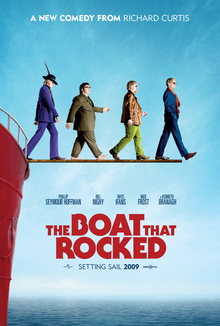
In 1966, various pirate radio stations broadcast to the United Kingdom from ships in international waters, specialising in rock and pop music not played on BBC Radio. Seventeen-year-old Carl, recently expelled from school, is sent to stay with his godfather Quentin, who runs the station Radio Rock anchored in the North Sea. The eclectic crew of disc jockeys and staffers, led by brash American DJ "The Count" and DJ "Doctor Dave". In London, government minister Sir Alistair Dormandy resolves to shut down pirate radio stations for their commercialism and immorality, instructing his subordinate Twatt to pursue legal stratagems to accomplish this. They attempt to cut off the pirates' revenue by prohibiting British businesses from advertising on unlicensed stations. Quentin counters by bringing massively popular DJ Gavin Kavanagh out of retirement on Radio Rock, enticing advertisers to pay their bills from abroad. Gavin's popularity creates a rivalry with The Count. Carl becomes smitten with Quentin's niece Marianne, but is heartbroken when she is seduced by Doctor Dave, while DJ "Simple" Simon Swafford marries glamorous fan Elenore in an onboard ceremony, but learns that she only married him to be near Gavin. The Count challenges Gavin to a game of chicken in defence of Simon's honour: The stubborn rivals climb the ship's radio mast to a dangerous height, but reconcile after they are both injured jumping into the ocean. Shortly after, Carl's mother Charlotte visits for Christmas, and denies that Quentin is his father. Carl gives her a cryptic message from reclusive late-night DJ "Smooth" Bob Silver, unexpectedly revealing that Bob is his father. Marianne arrives to apologise to Carl for sleeping with Dave, and she and Carl have sex. The following morning, the DJs announce news of the coupling to cheering fans across Britain. Meanwhile, Dormandy's vendetta against pirate radio advances when Twatt finds news of a fishing boat whose distress call was blocked by Radio Rock's powerful signal. Twatt proposes the creation of the Marine, &c., Broadcasting (Offences) Act 1967, making pirate radio stations illegal on the grounds that they endanger communication with other vessels. Despite heavy public support for the pirate stations, the act passes unanimously through Parliament and takes effect at midnight on 1 January 1967. The Radio Rock crew defy the law and continue broadcasting, firing up the ship's engine to evade arrest. The aging vessel's engine explodes, and the ship sinks. The DJs broadcast their position in hope of aid, and Twatt appeals to Dormandy to send rescue boats, but Dormandy refuses. Carl saves the oblivious Bob from his cabin while The Count vows to broadcast as long as possible. With the lifeboats inoperable, the crew gather on the prow as the ship goes down. They are rescued by dozens of fans in a fleet of small boats, with Carl being saved by Marianne. The Radio Rock ship disappears beneath the sea, with the Count emerging at the last moment.

Thirty Two Short Films About Glenn Gould
With memories revolving around the family's cottage near Lake Simcoe, Glenn Gould recalls how in his childhood, he had ostensibly made the decision to become a concert pianist at age five. In fact, he believes his mother had already chosen that career for him. He recalls being able to read music before he could read books, and learned the music of Johann Sebastian Bach from his mother. Gould later imagines interviewing himself, in which he confronts himself about why he chose to quit giving concerts at the age of 32, preferring to communicate to his audience through media instead. Gould reminds himself that the musician is inescapably an autocrat, no matter how benign. In crafting radio documentaries, Gould works on a piece called The Idea of North, which touches on the effects the environment has on the solitude and isolation of the people of Northern Canada. In a media interview, Gould reveals that The Idea of North is one of only five of his documentaries about isolation, and that he intends to make a comedy next because he is tired of serious expression. Interviewers also push him to explain how he could achieve his level of musical perfection without interest in being overly technical in his piano playing. They ask why he insists on being interviewed only over the telephone. Others question if Gould's supposed obsession in technology is merely a smokescreen to keep his distance from real people. As the markets plummet, Gould picks up word from the bodyguard of the visiting Sheik Yamani to invest in an obscure company called Sotex Resources, which is set to benefit from an exploration contract. Gould becomes the only client to profit in the wake of financial meltdown. However, Margaret Pacsu, a friend, notices Gould's bathroom is stocked heavily with various pills, including Valium, Trifluoperazine and Librax. Gould laughs off the idea that he is taking all of the pills simultaneously, and Pacsu does not notice any effects on his personality. As his birthday approaches, Gould becomes concerned that no one will attend his funeral, despite being aware of strong record sales in Central Europe and Japan. Gould dies at age 50 of a stroke. His cousin, Jessie Greig, says Gould was wrong and his funeral was heavily attended. He had noted that Voyager I and Voyager II, space probes launched for possible contact with extraterrestrial intelligence, contain Bach's music as played by Gould.


Pump Up the Volume
High school student Mark Hunter lives in a sleepy suburb of Phoenix, Arizona, and broadcasts an FM pirate radio station from his parents' basement, which functions as his sole outlet for his teenage angst and aggression. The station's theme song is " Everybody Knows " by Leonard Cohen and there are glimpses of cassettes by alternative musicians such as The Jesus and Mary Chain, Camper Van Beethoven, Primal Scream, Soundgarden, Ice-T, Bad Brains, Concrete Blonde, Henry Rollins, and Pixies. By day, Mark is a loner who has difficulty socializing. By night, under the nom de plume Happy Harry Hard-on or simply "Hard Harry", he expounds outsider views about problems with American society, expresses teen angst, and exposes the underhanded actions of the faculty. His audience grows from a handful of loyal listeners to the entire student body. Depressed teenager Malcolm Kaiser writes to Harry seeking advice about committing suicide. Harry flippantly expresses disbelief that Malcolm is sincere, saying "Maybe you'll feel better tomorrow." The next day it is discovered that Malcolm committed suicide. Fellow student Nora De Niro deduces that Mark is Hard Harry, and attempts to assuage the guilt he feels over Malcolm. The radio show becomes increasingly popular after Harry apologizes to Malcolm for not telling him not to follow through, and exhorts his listeners to confront their problems instead of surrendering to them through suicide. At the climax of his speech, overachieving student and consistent listener Paige Woodward jams her medals and accolades into a microwave, causing an explosion which injures her face. Unrest at the school increases as students share bootleg tapes re-playing Harry's show. A meeting of faculty and parents concludes that the pirate DJ is responsible for the problems at the school. The police investigate, first cutting off Mark's access to his P.O. Box, and then cutting off the wireless phone that Mark had surreptitiously hooked up at a neighboring house. The FCC begins an investigation. Mark decides to make a final broadcast. He installs his radio station in his mother's Jeep, creating a mobile transmitter so the FCC will have difficulty triangulating the radio signal. Nora drives while Mark broadcasts pursued by the police and the FCC. Harry's broadcast is heard by the entire school who have gathered at the athletics field. Mark's father, school board commissioner Brian Hunter, confronts Principal Loretta Cresswood demanding to know why she systematically expelled students with low test scores. Cresswood insists they were losers and troublemakers and that she did it for the good of the school. Brian immediately suspends Cresswood. The harmonizer Mark uses to disguise his voice breaks, and Mark decides to broadcast his final message as himself. The Jeep drives up to the crowd of students, and Mark tells them that the world belongs to them and that they should make their own future. He encourages them to "steal the air" and begin their own shows to put their thoughts and feelings out into the world. The police arrest Mark and Nora. As they are taken away, students shout their appreciation of "Harry". Mark turns to the students and tells them to "Talk hard!" As the film ends, the voices of students, and even one of the teachers, are heard introducing their own pirate radio shows.
