Genre: Music
Browse 55 movies in the Music genre.
All Genres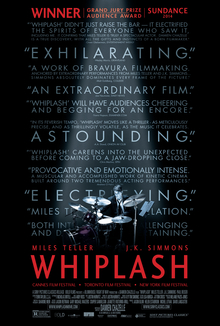
Whiplash
Andrew Neiman, a 19-year-old jazz drummer, attends the prestigious Shaffer Conservatory in New York City. Terence Fletcher, the conductor of Shaffer's most prestigious ensemble, overhears Andrew practicing and prompts him to play rudiments and a double-time swing beat. Unimpressed, Fletcher leaves, but later recruits him to perform in his ensemble as a backup for the core drummer, Carl Tanner. On his first day in Fletcher's class however, Andrew quickly discovers that Fletcher is relentlessly strict and abuses students verbally, physically, and psychologically. When Andrew apparently fails to keep tempo on Hank Levy 's " Whiplash " during his first ensemble rehearsal, Fletcher throws a chair at him, repeatedly slaps his face, and berates him. Determined to impress Fletcher, Andrew excessively practices, often until his hands bleed. After their first set at a jazz competition, Andrew misplaces Tanner's sheet music. Tanner cannot play without the sheets, so Fletcher allows Andrew to perform; Shaffer wins the competition. Fletcher promotes Andrew to core drummer, but abruptly reassigns the position to Ryan Connolly, a drummer from Andrew's previous ensemble within Shaffer. Andrew's single-mindedness toward music leads to him clashing with his family and breaking up with his girlfriend Nicole. One day, Fletcher begins rehearsal by announcing that Sean Casey, a former member of the Studio Band, has died in a car crash. He then pushes the three drummers to play at a faster tempo on " Caravan ", keeping them for a grueling five-hour practice. Andrew earns the core position back after he is the only one able to perform on tempo. Andrew's bus gets a flat tire on his way to the next competition. He rents a car, but arrives late and forgets his drumsticks at the rental office. Andrew races back and retrieves them, but his car is hit by a truck on the way back. An injured Andrew runs to the theater, arriving bloodied and weak as the ensemble enters the stage. He struggles to keep tempo and Fletcher halts the performance to dismiss him. Enraged, Andrew attacks Fletcher onstage and is expelled from Shaffer. At the request of his father Jim, Andrew meets a lawyer representing Casey's parents, who explain that Casey did not die in a car crash, but actually hanged himself after suffering from depression and anxiety due to Fletcher's abuse; and his parents want Fletcher held accountable. Andrew agrees to anonymously testify against Fletcher. Months later, Andrew, having abandoned drumming, encounters Fletcher playing piano at a jazz club. They have a conversation over drinks, during which Fletcher says that he was let go from Shaffer after someone complained about his conduct, admits he was harsh, but insists his methods were necessary to motivate students. He cites a story where Jo Jones allegedly threw a cymbal at Charlie Parker to argue that the next transformative jazz musician would never let themselves be discouraged. Fletcher invites Andrew to perform with his professional band at a New York JVC Jazz Festival, playing the same pieces from Shaffer; Andrew accepts. He calls Nicole to invite her, but learns she has a new boyfriend. At the festival, Fletcher reveals to Andrew that he knows Andrew testified against him; as revenge, he leads the band into Tim Simonec 's "Upswingin'", a song that Andrew does not know nor has the sheet to. After a disastrous performance, a humiliated Andrew walks offstage. After Jim embraces him, Andrew returns to the stage, reclaims the drum kit, and cuts off Fletcher by cueing the band into "Caravan". Fletcher, though angered, resumes conducting. Towards the end of "Caravan", Andrew improvises a lengthy solo. Impressed, Fletcher nods in approval before cueing the final chord.


Amadeus
In 1823, aged composer Antonio Salieri attempts suicide and is committed to a psychiatric hospital. He claims that he murdered Wolfgang Amadeus Mozart. Father Vogler, a young Catholic priest, encourages Salieri to confess his sins before God. After Vogler fails to recognize him, Salieri plays three old melodies to jog his memory. Vogler cannot recognize the first two (which Salieri wrote) but is relieved to recognize the third (Eine kleine Nachtmusik) at once. Salieri peevishly reveals that Mozart wrote it. Salieri begins his confession by saying he grew up hearing stories about the child prodigy Mozart. In his youth, Salieri was in love with music but was forbidden by his father to study the craft. Salieri proposed that if God made him a famous musician like Mozart, he would give God his faithfulness, chastity, and diligence. Salieri's father soon dies, which he interprets as a sign that God has accepted his vow. By 1774, Salieri became court composer to Holy Roman Emperor Joseph II in Vienna. However, he has enough taste to know that Emperor Joseph has no ear for music, though Salieri prides himself on the popularity of his work. After their first meeting, Salieri understands that Mozart is the better composer, but is shocked to learn that Mozart is obscene, immature, and dissolute. He also learns that Mozart never needs to pen a second draft of his music, implying divine inspiration. Salieri cannot fathom why God would choose a reprobate like Mozart as his earthly instrument. Salieri renounces God and vows to take revenge on him by destroying Mozart. Mozart's work is ahead of its time, and he struggles to find employment in Vienna. He spends himself into debt, alarming his wife Constanze. Salieri and Mozart bond over their shared contempt for Emperor Joseph's lack of taste, but Mozart is unimpressed by Salieri's populist work, which causes Salieri great pain. Mozart boldly adapts the subversive play The Marriage of Figaro into a comedic opera. Salieri rejoices, thinking Mozart's career is ruined, but Mozart stuns Salieri by convincing the Emperor to approve the project. The Emperor, however, finds the opera boring, and it is soon canceled. Eventually, Mozart's father, Leopold, dies. In response to criticisms and his grief, Mozart composes Don Giovanni, a dark, serious opera. Salieri is entranced but vindictively gets that opera canceled, too. Renouncing Vienna's artistic establishment, Mozart agrees to write The Magic Flute for a commoners' theater against Constanze's wishes. After watching Don Giovanni five times, Salieri realizes that the dead commander who accuses Giovanni of sin represents Mozart's inferiority complex towards his father. Posing as an anonymous patron, in a costume Leopold had worn to a masquerade ball, Salieri persuades the unstable and debt-ridden Mozart to accept a commission for a Requiem Mass. Salieri plans to kill Mozart, claim the Requiem as his own, and premiere it at Mozart's funeral, forcing God to listen as Salieri is acclaimed. Mozart overworks himself, juggling The Magic Flute and the Requiem. Constanze, who wants him to focus on the Requiem but fears his erratic behavior, leaves with their son Karl. Although The Magic Flute is a success, Mozart collapses from exhaustion before he can finish conducting the opera. Desperate to complete his plan but also desperate for more of Mozart's heavenly music, Salieri begs the bedridden Mozart to keep writing the Requiem. He takes dictation from Mozart throughout the night, during which he comes to terms with Mozart's superior talent. Mozart thanks Salieri for his friendship, and Salieri admits that Mozart is the greatest composer he knows. Constanze returns and attempts to kick Salieri out of the apartment, locking the Requiem away before he can steal it. As Salieri protests, they are shocked to discover that Mozart has died from exhaustion. Due to his debts, he is buried in a pauper's grave. Back in 1823, Vogler is too shaken to absolve Salieri, who surmises that God would rather destroy his beloved Mozart than allow Salieri to share in Mozart's glory. As Salieri is wheeled down a hallway, he proclaims himself the patron saint of mediocrities. He absolves the asylum's other patients of their inadequacies as Mozart's laughter rings in the air.


This Is Spinal Tap
Filmmaker Martin "Marty" Di Bergi is filming a documentary about English rock band Spinal Tap 's 1982 United States concert tour to promote their new album, Smell the Glove. The band comprises childhood friends David St. Hubbins and Nigel Tufnel on vocals and guitar, along with bassist Derek Smalls, keyboardist Viv Savage, and drummer Mick Shrimpton. The documentary shows Spinal Tap's early days as the skiffle group The Originals; they renamed themselves the New Originals when it was discovered another band was already called The Originals, only to change it back when the original Originals changed their name to The Regulars. They later had a hit as the Thamesmen, "Gimme Some Money", before changing their name to Spinal Tap and achieving a hit with the flower power anthem "Listen to the Flower People"; they subsequently began performing heavy metal. Several of the band's previous drummers died under strange circumstances: John "Stumpy" Pepys died in a "bizarre gardening accident" that police said was better left unsolved, Eric "Stumpy Joe" Childs died choking on someone else's vomit, and Peter "James" Bond exploded on stage. Nigel shows Marty his extensive guitar collection (including a Fender Bass VI so valuable it cannot even be looked at), as well as a custom-made amplifier with volume knobs that go up to eleven; Nigel claims that this makes the amplifier "one louder" than most others, on which the volume setting only goes up to "ten". Tensions rise between the band and their manager, Ian Faith, as several shows are canceled due to low ticket sales and major retailers refuse to sell Smell the Glove because of its sexist cover art. David's girlfriend Jeanine, a yoga and astrology devotee, joins the group on tour and participates in band meetings. Nigel and Ian dislike Jeanine's ideas for Spinal Tap's costumes and stage presentation. Without consulting the band, the band's record label releases Smell the Glove with an entirely black album cover. Despite Ian's assertion that it could have a similar appeal to the Beatles ' White Album, Smell the Glove fails to sell. Nigel suggests staging a lavish, Druid -themed stage show and asks Ian to order a replica Stonehenge trilithon. However, Nigel mislabels its dimensions, and the resulting prop is only 18 inches (46 cm) high rather than 18 feet (5.5 m), making the group a laughing stock. The group blames Ian, and when David suggests Jeanine should co-manage the group, Ian quits. The tour continues, rescheduled for much smaller venues, and Jeanine and David increasingly marginalize Nigel. At a gig at a United States Air Force base, Nigel is upset by an equipment malfunction and quits mid-performance. At their next gig, in an amphitheater at an amusement park where the band is billed below a puppet show, the band finds their repertoire is severely limited without Nigel. At Derek's suggestion, the band improvises an experimental "Jazz Odyssey", which is poorly received. On the last day of the tour, David and Derek consider ending Spinal Tap and exploring other projects, such as a musical about Jack the Ripper called Saucy Jack. Before they go on stage, Nigel arrives and tells them that Spinal Tap's song "Sex Farm" has become a major hit in Japan and that Ian wants to arrange a tour there. David bitterly refuses; later, however, as Nigel watches the band's performance from backstage, David relents and invites him onstage, delighting the crowd but infuriating Jeanine. Mick subsequently explodes on stage. Ian is rehired as the group's manager, and Spinal Tap (now with Joe "Mama" Besser as their drummer) performs a series of sold-out shows in Japan.

Fitzcarraldo
In the early part of the 20th century, Iquitos, Peru, a small city on the Upper Amazon, is experiencing rapid growth due to a rubber boom. One incomer, an Irishman named Brian Sweeney Fitzgerald (known locally as "Fitzcarraldo"), is a lover of opera and a great fan of the internationally renowned Italian tenor Enrico Caruso. He dreams of building an opera house in Iquitos, but, although he has an indomitable spirit, he has little capital. The Peruvian government has parceled up the areas in the Amazon basin known to contain rubber trees. However, the best parcels having already been leased to private companies for exploitation, Fitzcarraldo has been trying and failing to make the money to bring opera to Iquitos by various other means, including an ambitious attempt to construct a Trans-Andean Railway. A rubber baron shows Fitzcarraldo a map and explains that, while the only remaining unclaimed parcel in the area is on the Ucayali River, a major tributary of the Amazon, it is cut off from the Amazon (and access to Atlantic ports) by a lengthy section of rapids. Fitzcarraldo notices that the Pachitea River, another Amazon tributary, comes within several hundred meters of the Ucayali upstream of the parcel. He leases the inaccessible parcel from the government, and his paramour, Molly, a successful brothel owner, funds his purchase of an old steamship, which he christens the SS Molly Aida, from the rubber baron. After fixing up the boat, Fitzcarraldo recruits a crew and takes off up the Pachitea, which is largely unexplored because of the hostile Indians who live on its banks. Fitzcarraldo intends to go to the closest point between the Pachitea and the Ucayali, pull his three-deck, 320 -ton steamship up the muddy 40° hillside, and portage it from one river to the next. He plans to use the ship to collect rubber harvested along the Ucayali and then transport the rubber over to the Pachitea and, on different ships, down to market at Atlantic ports. Soon after they enter Indian territory, the majority of Fitzcarraldo's crew, who are unaware of his full plan, abandon the expedition, leaving only the captain, engineer, and cook. The natives are impressed by the steamship and, once they make contact, agree to help Fitzcarraldo without asking many questions. After months of work and great struggles, they successfully pull the ship over the mountain using a complex system of pulleys aided by the ship's anchor windlass. The crew falls asleep after a drunken celebration, and the chief of the natives severs the rope securing the ship to the shore. Fitzcarraldo awakens as the boat is entering the rapids, and is unable to stop it. The ship does not sustain any major damage, but Fitzcarraldo is forced to abandon his quest. Before returning to Iquitos, he learns that the natives helped him move the ship in the belief that sending it over the Ucayali rapids would appease the spirits dwelling there. Despondent, Fitzcarraldo sells the steamship back to the rubber baron, but there is time before the title changes hands for him to send for a European opera company that he is told is in Manaus. Lacking an opera house, they construct their sets on the deck of the ship, and the entire city of Iquitos comes down to the riverbank to watch as Fitzcarraldo floats it by, managing to bring opera to the city after all.

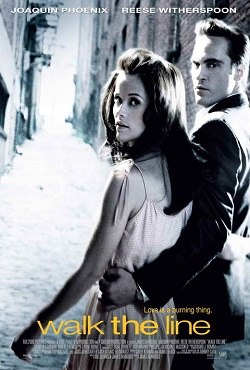
Walk the Line
The film begins in 1968 with Johnny Cash performing at Folsom State Prison. As the audience of inmates cheer him on, Cash waits backstage near a table saw, which reminds him of his early life. Two decades earlier, in 1944, 12-year-old Johnny is raised on a cotton farm in Dyess, Arkansas, with his brother Jack, his abusive father Ray, his mother Carrie, and his two sisters. One day, Jack is killed in a sawmill accident while Johnny is out fishing. Ray blames Johnny for Jack's death, saying that the Devil "took the wrong son". In 1950, Johnny enlists in the U.S. Air Force and is stationed in West Germany. While there, he purchases a guitar and finds solace in writing songs, including " Folsom Prison Blues ", which he develops in 1952. After his discharge from the military in 1954, Johnny returns to the United States and marries his girlfriend, Vivian Liberto. The couple moves to Memphis, Tennessee, where Cash works as a door-to-door salesman to support his growing family, but with little success. One day, Johnny walks past a recording studio and is inspired to form a band to play gospel music. He and his band audition for Sam Phillips, the owner of Sun Records, and Phillips signs them after they play "Folsom Prison Blues." The band tours as Johnny Cash and the Tennessee Two, along with other rising stars Elvis Presley, Carl Perkins, Roy Orbison and Jerry Lee Lewis. Johnny meets country music singer and songwriter June Carter while on tour and is immediately smitten. He tries to woo her, but she gently rebuffs his attempts. Despite this, they become friends. As Johnny grows up, he begins abusing drugs and alcohol, and over the objections of Vivian, he persuades June to go on tour with him. The tour is a success, but backstage, Vivian becomes critical of June's influence over Johnny. After one performance in Las Vegas, Johnny and June sleep together. The next morning, June notices Johnny taking pills and begins to doubt her choice to be with him. At their concert that evening, Johnny is upset by June's apparent rejection and behaves erratically, eventually passing out on stage. June is upset with Johnny's behavior and decides to dispose of his drugs. She begins to write " Ring of Fire " as a way to describe her feelings for him and the pain she feels as she watches him descend into addiction. After returning to California, Johnny travels to Mexico to purchase more drugs and is arrested. Soon after, Johnny's marriage to Vivian implodes; they divorce, and he moves to Nashville, Tennessee, in 1966. Johnny buys a large house near a lake in Hendersonville, Tennessee, in an attempt to reconcile with June. Ray and other members of the extended Carter family arrive for Thanksgiving, where Ray and Johnny get into an argument, and June's mother urges June to help Johnny. Johnny goes into detox and awakens next to June, who says they have been given a second chance. They begin a tentative relationship, but June resists Cash's marriage proposals. Later, Johnny records an album live at Folsom Prison after discovering that most of his fan mail is from prisoners. The performance is a success, and Johnny embarks on a tour with June and his band. At the end of the film, Johnny invites June to join him for a duet but stops in the middle of the song and tells her that he can't sing " Jackson " anymore unless she agrees to marry him. June accepts, and they share a passionate embrace on stage. Later, Johnny and his father reconcile their relationship while they are with their families.


