Genre: History (Page 10)
Browse 133 movies in the History genre.
All Genres


Flamin' Hot
In 1966 Southern California, Richard Montañez grows up as a hard-working child with a strict father and supportive grandfather. He meets his future wife Judy in school where he sells burritos to other children. He is arrested at a young age when nobody believes that he earned his money honestly. As adults, Richard and Judy marry but live as hoodlums in a gang, hustling to survive. They make an effort to turn their lives around once Judy gets pregnant with their first child. After one last arrest, the judge tells him to change his way of life. A second child later, Richard and his family struggle to make ends meet. Richard turns to his friend, former hoodlum Tony Romero, who helps him get a job at Frito-Lay. Despite lying on his resumé, he is hired by floor head Lonny Mason. Richard pays attention to the nuances of the factory and asks engineer maintenance leader Clarence C. Baker to teach him about the machines. Baker teaches Richard how to operate all the machinery in the factory. Unfortunately, the Reagan administration severely affects low-paying jobs, and Frito-Lay's stocks go down. This results in some of the workers getting laid off. Frito-Lay CEO Roger Enrico releases a video encouraging the workers to "think like a CEO," which inspires Richard. He takes his kids out for elotes (Mexican street corn). Noticing that his youngest son Steven likes the spicy flavor, he realizes that the way to save Frito-Lay is to pitch the brand to the Latino market. He convinces Baker and the rest of his coworkers to let him take some unflavored Cheetos home, but Judy suggests that he talk to his father Vacho first about a job. Vacho belittles Richard's plans, causing Judy to support Richard even more. The Montañezes work tirelessly trying to find the perfect spicy flavor for Cheetos, eventually getting the right concoction. Richard attempts to pitch his idea to Lonny only to be turned down, forcing him to sneak in and copy Enrico's phone number. Richard gets through to Enrico, who is intrigued to learn that he saw his video and asks that he send his flavored Cheetos. He tastes them and is hooked, setting up a meeting at the factory. Richard speaks from the heart, and his pitch is accepted with the Flamin' Hot Cheetos being put into production. While this results in more jobs, the new flavor is not flying off the shelves. Richard's children point out that there are no advertisements for the flavor. Richard returns to work and implores everyone to use their skills to sell the new flavor from the street. The tactic works, and Enrico calls to ask that the factory produce an even bigger order. While Baker gets the promotion he always desired, Richard is still a janitor. Lonny asks Richard to clean upstairs, only to find Enrico, who tells him that he understands his struggles growing up before revealing that he has been promoted to Director of Multicultural Marketing. Richard is applauded by his coworkers and happily calls Judy to tell her the good news.

The Electrical Life of Louis Wain
In 1881, after his father's death, Louis Wain, the only male member and eldest of the Wain family, supports his five sisters and his mother as a part-time illustrator for The Illustrated London News under editor Sir William Ingram. Wain declines a full-time job to try composing music and playwriting; neither venture is successful. Louis hires Emily Richardson as governess for his sisters and they are attracted to each other, to the dismay of eldest sister Caroline. Louis takes the full-time position to keep Emily as governess. He takes the family and Emily to the theatre to see The Tempest, during which he has a recurring nightmare of drowning. Emily comforts him in the men's toilets, causing a scandal when a neighbour gossips about the incident. Caroline fires Emily that night but before she can leave, Louis professes his love and they begin a courtship. They marry in 1884, causing another scandal due to her being ten years his senior and of a lower class. Louis takes freelance artist work to continue supporting his mother and sisters. Emily is diagnosed with breast cancer. They take in a stray kitten - unusual for the time - which they name Peter. Louis' initially realistic paintings of Peter become more anthropomorphic as Emily's condition worsens. Financial pressure causes Sir William to cut Louis' workload, and he advises Louis spend the time with Emily. She encourages Louis to show his cat pictures to Sir William, who prints them to acclaim in the Christmas edition. Emily dies. Louis draws more cat pictures, creating whole cat societies. By 1891, Wain's cat pictures are enormously popular, featured on postcards and greeting cards, and changing the perception of cats as acceptable house pets. He hosts cat-themed events and is chairman of The National Cat Society. Unaware of the need to copyright his work, Wain does not profit from reproductions and the family remains in debt. Sister Marie becomes mentally unwell and the family is evicted. Sir William provides a property at a reduced rate. Marie is institutionalised and Peter dies, causing Wain's own mental health to deteriorate. Newspaper magnate William Randolph Hearst sponsors Wain on a trip to New York in 1907, where Max Kase tells him people love his pictures. After some success in New York, in 1914 Caroline asks him to return to England. Marie and their mother die from influenza. Sir William dies of gout, and the family is evicted and moves into a smaller London flat. As Britain enters the First World War, Louis hits his head jumping off a bus and falls into coma, in which he sees a vision of 1999. He designs futuristic-themed cat toys. The toys are manufactured, but a German U-boat sinks the ship carrying the toys. Caroline dies in 1917, and Louis suffers a series of mental breakdowns. In 1924, his sisters commit him to the Springfield Mental Hospital. Mental institution inspector Dan Rider recognises Louis; he had drawn his dog's portrait. He campaigns, along with Wain's three remaining sisters, to raise money for a better facility for Louis that allows patients cats and outdoor access. The campaign gets an enormous response, as H.G. Wells and other prominent British figures assist. Louis is transferred to Bethlem Royal Hospital, where he has a cat companion. In 1930, he is admitted to Napsbury Hospital in London Colney. Louis takes his journal and a piece of Emily's scarf out to the painted countryside, where Emily had told him he would find her.


Experimenter
The film is based on the true story of famed social psychologist Stanley Milgram, who in 1961 conducted a series of radical behavior experiments at Yale University that tested the willingness of ordinary humans to obey an authority figure while administering electric shocks to strangers. In the first half of the film, it is shown how the experiments are conducted, with nearly every test subject succumbing to the pressure of the circumstances and administering shocks to a stranger, despite the stranger begging him to stop. Between the experiments, it is shown how Milgram meets Alexandra (or Sasha), who will become his wife and mother of two children. The second half of the film shows how Milgram struggles with the public outcry about the ethics of the experiments and how his career advances as he becomes a professor in New York City and continues to study social interactions and social pressure in more benign experimental settings, including the small-world experiment, the lost-letter experiment, the street-corner (or gawking) experiment, the familiar stranger experiment, and various experiments that he makes his students carry out. Archive footage occurs frequently, either as recordings that Milgram watches or as a backdrop for entire scenes. Milgram's work continues until he dies from a heart attack at the age of 51. In the final scene, the street-corner experiment is repeated in the present day, with a cameo of the real-life Sasha Milgram. In a mid-credits scene, more archival footage is shown.


The 13th Warrior
Ahmed ibn Fahdlan is a court poet of the Abbasid Caliph Al-Muqtadir of Baghdad until his amorous encounter with the wife of an influential noble gets him exiled as an "ambassador" to the Volga Bulgars. Traveling with his father's old friend, Melchisidek, his caravan is saved from Tatar raiders by the appearance of Norsemen. He takes refuge at their settlement on the Volga River, and communications are established through Melchisidek and Herger, one of the Norsemen, who happens to speak Latin. From Herger, both learn that the celebration being held by the Norsemen is in fact the precursor to a funeral for their recently deceased king. Herger also introduces them to one of the king's sons, Buliwyf. Ahmed and Melchisidek witness a fight in which Buliwyf kills his brother in self-defense, which establishes Buliwyf as heir apparent. That is followed by the funeral of the dead king, who is traditionally cremated on a Viking ship, set adrift with a female slave who offers to sacrifice herself and accompany him to Valhalla, the Norse afterlife (or " heaven "). The next day, the young Prince Wulfgar enters the camp to request Buliwyf's aid; his father, King Hrothgar, has asked for assistance, as his lands in the far north are under attack from an ancient evil so frightening that even the bravest warriors dare not name it. A völva (wisewoman) identifies this as the "angel of death" and says that the mission will be successful but only if thirteen warriors face this danger, and the thirteenth must not be a Norseman. Ahmed is automatically and unwillingly recruited. Ahmed is initially treated indifferently by the Norsemen, but they mock his smaller Arabian horse. However, he earns a measure of respect with a demonstration of horsemanship, his ability to write, and by quickly learning their language as he starts mentally translating it into Arabic. Buliwyf, already himself a polyglot, asks Ahmed to teach him the Arabic script, which cements their mutual goodwill. Buliwyf sees Ahmed's analytic ways as an asset to their quest. Reaching Hrothgar's kingdom, they confirm that their foe is indeed the ancient " Wendol ", fiends who come with the mist to kill and take human heads. While the group searches through a raided cabin, they find a Venus figurine, which is said to represent the " Mother of the Wendol ". On the first night, the warriors Hyglak and Ragnar die. After a string of clashes, Buliwyf's band determines that the Wendol are human cannibals, who are clad to appear like bears, live like bears, and think of themselves as bears. The warriors' numbers dwindling, having also lost Skeld, Halga, Roneth, and Rethel, and their positions all but indefensible, they consult another völva of the village. She tells them to track the Wendol to their lair and destroy their leaders, specifically the " Mother of the Wendol ", and their warlord, who wears "the horns of power". Buliwyf and the remaining warriors infiltrate the Wendol caves and kill the Mother but not before Buliwyf is scratched deeply across the shoulder by a claw attached to her hand, dipped in poison. Ahmed and the last of the Norse warriors escape the caves but without the injured Helfdane, who opts to stay behind and fight. They return to the village to prepare for a last stand. Buliwyf staggers outside before the battle and inspires the warriors with a Viking prayer for the honored dead who will enter Valhalla. Buliwyf succeeds in killing the Wendol warlord, defeats them, and succumbs to the poison. Ahmed witnesses Buliwyf's royal funeral alongside the four surviving members of the 13 (Herger, Weath, Edgtho, and Haltaf) before returning to his homeland, grateful to the Norsemen for helping him to "become a man and a useful servant of God".

The Heroes of Telemark
The Norwegian resistance sabotage the Vemork Norsk Hydro plant in the town of Rjukan in the county of Telemark, Norway, which the Nazis are using to produce heavy water, which could be used in the manufacture of an atomic bomb. Rolf Pedersen, a Norwegian physics professor, who, though originally content to wait out the war, is soon pulled into the struggle by local resistance leader Knut Straud (based on Knut Haukelid). Rolf's ex-wife Anna also becomes involved in the effort, and her relationship with Rolf reignites. Rolf and Knut sneak out of Norway on a passenger steamship to Britain that they hijack so they can deliver microfilmed plans of the hydroelectric plant to the British, who are impressed by the information. Then the two return to Norway by parachute to plan a commando raid against the plant. When a British plane carrying a force of Royal Engineers to undertake the raid is shot down over Norway by the Germans, Pedersen and Straud lead a small force of Norwegian saboteurs into the plant. The raid is successful, but the Germans quickly replace and repair the equipment. A Quisling (traitor) saboteur worms his way into the resistance group, after they debate whether to shoot him or not. He ends up escaping and betraying them, so that a German plane blows up their safe house. When the Nazis and the saboteur pursue Rolf and Knut, Rolf and the saboteur end up alone, and Rolf kills him. When Rolf and Knut learn of German plans to ship steel drums of heavy water to Germany, they sabotage the ferry carrying the drums, and it sinks in the deepest part of a fjord. Rolf himself ends up on the ferry when he sees a resistance comrade's widow and her young child getting aboard; Rolf improvises a "game" whereby all the children on board practise with lifejackets at the stern of the ship. Thus, when the ferry sinks, the children, and Rolf and the widow, are able to escape. Knut and Anna, in a small boat, come and help rescue passengers.
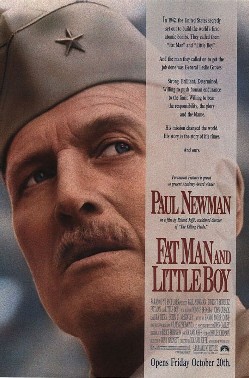
Fat Man and Little Boy
In September 1942, U.S. Army Corps of Engineers Colonel Leslie Groves, who oversaw the construction of the Pentagon, is assigned to head the ultra-secret Manhattan Project, to beat the Germans, who have a similar nuclear weapons program. Groves picks University of California, Berkeley, physicist J. Robert Oppenheimer to head the project team. Oppenheimer was familiar with northern New Mexico from his boyhood days when his family owned a cabin in the area. For the new research facility, he selects a remote location on top of a mesa adjacent to a valley called Los Alamos Canyon, northwest of Santa Fe. The different personalities of the military man Groves and the scientist Oppenheimer often clash in keeping the project on track. Oppenheimer in turn clashes with the other scientists, who debate whether their personal consciences should enter into the project or whether they should remain purely researchers, with personal feelings set aside. Nurse Kathleen Robinson and young physicist Michael Merriman question what they are doing. As Michael works with no protection from radiation during an experiment dubbed Tickling the Dragon's Tail, a probe he is holding slips from an apparatus and he is instantly bathed in a blue light, which is a visible result of a lethal dose of radiation. In the base hospital, nurse Kathleen can only watch as he develops massive swelling and deformation before dying a miserable death days later. While the technical problems are being solved, investigations are undertaken to thwart foreign espionage, especially from communist sympathizers who might be associated with socialist organizations. The snooping reveals that Oppenheimer has had a young mistress, Jean Tatlock, and he is ordered by Groves to stop seeing her. After he breaks off their relationship without being able to reveal the reasons why, she is unable to cope with the heartache and is later found dead, apparently a suicide. As the project continues in multiple sites across America, technical problems and delays cause tensions and strife. To avoid a single point of failure plan, two separate bomb designs are implemented: a large, heavy plutonium bomb imploded using shaped charges (" Fat Man "), and an alternative design for a thin, less heavy uranium bomb triggered in a shotgun or gun-type design (" Little Boy "). The bomb development culminates in a detonation in south-central New Mexico at the Trinity Site in the Alamogordo Desert (05:29:45 on July 16, 1945), where everyone watches in awe the first mushroom cloud with roaring winds, even miles away. Both bombs, Fat Man and Little Boy, are successful, ushering in the Atomic Age.