Genre: Fantasy (Page 3)
Browse 122 movies in the Fantasy genre.
All Genres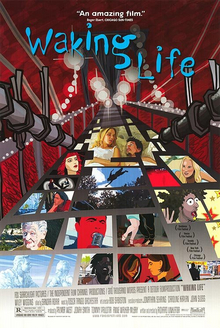
Waking Life
An unnamed young man lives an ethereal existence that lacks transitions between everyday events and eventually progresses toward an existential crisis. He observes quietly but later participates actively in philosophical discussions involving other characters—ranging from quirky scholars and artists to everyday restaurant-goers and friends—about such issues as metaphysics, free will, social philosophy, and the meaning of life. Other scenes do not include the protagonist but rather focus on an isolated person, a group of people, or a couple engaging in such topics from a disembodied perspective. Along the way, the film also touches upon existentialism, situationist politics, posthumanity, the film theory of André Bazin, and lucid dreaming, and references various intellectual and literary figures by name. Gradually, the protagonist realizes that he is living out a perpetual dream, broken up only by occasional false awakenings. So far, he is mostly a passive onlooker, though this changes during a chat with a passing woman who suddenly approaches him. After she greets him and shares her creative ideas with him, he reminds himself that she is a figment of his own dreaming imagination. Afterward, he starts to converse more openly with other dream characters, but begins to despair about being trapped in a dream. The protagonist's final talk is with a character (played by Linklater) whom he briefly encountered earlier in the film. This conversation reveals this other character's view that reality may be only a single instant that a person interprets falsely as time (and, thus, life); that living is simply the person's constant negation of God's invitation to become one with the universe; that dreams offer a glimpse into the infinite nature of reality; and that to be free from the illusion called life, one need only accept God's invitation. The protagonist is last seen walking into a driveway, when he suddenly begins to levitate, paralleling a scene at the start of the film of a floating boy in the same driveway. The protagonist uncertainly reaches for a car door handle but is too swiftly lifted above the vehicle and over the trees. He rises into the endless blue expanse of the sky until he disappears from view.

Midnight in Paris
In 2010, disillusioned screenwriter Gil Pender and his fiancée, Inez, vacation in Paris with Inez's wealthy parents. Gil, struggling to finish his debut novel about a man who works in a nostalgia shop, finds himself drawn to the artistic history of Paris, especially the Lost Generation of the 1920s, and has ambitions to move there, which Inez dismisses. By chance, they meet Inez's old college friend, Paul, and his wife, Carol. Paul speaks with great authority but questionable accuracy on French history, annoying Gil but impressing Inez. Intoxicated after a night of wine tasting, Gil decides to walk back to their hotel, while Inez goes with Paul and Carol by taxi. At midnight, a 1920s car pulls up beside Gil and delivers him to a party for Jean Cocteau, attended by other people of the 1920s Paris art scene. Zelda Fitzgerald, bored, encourages her husband Scott and Gil to leave with her. They head to a cafe where they run into Ernest Hemingway and Juan Belmonte. After Zelda and Scott leave, Gil and Hemingway discuss writing, and Hemingway offers to show Gil's novel to Gertrude Stein. As Gil leaves to fetch his manuscript, he returns to 2010 only to find a laundromat in the cafe's location. The next night, Gil tries to repeat the experience, this time bringing Inez along, but she returns to the hotel before midnight. Subsequently returning to the 1920s, he accompanies Hemingway to visit Gertrude Stein, who is critiquing Pablo Picasso 's new painting of his lover Adriana. Gil becomes drawn to Adriana, a costume designer who also had affairs with Amedeo Modigliani and Georges Braque. Having heard the first line of Gil's novel, Adriana praises it and admits she has always longed for the past. Inez grows jaded with Paris and Gil's continual disappearances, while her father grows suspicious and hires a private detective to follow him. Gil continues to time-travel the following nights. Adriana leaves Picasso and continues to bond with Gil, who is conflicted by his attraction to her. Gil explains his situation to Salvador Dalí, Man Ray, and Luis Buñuel; as surrealists, they do not question his claim of coming from the future. Gil later suggests the plot of The Exterminating Angel to Buñuel. Back in the present, Gil meets Gabrielle, an antique dealer and fellow admirer of the Lost Generation. Later at a book stall he finds Adriana's diary, which reveals that she had been in love with Gil and dreamed of being gifted earrings before having sex with him. Planning to seduce Adriana, Gil plans to take a pair of Inez's earrings but is thwarted by her early return to the hotel room. Gil instead buys new earrings, giving them to Adriana after returning again to the past. Later, a horse-drawn carriage appears and transports them to the Belle Époque, an era Adriana considers Paris's Golden Age. They go to the Moulin Rouge where they meet Henri de Toulouse-Lautrec, Paul Gauguin, and Edgar Degas, who all agree that Paris's best era was the Renaissance. Adriana is offered a job designing ballet costumes; thrilled, she proposes to Gil that they stay. But he, observing the unhappiness of Adriana and the other artists, realizes that chasing nostalgia is fruitless because the present is always "a little unsatisfying." Adriana decides to stay, and they part ways. Meanwhile, the detective following Gil takes a "wrong turn" and ends up being chased by the palace guards of Louis XVI just before a revolution breaks out. Gil rewrites the first two chapters of his novel and gives his draft to Stein, who praises his rewrite. Still, Hemingway says that on reading the new chapters he does not believe that the protagonist does not realize that his fiancée (based on Inez) is having an affair with the character based on Paul. Gil returns to 2010 and confronts Inez, who admits to having sex with Paul but regarded it as a meaningless fling. Gil breaks up with her and decides to stay in Paris. While walking by the Seine at midnight, no carriage comes by but Gil encounters Gabrielle. As it begins to rain, he offers to walk her home and learns that they share a love for Paris in the rain.


My Winnipeg
Although ostensibly a documentary, My Winnipeg contains a series of fictional episodes and an overall story trajectory concerning the author-narrator-character "Guy Maddin" and his desire to produce the film as a way to finally leave/escape the city of Winnipeg. "Guy Maddin" is played by Darcy Fehr but voiced by Maddin himself (in narration): Fehr appears groggily trying to rouse himself from sleep aboard a jostling train as Maddin wonders aloud "What if?" What if he were able to actually rouse from the sleepy life he lives in Winnipeg and escape? Maddin decides that the only possible escape would be to "film my way out", thus motivating the creation of the "docu-fantasia" already underway. Maddin then describes Winnipeg in general terms, introducing it to the viewer, noting primarily its location at the junction of the Red and Assiniboine rivers, a place known as " the Forks ". Maddin equates this Y-like junction to a woman's groin and associates it with his mother. Maddin also notes the apocryphal aboriginal myth of a secret "Forks beneath the Forks", an underground river system below the aboveground river system –the superimposition of these two sets of rivers has imbued the site and Winnipeg itself with magical/magnetic/sexual energy. Maddin also notes that Winnipeg is the geographical centre of North America, and thus these secret rivers are "the Heart of the Heart" of the continent and of Canada. Maddin regales the viewer with one of the film's many suspect historical "facts" about Winnipeg: "the Canadian Pacific Railway used to sponsor an annual treasure hunt required our citizens to wander our city in a day-long combing of the streets and neighbourhoods. First prize was a one-way ticket on the next train out of town." No winners in a hundred years could bring themselves to leave the city after coming to know the city so closely over the course of the treasure hunt. Maddin then posits an alternative explanation for Winnipeggers never leaving Winnipeg: sleepiness. He notes that Winnipeg is the sleepwalking capital of the world, with ten times the normal rate of sleepwalking, and that everyone in Winnipeg carries around the keys to their former homes in case they return while asleep. Winnipeg by-laws require that sleepwalkers be allowed to sleep in their old homes by the new tenants. Maddin rents his own childhood home at 800 Ellice Avenue for a month, hiring actors to play his family (including Ann Savage as his mother) in order to recreate scenes from his childhood memories, excluding his father and himself. The "family" gathers to watch the television show LedgeMan, a fictional drama in which "the same oversensitive man takes something said the wrong way, climbs out on a window ledge, and threatens to jump." His mother, in the next window, convinces him to live. Maddin's mother is noted as the star of the show. The film recounts the conditions of the 1919 Winnipeg General Strike, a real-world event with international significance, before returning to the family re-enactments, including Mother's suspicion of Janet Maddin, who hit a deer on the highway but is accused of covering up a sexual encounter. Maddin announces that this, like "everything that happens in is a euphemism." The film then recounts the city's history of Spiritualism, including a visit by Sir Arthur Conan Doyle in 1923. The film next examines Winnipeg architectural landmarks, including the Eaton's building and the Winnipeg Arena, both of which are demolished (while the arena is being destroyed, Maddin becomes the last person to urinate in its washroom). Maddin imagines the arena's salvation by the "Black Tuesdays", a fictional team of hockey heroes "in their 70s, 80s, 90s and beyond", then re-enacts a family scene where Mother is harassed to cook a meal. The film recounts a racetrack fire that drove horses to perish in the Red River – the horse heads reappear, ghostly, each winter, frozen in the ice. Further Winnipeg landmarks, including the Golden Boy statue atop the provincial legislative building, the Paddle Wheel restaurant, the Hudson's Bay department store, and the Manitoba Sports Hall of Fame, make appearances in distorted versions of themselves, as does the Sherbrook Pool. The film then recalls If Day (an actual historical event when a faked Nazi invasion of the city was mounted during World War II to promote the sale of war bonds), and a buffalo stampede set off by the mating of two gay bison. Time is now running out for Guy Maddin, who fears he will never leave Winnipeg, since the family re-enactments have failed to free him fully. To accomplish this feat of leaving, Maddin imagines a pinup girl for the 1919 strike's newsletter The Citizen: dreaming up this "Citizen Girl" allows Maddin to leave Winnipeg, guilt-free. The final family re-enactment then involves Maddin's brother Cameron, who in real life committed suicide, rationalizing this death calmly in a discussion with Maddin's "Mother".

Stranger Than Fiction
Harold Crick is an Internal Revenue Service (IRS) agent living a solitary life of strictly scheduled routine in Chicago. On the day he is assigned to audit an intentionally tax-delinquent baker named Ana Pascal, Harold begins hearing the voice of a woman narrating his life. When his wristwatch stops working and he resets it using the time from a bystander, the voice narrates that this action will eventually result in Harold's death. Harold consults a psychiatrist, who suggests he see a literary expert if he believes there is a narrator. He visits literature professor Jules Hilbert, who initially dismisses him. However, he recognizes omniscient narrative devices in what Harold claims the voice said, and is intrigued. He tries to help Harold identify the author, and determine if his story is a comedy or tragedy. As Harold audits Ana, he develops an attraction to her, but when he obliviously rejects a gift of cookies because it could be considered a bribe, he takes it as a sign that he is in a tragedy. Jules tells Harold to spend the day at home doing nothing, and his living room is destroyed by a demolition crew that went to the wrong building. Jules takes such an improbable occurrence as proof that Harold is no longer in control of his own life, and advises he enjoy the time he has left, accepting whatever destiny the narrator has for him. Harold takes time off from work, learns to play guitar, moves in with his co-worker Dave, and starts dating Ana. When she begins to fall in love with him, he reevaluates his story as a comedy. While meeting with Jules, Harold sees a television interview with author Karen Eiffel, and recognizes her voice as his narrator's. Jules, an admirer of Karen's work, says that all of her books are tragedies: the protagonist always dies. Karen has been struggling with writer's block on her next book because she cannot figure out how to kill Harold Crick, but has had a breakthrough and has begun writing again. Harold telephones Karen and stuns her by accurately recounting her book to her. They meet in person, and she explains she has outlined the conclusion, but has not yet typed it in full. Her assistant, Penny, recommends that Harold read the outline, but he cannot bring himself to do so, and gives it to Jules. Jules deems it Karen's masterpiece to which Harold's death is integral, and he consoles Harold that death is inevitable, but this death will hold a deeper meaning. Harold reads the outline and returns it to Karen, telling her the death she has written for him is beautiful and he accepts it. He takes care of some errands, and spends his last night with Ana. The next morning, Harold goes about his routine again, as Karen writes and narrates. Karen reveals that when Harold reset his wristwatch, the bystander's time was three minutes fast, so he reaches the bus stop early that morning. A boy riding a bicycle falls in front of the bus; Harold runs into the street to save him, and is hit himself. However, Karen, traumatized by the idea that she unwittingly narrated real people to their deaths, cannot bring herself to finish the sentence declaring him dead. She meets Jules and offers him a revised ending. Harold, heavily injured, wakes up in a hospital, and learns that shrapnel from his wristwatch — which was destroyed in the collision — blocked his ulnar artery and saved him from bleeding to death. Jules thinks this new ending weakens the book. Karen replies that the book was about a man who did not know he was going to die, but if Harold knew and accepted his fate, he is the kind of person who deserves to live. Karen's narration closes the film over a montage of Harold's newly invigorated life, ending on the ruined wristwatch that saved his life.

Scott Pilgrim vs. the World
In Toronto, Scott Pilgrim, a 22-year-old bassist for unsuccessful indie garage band Sex Bob-Omb, dates Knives Chau, a 17-year-old high-school student, to the disapproval of his friends in the band, his younger sister Stacey, and his roommate Wallace Wells. Scott meets Ramona Flowers, an American Amazon delivery girl, at Julie Powers’ party, after having first seen her in a dream. Scott loses interest in Knives but does not break up with her immediately before pursuing Ramona. When Sex Bob-Omb plays in a battle of the bands sponsored by record executive Gideon Graves, Scott is attacked by Ramona's ex-boyfriend Matthew Patel. Sex Bob-Omb's competition is incinerated by Matthew's fireball attacks, but Scott defeats him and learns he must defeat her remaining six evil exes in order to date Ramona. Scott finally breaks up with Knives, who blames Ramona and swears to win him back by becoming more like Ramona. Scott soon encounters Ramona's second ex, actor and skateboard junkie Lucas Lee. Scott defeats Lucas by tricking him into attempting a grind on a 200-plus step icy railing and crashing explosively. The band is soon asked to open for Clash at Demonhead, whereupon Scott encounters Ramona's third ex, the super-powered vegan bassist Todd Ingram, who is dating Scott's ex, Envy Adams, the lead singer. Scott deceives Todd into drinking half and half, and Todd is confronted by the vegan police and stripped of his powers; Scott then delivers the final blow. Scott then encounters Ramona's fourth ex, bisexual ninja Roxy Richter, and with the help of Ramona, he manages to beat her. Scott's growing frustration soon boils over, and after an outburst regarding Ramona's dating history, she breaks up with him while leaving him a list of her exes. At the next battle of the bands, Sex Bob-Omb defeats Ramona's fifth and sixth exes, techno twins Kyle and Ken Katayanagi, earning Scott an extra life. Despite this, Ramona appears to get back with her seventh and final ex, Gideon. Sex Bob-Omb accepts Gideon's record deal, except Scott, who quits the band in protest, during which their roadie, Young Neil, becomes their new bassist. Gideon invites Scott to his venue, the Chaos Theater, where Sex Bob-Omb is playing. Resolving to win Ramona back, Scott challenges Gideon to a fight for her affection, earning the "Power of Love" sword. Knives interrupts the battle, attacking Ramona, and Scott is forced to reveal that he cheated on both of them. Gideon kills Scott, and Ramona visits him in limbo to reveal that Gideon has implanted her with a mind control device. Scott uses his 1-up to come back to life and re-enters the Chaos Theater. He makes peace with his friends and challenges Gideon, this time for himself, gaining the "Power of Self-Respect" sword. After apologizing to Ramona and Knives for cheating on them and accepting his own faults, Scott joins forces with Knives and they defeat Gideon. Now free from Gideon's control, Ramona prepares to leave. After the fight, Scott is faced by his darker version, Nega-Scott, with whom he hits it off. Knives accepts that her relationship with Scott is over and, at her encouragement, he leaves with Ramona to "try again".

Dark City
John Murdoch awakens in a hotel bathtub with amnesia. He receives a phone call from Dr. Daniel Schreber, who urges him to flee the hotel to evade a group of men who are after him. In the room, Murdoch discovers the corpse of a ritualistically murdered woman and a bloody knife. He flees the scene, just as a group of pale men in trenchcoats ("the Strangers") arrive. Police Inspector Frank Bumstead, who is investigating murdered prostitutes, identifies Murdoch as a suspect. Following clues, Murdoch learns his name and finds out he has a wife named Emma. When the Strangers corner him, Murdoch instinctively alters reality (an ability the Strangers share and refer to as tuning) to create an escape path for himself. Murdoch wanders the streets of the city where it is perpetually nighttime but no one seems to notice. When the clock strikes twelve, Murdoch witnesses everyone else fall asleep and the Strangers use tuning to physically rearrange the city's architecture. Afterwards, assisted by Schreber, the Strangers change the inhabitants' memories using an injection containing the new memories. Murdoch learns that he came from a coastal town called Shell Beach, which everyone knows, though no one remembers how to get there and Murdoch's attempts to visit fail. The Strangers inject a copy of the memories given to Murdoch into one of their men, Mr. Hand, hoping it will help them predict Murdoch's movements and track him down. Inspector Bumstead catches Murdoch, though he acknowledges that Murdoch is most likely innocent, as he has misgivings about the city's nature. They confront Schreber, who explains the Strangers' nature. They are extra-terrestrials residing in human corpses who share a hive mind, and are experimenting with humans to analyze individuality in hopes of making a discovery that will help their race to survive. Murdoch, as Schreber reveals, is an anomaly who inadvertently awoke before Schreber could implant his latest identity as a murderer. Murdoch and Bumstead take Schreber and attempt to reach Shell Beach but instead end up at a poster for the town on a wall at the edge of the city. Frustrated, Murdoch and Bumstead break through the wall, revealing outer space, just before some of the Strangers, including Mr. Hand, arrive with Emma as a hostage. In the ensuing fight, Bumstead and one of the Strangers fall through the hole and drift out into space, and the city is shown to be a deep space habitat surrounded by a force field. The Strangers bring Murdoch to their home beneath the city and force Schreber to imprint Murdoch with their collective memory, believing Murdoch to be the culmination of their experiments. Against their order, Schreber instead injects Murdoch with memories of decades of training about the Strangers, their machines, and tuning. Murdoch awakens with his powers fully realized. He frees himself and battles the Strangers, eventually defeating their leader Mr. Book in a psychokinetic fight high above the city. After learning from Schreber that Emma has been re-imprinted and cannot be restored, Murdoch employs his powers, amplified by the Strangers' machines, to create a real Shell Beach within the habitat. On his way home, Murdoch encounters a dying Mr. Hand and informs him that the Strangers searched in the wrong place—the mind—to understand humanity. He rotates the habitat toward the star it had been turned away from and the city experiences sunlight for the first time. Opening a door leading out of the city, Murdoch steps out to view the sunrise. On the pier in front of him is the woman he knew as Emma, who now has new memories and a new identity as Anna. Murdoch reintroduces himself and they walk to Shell Beach, beginning their relationship anew.

The Enchanted Cottage
At a party, guests are waiting for the married couple Laura and Oliver Bradford to arrive. John Hillgrove, a blind pianist, proceeds to perform his tone poem titled "The Enchanted Cottage," which he wrote in their honor. Laura Pennington cycles to a seaside New England cottage where she meets Hillgrove and his young nephew Danny. Laura had heard fantastical stories about the cottage from her mother before her death. Feeling ostracized for her homely appearance, she is hired as a caretaker by Mrs. Abigail Minnett, a widowed tenant owner. She feels a mutual connection with Laura after losing her husband during World War I. Oliver Bradford, a soon to be called up Army Air Forces pilot, arrives, having rented the cottage with his new fiancée, Beatrice Alexander. Beatrice, however, is displeased with the cottage decor, but Laura reassures her that the cottage is magical, showing her the window where couples have written their names. Later that night, a honeymoon party is planned for the engaged couple, but Oliver sends a letter stating he will be unable to arrive. He has been called back into military service before his wedding. Beatrice subsequently cancels their leasing agreement. One year later, a telegram arrives stating Oliver's intention to rent the cottage indefinitely. Oliver arrives, hiding his face inside his trench coat, and locks himself in his room. During a stormy night, Laura enters his room where Oliver reveals his disfigurement from the war. His face is scarred, and his right arm and hand are disabled after his plane was shot down in the Battle of Java. The next morning, Laura develops a connection with Oliver in the garden. Hillgrove arrives and converses with Oliver, stating that when he became blind, he developed a new lease on life by appreciating music. By nighttime, Oliver receives a letter from his mother, Mrs. Price, but he refuses to see her and his stepfather due to how he looks with his war injuries. Laura finds Oliver by the seashore. In an attempt to keep distance from his mother, Oliver proposes to Laura, and she accepts. After their honeymoon, Laura and Oliver return to the cottage, both feeling transformed. A flashback to before their wedding dinner is shown in which the couple initially reflect on their sham marriage. Laura tries to declare her love for Oliver but is unable to do so. She runs to her bedroom in tears, but Oliver comforts her. He realizes his genuine love for Laura, seeing her as a beautiful, glamorous woman. Laura in return sees him as handsome and unscarred. At the cottage, Oliver's mother and stepfather arrive, and Hillgrove unsuccessfully attempts to notify them about Oliver and Laura's "transformations". However, Mrs. Price mentions Laura's "not being pretty" while complimenting her character before she leaves, which breaks the spell of their mutual illusion, and they're "transformed" back to their former selves. The couple turns to Mrs. Minnett, who gives them her validation of their love, telling them that her beloved late husband made her feel beautiful, because that's how people who are truly in love see each other—and that's the real enchantment of the cottage. She then leaves the room. Oliver and Laura hold hands, then proceed to write their names on the window. Back to the present, the couple arrives at the front door, where they happily embrace and kiss each other as their idealized selves before entering the house.

The Hourglass Sanatorium
Joseph (Jan Nowicki) travels through a dream-like world, taking a dilapidated train to visit his dying father, Jacob, in a sanatorium. When he arrives at the hospital, he finds the entire facility is going to ruin and no one seems to be in charge or even caring for the patients. Time appears to behave in unpredictable ways, reanimating the past in an elaborate artificial caprice. Though Joseph is always shown as an adult, his behavior and the people around often depict him as a child. He befriends Rudolf, a young boy who owns a postage stamp album. The names of the stamps trigger a wealth of association and adventure in Joseph. Among the many occurrences in this visually potent phantasmagoria include Joseph re-entering childhood episodes with his wildly eccentric father (who lives with birds in an attic), being arrested by a mysterious unit of soldiers for having a dream that was severely criticized in high places, reflecting on a girl he fantasized about in his boyhood and commandeering a group of historic wax mannequins. Throughout his strange journey, an ominous blind train conductor reappears like a death figure. He also has a series of reflections on the Holocaust that were not present in the original texts, reading Schulz's prose through the prism of the author's death during World War II and the demise of the world he described.

Dracula
In 1462, Vlad Dracula returns from a victory in his campaign against the Ottoman Empire to find his beloved wife Elisabeta has committed suicide after his enemies falsely reported his death. A Romanian Orthodox priest tells him that his wife's soul is damned to Hell for her suicide. Enraged, Vlad desecrates the chapel and renounces God, declaring he will rise from the grave to avenge Elisabeta with all the powers of darkness. He then stabs his sword into the chapel's stone cross and drinks the blood that pours from it, becoming a vampire. In 1897, solicitor Jonathan Harker takes the elderly Transylvanian Count Dracula as a client from his colleague R. M. Renfield, who has gone insane and is now an inmate in Dr. Jack Seward 's asylum. Jonathan travels to Dracula's castle in Transylvania to arrange Dracula's real estate acquisitions in London. There, he meets Dracula, who finds a picture of his fiancée Mina Murray and believes she is Elisabeta reincarnated. Dracula leaves Jonathan to be fed upon by his brides, while he sails to England with Transylvanian soil, taking up residence at Carfax Abbey, which he recently purchased. In London, Dracula, in werewolf form, hypnotically seduces and bites Mina's best friend Lucy Westenra, with whom Mina is staying while Jonathan is in Transylvania. Lucy's deteriorating health and behavioral changes prompt former suitors Quincey Morris and Dr. Seward, along with her fiancé Arthur Holmwood to summon Dr. Abraham Van Helsing, Seward's mentor, who recognizes Lucy as being the victim of a vampire. Dracula, appearing young and handsome during daylight, meets and charms Mina. Mina develops feelings for Dracula, accompanying him on several outings. When Mina receives word from Jonathan—who has escaped the castle and recovered at a convent—she travels to Romania to marry him. A heartbroken Dracula transforms Lucy into a vampire. Van Helsing, Holmwood, Seward, and Morris kill the undead Lucy the following night. After he and Mina return to London, Jonathan and Van Helsing lead the others to Carfax Abbey, where they destroy the Count's boxes of soil. Dracula enters the asylum and kills Renfield for warning Mina of his presence. He visits Mina, who is staying in Seward's quarters, and confesses that he murdered Lucy and has been terrorizing Mina's friends. Though furious at first, Mina admits that she still loves him and remembers Elisabeta's previous life; at her insistence, Dracula begins transforming her into a vampire. The hunters burst into the bedroom, and Dracula, in a bat humanoid form, claims Mina as his bride before escaping as a swarm of rats. As Mina changes, Van Helsing hypnotizes her and learns via her connection with Dracula that he is sailing home in his last remaining box. The hunters depart for Varna to intercept him, but Dracula reads Mina's mind and evades them. Van Helsing and Mina travel to the Borgo Pass and the castle, while the other hunters try to stop the gypsies transporting Dracula. At night, Van Helsing and Mina are approached by Dracula's brides. Mina succumbs to their chanting and attempts to seduce Van Helsing. Before Mina can feed on his blood, Van Helsing places a communion wafer on her forehead, leaving a mark that slows her transformation. He surrounds them with a ring of fire to protect them from the brides, then kills the brides the following morning. Dracula's carriage arrives at the castle, pursued by the hunters. A fight between the hunters and Romani ensues. Morris is fatally stabbed in the back and Dracula bursts from his coffin at sunset. Jonathan slits his throat with a kukri knife while Morris stabs him in the heart with his knife. Van Helsing and Jonathan allow Mina to retreat with the Count while Morris dies in the arms of Seward, comforted by his friends. In the chapel where he renounced God, Dracula lies dying. He and Mina share a kiss as the candles adorning the chapel light up and the cross repairs itself. Dracula reverts to his younger self and asks Mina to give him peace. Mina thrusts the knife through his heart. As he dies, the mark on her forehead disappears, freeing her from his curse. She then decapitates him and gazes up at a fresco of Vlad and Elisabeta ascending to heaven together, finally reunited.

Vampyr
Late one evening, Allan Gray, a wandering student of the occult, arrives at an inn close to the village of Courtempierre, France, and rents a room. He is awakened from his sleep by an old man, who enters the locked room and leaves a small rectangular package on the table with "To be opened upon my death" written on the wrapping paper. Feeling drawn to investigate, Gray takes the package and leaves the inn. Gray follows the shadow of a soldier with a peg leg to a disused factory, where he sees the shadow reunite with its body, and witnesses other shadows dancing. He also sees an old woman who seems to hold sway over the shadows, and encounters an old man with a mustache, who shows Gray the door. Following some more shadows to a manor house, Gray looks through one of the windows and sees the lord of the manor, who is the man who gave him the package, get shot by the shadow of the soldier. Gray gets the attention of an old servant, and they rush to the lord of the manor, but it is too late to save him. Giséle, the lord of the manor's younger daughter, is there when he dies, but her sister, Léone, does not leave her bed, as she is gravely ill. A coachman is sent to get the police, and the old servant's wife invites Gray to stay the night. In the library, Gray opens the package and finds a book inside about horrific demons called vampires. As he begins to read about how the creatures suck blood and gain control over the living and dead, Giséle says she sees Léone walking outside. They follow her, and, when they catch up, see the old woman from the factory bent over Léone's unconscious body. The old woman slinks away, and Léone, who is discovered to have fresh bite wounds, is carried back to bed. The carriage returns, but the coachman is dead. The village doctor visits Léone at the manor, and Gray recognizes him as the old man with a mustache that he saw in the factory. The doctor tells Gray that Léone needs a blood transfusion, and Gray agrees to donate his blood. Exhausted from blood loss, Gray falls asleep. Meanwhile, the old servant has noticed the book and begun to read it. He learns that a vampire can be defeated by opening its grave at dawn and driving an iron bar through its heart, and that there are rumors that a vampire was really behind a previous epidemic in Courtempierre, with a woman named Marguerite Chopin being the prime suspect. Gray wakes up sensing danger and rushes to Léone's bedside, where he stops her from drinking poison that the old woman had the doctor bring to the manor. The doctor flees, kidnapping Giséle, and Gray follows. Just outside the factory, Gray trips and has an out-of-body experience, in which he sees himself dead, sealed in a coffin with a window, and carried away to be buried. After his spirit returns to his body, he notices the old servant heading to Marguerite Chopin's grave. They open the grave and find the old woman perfectly preserved, until they hammer a large metal bar through her heart, at which point she becomes a skeleton. The curse of the vampire is lifted, and, back at the manor, Léone suddenly recovers. The ghost of the lord of the manor appears to the doctor, causing him to run away and the soldier to fall to his death down a flight of stairs. Using information he gathered during his out-of-body experience, Gray finds and unties Giséle. The doctor tries to hide in an old mill, but the old servant, seemingly aided by an unseen force, locks the doctor in a chamber where flour sacks are filled and activates the mill's machinery, which fills the chamber with flour and suffocates the doctor. Giséle and Gray cross a foggy river in a boat and find themselves in a bright clearing.

The Hobbit: The Battle of the Five Armies
Bilbo and the Dwarves watch from the Lonely Mountain as the dragon Smaug sets Laketown ablaze. Bard breaks out of prison and kills Smaug with the black arrow. Smaug's falling body crushes the Master of Laketown and his cronies, who were escaping on a boat with the town's gold. Bard becomes the new leader of Laketown and guides its people to seek refuge in the ruins of Dale. Thorin, now possessing the vast treasure in the mountain, searches obsessively for the Arkenstone, which Bilbo had previously found but kept hidden. Upon hearing that Laketown survivors have fled to Dale, he orders the entrance of the Lonely Mountain sealed off. Meanwhile, Galadriel, Elrond, and Saruman arrive at Dol Guldur and free Gandalf, sending him to safety with Radagast. They battle and defeat the Nazgûl and then face a formless Sauron, whom Galadriel banishes to the East. Azog, marching on Erebor with his vast Orc army, sends his son Bolg to Mount Gundabad to summon their second army. Legolas and Tauriel witness the march of Bolg's army, bolstered by Orc berserkers and giant bats. Thranduil and an Elf army arrive in Dale to reclaim treasure held by Dwarf king Thrór. To avoid war, Bard attempts to negotiate with Thorin, asking him to share the gold previously promised to Laketown, but Thorin refuses. That night, Gandalf arrives to warn Bard and Thranduil of Azog's army, but Thranduil dismisses him. Bilbo sneaks the Arkenstone out of Erebor and gives it to Thranduil and Bard to trade for treasures and prevent war. The next morning, a combined army of Elves and Lake-town men approaches the Lonely Mountain, and Thranduil and Bard reveal that they have the Arkenstone. Thorin believes it to be a ruse, but Bilbo reveals the truth, at the same time reprimanding Thorin for his greed. Thorin nearly kills Bilbo but is stopped by Gandalf. Thorin's cousin, Dáin arrives with his Dwarf army, and a battle looms until Azog's forces arrive. As Dáin leads his forces to face the Orcs, Gandalf convinces Thranduil to join forces against Azog's army. Azog splits his army, sending some of his forces to attack Dale, so Bard and Lake-town army return to the city to defend it. Inside Erebor, Thorin, realising his greed and selfishness, regains his sanity and leads his company to join the battle. He rides with Dwalin, Fíli, and Kíli to Ravenhill to kill Azog. Meanwhile, Tauriel and Legolas arrive to warn the Dwarves of Bolg's arrival, and Bilbo volunteers to relay the news to Thorin, using his magic ring to move through the combat unseen. Azog kills Fíli as Bilbo and the other Dwarves are forced to watch. Bolg overpowers Tauriel and kills Kíli, who has come to her aid. Legolas battles Bolg and eventually kills him. The Great Eagles arrive with Radagast and Beorn, and the Orcs are finally defeated. In the climax, Thorin engages Azog in a duel and kills him, but is fatally wounded. Bilbo reconciles with the dying Thorin, while Tauriel mourns Kíli. Thranduil advises Legolas to seek out a ranger in the north who goes by the name Strider. Thorin's company settles back into Erebor with Dáin as their new king. Bilbo bids farewell to the company's remaining members and journeys home to the Shire with Gandalf. As the two part ways on the outskirts of the Shire, Gandalf admits his knowledge of Bilbo's magic ring and warns him of it, although Bilbo assures him that he had lost the ring. Bilbo returns to Bag End to find his belongings being auctioned off because he was presumed dead. He stops the sale and tidies up his home, revealing he still possesses the ring. Sixty years later, Bilbo happily receives a visit from Gandalf on his "111th" birthday.