Genre: Drama (Page 7)
Browse 989 movies in the Drama genre.
All Genres
The Third Man
Holly Martins, an American author of Western pulp novels, arrives in the British sector of Allied-occupied Vienna seeking Harry Lime, a childhood friend who has offered him a job. However, Martins is told that Lime was killed by a car while crossing the street. At Lime's funeral, Martins meets two Field Security Section men, part of the ICPO: Sergeant Paine, a fan of Martins' novels, and Major Calloway. Afterward, Martins is asked to lecture at a book club a few days later. He then meets a friend of Lime's, "Baron" Kurtz, who tells Martins that he and another friend, Popescu, carried Lime to the side of the street after the accident, and that, before he died, Lime asked them to take care of Martins and Lime's girlfriend, actress Anna Schmidt. As Martins and Anna query Lime's death, they realise that accounts differ as to whether Lime was able to speak before his death, and how many men carried away the body. The porter at Lime's apartment tells them that he saw a third man helping. He offers to give Martins more information but is murdered before they can speak again; Martins and Anna flee the scene after a mob begins to suspect him of the murder. When Martins confronts Major Calloway and demands that Lime's death be investigated, Calloway reveals that Lime was stealing penicillin from military hospitals, diluting it, and then selling it on the black market, injuring or killing countless people. Martins agrees to drop his investigation and leave. An inebriated Martins visits Anna and confesses his feelings for her. A man crosses the street towards her front door, but moves away after seeing Martins at the window. After leaving, Martins walks the streets until he notices Anna's cat and realises someone is watching from a darkened doorway. In a momentary flash of light, Martins sees that the man is Lime. Martins calls out, but Lime flees and vanishes. Martins summons Calloway, who realises that Lime has escaped through the city's sewers to the Soviet sector. The British police exhume Lime's coffin and discover that the body is that of a hospital orderly who had been assisting him. Anna, who is Czech, is to be sent to the Soviet sector after the British police discover that she has a forged Austrian passport, and is questioned again by Calloway. Martins goes to Kurtz and asks to see Lime. Lime and Martins meet and talk as they ride the Wiener Riesenrad. Lime speaks cynically of the insignificance of his victims' lives and the personal gains to be earned from the city's chaos and deprivation. Martins realises that Lime sold Anna out to the Soviet authorities for his own benefit. Lime obliquely threatens Martins as he is now the only 'proof' that Lime is alive, however Martins retorts that the authorities are aware of the false burial. Lime then offers Martins a chance to join in on his scheme before leaving quickly. Calloway asks Martins to help arrest Lime; he agrees provided that Calloway will arrange for Anna to leave Vienna rather than be handed over to the Soviets. The British authorities arrange for Anna to take a train to Paris, but she spots Martins, who has come to observe her departure, at the station. After persuading Martins to reveal the plan to capture Lime, she leaves in order to warn him. Exasperated, Martins decides to leave Vienna; on the way to the airport, Calloway stops at a hospital to show Martins children dying of meningitis who were treated with Lime's diluted penicillin, which convinces him to stay and assist in capturing Lime. Lime arrives at a café in the international zone to meet Martins, but Anna is able to warn him that the police are closing in. He flees into the sewer, with the police following him underground. Lime shoots and kills Sgt Paine, but Calloway shoots and badly wounds Lime. Lime drags himself up a cast-iron stairway to a street grating but cannot lift it. Martins, armed with Paine's gun, runs after Lime finding him beneath the grating where they stare at each other. Calloway, realising Martins has chased Lime, shouts that Martins must not take any chances and shoot on sight. Lime nods his head slightly at Martins. Calloway follows down the tunnel as a single shot is heard. Martins attends Lime's second funeral at the risk of missing his flight out of Vienna. He waits on the road to the cemetery to speak with Anna, but she walks past without glancing in his direction.

Catch Me If You Can
In 1969, FBI agent Carl Hanratty arrives in Marseille, France, to pick up prisoner Frank Abagnale Jr., who has fallen ill due to the prison's poor conditions. In a flashback, Frank is living in New Rochelle, New York, with his father, Frank Sr., and his French mother, Paula, in 1963. During his youth, he witnesses his father's many techniques for conning people, but Frank Sr.'s tax problems with the IRS eventually force the family to move from their house and into a small apartment. One day, Frank discovers his mother is having an affair with Jack Barnes, his father's friend from the New Rochelle Rotary Club. When his parents divorce, Frank runs away. Needing money, he turns to confidence scams to survive, his cons progressively growing bolder. He poses as a Pan Am pilot named Frank Taylor and forges payroll checks from Pan Am. Soon, his forgeries are worth millions of dollars. News of the crimes reaches the FBI and Carl begins tracking Frank. He finds him at a motel, but Frank tricks Carl into believing he is a Secret Service agent named Barry Allen. He escapes before Carl realizes he was fooled. Frank begins to impersonate a doctor. As Dr. Frank Conners, he falls in love with Brenda, a naive young hospital nurse, and asks her attorney father for both her hand in marriage and help with arrangements to take the Louisiana State Bar exam, which Frank passes. Carl tracks Frank to his and Brenda's engagement party, but Frank escapes through a bedroom window, telling Brenda to meet him at Miami International Airport two days later. At the airport, Frank spots Brenda but also plainclothes agents. He realizes she has been followed and drives away. Reassuming his pilot identity, he stages a recruiting drive for stewardesses at a local college. Surrounded by eight young women dressed as stewardesses, which distracts the agents at the airport, Frank escapes on a flight to Madrid. In 1967, Carl tracks Frank down in his mother's hometown of Montrichard, France, and convinces him to surrender to the French police. Frank is arrested and taken into custody there, but Carl assures him he will be extradited to the U.S. In 1969, Carl accompanies Frank on a flight to the U.S. As they approach, Carl informs Frank that his father has died. Grief-stricken, Frank escapes from the plane through a toilet and reaches the house of his mother, who is now married to Barnes and is living with him and their young daughter. Heartbroken by his mother having a new family, Frank surrenders to Carl and a judge sentences him to 12 years in a maximum-security prison. Carl visits Frank in prison; he shows him a fraudulent check from a case he is investigating. Frank immediately deduces that a bank teller was involved in the fraud. Impressed, Carl convinces the FBI to allow Frank to serve the remainder of his sentence working for the FBI Financial Crimes Unit. Frank agrees, but soon grows restless doing the tedious office work. One weekend, Frank prepares to impersonate a pilot again but is intercepted by Carl, who says he is willing to let him continue with his con, assuring Frank that no one is chasing him and that it is his choice. Frank returns to work the following week. As they discuss another fraudulent check, Carl asks him how he cheated on the Louisiana State Bar exam, and Frank tells him he did not cheat, but studied for two weeks and passed it. Carl smiles and asks Frank if he is telling the truth, but Frank does not answer, instead giving Carl input on the check. The closing titles state that (as of 1991) Frank has now been married for 26 years, has three sons and is living in the Midwestern United States, and that he has remained friends with Carl and has made a living as a leading expert on bank fraud and forgery.

Logan
In 2029, no mutants have been born in 25 years, and an aging Logan suffers as his healing ability is failing, slowly poisoned by his adamantium skeletal grafts. Working as a limousine driver in El Paso, Texas, he and the mutant tracker Caliban take care of the elderly Charles Xavier, in an abandoned smelting plant in northern Mexico. Xavier has dementia that causes him to have destructive telepathic seizures, one of which killed several of the X-Men years prior. Logan reluctantly agrees to escort Gabriela López, a former nurse for biotechnology corporation Alkali-Transigen, and a young girl named Laura to Eden, a supposed refuge near the American-Canadian border, but finds Gabriela dead. Upon returning to the plant, Logan is confronted by Donald Pierce, Transigen's cyborg chief of security, who had killed Gabriela and was looking for Laura, who had stowed away in the back of Logan's limo and has powers similar to his. She, Logan, and Xavier escape from Pierce and his Reavers, but Caliban is captured. Pierce tortures Caliban into tracking Laura. Xavier and Logan watch a video on Gabriela's phone, revealing that Transigen created Laura and other children from mutant DNA to become weapons. The children proved challenging to control and were to be executed, but Gabriela and other nurses helped some escape. Xavier reveals to Logan that Laura was created from Logan's DNA and calls her Logan's daughter. In Oklahoma City, Logan discovers that Eden appears in Laura's X-Men comic and tells her it is fictional. The Reavers arrive, but Xavier has a seizure that incapacitates everyone except Logan and Laura, who kill the mercenaries and injects Xavier with levetiracetam. As they flee, Dr. Zander Rice, the head of Transigen, arrives to help Pierce. Logan, Laura, and Xavier help farmer Will Munson and his family after a traffic incident, accepting an offer of dinner at their home, where Logan drives off enforcers from a corporate farm. Rice unleashes X-24, a violent, mindless feral clone of Logan in his prime created as Transigen's ultimate weapon. X-24 kills Xavier and Will's family before capturing Laura. Caliban sets off grenades, killing himself and several Reavers but only injuring Pierce. Logan is outmatched by X-24, but Will pins X-24 with his truck before dying from his injuries. Logan and Laura escape with Xavier's body. After burying Xavier, Logan passes out. Laura takes him to a doctor and persuades him to prove that the site in North Dakota is not Eden. They find Rictor and other Transigen children preparing to cross into Canada. Laura finds an adamantium bullet that Logan has kept since he escaped from the Weapon X facility, which he once considered using to commit suicide. Logan decides not to accompany them, to Laura's dismay. When the Reavers ambush the children, Logan takes an overdose of a serum given to him by Rictor that temporarily enhances his healing abilities and boosts his strength. With Laura's help, he slaughters most of the Reavers before the serum wears off. As Pierce holds Rictor at gunpoint, Rice tells Logan, who killed Rice's father years ago at the Weapon X facility, that no new mutants have been born in the USA due to genetically engineered crops created by Transigen and distributed through the food supply. Logan, having found a gun, shoots Rice dead and injures Pierce. X-24 fights Logan as the children combine their powers to kill Pierce and the remaining Reavers. Rictor uses his powers to flip a truck onto X-24, but X-24 frees himself and impales Logan on a large tree branch, mortally wounding him. Laura loads Logan's revolver with the adamantium bullet and shoots X-24 in the head, killing him. Near death, Logan tells Laura not to become the weapon she was made to be, and after she tearfully acknowledges him as her father, Logan dies peacefully in Laura's arms. She and the children bury Logan, with Laura reciting as his eulogy the closing speech from Shane, which Logan, Xavier, and she had watched in the Oklahoma City hotel. Before the children depart, Laura tilts the Cross on his grave marker to create an "X".

OMG: Oh My God!
Kanji Lalji Mehta, a middle-class Gujarati atheist, owns a shop of Hindu idols and antiques in Mumbai. He mocks religious activities around him until one day, a low-intensity earthquake hits the city, with Kanji's shop being the only one destroyed; his family and friends blame this on his atheism. At the insurance office, Kanji learns that the disaster claim does not cover any damage caused by natural calamities classified under " Act of God." Running out of options, he decides to sue God but fails to find a lawyer for such a lawsuit. Hanif Qureshi, a working-class Muslim lawyer, helps him file the case after Kanji decides to fight on his own. Legal notices are sent to the insurance company as well as to religious people like Siddheshwar Maharaj, Gopi Maiyya, and their group's founder, Leeladhar Swamy, forcing them to court as representatives of God. As the court case commences and gains attraction for its bizarre quality, Kanji finds himself facing armed fundamentalists and harassment, with his mortgage provider occupying the house and his family leaving him. He is then rescued by Krishna Vasudev Yadav, who claims to be a real estate agent originally from Gokul, Uttar Pradesh, yet is also responsible for supernatural acts outside of the human realm. The lawsuit causes a public outcry. On Krishna's advice, Kanji goes to the media and gets wide coverage. Sympathisers join him in the lawsuit, causing the number of claims to skyrocket and Catholic fathers and Muslim Maulvis to also be forced as defendants. When the court demands written proof that the earthquake was an 'Act of God,' Krishna steers Kanji toward holy books such as the Bhagavad Gita, the Quran, and the Bible. Kanji reads them and finds a passage in each that says the world and all events are a creation of God and come from God's will alone. This strengthens his case and increases public support. However, Kanji suffers a stroke in court and is rushed to the hospital, where he goes into a coma and is paralyzed. When he opens his eyes after a month, he finds Krishna, who reveals that he is God and proves it by curing Kanji completely. He further reveals that while He created the entire world, animals and humans, religion was created by humans, and he was the one who destroyed Kanji's shop because he sought to punish the godmen who showed his fear to the public to earn money. He adds that he created the entire world and thus does not like to live in temples, contrary to what the godmen claim, and he is not interested in the offerings he gets from devotees. Instead, he created millions of humans who die of hunger and would be glad if those offerings were given to them instead. He figured out that an atheist like Kanji would end up exposing them if he destroyed his shop, and thus destroyed it by causing the disaster, and started to help him with the lawsuit by appearing as a human, befriending him, and revealing himself in his true form so that Kanji realises that although he does exist, he does not live in temples but in every creature he created. Kanji learns that the lawsuit's verdict was in his favour, and religious organizations were ordered by the court to pay the compensation to all the plaintiffs. As a result of this, people have begun revering Kanji himself as a god. Leeladhar, Gopi Maiyya, and Siddheshwar have taken advantage of this by opening a temple dedicated to Kanji and accumulating millions in donations. Krishna explains to Kanji that his job as God is to show people right and wrong – people do with it what they will. Moved by Krishna's words, Kanji breaks his own statue, admonishing the crowd about trusting in God-men and advises them to search for God in themselves and in others, not in statues; that God is everywhere, not just in temples, and faith should come from within. He tells them not to believe in fraudulent godmen, as their job is to turn religion into business. After successfully completing the job, he goes back to thank Krishna, only to find that he and his motorcycle have disappeared. Kanji's family arrives, and they get reunited. Kanji sees Krishna's keychain on the ground. When he is about to keep it, he hears Krishna's voice, telling him to get rid of the keychain, as fear of God and reliance on religious objects were what he'd fought against. Kanji smiles and throws it away, watching as it disappears into the sky with a flash.

The Message
The film begins with Muhammad sending an invitation to accept Islam to the surrounding rulers: Heraclius, the Byzantine Emperor; Muqawqis, the Patriarch of Alexandria; Kisra, the Sasanian Emperor. Earlier, Muhammad is visited by the angel Gabriel, which shocks him deeply. The angel asks him to start and spread the Quran. Gradually, a small number of people in the city of Mecca begin to convert. Observing this, more enemies come and hunt Muhammad and his companions from Mecca and confiscate their possessions. Some of these followers fled to Abyssinia to seek refuge with the protection given by the king there. They head north, where they receive a warm welcome in the city of Medina and build the first Islamic mosque (Quba Mosque). They are told that their possessions are being sold in Mecca on the market. Muhammad chooses peace for a moment, but still gets permission to attack. They are attacked but win the Battle of Badr. The Meccans, desiring revenge, fight back with three thousand men in the Battle of Uhud, killing Hamza. The Muslims run after the Meccans and leave the camp unprotected. Because of this, they are surprised by riders from behind, so they lose the battle. The Meccans and the Muslims close a ten-year truce. A few years later, Khalid ibn Walid, a Meccan general who has killed many Muslims, converts to Islam. Meanwhile, Muslim camps in the desert are attacked in the night. The Muslims believe that the Meccans are responsible. Abu Sufyan comes to Medina fearing retribution and claiming that it was not the Meccans, but robbers who had broken the truce. None of the Muslims give him an audience, claiming he "observes no treaty and keeps no pledge". The Muslims respond with an attack on Mecca with many troops and "men from every tribe". Abu Sufyan seeks an audience with Muhammad on the eve of the attack. The Meccans become very scared but are reassured that people in their houses, by the Kaaba, or in Abu Sufyan's house will be safe. They surrender and Mecca falls into the hands of the Muslims without bloodshed. The pagan images of the gods in the Kaaba are destroyed, and the very first azan in Mecca is called on the Kaaba by Bilal ibn Rabah. The Farewell Sermon is also delivered. The film ends with the narrator discussing the legacy of Islam, followed by actual footage of worshipers making tawaf around the Kaaba in recent times. The end credits feature a montage of footage from various mosques around the world as the adhan echoes throughout them all and Muslims gather to pray in congregation.


The Best Years of Our Lives
Three returning World War II veterans meet on a flight to their midwestern hometown of Boone City. USAAF bombardier captain Fred Derry had been a drugstore soda jerk who lived with his father and stepmother on the wrong side of the tracks. Before shipping out, Fred married gold-digger Marie after a whirlwind romance. Marie has since been working in a nightclub to fill her time (and her nightlife) in spite of Fred's generous combat pay as an Air Force officer. U.S. Army sergeant Al Stephenson is a bank executive; he, his wife Milly and their children Peggy and Rob live in a luxury apartment. U.S. Navy petty officer Homer Parrish was a star high school athlete living with his middle-class parents and younger sister, and dating his next-door neighbor Wilma, whom he intended to marry upon his return from the war. Each man faces challenges integrating back into civilian life. Homer lost both hands in the war; he is reluctant to return home and face his well-meaning parents and their friends, who have a hard time seeing past his disability. Homer can deftly use his mechanical hooks, but hesitates to display affection for Wilma as he cannot believe she will still want to marry him. Al, tired and jaded, returns to the bank and is given a promotion, but wrestles with alcohol. Fred suffers from PTSD flashbacks by night. Fred arrives home and cannot locate his party girl wife, who does not expect him. The Stephensons and Peggy invite Fred to go out with them, bar-hopping to celebrate Al's return. An inebriated Fred keeps asking Peggy who she is; she humorously reminds him she's "Al's daughter." When Fred can't get into his apartment, the Stephensons offer him a bed for the night. Later, Peggy calms Fred during a nightmare, and they develop a mutual attraction. When Peggy and her boyfriend invite Fred and Marie out to dinner, Peggy realizes how shallow and materialistic Marie is and determines to break up Fred's marriage. Homer is frustrated and often depressed by his loss of independence. Concerned that Wilma doesn't fully understand the difficulties of being married to him, Homer demonstrates how she'll need to assist him when he removes his prosthetic hands at bedtime, leaving him helpless. Wilma reaffirms her love and vows her commitment to a grateful and emotional Homer, who finally embraces her. Widely respected by the bank's senior management for his past business acumen, Al is admonished after approving an unsecured loan to a farmer and fellow veteran without collateral. With inhibitions lowered by excessive drinking, Al gives a speech at a work banquet that satirizes requiring a veteran to provide collateral before risking his life to take a hill in battle. With little work experience and unable to find a better job than soda jerk, Fred returns to the same drugstore and is now supervised by his former protege. Fred and Peggy's attraction grows stronger, increasing tensions with Al. When Homer visits Fred at the drugstore, another customer criticizes US involvement in the war, telling Homer his injuries were unnecessary. Homer responds angrily, and Fred punches the customer, for which he's fired. Marie, frustrated with Fred's lack of financial success and missing her past nightlife, seeks a divorce. Bitter and seeing no future in Boone City, especially with Al telling him to stay away from Peggy, Fred decides to catch the next plane out. While waiting at the airport, Fred walks into an aircraft graveyard, climbing into the bombardier's seat of a decommissioned B-17 bomber. He's roused from a painful flashback by a work crew foreman, who tells him the planes are being demolished for use in the growing prefab housing industry. Fred asks if they need help in the budding business and is hired. Al, Milly, and Peggy attend Homer and Wilma's wedding, where Fred is best man. Now divorced, Fred reunites with Peggy after the ceremony and expresses his love but says things may be financially difficult if she stays with him. Peggy's smile expresses her joy and she and Fred kiss.
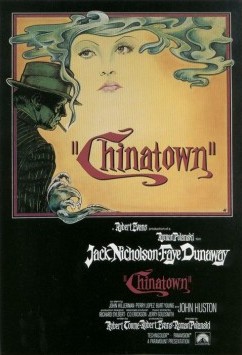
Chinatown
In 1930s Los Angeles, a woman identifying herself as Evelyn Mulwray hires private investigator J. J. "Jake" Gittes to trail her husband, Hollis, the chief engineer at the Department of Water and Power. Gittes photographs Hollis in the company of a young woman and the pictures make their way into the Post-Record, exposing their apparent affair. Gittes is then confronted by the real Evelyn Mulwray, who threatens to sue him. He concludes that the impostor was using him to discredit Hollis. Gittes crosses paths with his former colleague, LAPD Lieutenant Lou Escobar, when Hollis's corpse is found in a reservoir. Investigating further, he discovers that huge quantities of water are being released from the reservoir each night, despite the fact that the city is in the midst of a drought. Water Department Security Chief Claude Mulvihill warns him off, and he has his nose slashed by one of Mulvihill's henchmen. Gittes receives a call from Ida Sessions, the woman who posed as Evelyn. She refuses to say who hired her, but urges Gittes to check the Post-Record ' s obituary section. Now working for Evelyn, Gittes investigates Hollis's death. He learns that Hollis was once the business partner of Evelyn's wealthy father, Noah Cross. Cross offers to double Gittes's fee if he finds Hollis's supposed mistress, who has disappeared. Public records reveal that much of the Northwest Valley has recently changed ownership. Gittes recognizes one of the buyers' names from the obituary section; the obituary indicates that he had been dead for a week when the deal was closed. Gittes and Evelyn bluff their way into the retirement home where the buyer had lived and discover that many of the other residents are " buyers " too, although they have no knowledge of this fact. A suspicious staff member calls Mulvihill, but Gittes and Evelyn escape him and his thugs and hide at her mansion, where they sleep together. Later that night, Gittes follows Evelyn to a house where he sees her comforting the missing girl. When confronted, Evelyn claims the girl is her sister, Katherine. A call from Escobar summons Gittes to Ida's apartment; she has been murdered. Escobar reveals that Hollis had saltwater in his lungs, indicating that he did not drown in the reservoir. He suspects Evelyn is responsible for her husband's murder and tells Gittes to produce her quickly. At the Mulwray residence, Gittes retrieves a pair of bifocals from the saltwater garden pond. Gittes confronts Evelyn about both Katherine, whom she now claims is her daughter, and her husband, whom she denies murdering. Frustrated, he repeatedly slaps Evelyn until she breaks down and reveals that Katherine is both her sister and daughter; the girl's father is Cross, who impregnated Evelyn when she was 15. She tells Gittes that the glasses he found did not belong to Hollis, because he did not wear bifocals. Gittes arranges for the women to flee to Mexico and instructs Evelyn to meet him at her butler's home in Chinatown. He summons Cross to the Mulwray estate, having deduced that Cross dropped his bifocals when he drowned Hollis in the pond. Cross reveals that he is behind both the water shortage and the land grab in the Northwest Valley. Once the land is his, he will get Los Angeles to incorporate the Valley into the city, and obtain a contract from the city to build a reservoir there. He discredited and killed Hollis when the latter came close to uncovering the plan. At gunpoint, Cross and Mulvihill force Gittes to take them to Chinatown, where both Cross's daughter Katherine and the police are waiting. Escobar detains Gittes as Cross attempts to claim Katherine. Evelyn, determined to both protect Katherine from Cross and avoid her learning that Cross is her father, shoots Cross in the arm and tries to escape with Katherine, but the police open fire, killing Evelyn. Cross takes a distraught Katherine away, and Escobar orders Gittes released. As the traumatised Gittes, realizing Cross will get away with everything, is led away by his associates, one tells him, "Forget it, Jake. It's Chinatown."

La haine
The film opens with a montage of news footage depicting urban riots in a banlieue in the commune of Chanteloup-les-Vignes near Paris. The riots are the result of a local man named Abdel Ichaha being gravely injured in police custody and is hospitalized in intensive care. The riots escalate, leading to a siege of the local police station and the loss of a police officer's revolver. The film follows the lives of three friends of Abdel, all young men from immigrant families, over approximately the next twenty consecutive hours. Vinz, a young Jewish man with an aggressive temperament, seeks revenge for Abdel's injuries. He harbors a deep hatred for all police officers and secretly emulates Travis Bickle, from the American film Taxi Driver, posturing in front of his bathroom mirror. Hubert, a Christian Afro-French boxer and small-time drug dealer, aspires to escape the banlieue and create a better life for himself. However, his boxing gymnasium was destroyed in the riots. Saïd, a young North African Muslim, acts as a mediator between Vinz and Hubert, who constantly argue. The three friends lead a directionless daily routine and frequently find themselves under police surveillance. At a rooftop party that is broken up by the police, Vinz insults Notre Dame, a plainclothes police officer. After the trio leaves, Vinz reveals that he has discovered the.44 Magnum revolver lost during the riot. He plans to use it to kill a police officer if Abdel dies. While Hubert disapproves, Vinz secretly takes the gun with him. They try to visit Abdel in the hospital but are stopped by the police. Saïd is arrested after they aggressively refuse to leave, but he is later released with the assistance of a police officer who knows his brother. Vinz and Hubert disagree about their perspectives on policing and violence, and they temporarily part ways. Saïd accompanies Vinz, while Hubert briefly returns home. They reunite at another gathering in the banlieue. It descends into chaos when Abdel's brother attempts to murder a police officer as an act of revenge. In a confrontation with the police, the three narrowly escape after Vinz almost shoots a riot officer. They board a train to Paris. Their interactions with both friendly and hostile Parisians cause several encounters to escalate into risky confrontations. In a public restroom, they encounter a Polish survivor of the gulag. He tells them a story about a man who froze to death after refusing to relieve himself in public near the train and failing to re-board it in time. The trio don't understand what the story means. Later, they visit Astérix, a frequent cocaine user who owes money to Saïd. Tempers rise as Astérix appears to force Vinz to play Russian roulette, but the gun was secretly unloaded. Later, they encounter plainclothes officers who arrest Saïd and Hubert, while Vinz manages to escape. The police officers verbally and physically abuse the duo before jailing them until late at night. The three miss the last train home from Saint-Lazare station and spend the night on the streets. After failing to hotwire a car and being kicked out of an art gallery, the trio make their way to a rooftop, where they insult some passing skinheads. They take shelter in a shopping mall, where they hear a news broadcast reporting Abdel's death. Later, Vinz disappears. Hubert and Saïd find him pointing a finger gun at a police officer; the two angrily abandon Vinz at the mall. But, Hubert and Saïd later encounter the group of skinheads they had harassed, who now mercilessly attack them. Vinz intervenes and holds one of the skinheads at gunpoint. Although Hubert pushes for Vinz to kill the guy, he hesitates and finally lets the skinhead go. In the early morning, the trio returns home. Vinz gives the gun to Hubert. Vinz and Saïd encounter Notre Dame, whom Vinz had insulted at the rooftop party. He seizes Vinz, threatening him with a loaded gun against his head. Hubert rushes to their aid, but Notre Dame accidentally discharges his gun, killing Vinz. Hubert and Notre Dame enter a Mexican standoff, with each pointing a gun at the other. During the standoff, Hubert, in voiceover, tells a story with the image of a man falling from a building, assuring himself that everything is fine, as a metaphor for society's decline. Saïd closes his eyes, and a gunshot is heard. The outcome is not revealed.

Jean de Florette
The story takes place outside a village in Provence, in the south of France, shortly after the First World War. Ugolin Soubeyran returns from his military service and throws himself into a project to grow carnations on his property in the mountains. His uncle César, referred to as Le Papet (meaning "the grandfather" in the local dialect), is at first skeptical; but is convinced when the flowers get a good price at the market. They decide the project is worthy of expansion, and together they go to see the neighbouring farmer, Pique-Bouffigue, to buy his land. The land in question is apparently dry, but Papet knows of a spring that could solve that problem. Pique-Bouffigue angrily refuses to sell, and an altercation breaks out. In the fight, Pique-Bouffigue is killed by Papet. After the funeral, Papet and Ugolin plug with cement and earth the spring that could water the land. Unknown to them, they are seen blocking the spring by a poacher. The property is inherited by Pique-Bouffigue's sister, Florette, who left the area long ago, but she dies very shortly afterwards and the inheritance goes to her son, Jean Cadoret, who works in the city as a tax collector. Ugolin, according to local custom, refers to him as Jean de Florette – Florette's Jean. To discourage Jean from taking up residence, Ugolin damages the roof of the house. Jean, who is hunchbacked, arrives with his wife, Aimée, and young daughter, Manon. He makes it clear that he has no intention of selling: having left the tax administration in order to live a more "authentic" life as a farmer, he wants to make the farm profitable within two years, breeding rabbits and growing their produce himself. Ugolin finds Jean likeable and strikes up a friendship of sorts with him, but keeps going along with his uncle's plans. Papet does not get acquainted with Jean - whom he only meets once, fleetingly, in the village - but observes him from afar cultivating his farm, and laughs at the city dweller's inexperience. Jean does not know about the nearby blocked spring, only of one that is further, two kilometres away, though still on his land. He is reliant on rainfall to fill a cistern to supply the livestock and irrigate the crops. Ugolin and Papet keep secret from Jean the fact that the area where Jean's farm lies rarely gets any rain. Meanwhile, they work to turn the local community against Jean, because the late Pique-Bouffigue has cousins in the village who know about the blocked spring and would tell Jean about it if they became friendly with him. Jean initially makes progress and earns a small profit from farming rabbits. In the long run, however, getting water proves problematic. Dragging it all the way from the distant spring is a backbreaking task. Jean asks to borrow Ugolin's mule, but Ugolin gives vague excuses. Jean uses a dowsing rod to try and find springs, but it proves ineffective. When the rain does come, it falls on the surrounding area but not where it is needed. The dusty winds of the sirocco then arrive, bringing the farm near catastrophe. Jean decides to dig a well. Ugolin tells Jean that his project is hopeless and that he might be better off selling. Jean asks how much he could expect to receive for the farm, and Ugolin gives an estimate of around 8,000 francs. However, it turns out that Jean still has no intention of selling, but wants to use the value of the property to take out a mortgage. Papet decides that he will himself grant the mortgage, because that way he will either earn the interest or drive Jean away for good. From the mortgage money, Jean buys dynamite to finish the well, but in his first blast, he is hit by a flying rock, falls into the cavity, and subsequently dies of his injuries. Ugolin returns with the news to Papet, who asks him why he's crying. "It is not me who's crying," he responds, "it's my eyes." Aimée and Manon cannot remain on the farm, and Papet buys them out. As mother and daughter are packing their belongings, Papet and Ugolin go to where they blocked the spring and remove the plug. Manon follows them, and when she sees what they are doing, she understands and screams. The men hear it, but dismiss the sound as that of a buzzard. Papet performs a mock baptism of his nephew in the water of the spring.

Gran Torino
Recently widowed Walt Kowalski is an ill-tempered and racially prejudiced Korean War veteran and retired Ford factory worker. His Rust Belt neighborhood in Metro Detroit has become ridden with gang violence among poor Hmong immigrants, including Walt's next-door neighbors, the Vang Lor family. Walt is estranged from his spoiled family, and on his eightieth birthday angrily rejects his son's suggestion that he move to a retirement community in favor of living alone with his aging Labrador retriever Daisy. A chronic smoker, Walt suffers from coughing fits, occasionally spitting up blood. As Walt's late wife requested, her priest, Father Janovich, tries to comfort Walt and persuade him to go to confession. Despite being harshly rejected by Walt, Father Janovich persists. Thao Vang Lor is coerced by a Hmong gang led by his cousin, "Spider," to steal Walt's 1972 Ford Gran Torino as an initiation. Walt catches Thao and thwarts the theft; Thao escapes after Walt nearly shoots him. When the gang tries to abduct Thao forcefully, Walt scares them off with his M1 Garand rifle, earning the local Hmong community's respect. As penance, Thao's mother makes Thao work for Walt performing tasks that improve the neighborhood. The two men soon form a tenuous mutual respect. Walt mentors Thao, helping him obtain a construction job. Walt also rescues Thao's sister, Sue, from being raped by three African American gangsters. Despite his initial prejudices, Walt bonds with the Vang Lor family. With his cough worsening, Walt consults a doctor who provides a dismal prognosis, which he conceals. After the gang assaults Thao on his way home from work, Walt physically assaults a member as a warning. In retaliation, the gang beats and rapes Sue, and then injures Thao in a drive-by shooting. Out of fear, the family refuses to report the crimes. The following day, an enraged Thao seeks Walt's help to exact revenge; Walt convinces him to return later that day. Walt buys a suit, gets a haircut, and finally confesses to Father Janovich. When Thao arrives, Walt takes him to his basement and gives him his Silver Star, telling him that he is haunted by the memory of killing an enemy child soldier who was trying to surrender to him, and he wants to spare Thao from shedding blood. He locks Thao in the basement and departs to the gang's residence. When Walt arrives, the gang members draw their guns as he berates them for their crimes, drawing the attention of the neighbors. Walt puts a cigarette in his mouth, slowly reaches into his jacket pocket, and pulls his hand out quickly. Thinking Walt is brandishing a pistol, the gang members shoot and kill him. Walt's hand opens to reveal his Zippo lighter bearing the 1st Cavalry insignia. Following Walt's direction, Sue frees Thao, and they arrive at the scene. A police officer tells Thao and Sue that Walt was unarmed and that the gang members are arrested for murder. The officer goes on to say that the gang members will be going to prison for a very long time, thanks to witnesses coming forward. Father Janovich conducts Walt's funeral, which his family, his barber, and the Hmong community attend. Afterward, Walt's last will and testament is read. Much to the dismay of Walt's family, Walt leaves his house to the church and his cherished Gran Torino to Thao, on the condition that Thao does not modify the car. Sometime later, Thao drives along Detroit's Jefferson Avenue with Daisy at his side.