Genre: Drama (Page 49)
Browse 989 movies in the Drama genre.
All Genres
Basic Instinct
In San Francisco, a blonde woman ties retired rock star Johnny Boz to a bed with a silk scarf during sex, then stabs him to death with an ice pick. SFPD Detective Nick Curran and his partner, Gus Moran, investigate the murder. The prime suspect is Boz's girlfriend, crime novelist Catherine Tramell, whose latest novel mirrors the details of the killing. Catherine is uncooperative with the investigators, taunting them by smoking during questioning and exposing herself. Though released for lack of evidence, she becomes a person of interest when Nick learns that she has a history of close relationships with violent individuals. These include her girlfriend Roxanne "Roxy" Hardy, who killed her younger brothers as a teenager, and Hazel Dobkins, a convicted family murderer. Nick, a recovering alcoholic with a history of drug abuse and a prior incident in which he accidentally shot two tourists, attends mandatory counseling with police psychologist Dr. Elizabeth Garner, with whom he has an unstable romantic relationship. He discovers that Catherine is using him as the inspiration for a new character—a detective who is murdered after falling for the wrong woman. When Nick suspects that his confidential psychiatric file has been leaked, he assaults internal affairs lieutenant Marty Nilsen, who had access to the file. Nilsen is later found murdered and Nick is placed on administrative leave. At Boz's nightclub, Nick sees Catherine and Roxy using cocaine. Later, at Catherine's home, she ties Nick to the bed during sex while Roxy watches. Moran expresses concern about Nick's involvement with Catherine and uncovers that Nilsen received a $50,000 payment months before Nick met her. Roxy attempts to kill Nick in a car attack but dies in the ensuing crash. Catherine reveals that she had an intense relationship with a woman in college who became obsessed with her. Nick suspects the woman was Garner, who claims the obsession went the other way. Investigating further, Nick finds that Nilsen had withdrawn a complaint Catherine filed against Garner years earlier. He also uncovers that a professor shared by Garner and Catherine was killed with an ice pick in an unsolved case resembling Catherine's fiction, and that Garner's former husband was murdered in another unresolved case investigated by Nilsen. Nick finds the draft of Catherine's new novel, which depicts a detective discovering his partner's body in an elevator. Catherine abruptly ends their relationship. Later, Moran tells Nick he has arranged to meet Catherine's former college roommate in Oakland to learn more about her and Garner. When Nick arrives, he finds Moran stabbed to death with an ice pick in an elevator, mirroring the novel. Garner arrives shortly afterward, claiming she was lured there by a message. Believing she is reaching for a weapon, Nick shoots and kills her but she is found to be unarmed. Police find evidence in Garner's apartment implicating her in multiple murders, including files and photographs related to Catherine. Nick is left confused and emotionally shaken. Later, Catherine returns to Nick's apartment and they have sex. As they lie in bed discussing their future, an ice pick lies unseen beneath the bed.

Bank of Dave
The film is based on the real-life experiences of Dave Fishwick. It follows the story of a Burnley self-made millionaire who struggles to set up a community bank to help the town's local businesses to thrive. To do so, he must battle London's elite financial institutions and compete for the first banking licence in more than 150 years.

The Kingdom
Al-Qaeda terrorists in Riyadh, Saudi Arabia, detonate an explosive at an American oil company housing compound, killing both American and Saudi citizens. Before this, terrorists disguised as Saudi State Police had shot the inhabitants in the compound before they were stopped by Sergeant Haytham of the Saudi State Police; after this, another terrorist commits a suicide bombing. Francis Manner, the Federal Bureau of Investigation 's Legal Attaché in Saudi Arabia, alerts his colleague, Special Agent Ronald Fleury, to the attacks before being killed by the second bomb. At FBI Headquarters in Washington, D.C., Fleury briefs his rapid deployment team on the attack, believing it to have been orchestrated by local Saudi terrorist Abu Hamza. He recruits forensic examiner Janet Mayes, intelligence analyst Adam Leavitt, and bomb technician Grant Sykes to his team. Although the U.S. Justice Department and the U.S. State Department hinder FBI efforts to investigate, Fleury blackmails the Saudi ambassador into allowing his team into Riyadh. On arrival, the team is met by Colonel Faris al-Ghazi, the commander of the Saudi State Police Force providing security at the compound, and General Al Abdulmalik of the Saudi Arabian National Guard. The general's inexperience in criminal investigation hinders Fleury's team. The team is invited to the palace of Saudi Prince Ahmed bin Khaled, where Fleury convinces the Prince that Colonel al-Ghazi is a better fit to lead the investigation. With this change in leadership, the Americans are allowed direct access to the crime scene. This allows Fleury to sympathize with and befriend al-Ghazi. While searching for evidence, Sergeant Haytham and Sykes discover the second bomb was detonated in an ambulance and that the brother of one of the dead terrorists had access to ambulances and police uniforms. Al-Ghazi orders a raid by the Saudi Emergency Force on a terrorist stronghold, killing several of them. Afterward, Fleury's team discovers clues, including photos of the U.S. and other Western embassies in Riyadh. The U.S. Embassy Deputy Chief of Mission Damon Schmidt notifies Fleury and his team that they have been ordered to return to the United States. However, the team's convoy is attacked and Leavitt is kidnapped. Al-Ghazi commandeers a civilian vehicle, and the team chases the car holding Leavitt into the dangerous Al-Suwaidi neighborhood. As they pull up, a gunman fires rocket-propelled grenades at them and a fierce firefight starts. Leavitt is carried into a room inside a complex, where the terrorists prepare to film his execution before Mayes, separated from al-Ghazi and Fleury, saves him just in time. As al-Ghazi and the team start to leave, Fleury notices a trail of blood leading to the back of the apartment, where a family lives. After noticing several clues, al-Ghazi realizes the grandfather is Abu Hamza. Abu Hamza's teenage grandson walks out of the bedroom and shoots al-Ghazi in the neck, then points his gun at Mayes, prompting Fleury to kill him and Haytham to kill Abu Hamza. Al-Ghazi bleeds out in Fleury's arms, while Abu Hamza whispers something to his other grandchild. At Al-Ghazi's house, Fleury and Haytham meet and comfort his family. Fleury and his team return to the US, where they are commended by the FBI Director for their work. Leavitt asks Fleury what he whispered to Mayes, earlier in the film, to get her to stop crying over Manner. Simultaneously, both Fleury and Hamza's grandson responds "We are gonna kill 'em all."

Night on the Galactic Railroad
Giovanni is a young, bluish-colored cat, whose father is away on a fishing trip and whose mother is ill at home. At school, during a lesson about the Milky Way, Giovanni's teacher asks him what the galaxy is composed of. Giovanni knows that it is made of stars, but is unable to say so, and his classmate Campanella does the same to save Giovanni from their fellow schoolmates' teasing. After school, Giovanni works a typesetting job at a print shop, and buys a loaf of bread and some sugar. He returns home to find that no milk was delivered that day, so he heads to the dairy, where he is told by an elderly cat to return at a later time. That night, the Centaurus Festival, or the Festival of Stars, takes place in the town. Upon reaching the festivities, Giovanni is mocked by his classmates for expecting an otter-skin coat from his father. Giovanni runs to the top of a hill at the edge of town and gazes up at the night sky. A steam train suddenly appears, and Giovanni boards it. On board, he is joined by Campanella, and as the train sets in motion, the two observe fields of flowers outside the windows of their train car. The train travels past the Northern Cross and halts at a stopover, where Giovanni and Campanella disembark. They walk down a flight of steps and are directed by a sign towards "The Pliocene Coast", where they find their teacher leading an excavation of fossils from crystallized sands. They return to the train, where they meet a bird-catcher who catches herons and turns the birds into candy. Giovanni and Campanella help a blind wireless operator to his radio system. He picks up a transmission which an elderly passenger identifies as the hymn " Nearer, My God, to Thee ". When a ticket inspector appears, Giovanni discovers in his pocket a rare ticket which allows him to go anywhere that the train runs. They are then joined in their seats by a tutor and two children, who were on board a ship that sank after hitting an iceberg. They share apples and pass by a vast cornfield where they hear the " New World Symphony ". As the train passes Scorpius, one of the children recalls a story about a scorpion who perished in a well after escaping a weasel; regretting that it did not sacrifice itself for a good cause, the scorpion prayed to bring happiness to others in its next life, and its body burst into a bright flame that still burns in the night sky. The train stops at the Southern Cross, where every passenger except for Giovanni and Campanella disembark for the Christian Heaven. Giovanni pledges that he and Campanella should continue on the train's journey together forever, but as the train approaches the Coalsack, Campanella sees what he claims to be "the true Heaven", where his mother is waiting for him. Campanella vacates the train, leaving Giovanni alone. Giovanni awakens on the hilltop. He returns to the dairy, where this time he collects a bottle of milk from a farmer. As Giovanni passes through town on his way home, he learns that Campanella fell into a river while saving one of their classmates, Zanelli, from drowning. Giovanni hurries to the river, where he finds Campanella's father giving up searching for his son, as his disappearance occurred 45 minutes prior. He tells Giovanni that he has received a letter from his father, stating that he will be home soon. Giovanni believes Campanella is "at the edge of the universe", which he says he knows "because we explored it together". He vows to be like the scorpion who promised to bring happiness to others, and continues homeward.

The Boys from Brazil
Barry Kohler, a young amateur Nazi hunter, spies on a meeting of the fugitive Nazi organisation Kameraden in Paraguay. At this meeting, infamous Auschwitz doctor Josef Mengele issues instructions for the assassinations of 94 civil servants in Western Europe and North America, all of them low-ranking and aged around 65, on particular dates over the next two years. Kohler telephones Ezra Lieberman, a famous (as well as penniless and cynical) Nazi hunter living in Vienna, to inform him of his discovery. While still on the phone, Kohler is surprised by the Kameraden and killed. With the help of his sister Esther, British journalist Sidney Beynon and Jewish-American vigilante leader David Bennett, Lieberman begins investigating the deaths of civil servants fitting the profile who die suddenly over the next few months. He is struck by the fact that all of the dead men have sons aged 13 who look exactly alike, with pale skin, dark hair and blue eyes. He discovers that all of the boys were illegally adopted and that some of the adoptions were facilitated by Kameraden member Frieda Maloney, who has since been jailed. Lieberman interviews Maloney, who tells him that the boys were provided by an intermediary in Brazil. She mentions that one of the adoptive fathers she dealt with, American Henry Wheelock, gave her a newborn puppy in exchange for her baby. Seeking an explanation for the boys' identical appearance, Lieberman consults the biologist Dr Bruckner, who explains the principles of cloning. Lieberman deduces that the boys are clones of Adolf Hitler, all created from a single DNA sample by Mengele, who has also been seeking to ensure that their childhoods imitate that of the original Hitler by having them adopted by parents who resemble Hitler's own abusive father Alois (a civil servant in the Austro-Hungarian Empire) and doting mother Klara. This is done in the hopes that their later lives will follow the same course, and that as adults they will establish new Nazi regimes in their respective countries. The murders of the fathers are part of this plan, designed to reflect the death of Alois when Hitler was 13. Based on this revelation, and the age of Maloney's dog, Lieberman realises that Henry Wheelock is due to be murdered in just four days' time. Alarmed by the progress of Lieberman's investigation and Mengele's increasingly erratic behaviour (after he beats one of his men nearly to death for killing his target on the wrong date), the Kameraden leadership attempts to shut down the project, but Mengele escapes. Lieberman travels to rural Pennsylvania to warn Henry Wheelock, only to discover that Wheelock has already been murdered by Mengele, posing as Lieberman. The doctor badly wounds Lieberman with a gunshot, but is then cornered by the family's vicious Doberman Pinschers (Mengele fears dogs). When Wheelock's son Bobby arrives home from school, Mengele attempts to tell him about his real origins. He makes no attempt to deny killing Wheelock, telling Bobby that he must rise above his worthless adoptive family and embrace his destiny. This enrages the boy, who orders the dogs to kill Mengele. Lieberman recovers a list from Mengele's pocket detailing the identities of all 94 clones, and then collapses from blood loss. As Lieberman recuperates in hospital, he is visited by Bennett who asks him to hand over the list so that his vigilante group can eliminate the clones. Lieberman refuses and instead burns the list, declaring that they are innocent children who may yet grow up to be harmless. The final scene shows Bobby Wheelock gazing in fascination at photographs he took of Mengele's mauled corpse.

The Sure Thing
High school senior Walter "Gib" Gibson and best friend Lance celebrate moving on to college, though Gib mostly laments having lost his touch with girls. Lance heads to UCLA while Gib attends an Ivy League college in New England. The two friends regularly communicate with Gib saying his luck with girls is unchanged. Gib attempts to woo the ambitious, regimented Alison Bradbury, his English classmate by tricking her into tutoring him. His clumsy seduction angers her. Lance invites Gib to come to California for Christmas break, saying he can set him up with a beautiful girl, claiming she is a "sure thing" with no strings attached. Gib arranges a cross-country ride share with Gary and Mary Ann only to discover that Alison is also a passenger. She is headed to UCLA to visit her boyfriend, Jason. The tension and bickering between Gib and Alison become too much for Gary and Mary Ann, and they abandon the two roadside in the middle of nowhere, infuriating Alison. Alison hitches a ride from a middle-aged man driving a pick-up truck. When he attempts to sexually assault her, Gib, who hid in the truck bed, quickly intervenes. The two decide to stick together, eventually making it to a bus station. However, Gib lacks enough money for the fare, so the two instead check into a motel. While Alison is talking to Jason on the phone, Gib leaves and ventures to a nearby bar. He spends his remaining cash on drinks and drunkenly sings Christmas carols with the locals. The next morning, Gib has Allison stuff her shirt with scarves to appear pregnant, hoping it increases their chances of getting a ride. The two hitchhike to a restaurant, whereupon Alison realizes she left her appointment book and cash back at the motel. That night, the two are caught outside in a rainstorm, until Alison suddenly remembers she has her father's emergency credit card. The two stay at an upscale hotel, where they treat themselves to drinks and dinner. The next morning, Alison is pleased to find Gib embracing her, but he quickly pulls away upon waking up. While hitchhiking with a truck driver through Arizona, Alison overhears Gib saying that he is on his way to meet a "sure thing". Upon arriving at the UCLA campus, Alison angrily parts ways with Gib. That night, Gib attends a Christmas mixer where Lance introduces Gib to the "sure thing" girl. Meanwhile, Alison is bored staying in Jason's dormitory and drags him to the same party. Alison and Gib see each other, but their mutual jealousy leads to a confrontation. Gib takes the "sure thing" to Lance's room but he can only think about Alison. In Jason's dormitory, Alison tells him about Gib. He asks if she loves Gib and it is implied that she does. Back on campus after Christmas break, Gib tries making amends with Alison, but she ignores him, angry about the party and believing Gib slept with the “sure thing.” In English class, Professor Taub reads Gib's essay, which describes his night with the "sure thing". The girl in the essay asks the protagonist if he loves her, but for the first time he realizes that those are not just words, and he cannot sleep with her. Alison realizes what actually happened that night and tells Gib that she and Jason broke up. The two reconcile and kiss.
Ash Is Purest White
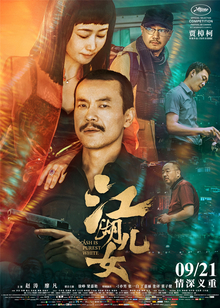
In 2001, Qiao and her boyfriend Bin, a mob boss, have a lot of power in Datong, an old mining city that has become poor since the coal prices dropped. After Bin's boss is murdered, Qiao suggests they run away from everything and get married, but Bin is not interested. One night a group of motorcyclists attack Bin and his driver, claiming to dethrone him. Qiao grabs Bin's handgun and fires two warning shots into the air, scaring off the attackers. The police tell Qiao that the gun is illegally owned and asks her whose it is; she repeatedly claims it is hers. She spends five years in prison for possessing an illegal firearm but Bin does not visit her during that time. After Qiao is released, she tries to call him but can never seem to get in touch. She travels by boat to the city in Hubei province where Bin is living but is instead greeted by Bin's new girlfriend—meanwhile, Bin hides in another room. Qiao says that if he wants to break up with her, he will have to tell her himself. She has almost no money to her name so she cons a few strangers for money and food. She hires a motorcycle driver to take her to the power plant where she thinks that Bin works, and along the way the driver suggests that they have sex. She uses this opportunity to steal his bike, and when she gets to the power plant she reports to a police officer that the driver tried to rape her and that he should call her boyfriend Bin. This finally forces Bin to see her. In a hotel room, Bin says he's a changed man, no longer a " jianghu " gangster, and has no place in his life for Qiao anymore. He can never go back to Datong because he has lost all the respect he once had there. Qiao says that she saved his life and took the blame for him: he should have been waiting for her the day she got out of prison. Since he refuses to say it, she finally says that their relationship is over and he leaves. On a train back to Datong, she meets a passenger who claims to be developing a UFO -hunting tourism company and invites her to join him after she claims to have seen one herself. But after they transfer onto another train, he admits that it was all a lie. She gets off the train, sees a bright object fly swiftly overhead, and makes her way back to Datong. In 2017, Qiao gets a call from Bin, and when she picks him up, finds him using a wheelchair. She brings him back to their old gambling parlor where she now works and many of his old friends are happy to see him. He is closed-off and hot-tempered, immediately starting fights, and Qiao nearly throws him out. He tells her that he had a stroke from drinking too much and she finds a doctor to help rehabilitate him. When he can walk again, he sneaks out of Qiao's building with just a brief voicemail to say he has left. Qiao goes to the front door when she learns he has gone but she cannot see him.

Bombay Beach
The film tells the story of three protagonists: Benny Parrish, a young boy diagnosed with bipolar disorder whose troubled soul and vivid imagination create both suffering and joy for him and his complex and loving family; "CeeJay" (played by Cedric Thompson), a black teenager and aspiring football player who has taken refuge in Bombay Beach hoping to avoid the same fate of his cousin who was murdered by a gang of youths in Los Angeles; and that of Red, an ancient survivor, once an oil field worker, living on the fumes of whiskey, cigarettes, and an irrepressible love of life. Together they make up a triptych of American manhood in its decisive moments, populating the Salton Sea's land of thwarted opportunity. The New York Times writes, “ feels like a fever dream about an alternate universe. Suffused with a sense of wonder, it hovers, dancing inside its own ethereal bubble.” Har’el explains about the film, “This film can only serve to show glimpses into some of the larger issues one can pick out from these people’s lives and the way in which they live their lives in this particular place. All these things that can be perceived as wrong or right, or bad or good, all reside together, side by side. This is the human experience of life and that’s what I wanted to illustrate more than anything, how things co-exist, all the wrongs and the rights together, the love and the violence, the broken dream and the persistence of dreams. Even though the dream is broken, you can still see the people.” From Salon: “You either like this kind of ambitious, brave, borderless experiment or you don’t, and I think it’s absolutely magical and tragic. Maybe it took a foreign-born Jewish filmmaker to make a movie that seems so positively biblical (…) about the current conditions of America.”


Charlie Wilson's War
In 1980, Congressman Charlie Wilson, an East Texas Democrat, is more interested in partying than legislating, frequently throwing huge galas and staffing his congressional office with attractive young women. His social life eventually brings about a federal investigation into allegations of his cocaine use, conducted by federal prosecutor Rudy Giuliani as part of a larger investigation into congressional misconduct. The investigation results in no charge against Wilson. A friend and romantic interest, Joanne Herring, Houston socialite, political activist, diplomat, and television talk show host, encourages Charlie to do more to help the Afghan people, and persuades him to visit the Pakistani leadership. The Pakistanis complain about the inadequate support of the U.S. to oppose the Soviet Union, and they insist that Wilson visit a major Pakistan-based Afghan refugee camp. The Congressman is deeply moved by their misery and determination to fight, but is frustrated by the regional CIA personnel's insistence on a low key approach against the Soviet occupation of Afghanistan. Wilson returns home to lead an effort to substantially increase funding to the mujahideen. As part of this effort, Charlie befriends maverick CIA operative Gust Avrakotos and his understaffed Afghanistan group to find a better strategy, especially including a means to counter the Soviets' formidable Mil Mi-24 Hind helicopter gunship. This group was composed in part of members of the CIA's Special Activities Division, including a young paramilitary officer named Michael Vickers. As a result, Charlie's deft political bargaining for the necessary funding and Avrakotos' careful planning using those resources, such as supplying the guerrillas with FIM-92 Stinger missile launchers, turns the Soviet occupation into a deadly quagmire with their heavy fighting vehicles being destroyed at a crippling rate. Charlie enlists the support of Israel and Egypt for Soviet weapons and consumables, and Pakistan for distribution of arms. The CIA's anti-communism budget evolves from $5 million to over $500 million (with the same amount matched by Saudi Arabia), startling several congressmen. This effort by Charlie ultimately evolves into a major portion of the U.S. foreign policy known as the Reagan Doctrine, under which the U.S. expanded assistance beyond just the mujahideen and began also supporting other anti-communist resistance movements around the world. Charlie states that senior Pentagon official Michael Pillsbury persuaded President Ronald Reagan to provide the Stingers to the Afghans. Gust vehemently advises Charlie to seek support for post-Soviet occupation Afghanistan, referencing the "zen master's" story of the lost horse. He also emphasizes that rehabilitating schools in the country will help educate young children before they are influenced by the " crazies ". Charlie attempts to appeal this with the government but finds no enthusiasm for even the modest measures he proposes. In the end, Charlie receives a major commendation for his support of the U.S. clandestine services, but his pride is tempered by his fears of the blowback his secret efforts could yield in the future and the implications of U.S. disengagement from Afghanistan.
The Interview
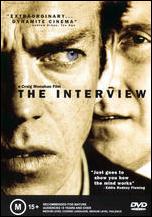
Edward Rodney Fleming (Weaving) is a man living alone after losing his job and wife. One morning, Detective Sergeant John Steele (Martin) and his subordinate, Detective Wayne Prior (Aaron Jeffery), break into Fleming's apartment. They rough Fleming up, ransack his belongings, and take him to the police station in handcuffs. Steele and Prior question Fleming in an interrogation room. The police claim a witness saw Fleming with Andrew Beecroft, the owner of a stolen car. They also claim Fleming's handwriting matches the writing on some forged sales correspondence between Beecroft and a fake buyer, and that the fake buyer's alias matches an alias Fleming used as a teenager to steal a car for a joyride. Fleming denies any knowledge of the theft and only meekly asks for food, as he has not eaten since the previous day. Steele offers false expressions of empathy, while Prior intimidates Fleming when the recorder is off. In between questioning, Detective Inspector Jackson orders Steele to deal with an intrusive reporter, Barry Walls. Steele complains to Walls about how his reckless reporting has previously interfered with police work. Walls shares that he overheard Prior questioning Steele's skills behind his back, to convince Steele he can be useful in return for information. Steele confronts Prior in private, pins him to the wall, and warns him against future disloyalty. As the interrogation proceeds, Steele reveals to Fleming that the car's owner is missing. Fleming correctly guesses he is suspected of murdering the car's owner, and that the police believe the theft is related to other missing persons cases reported in the news. Fleming asks for a lawyer. While Fleming's lawyer advises him to say nothing until he is released in a few hours, Steele convinces Jackson to give him more time with the Fleming. Fleming's demeanour grows in confidence. Despite his lawyer's advice, he expresses his belief that the missing persons were murdered, and mocks the police for chasing some kind of overarching motive. Fleming hints that he might have more to share after eating. When Steele finally provides food, Fleming proudly details how Beecroft picked him up while hitchhiking. He decided to kill Beecroft on a whim. He bludgeoned Beecroft after they drank together, and then he took Beecroft's car and wallet after disposing of the body. Fleming also casually admits to killing five or six other victims starting from a few years ago, claiming he cannot be bothered to remember the details although he always beat them to death after hitchhiking with them. Fleming agrees to provide a video-recorded confession as well. However, during the videotaping, Jackson walks in and asks to speak to Fleming. Fleming immediately recants everything and says he only told Steele and Prior what they wanted to hear because they brutalized him, threatened him, and refused to feed him. Jackson forces Steele and Prior to end the questioning. Later, Steele is informed that the entire day's interrogation was being filmed without his knowledge, due to an investigation by a police ethics committee after too many suspects made formal complaints about his conduct. The officer in charge of the ethics review, Detective Hudson, determines that Steele's entire interview is inadmissible in court due to suggestions, false promises, intimidation, and other questionable techniques by Steele and Prior. Steele blames Jackson for ruining the interview and failing to stand up for him, although Jackson offers to testify that Steele tried to reel in Prior's aggression. Convinced of Fleming's guilt and outraged that he will walk free, Steele arranges to secretly give the entire case info and the audio recording of the confession to Walls. Steele tells Walls he does not care about the consequences since he believes he will be fired anyway. Afterwards, Hudson interviews Steele using another audio recorder. Steele accuses Hudson of a personal grudge, as Hudson led previous ethics investigations against him, too. Hudson turns off the recorder, angrily insults Steele, and tells him he will make sure he is fired. Unbeknownst to Hudson, Steele had his own recorder running and recorded Hudson's abusive comments. Steele is last seen planning how to use his recording of Hudson to defend himself. Fleming leaves the station with an ambiguous grin. In the final scene, he is shown hitchhiking again.
