Genre: Drama (Page 35)
Browse 989 movies in the Drama genre.
All Genres
Lorenzo's Oil
Lorenzo is a bright and vibrant young boy living in the Comoro Islands, as his father Augusto Odone works for the World Bank and is stationed there. However, after relocating with his parents to the United States, he begins to show signs of neurological problems, such as falling, loss of hearing, tantrums, etc. The boy is diagnosed as having adrenoleukodystrophy (ALD), which is fatal within two years. Failing to find a doctor capable of treating their son's rare disease, Augusto and his wife, Michaela, set out on a mission to find a treatment to save their son. In their quest, the Odones clash with doctors, scientists and a support group that is skeptical that anything could be done about ALD, much less by laypeople. But they persist, setting up camp in medical libraries, reviewing animal experiments, enlisting the aid of Professor Gus Nikolais, badgering researchers, questioning top doctors all over the world and even organizing an international symposium about the disease. Despite research dead-ends, the horror of watching their son's health decline and being surrounded by skeptics (including the coordinators of the support group they attend), they persist until they finally hit upon a possible therapy. The Odones sponsor an international meeting of scientists doing research on ALD, requiring two conditions ahead of time. First they insist that the meeting focus on potential treatments and second, they require that they be allowed to participate, despite being non-scientist laypeople. The pivotal scene in the movie portrays this meeting, in which the scientists are presenting their research. When Dr. William B. Rizzo mentions his studies in which the addition of oleic acid to cultured cells blocked accumulation of the factors which cause ALD, the Odones jump into the conversation, asking if this oil might help their son. Although the scientists play down their hope, pointing out that it would take years of work to produce the oil and test in clinical trials, the Odones seize the promise of this possible curative treatment. As the scene ends, Michaela Odone is shown beginning the effort to find someone able and willing to produce the same oil Dr. Rizzo gave to his cells. They obtain oleic acid from an industrial manufacturer of lubricants, but this only lowers Lorenzo's levels by 50% before leveling off, and they realize they are only countering some of the shorter chains produced by one enzyme. To remove the other, they will have to add a distillation of erucic acid. They contact over 100 firms around the world until they find an elderly British chemist, Don Suddaby, who is working for Croda International and is willing to take on the challenge of distilling the proper formula. The Odones obtain a precious vial of the oil (actually containing two specific long chain fatty acids, isolated from rapeseed oil and olive oil) and add it to their son's diet. This treatment proves successful in normalizing the accumulation of the very long chain fatty acids (which had been causing their son's steady decline), as measured in blood levels. This treatment halts the progression of his disease and is dubbed "Lorenzo's Oil". This oil is soon found to be successful in preventing the progression of harm in other patients with ALD. Meanwhile, Lorenzo has a great deal of neurological damage, and the Odones are dismayed to see that the oil can reverse their son's symptoms only very, very slowly. The Odones realize that more rapid improvement of their son's severe condition will require treatments to repair the myelin sheath (a lipid insulator) around the nerves, and Augusto is shown taking on the new challenge of organizing biomedical efforts to heal myelin damage in patients. Lorenzo, at the age of 14, shows definite improvement (swallowing for himself and answering "yes" or "no" questions by blinking) and it is revealed that he has regained his sight, can move his head from side to side, vocalize simple sounds and is learning to use a computer. The movie ends with scenes of ALD patients who were treated with Lorenzo's Oil earlier in the course of their disease. In these patients, the devastating neurological degeneration from which Lorenzo suffered was prevented.

The Way Back
After the Soviet invasion of Poland in World War II, Polish army officer Janusz Wieszczek is held prisoner and interrogated by the NKVD. Unable to force a confession of espionage from him, the Soviets torture his wife until she denounces him. He is sentenced to 20 years in a Gulag labour camp in Siberia. Janusz is imprisoned with Mister Smith, an American engineer; Khabarov, an actor; Valka, a hardened Russian criminal; Tomasz, a Polish artist; Voss, a Latvian priest; Kazik, a Pole suffering from night blindness; and Zoran, a Yugoslav accountant. Khabarov confides a plan to escape to Mongolia, passing Lake Baikal. Smith cautions Janusz that Khabarov discusses escape plans with newcomers only to maintain his morale, but nothing will come of it. Janusz intermittently hallucinates the front door of a country home and adjoining window ledge with plants and a rock he attempts to grab for but never quite reaches. Janusz escapes from the camp with Smith, Valka, Voss, Tomasz, Zoran, and Kazik during a severe snowstorm that covers their tracks. Kazik freezes to death two nights later after getting lost while looking for firewood. Several more days of hard travel through Siberian snow brings them to Lake Baikal where they meet Irena, a Polish girl. She tells them that Russian soldiers murdered her parents and sent her to a collective farm near Warsaw from which she escaped. Smith knows Warsaw to be occupied by the Germans, not the Soviets, but despite misgivings that she'll slow them down and tax their meager food supply, he agrees to let her accompany them. He confronts her about the lie and she admits her parents were communists who were killed, leaving her in an orphanage. The group reaches the unpatrolled border between the Soviet Union and Mongolia, and Valka, who idolizes Joseph Stalin, refuses to cross. The rest continue to Ulaanbaatar to discover that Mongolia is under communist control. Since China is at war with Japan, he convinces the group to take refuge in British India instead and they continue south across the Gobi Desert. Lack of water, sandstorms, sunburn, blisters, and sunstroke weaken the group. They find temporary relief at a well and then lose most of their water supply in a sandstorm. The group carries on; Irena dies a few days later followed by Tomasz. Smith nearly dies but Janusz, Zoran, and Voss motivate him until the severely dehydrated men reach a new water source. The group passes through the Great Wall into China and reach the Himalayas on the verge of death. A Tibetan monk takes them to a Buddhist monastery where they regain their strength. Smith decides to go to Lhasa with the help of one of the monk's contacts, who will smuggle him out through China so he can make contact with the US military and return to home. The remaining three reach India where villagers assist them, and the Indian government arranges their peaceful return home. Janusz walks around the world until 1989, when the communist regime in Poland is ousted from power. Fifty years after being taken captive, Janusz again envisions reaching for the rock by the door. This time he succeeds, and takes a key hidden underneath. He opens the door and is reunited with his wife.

Rounders
New York City law student and gifted poker player Mike McDermott dreams of winning the World Series of Poker. At an underground Texas hold 'em game run by Russian mobster Teddy "KGB", an overconfident Mike loses his entire $30,000 bankroll in a single hand. Shaken, he promises his girlfriend and fellow student Jo he has quit poker, and concentrates on law school. His mentor Joey Knish offers to stake him to rebuild his bankroll, but Mike declines and accepts a part-time job to make money. Months pass and Mike stays true to his promise until his childhood friend, Lester "Worm" Murphy, is released from prison. While Mike is an honest player, Worm is a hustler and unapologetic cheat. To help Worm pay off a debt, Mike sets him up with games across town and reluctantly sits in on one, interfering with his studies and his relationship with Jo. Mike allows Worm to play on his credit at the Chesterfield Club. After being lent $2,000, Worm gets up to $10,000 and cashes out for the full amount, which starts a tab in Mike's name. Worm runs into Grama, a dangerous pimp, who reveals he is working for KGB and has bought Worm's debt, now totaling $25,000 with interest. Grama takes Worm's $10,000, threatening him to pay the rest. As Mike returns to his poker lifestyle and friends, Jo ends their relationship. Mike learns from Petra at the Chesterfield that Worm has racked up a $7,000 debt in Mike's name. Worm tells Mike about Grama, but withholds the KGB connection. Mike vouches for Worm to Grama, but Worm and Grama insult each other and nearly come to blows. Grama gives them five days to pay the remaining $15,000. Mike decides to help Worm win the money by playing in several games in and around the city. Mike wins $7,200 in three days, but still needs to more than double it in 48 hours. Worm drives Mike to Binghamton for a game hosted by New York state troopers, where he comes close to winning the $7,800 needed before Worm unexpectedly joins the game. Soon after, a trooper catches Worm base-dealing to help Mike; they are beaten up and relieved of their entire bankroll. Worm confesses that Grama is working for KGB and decides to flee; Mike returns to the city alone. Mike asks Grama for more time, to no avail. He asks Knish for the money, but is refused out of principle. Knish chastises him for poor decisions, and Mike finally reveals why he took the ill-fated risk at KGB's club; he once beat poker legend Johnny Chan at a single hand in Atlantic City and thinks he can compete and possibly win the World Series of Poker. Desperate, Mike goes to his law professor, Petrovsky, who lends him $10,000. Mike challenges KGB to a second heads-up no-limit Texas hold 'em game for the remaining debt, with winner-take-all stakes, which KGB accepts. Mike beats KGB in the first session, winning $20,000. KGB offers to let Mike's winnings "ride" and continue the game, but Mike – with enough to pay off most of his debts – declines. As he is about to leave, KGB taunts that he is paying Mike with the money that he won from their previous game. Mike changes his mind and decides to continue playing. Mike doubles the blinds at the risk of losing everything, and possibly his life, to KGB. As the night wears on, he spots KGB's tell and folds a crucial hand. Irate at missing a chance to bust Mike, KGB begins to play on " tilt ". In the final hand, Mike baits a boastful KGB into going all-in and defeats him with a nut straight. KGB throws a tantrum at having been lured into a mistake. The rattled KGB calls off his goons and admits that Mike won fairly, allowing him to leave with his winnings. With over $60,000, Mike settles Worm's $15,000 debt to Grama, the Chesterfield's $6,000 credit, and his professor's $10,000 loan, and restores his original bankroll of "three stacks of high society". He drops out of law school, bids Jo goodbye, and leaves for Las Vegas to play in the World Series of Poker.

Lars and the Real Girl
Lars Lindstrom lives a quiet life in a small town. His mother died when he was born, causing his grief-stricken father to have been a distant parent to Lars and his older brother, Gus. Gus feels guilty for leaving as soon as he could to support himself; Lars struggles with the loss of his mother during his birth and an irrational fear about the risk of death during childbirth. As a result, he exhibits avoidance behaviors and is avoidant of touching others (haphephobia), causing social awkwardness and isolation. Having inherited the family home after their father's death, the two brothers live on the property along with Gus's wife, Karin. Lars lives in the converted garage, while Gus and Karin, who is pregnant with their first child, live in the main house. Despite Karin's efforts to bring Lars out of his shell, interacting with or relating to his family and co-workers is very difficult for him. A colleague at his office, Margo, also tries to engage him, but Lars is impervious to her attempts. One evening, Lars announces that he has a visitor whom he met online, a wheelchair-mobile missionary of Brazilian and Danish descent named Bianca. Gus and Karin are startled to discover that Bianca is actually a lifelike doll, ordered from an adult website, whom Lars treats as a live human being. Concerned about his mental health, they convince him to take Bianca to see the family doctor, Dagmar Berman, who is also a psychologist. Berman diagnoses Bianca with low blood pressure and urges Lars to return under the guise of "weekly treatments" for Bianca, while actually analyzing Lars. During this time, Margo has begun to date another co-worker, which silently bothers Lars. Lars introduces Bianca as his girlfriend to his co-workers and various townspeople. Sympathetic to Lars, the town inhabitants react to the doll as if she were real; however, in order to reduce Lars's dependence on her, they fill her "schedule" with social events and volunteer programs. When Margo reveals to Lars she has broken up with her boyfriend, he agrees to go bowling with her while Bianca attends a school board meeting; later they are joined by more friends. One morning, Gus and Karin are awakened by a panicked Lars, alarmed because Bianca is unresponsive, and she is rushed to the hospital. After Lars tells Gus and Karin that Bianca is dying, Berman explains that Lars alone has made these decisions about Bianca's future. During a last visit to the lake, Gus and Karin witness a despondent Lars in the water with a "dying" Bianca. Bianca's funeral is well-attended by the townspeople; after she is buried, Lars and Margo linger at the gravesite. When Margo suggests they catch up with the others, Lars asks if she would like to take a walk. She accepts.
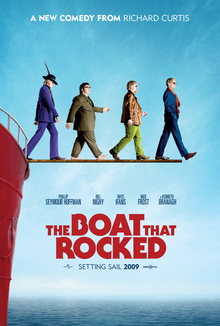
Pirate Radio
In 1966, various pirate radio stations broadcast to the United Kingdom from ships in international waters, specialising in rock and pop music not played on BBC Radio. Seventeen-year-old Carl, recently expelled from school, is sent to stay with his godfather Quentin, who runs the station Radio Rock anchored in the North Sea. The eclectic crew of disc jockeys and staffers, led by brash American DJ "The Count" and DJ "Doctor Dave". In London, government minister Sir Alistair Dormandy resolves to shut down pirate radio stations for their commercialism and immorality, instructing his subordinate Twatt to pursue legal stratagems to accomplish this. They attempt to cut off the pirates' revenue by prohibiting British businesses from advertising on unlicensed stations. Quentin counters by bringing massively popular DJ Gavin Kavanagh out of retirement on Radio Rock, enticing advertisers to pay their bills from abroad. Gavin's popularity creates a rivalry with The Count. Carl becomes smitten with Quentin's niece Marianne, but is heartbroken when she is seduced by Doctor Dave, while DJ "Simple" Simon Swafford marries glamorous fan Elenore in an onboard ceremony, but learns that she only married him to be near Gavin. The Count challenges Gavin to a game of chicken in defence of Simon's honour: The stubborn rivals climb the ship's radio mast to a dangerous height, but reconcile after they are both injured jumping into the ocean. Shortly after, Carl's mother Charlotte visits for Christmas, and denies that Quentin is his father. Carl gives her a cryptic message from reclusive late-night DJ "Smooth" Bob Silver, unexpectedly revealing that Bob is his father. Marianne arrives to apologise to Carl for sleeping with Dave, and she and Carl have sex. The following morning, the DJs announce news of the coupling to cheering fans across Britain. Meanwhile, Dormandy's vendetta against pirate radio advances when Twatt finds news of a fishing boat whose distress call was blocked by Radio Rock's powerful signal. Twatt proposes the creation of the Marine, &c., Broadcasting (Offences) Act 1967, making pirate radio stations illegal on the grounds that they endanger communication with other vessels. Despite heavy public support for the pirate stations, the act passes unanimously through Parliament and takes effect at midnight on 1 January 1967. The Radio Rock crew defy the law and continue broadcasting, firing up the ship's engine to evade arrest. The aging vessel's engine explodes, and the ship sinks. The DJs broadcast their position in hope of aid, and Twatt appeals to Dormandy to send rescue boats, but Dormandy refuses. Carl saves the oblivious Bob from his cabin while The Count vows to broadcast as long as possible. With the lifeboats inoperable, the crew gather on the prow as the ship goes down. They are rescued by dozens of fans in a fleet of small boats, with Carl being saved by Marianne. The Radio Rock ship disappears beneath the sea, with the Count emerging at the last moment.

The Best of Enemies
In 1971 in Durham, North Carolina, Ann Atwater tries to get better housing conditions for poor black people, and is ignored by the all-white judge panel. Ann's daughter's school catches on fire, causing local Ku Klux Klan president C. P. Ellis to fear that the black children will come to the white schools. Bill Riddick sets up a meeting with them both, to arrange charrettes to discuss segregation and other issues. Both refuse at first as they hate each other, but are convinced. C.P. proudly refuses to sit with Bill and Ann, since they are black and he is white. They agree to pick some people randomly from the group to vote on the issues at the end of the meeting sessions. C.P tries to talk to these selected to vote, but is rebuffed. A black reverend asks Bill if he can play gospel music at the end of each session. C.P. refuses, saying that if the Black people want to sing gospel music at the charrette, he should be allowed to put out his KKK items on display. Ann refuses, but Bill agrees. At one meeting, a group of black teenagers tries to destroy the KKK items, but Ann stops them and tells them to instead understand what the KKK is. C.P. observes. Bill insists Black and White people in their group sit next to each other in the cafeteria as they eat. He makes C.P and Ann sit together alone. They eat in tense silence, then she asks him if he has a boy in Murdock. C.P. refuses to talk about his son. Murdock is a facility for disabled boys, and his son has Down syndrome. C.P. rushes to Murdock, as his son Larry has been put in the same room with another boy who is screaming, upsetting Larry. C.P. demands that his son be placed in a room of his own, but the nurses say he can't afford it. Ann visits Larry and convinces Bernadette, who works there, to put him in his own room. Bill takes Ann, C.P., and the rest of their group to visit the black school that was burned. C.P. is shocked by the damage. Ann's daughter says hi to Ann, but gives C.P the evil eye when she realises who he is. C.P.'s wife Mary, overjoyed with Ann's help, goes to thank her. Ann is told that C.P. has always been racist. Mary later calls C.P out when he tells her about his encounter with Ann's daughter, asking him what he expected. The encounter and Mary's words leave C.P shaken and start to question his beliefs. The night before the final vote, C.P.'s KKK troublemaking friends threaten the selected voters to vote for segregation. When C.P. finds out, he is dismayed. Especially since one of the targets is a Vietnam vet who C.P had talked to earlier and learned that the man's manager, a black man, is also a vet and had saved his life on several occasions. When Ann hears about it, she screams at C.P., calling him a coward. During the voting, all the issues pass, coming down to the final issue of desegregation. The voters give their vote one by one. Ann votes for it, and C.P. surprises everyone by doing the same, realizing the KKK is hateful. He also makes a speech and rips up his KKK membership card, to the fury of his watching KKK friends. They threaten him and try to set fire to his gas station but C.P. douses it. The white community shuns and boycotts his station. Ann and Bill bring in the black community to buy from him instead. The real life Ann and C.P. went around to different cities together, to talk about their experiences. They remained friends to the end of C.P.'s life, with Ann giving the eulogy at his funeral.

Toni Erdmann
Winfried Conradi is a divorced music teacher from Aachen with a passion for bizarre pranks involving several fake personas. Following the death of his beloved dog, he decides to reconnect with his daughter, Ines, who is pursuing a career in business consulting. Ines is working in Bucharest, Romania, on an outsourcing project in the oil industry. Consumed by her work, she seems to have little time for her family. Winfried spontaneously travels to Bucharest and waits for Ines in the lobby of an office complex. After several hours, she finally appears, accompanied by several of her client's board members and on the way to a meeting. Winfried puts on sunglasses and fake teeth as a playful disguise, and approaches the group from the side while hiding behind a newspaper. Ines ignores him, but meets with him briefly after work and invites him to a business reception at the US Embassy. In the evening, Winfried and Ines attend the reception, where they meet Henneberg, a German oil company CEO with whom Ines wishes to secure a consulting contract. Ines tries to gain Henneberg's attention, but Henneberg seems more interested in her father. Winfried tells Henneberg that he has hired a replacement daughter because Ines is always busy. To Ines's surprise, Henneberg invites Winfried and Ines for drinks, along with his entourage. At the bar, Henneberg once again brushes Ines aside and makes fun of Winfried. After several days, Ines and Winfried are struggling to get along. Stressed out from work, Ines oversleeps, missing a planned rendezvous with clients, and blames her father for not waking her up. Feeling alienated and unwanted, he leaves in a taxi for the airport. Ines continues with her work as normal, and several days later arranges to meet two female friends at a bar. While Ines and her friends are chatting, a man approaches and introduces himself as "Toni Erdmann". The man is clearly Winfried in a wig and false teeth, but Ines does not let on. Her two friends politely engage "Erdmann" in conversation; he explains that he is a "life coach" and consultant visiting Bucharest to attend the funeral of his friend's turtle. Ines is increasingly frustrated and unfulfilled in her work and personal life, but continues to encounter "Erdmann" sporadically at parties or outside her office. At first Ines is angry with her father, and accuses him of trying to "ruin" her, but as time goes on she comes to see the value of her father's interventions in her life, and plays along with the ruse. "Erdmann" accompanies her on a night out with her work friends, and eventually even accompanies her to a business meeting. In turn, "Erdmann" takes Ines to a Romanian family's Easter party, where he forces her into a reluctant performance of Whitney Houston 's " Greatest Love of All ". After singing, Ines promptly rushes off. Back at her flat, Ines is preparing to host a business team-building brunch to celebrate her birthday. She struggles to zip up her tight dress, realizes her shoes don't match, and attempts to change clothes. The doorbell rings. Instead of redressing, or changing her outfit, she opens the door wearing only her underpants. The first guest is her friend Steph, who offers to help her get dressed. Ines refuses, and when the next guest arrives she spontaneously removes her underpants and answers the door naked, telling her guests that her birthday brunch is a "naked party". Each of them reacts differently, with some leaving in disgust while others self-consciously strip. As the party becomes increasingly awkward, Winfried arrives dressed in a full-body Bulgarian kukeri costume. The costume first scares, then amuses, the partygoers, and Winfried soon leaves. Ines follows him. Outside in a public park, they hug, Winfried still in costume. She leaves the park. Winfried lies down on the grass, exhausted, and then seeks help from a hotel desk to remove the costume's head. Months later, Ines returns to Germany for her grandmother's funeral. She has quit her job in Bucharest and will shortly begin a new one in Singapore. While talking with Winfried in the garden, Ines grabs the fake teeth from his shirt pocket and puts them on. Winfried says he wants to take a photo and goes to get his camera, leaving Ines alone in the garden.

Okja
In 2007, " environmentalist " Lucy Mirando becomes CEO of the Mirando Corporation, succeeding her twin sister Nancy. Announcing they have been breeding a special kind of "super pig", 26 specimens are sent to farmers around the world. In about 10 years from now, one will be crowned the winner as the best super pig. In 2017, a teenage girl named Mija lives in the South Korean mountains with her grandfather and their super pig Okja. Mija and Okja have a very close relationship as they spend much of their time together. At one point, Okja saves Mija from falling off a cliff. They are visited by Mirando spokesperson and zoologist Dr. Johnny Wilcox, who declares Okja the best super pig, and announces that they will take her to New York City. Her grandfather gives Mija a solid gold pig figurine, explaining he saved up to replace Okja when she was taken away. Devastated, Mija goes to Seoul to find Okja, where she sees her being loaded onto a truck. Mija chases down the truck, but it is intercepted by the Animal Liberation Front. In the resulting chaos, Mija and Okja run away and are eventually saved by the ALF led by Jay. The truck driver Kim Woo-shik resigns from his job. Jay asks another ALF member K to translate and tell Mija that they plan to put a recording device in Okja's ear and let her be recaptured by the Mirando Corporation to document how they mistreat animals. Mija asks them to return her to the mountains, but K purposely mistranslates and tells them Mija agrees. They leave and Okja is recaptured. To minimize PR damage to the company, Lucy pays for Mija to come to New York to stage a heart-warming reunion with her pig. Okja is taken to a laboratory where she is forcibly bred with another super pig and flesh is taken from her for a taste test. After the ALF sees the footage, K reveals that he lied to the rest of the group about Mija's support of the plan. Jay beats up K and expels him from the ALF while promising to return his equipment when they are done with it. In New York, Mija has to comply with the Mirando Corp. Jay slips into her room and tells her they plan to rescue Okja while on stage. During the Mirando parade, a battered and temporarily blinded Okja attacks Mija. Jay tries to hurt Okja to protect the girl, but Mija doesn't let him and calms Okja down. The ALF shows Okja's mistreatment to the public, who quickly turn against Mirando. Lucy surrenders Mirando back to Nancy who contacts the private security firm Black Chalk to take out the ALF members. Okja is recaptured and the ALF members are arrested except for Mija and Jay who are rescued by a remorseful K. Nancy starts full production at the slaughterhouse. K, Mija, and Jay travel to a processing plant in search of Okja and find her being forced up a ramp into a slaughterhouse. On the verge of being slaughtered, Mija shows a Mirando employee a photo of herself with baby Okja, prompting him to stop. Nancy arrives and Mija offers the gold pig in exchange for Okja's life. Although initially reluctant, Nancy agrees as she deemed it a good business deal, having Jay and K arrested by Black Chalk. As Mija and Okja are escorted away, a pair of super pigs push their newborn through the electric fence to Okja to hide and rescue from the farm. Back in the countryside, Mija resumes her life with her grandfather, Okja, and the new piglet. She then joins her grandfather for dinner as Okja looks on. In a post-credits scene, Jay is released from prison, boarding a bus with K and the other released members of the ALF. With their newest member Kim Woo-shik, who was revealed to have started mirandoisfucked.com, they plan to disrupt a major Mirando shareholders meeting as more new recruits are revealed.

Dasavatharam
A prologue, set in the 12th century, where Rangarajan Nambi, a devout Vaishnavite, resists King Kulothunga II's efforts to desecrate a Vishnu idol. Nambi is executed by drowning, along with the idol, setting a thematic backdrop for the story. In 2004, Govindarajan Ramaswamy, an Indian scientist in the U.S., is working on a bio-weapon—a synthetic virus. When a lab monkey dies after ingesting the virus, Govind realizes the threat it poses. After discovering that his superior, Dr. Sethu, plans to sell the virus to terrorists, Govind flees with the vial. During a scuffle, the vial is mistakenly shipped to India. Christian Fletcher, a mercenary ex- CIA agent hired to retrieve the vial, kills several people in pursuit, including Govind's friend Suresh and his wife Yuka. Govind follows the package to Chidambaram, where it ends up with an elderly woman, Krishnaveni, who unknowingly hides it inside a Vishnu idol. Govind's attempts to retrieve it are complicated by Fletcher's pursuit, the local police, and Krishnaveni's devout granddaughter, Andal, who believes he is trying to steal the idol. Multiple subplots unfold: Fletcher's translator-wife and partner-in-crime, Jasmine, is killed during a skirmish involving a rogue elephant; Yukha's brother Shingen, a Japanese martial artist arrives to avenge Yuka's death; and Telugu police officer Balram Naidu investigates Govind's activities. Along the way, Govind and Andal encounter various characters, including social activist Vincent Poovaraghan and a Muslim family headed by the towering Khalifulla. The vial is accidentally switched with a medicine cooler belonging to singer Avatar Singh, who is being treated for throat cancer. Eventually, Fletcher takes hostages, demanding the virus in exchange. After a series of chases and confrontations—including one at Avatar's concert—the vial ends up back in the idol. Govind attempts to neutralize the virus by immersing it in the ocean after finding out that sodium chloride weakens it. A fight breaks out at a construction site between Govind and Fletcher, with Shingen intervening. Fletcher swallows the virus but dies as a massive tsunami hits the coast. The natural disaster wipes out the threat, killing Fletcher and causing widespread destruction. Govind, Andal, and others survive. Andal believes the tsunami was divine intervention, but Govind maintains a rationalist view, questioning the morality of such devastation as a means of salvation. They then profess their love for each other. Govind is honored for his efforts with an event, attended by world leaders, and a final glimpse of Nambi's idolized remains washed ashore.
Window to Paris
In 1992 Russia, music teacher Nikolay Chizhov moves into a communal apartment in St. Petersburg, where he discovers a mysteriously boarded-up window in his new room. During a housewarming party, he and his guests drunkenly descend from this window, believing it leads to the streets of St. Petersburg. Instead, they stumble upon a bar in Paris. The next day, Chizhov learns from a returning elderly resident that the window periodically opens to Paris for a few weeks every few decades. Realizing the limited time to access Paris, Chizhov's neighbor, Gorokhov, and his family begin cross-border ventures through the window, from selling souvenirs to transporting a Citroën 2CV into Russia. Alongside the whimsical exploits, Chizhov faces challenges in his career and personal life. After protesting the dismissal of music education at his school, he is fired, prompting a student strike in his support. He tries to find work in Paris, only to turn down an unusual gig at a nudist club. A romance develops between Chizhov and Parisian Nicole, whose apartment connects to the same rooftop as the magical window. When Gorokhov lures Nicole into Russia, she becomes lost and overwhelmed by the harsh realities of 1990s Russia before Chizhov ultimately helps her return to Paris. Later, fulfilling a promise to his students, Chizhov uses the window to show them Paris, but they miss the window's closing, forcing them to attempt a daring return to Russia by hijacking a plane. Months later, Chizhov and Gorokhov spot the old resident's cat emerging from a crack in the wall, sparking their hopes of reopening the path to Paris.

The Disaster Artist
In San Francisco in 1998, 19-year-old Greg Sestero befriends Tommy Wiseau in Jean Shelton 's acting class after Tommy gives a bizarre interpretation of a scene from A Streetcar Named Desire. Greg is impressed by Tommy's fearlessness, though Tommy also exhibits unusual habits and mannerisms; for instance, he can afford apartments in both San Francisco and Los Angeles, but refuses to discuss his personal life or the source of his wealth, and insists that he is from New Orleans despite his pronounced European accent. At Tommy's suggestion, the two move to Los Angeles to pursue acting careers. Greg signs with talent agent Iris Burton, regularly attends auditions, and starts dating a girl named Amber. Meanwhile, Tommy is constantly rejected by agencies, acting teachers, casting directors, and producers, and believes Amber is sabotaging his and Greg's friendship. As Greg's auditions begin to dry up, Tommy decides to make a film for them to star in. He writes the screenplay for The Room, a melodrama about a love triangle between banker Johnny (played by Tommy), his fiancée Lisa, and his best friend Mark (played by Greg, who is also given a line producer credit). Tommy insists on buying, rather than renting, all of the production equipment they need, and decides to shoot the film on 35 mm film and HD Digital simultaneously, another costly and unnecessary measure. Tommy hires Raphael Smadja as the cinematographer and Sandy Schklair as the director and script supervisor, and casts actress Juliette Danielle as Lisa. While production starts smoothly, Tommy's controlling behavior and lack of experience soon begin to cause problems. He forgets his lines, arrives late, and refuses to supply his crew with basic needs like drinking water and air conditioning, even when one of the actors suffers a heatstroke on set. The cast and crew are baffled by the film's nonsensical plot and Tommy's inexplicable directorial and acting choices. Tensions mount between the crew and Tommy when he refuses to film on a closed set and insults Juliette during a sex scene, during which he almost gets into a fight with Smadja. Tommy then angrily reveals that he has been watching the behind-the-scenes footage of the production and thus knows what the cast and crew have been saying about him behind his back, and that he has spent $5 million on the production, though he does not disclose where these funds came from. While The Room is still filming, Greg and Amber run into Bryan Cranston at a café. Cranston reveals that he is directing an upcoming episode of Malcolm in the Middle, the TV show he is on, and invites Greg to play a lumberjack character, noting his lumberjack-like facial hair. Greg begs Tommy to delay shooting of an upcoming scene in The Room where Mark shaves his beard (for no apparent purpose), but Tommy refuses. Greg begrudgingly finishes the film, relinquishing his opportunity to be on the show. On the last day of shooting, which is on location back in San Francisco, Greg lashes out at Tommy for his selfishness throughout their friendship and demands that Tommy finally reveal his age, birthplace, and source of income. Tommy refuses and Greg storms off, while a disheartened Tommy declares that filming is wrapped. By June 2003, Greg has broken up with Amber and started working in theater, and Tommy has finished work on The Room, which he invites Greg to the premiere of. Greg reluctantly agrees; the entire cast and crew also attend. As the film plays on the screen, the capacity audience at first reacts with bemused silence, then increasingly with laughter at Tommy's poor performance, script, and filmmaking techniques. A humiliated Tommy storms out of the theater, but Greg follows him and asserts that the audience's enthusiastic response is something to be proud of, reconciling their friendship. With renewed optimism, Tommy takes the stage as the film ends and expresses his appreciation of the warm reception for his "comedic" film. He invites Greg to join him, and the pair receive a standing ovation. In a post-credits scene, a man named Henry approaches Tommy at a party and invites him to hang out. Tommy declines, but recognizes Henry's familiar "New Orleans" accent.