Genre: Drama (Page 26)
Browse 989 movies in the Drama genre.
All Genres
Zhurnalist
The film consists of two parts. In the first part entitled "Encounters" a successful journalist from Moscow Yuri Aliabiev (Y.Vasiliev) travels to a small city in the Urals because a certain Anikina, woman living in the city, writes complaints about local authorities accusing them of dissipation and bribe-taking. Arriving in the city Aliabiev meets Shura Okaemova, a nice-looking girl who works at a local plant. Attracted by Shura's intelligence and beauty Aliabiev attempts to seduce her but Shura rejects his attempts. Aliabiev leaves for Moscow and then on a business trip for Paris. The second part ("Garden and Spring") tells about Aliabiev's life in Paris where he meets Annie Girardot, attends the rehearsal of Mireille Mathieu and conducts extensive discussions with his new friend, an American journalist, trying to persuade him in the advantages of Soviet way of life. Returning from Paris to Moscow Aliabiev travels to the city in the Urals again. He failed to forget Shura and wants to resume their relationship. On arriving to the city he finds out that Anikina wrote letters to local authorities accusing Shura of a liaison with him. The Komsomol meeting decided to move Shura from her house to a hostel. Aliabiev finds Sura to tell her about his love and they decide to marry.

No Other Choice
Man-su, an award-winning veteran employee at a papermaking company, lives happily in his beloved childhood home with his wife Mi-ri and their children: Si-one, Mi-ri's teenage son from a previous marriage, and Ri-one, an autistic cello prodigy. The company is bought out and a devastated Man-su is laid off after defending his fellow workers, but assures his family he will resume papermaking within three months. Thirteen months later, Man-su has been unable to find another job in the papermaking industry. His family is forced to minimize their spending, including rehoming their two dogs with Mi-ri's parents, upsetting Ri-one, whose cello teacher recommends her for expensive advanced classes. The family considers selling their home to the parents of Si-one's friend Dong-ho, and Mi-ri takes a part-time job as a dental assistant to suave dentist Jin-ho, while Man-su endures a toothache he cannot afford to treat. Man-su attempts to join the successful Moon Paper company, but is humiliated by manager Seon-chul. Wanting his job, Man-su nearly kills Seon-chul with a potted plant, but realises this will not matter unless he is the best candidate to replace him. Instead, Man-su uses a fake job advertisement to identify his chief competitors: Beom-mo and Si-jo. Retrieving his father's Vietnam War gun, he prepares to kill Seon-chul, Beom-mo, and Si-jo to eliminate his competition. Spying on Beom-mo, an unemployed drunkard, Man-su is bitten by a snake and treated by Beom-mo's dissatisfied wife, A-ra, and is later unable to stop Beom-mo from discovering A-ra's infidelity. A-ra finds Man-su confronting Beom-mo at gunpoint, leading to a struggle for the gun, but A-ra shoots Beom-mo dead and Man-su escapes. He arrives late to a costumed party, where Mi-ri dances with Jin-ho instead. A-ra and her lover bury Beom-mo, but Man-su recovers the gun. Man-su and Mi-ri accuse each other of infidelity, and she reminds him that he was a violent drunk when Si-one was very young, but they reconcile. At the shoe store where Si-jo works, Man-su recognises him as a kindred devoted father, but tricks him into staying late and feigns car trouble; when Si-jo stops to help, Man-su reluctantly shoots him and drives away with his corpse. Si-one and Dong-ho are arrested for stealing iPhones from Dong-ho's father's store, but Man-su and Mi-ri blackmail Dong-ho's father, who used the store for his own infidelity, into having Dong-ho take the blame. Detectives question Man-su about Beom-mo and Si-jo's disappearances, having linked them as unemployed paper men. Smoking on the roof, Si-one witnesses Man-su in his greenhouse trying to dismember Si-jo's corpse with a chainsaw. Unable to do so, Man-su buries the body in his garden, alongside Si-one's stolen iPhones, and plants an apple tree. Plying Seon-chul with alcohol at his remote cabin, Man-su breaks his sobriety and drunkenly extracts his own tooth. Haunted by nightmares about his father and the chainsaw, Si-one informs his mother, who digs up the tree and calls Man-su. Determined to protect his family, Man-su suffocates Seon-chul with meat and stages his death to appear as if he choked on his own vomit. Mi-ri tells Si-one that Man-su dismembered and buried a pig to nourish the apple tree, and she and Man-su come to a tense understanding. Moon Paper hires Man-su to replace Seon-chul, allowing the family to keep their home and reunite with their dogs. Ri-one's antisocial behavior improves, and Mi-ri realises her unusual drawings are actually musical compositions. The detectives reveal that A-ra has implicated Beom-mo as a gun-owner, and conclude that he murdered Si-jo and went on the run, lifting suspicion off Man-su. At his new job, Man-su celebrates alone in a modern paper mill run by machines instead of workers.

Lolita
Humbert Humbert, a middle-aged European professor of French literature, arrives in Ramsdale, New Hampshire, searching for summer accommodation before his professorship begins at Beardsley College, Ohio. Charlotte Haze, a sexually frustrated widow, offers him a room to rent at her house. Initially uninterested, Humbert changes his mind when he sees Charlotte's young daughter Dolores, nicknamed "Lolita", and is immediately smitten with her. Wanting Humbert's time for herself, Charlotte sends Dolores to an all-girl summer camp. After the Hazes depart for camp, the maid gives Humbert a love confession letter from Charlotte demanding that he vacate immediately, unless he reciprocates and marries her. Despite laughing while reading the letter, Humbert stays and marries Charlotte. In Lolita's absence, Humbert becomes withdrawn, and Charlotte grows unfulfilled and upset. She discovers Humbert's diary detailing his passion for Dolores and his contempt for Charlotte. Distraught, she runs outside, is hit by a car and dies. Humbert is visited by Charlotte's friends, who mistake his apathy with suicidal ideation and reveal that she had little time left anyway, since nephritis affected her single kidney. Humbert picks up Dolores from camp, telling her that Charlotte is sick in a hospital. They stay overnight in a hotel hosting police convention attendees, and attract the attention of another guest. While Dolores sleeps upstairs, this stranger insinuates himself upon Humbert, presenting himself as a policeman and cryptically steering the conversation to Humbert and Dolores. The next morning, Dolores suggests to Humbert that they play a "game" she learned at camp, and it is implied that they have sex. Humbert later confesses to Dolores that her mother is dead. Grief-stricken, she stays with Humbert. The two commence a trip cross country, acting publicly as father and daughter. In the fall, Humbert initiates his position at Beardsley College and enrolls Dolores in high school there. A jealous Humbert worries about her involvement with male classmates and the lead she has been offered in the school play, and people grow curious about his protectiveness. One night, he returns home to find a stranger in his darkened living room. Claiming to be Dr. Zempf, the psychologist from Dolores's school, he inquires about her knowledge of " the facts of life " and coerces Humbert into allowing her to participate in the school play. During a performance of the play, Humbert learns that Dolores has been lying about spending Saturday afternoons at piano practice. They have an argument and Humbert decides to take Dolores on the road again. Dolores objects at first, but seemingly changes her mind after making a surreptitious phone call. Once on the road, Humbert realizes that they are being followed by a car. Dolores falls ill and he takes her to the hospital. One night, a mysterious call to his motel room prompts Humbert to visit the hospital in order to discharge Dolores, but he is told that she already left with a man claiming to be her uncle. Humbert is devastated. Three years later, he receives a letter from Dolores, now pregnant, married to an unemployed and half-deaf mechanic, and in need of money. Humbert visits her and asks who had kidnapped her from the hospital. She says that it was Clare Quilty, a famous playwright and the intrusive stranger who kept crossing their path all along, disguising himself as a policeman and later Dr. Zempf. Dolores was infatuated with Quilty ever since his fling with Charlotte years ago, and carried on an affair with him at Beardsley. She left the hospital with him when he promised her a Hollywood contract. Instead, he secluded her in a dude ranch near Santa Fe and demanded that she join his depraved lifestyle and act in his child pornography, which she refused. Humbert begs Dolores to leave with him. She refuses, on account of her new predicament, but apologizes for cheating. Humbert gives Dolores $13,000, her money from the sale of Charlotte's house. He then leaves to confront Quilty in his mansion at gunpoint. A drunk Quilty tries to dodge the situation with bizarre offers (including an invitation to attend executions), but is shot dead by Humbert. A postscript reveals that Humbert later died of coronary thrombosis awaiting trial for Quilty's murder.

The Counterfeiters
The film begins shortly after the end of the Second World War, with a man arriving in Monte Carlo. After checking into an expensive hotel and paying with cash, he takes in the high life of Monte Carlo, successfully gambling in a casino and attracting the attention of a beautiful French woman. Later, she discovers tattooed numerals on his arm, revealing him as a survivor of the Nazi concentration camps. The film then flashes back to Berlin in 1936, where the man, Salomon Sorowitsch, is revealed as a successful forger of currency and passports. Caught by the police, he is imprisoned, first in a labour camp, then in Mauthausen concentration camp near Linz. In an effort to secure himself protection and meagre comforts at the camp, he turns his forging skills to portraiture, attracting the attention of the guards, who commission him to paint them and their families in exchange for extra food rations. Sorowitsch's talents bring him wider attention, and he is transferred out of the concentration camp. Brought in front of the police officer who arrested him in Berlin, he finds himself put together with other prisoners with artistic or printing talents and begins working in a special section of the Sachsenhausen concentration camp devoted to forgery. The counterfeiters are kept in relatively humane conditions, with comfortable bunks, a washroom and adequate food, although their guards continue to subject them to brutality and insults. His fellow prisoners have a range of backgrounds from Jewish bank managers to political agitators, and while some are content to work for the Nazis to avoid the extermination camps, others see their efforts as supporting the German war effort. At first, self-preservation appears to guide Sorowitsch, but his motives for forging for the Nazis are complicated by his growing concern for his fellow prisoners, his awareness of their role in the wider war against the Nazis, and his professional pride in counterfeiting the US dollar, a currency he was previously unable to forge. Sorowitsch juggles the Nazi demands for progress, his co-counterfeiters' determination to sabotage the operation, and his loyalties to his fellow prisoners. The prisoners successfully counterfeit the British pound but intentionally delay the forgery of the US dollar. Gradually, the inmates discern slivers of evidence that the war has turned decidedly against the Nazis. One day the camp guards suddenly announce that the printing machines are to be dismantled and shipped away, which leads the counterfeiters to fear that they will finally be killed. Before anything happens to them, the German guards flee the camp in advance of the Red Army. Starving prisoners from other parts of the camp, armed with confiscated weapons, take over and break into the compound where the counterfeiters had been held in relative luxury. Until the insurrectionists see the well-fed printers' prison tattoos, they believe them to be SS officers and threaten to shoot them. The counterfeiters then must account for their forging actions to the half-dead prisoners. The film then returns to post-war Monte Carlo, where Sorowitsch, apparently disgusted by the life he is now leading on the currency that he forged for the Nazis, intentionally gambles it all away. Sitting alone afterward on the beach, he is joined by the French woman, concerned after his seemingly disastrous losses at the table. Dancing slowly together on the beach, she continues to remark on all the money he has lost, to which he replies, laughing, "We can always make more".


My Winnipeg
Although ostensibly a documentary, My Winnipeg contains a series of fictional episodes and an overall story trajectory concerning the author-narrator-character "Guy Maddin" and his desire to produce the film as a way to finally leave/escape the city of Winnipeg. "Guy Maddin" is played by Darcy Fehr but voiced by Maddin himself (in narration): Fehr appears groggily trying to rouse himself from sleep aboard a jostling train as Maddin wonders aloud "What if?" What if he were able to actually rouse from the sleepy life he lives in Winnipeg and escape? Maddin decides that the only possible escape would be to "film my way out", thus motivating the creation of the "docu-fantasia" already underway. Maddin then describes Winnipeg in general terms, introducing it to the viewer, noting primarily its location at the junction of the Red and Assiniboine rivers, a place known as " the Forks ". Maddin equates this Y-like junction to a woman's groin and associates it with his mother. Maddin also notes the apocryphal aboriginal myth of a secret "Forks beneath the Forks", an underground river system below the aboveground river system –the superimposition of these two sets of rivers has imbued the site and Winnipeg itself with magical/magnetic/sexual energy. Maddin also notes that Winnipeg is the geographical centre of North America, and thus these secret rivers are "the Heart of the Heart" of the continent and of Canada. Maddin regales the viewer with one of the film's many suspect historical "facts" about Winnipeg: "the Canadian Pacific Railway used to sponsor an annual treasure hunt required our citizens to wander our city in a day-long combing of the streets and neighbourhoods. First prize was a one-way ticket on the next train out of town." No winners in a hundred years could bring themselves to leave the city after coming to know the city so closely over the course of the treasure hunt. Maddin then posits an alternative explanation for Winnipeggers never leaving Winnipeg: sleepiness. He notes that Winnipeg is the sleepwalking capital of the world, with ten times the normal rate of sleepwalking, and that everyone in Winnipeg carries around the keys to their former homes in case they return while asleep. Winnipeg by-laws require that sleepwalkers be allowed to sleep in their old homes by the new tenants. Maddin rents his own childhood home at 800 Ellice Avenue for a month, hiring actors to play his family (including Ann Savage as his mother) in order to recreate scenes from his childhood memories, excluding his father and himself. The "family" gathers to watch the television show LedgeMan, a fictional drama in which "the same oversensitive man takes something said the wrong way, climbs out on a window ledge, and threatens to jump." His mother, in the next window, convinces him to live. Maddin's mother is noted as the star of the show. The film recounts the conditions of the 1919 Winnipeg General Strike, a real-world event with international significance, before returning to the family re-enactments, including Mother's suspicion of Janet Maddin, who hit a deer on the highway but is accused of covering up a sexual encounter. Maddin announces that this, like "everything that happens in is a euphemism." The film then recounts the city's history of Spiritualism, including a visit by Sir Arthur Conan Doyle in 1923. The film next examines Winnipeg architectural landmarks, including the Eaton's building and the Winnipeg Arena, both of which are demolished (while the arena is being destroyed, Maddin becomes the last person to urinate in its washroom). Maddin imagines the arena's salvation by the "Black Tuesdays", a fictional team of hockey heroes "in their 70s, 80s, 90s and beyond", then re-enacts a family scene where Mother is harassed to cook a meal. The film recounts a racetrack fire that drove horses to perish in the Red River – the horse heads reappear, ghostly, each winter, frozen in the ice. Further Winnipeg landmarks, including the Golden Boy statue atop the provincial legislative building, the Paddle Wheel restaurant, the Hudson's Bay department store, and the Manitoba Sports Hall of Fame, make appearances in distorted versions of themselves, as does the Sherbrook Pool. The film then recalls If Day (an actual historical event when a faked Nazi invasion of the city was mounted during World War II to promote the sale of war bonds), and a buffalo stampede set off by the mating of two gay bison. Time is now running out for Guy Maddin, who fears he will never leave Winnipeg, since the family re-enactments have failed to free him fully. To accomplish this feat of leaving, Maddin imagines a pinup girl for the 1919 strike's newsletter The Citizen: dreaming up this "Citizen Girl" allows Maddin to leave Winnipeg, guilt-free. The final family re-enactment then involves Maddin's brother Cameron, who in real life committed suicide, rationalizing this death calmly in a discussion with Maddin's "Mother".

Balloon
The film is set in Pößneck, Thuringia, in the summer of 1979. The Strelzyk and Wetzel families develop a daring plan to flee the GDR to West Germany in a self-made hot air balloon. About to attempt an escape in perfect wind conditions, Günter Wetzel decides it is too dangerous. He thinks the balloon is too small for eight people, and his wife Petra is afraid for their two young children. Therefore, they stop trying to escape for a short time. Doris and Peter Strelzyk now want to dare to escape alone with their two sons. Their teenage son Frank has fallen in love with Klara Baumann, the daughter of his neighbour Erik, who works for the Stasi, and writes her a farewell letter. The same night, the Strelzyk family packs the balloon and other accessories in their trailer, drives into the forest, and takes off. Hidden in the clouds, they cannot be seen by the border guards. However, the balloon goes down with Doris, Peter, and their two sons Frank and Andreas (called "Fitscher") in the gondola shortly before the border because the pipes from the gas bottles to the burner freeze up and become clogged. None of the four are injured, they get back to their car and destroy all evidence. Frank just manages to retrieve the letter to Klara. The Stasi finds the abandoned balloon and discovers the attempted escape, and under the direction of Lieutenant Colonel Seidel, begins a large investigation. He interrogates the border guards who were on duty at the time of the attempt to escape and accuses them of not taking their task seriously enough. The investigators narrow down the radius in which the balloon must have started, and thus also the circle of suspects. For the next few weeks, both families live in constant fear that the Stasi might link them to the attempted escape. Doris in particular is worried because she lost her medication in the forest, which gave the Stasi important information in the form of personalised pills. Peter wants to try again. Before that, however, they travel to East Berlin, where they hope to be able to get out of the country with the help of the East Berlin US Embassy, but this attempt fails. Peter can convince Günter to make another balloon attempt to escape. Since they must be careful in obtaining the materials to avoid raising suspicion, the family members only buy small quantities of suitable fabric in different cities. Günter sits at the sewing machine every night to join the pieces of fabric. Meanwhile, Seidel is fast putting together all the clues tying the family to the escape. He must prevent the GDR from being embarrassed by a successful escape attempt at all costs. Just as Doris feared, the investigators trace their medication back to the local pharmacy, where all recipients of the tablets are now being identified and checked. The Stasi published photos in the press of objects that the Strelzyks had to leave behind at the landing site of their first attempt. Günter has to move the sewing work to the Strelzyks' cellar because his neighbours have become aware of the constant running noise of the sewing machine. When Frank realises that Klara's father Erik has to go to the pharmacy because someone is wanted and that the wind is blowing to the south, the prerequisite for their escape, they want to make the second attempt that same night. When the Stasi employees work out their identities and break into their houses, the families are already on their way to the starting point. The start is not as perfect this time as on their first attempt and when the gas runs out they have to land in a forest after half an hour's flight. At first, it is not clear whether they have successfully crossed the border. Peter and Günter then explore the area and meet a police patrol car. When the police tell them that they are in Upper Franconia, the families react joyfully. Lieutenant Colonel Seidel and his superior must explain themselves to Stasi chief Erich Mielke, and Erik Baumann is interrogated by the Stasi. Ten years later, Doris and Peter Strelzyk watch Hans-Dietrich Genscher 's announcement from the Prague embassy on television that the GDR citizens gathered there are allowed to leave.

Source Code
U.S. Army pilot Captain Colter Stevens wakes up on a Metra commuter train going into Chicago. He is disoriented, as his last memory was of flying a mission in Afghanistan. However, to the world around him – including his friend Christina Warren and his reflection in the train's windows and mirrors – he appears to be a different man: a school teacher named Sean Fentress. As he expresses his confusion to Christina, the train explodes while passing another train, killing everyone aboard. Stevens abruptly awakens in a dimly lit cockpit. Communicating through a video screen, Air Force Captain Colleen Goodwin verifies Stevens' identity and tells him of his mission to find the train bomber before sending him back to the moment he awoke on the train. Believing he is being tested in a simulation, Stevens finds the bomb in a vent inside the lavatory but is unable to identify the bomber. Still thinking he is in a simulation, Stevens leaves the bomb and goes back down to the main cabin before the train explodes again. Stevens again reawakens in his capsule and after demanding to be briefed, learns that the train explosion actually happened and that it was merely the first attack of a suspected series. He is sent back yet again, eight minutes before the explosion, to identify the bomber. This time, he disembarks from the train (with Christina) to follow a suspect. This turns out to be a dead end, the train still explodes in the distance, and Stevens is killed by a passing train after falling onto the tracks while interrogating the suspect. The capsule power supply malfunctions as Stevens reawakens. He claims to have saved Christina, but Dr. Rutledge, head of the project, tells him that she was saved only inside the "Source Code". Rutledge explains that the Source Code is an experimental machine that reconstructs the past using the dead passengers' residual collective memories of eight minutes before their deaths. Therefore, the only thing that matters is finding the bomber to prevent the upcoming second attack in Chicago. On the next run, Stevens learns that he was reported as killed in action two months earlier. He confronts Goodwin, who reveals that he is missing most of his body, is on life support, and is hooked up to neural sensors. The capsule and his healthy body are "manifestations" made by his mind to make sense of the environment. Stevens is angry at this forced imprisonment. Rutledge offers to terminate him after the mission, and Stevens eventually accepts. After numerous attempts, including being arrested by train security for trying to obtain a weapon, Stevens identifies the bomber through a fallen wallet as the nihilistic domestic terrorist Derek Frost. He memorizes Frost's license and vehicle registration plates, and discovers a dirty bomb built inside a van owned by Frost; Christina follows him, and Frost shoots both of them dead. Outside the Source Code, Stevens relays his knowledge to Goodwin, which helps the police arrest Frost and prevents the second attack. He is congratulated for completing his mission. Rutledge secretly reneges on his deal to let Stevens die, as he is still the only candidate able to enter the Source Code. Being more sympathetic to his plight, Goodwin sends Stevens back one last time and promises to disconnect his life support after eight minutes. This time, he sets a date with Christina, defuses the bomb, apprehends Frost, and reports him to the police. He calls his father under the guise of a fellow soldier and reconciles with him, and sends Goodwin an email. After eight minutes, Goodwin terminates Stevens's life support. As the world around him continues to progress beyond eight minutes, Stevens confirms his suspicion that the Source Code is not merely a simulation, but rather a machine that allows the creation of alternate timelines. He and Christina leave the train and go on a date. In the same (alternate) reality, Goodwin receives Stevens's message. He tells her of the Source Code's true capability and asks her to help the alternate-reality version of him.

The Big Blue
Children Jacques Mayol and Enzo Molinari grow up in Amorgos, Greece in the 1960s. Enzo challenges Jacques to collect a coin on the sea floor but Jacques refuses. Jacques' father—who harvests shellfish from the seabed using a pump-supplied air hose and helmet —goes diving. His breathing apparatus and rope gets caught and punctured by rocks, and weighed down by water, he drowns in front of the children. By the 1980s, both are well known for their freediving skills. In Sicily, Enzo rescues a trapped diver from a shipwreck. He is a world champion freediver and now wishes to find Jacques and persuade him to return to no-limits freediving to prove he is still the better of the two. Jacques works as a human research subject with dolphins and is participating in research into human physiology in the lakes of the Peruvian Andes, where his bodily responses to cold water immersion are being recorded. Insurance broker Johana Baker visits the station and is introduced to Jacques. After hearing that Jacques will be at the World Diving Championships in Taormina, Sicily, she fabricates an insurance problem that requires her presence there, to meet him again. The two start dating. However, neither of them realizes the extent of Jacques' allure for the deep. Jacques beats Enzo by 1 metre, and Enzo offers him a crystal dolphin as a gift, and a tape measure to show the small difference between their respective records. Johana goes back home to New York but is fired after her deception is discovered; she leaves New York and begins to live with Jacques. She hears the story that mermaids appear to the ones who truly love the sea and lead them to an enchanted place. At the next World Diving Championships, Enzo beats Jacques' record. The depths at which the divers compete enter new territory, and the dive doctor suggests they should stop, to no avail. Jacques is asked to look at a dolphinarium where a new dolphin has been placed, and where the dolphins are no longer performing; surmising that the new dolphin is homesick, the three of them break in at night to liberate and return her to the sea. Back at the competition, other divers attempt to break Enzo's world record, but each fails. Jacques succeeds, reaching 400 feet (120 m). Angered by this, Enzo prepares to break Jacques' record. The doctor warns that the competitors must not go deeper, as the pressure becomes lethal at those depths. Enzo dismisses the doctor and attempts the dive anyway but is unable to return to the surface. Jacques dives to rescue him. Enzo, dying, tells Jacques that he was right and that it is better down there. He begs Jacques to help him back down to the depths, where he belongs. Distraught, Jacques refuses, and Enzo dies in his arms. To honor his dying wish, Jacques takes Enzo's body back down to a depth where the human body becomes negatively buoyant, and lets his friend sink into the depths. Jacques—himself suffering from cardiac arrest after the dive—is rescued by supervising scuba divers and requires his heart to be restarted with a defibrillator before being placed in medical quarters to recover. Jacques appears to be recovering from the diving accident but later experiences a hallucinatory dream in which the ceiling collapses and the room fills with water, and he finds himself in the ocean depths with dolphins. After discovering she is pregnant, Johana returns to check up on Jacques but finds him lying unresponsive in his bed with bloody ears and a bloody nose. Johana attempts to help him, but Jacques gets up and walks to the diving boat and gets suited up for one final dive. Desperately, Johana begs Jacques not to go, saying she is alive but whatever has happened at the depths is not, but he says he has to. She announces she is pregnant and begs Jacques to stay. However, she eventually lets him go. The two embrace and Johana breaks down crying. Jacques then places the release cord for the dive ballast in her hand, and—still sobbing—she pulls it, sending him down to the depths. Jacques descends and floats for a moment, staring into the darkness. A dolphin then appears, and Jacques lets go of his harness, swimming away with it into the darkness.

A Touch of Spice
Fanis Iakovides, professor of astronomy and astrophysics, recalls his childhood memories from growing up in Istanbul. When Fanis was 7 years old, his grandfather Vassilis was an owner of a general store with a specialty in spices. He was also a culinary philosopher and his mentor. Fanis grew very attached to his grandfather who would assist with his homework using imaginative techniques. For instance, Vassilis would teach his grandson the planets of the Solar System by showing an illustration of it and replacing the planets with spices. Cinnamon took the place of Venus since according to Vassilis, "like all women, cinnamon is both bitter and sweet". Fanis also fell in love for the first time in his grandfather store's upper floor with a young Turkish girl, Saime. However, beginning with the Istanbul Pogrom in 1955, through 1978, the ethnic Greek community of Istanbul was reduced from 135,000 to 7,000 by a series of government orchestrated riots, pogroms and deportations. Most of Fanis' family is deported in 1964 with the Ankara government decision to renege on the 1930 Greco-Turkish Ankara Convention, affirming the right of Greek etablis (Greeks who were born and lived in Istanbul but held Greek citizenship) to live and work in Turkey, and most Greek citizens who lived in Constantinople were deported to Greece, despite most never having previously resided there. Since Vassilis was not a dual citizen, he was able to stay behind while his grandson Fanis and his parents were deported to Athens. Fanis had trouble initially adapting in Greece, constantly trying to spend his time in the kitchen cooking, as it was the only link between him and his homeland. However, this would upset his mother who was afraid that the boy was either severely depressed or a homosexual. Fanis grew from childhood to adulthood, preserving his culinary talents and often offering his secrets of the Politiki Cuisine to those that ask for his help. As the years passed by, and the tension between Turkey and Greece resolved, grandfather Vassilis made several promises to visit his grandson in Athens but failed to keep them. The reason for the final incompletion of this engagement was his rapidly declining health. Consequently, Fanis returns to Constantinople after three decades to visit his near-death grandfather and also runs into his old love, Saime, who is now married. Together, they reflect on their lives and the way politics managed to change everything. Fanis will eventually realize that contrary to what his grandfather had taught him, he forgot to put a little bit of "spice in his own life".
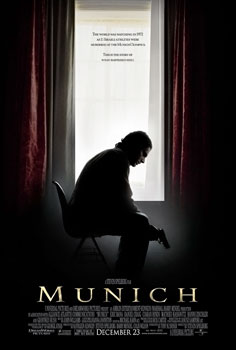
Munich
At the 1972 Summer Olympics in Munich, the Palestinian militant group Black September carried out a terrorist attack resulting in the deaths of eleven members of the Israeli Olympic team. Avner Kaufman, a Mossad agent of German-Jewish descent, is chosen to lead a mission to assassinate eleven Palestinians involved in the massacre. At the direction of his handler Ephraim, to give the Israeli government plausible deniability, Kaufman resigns from Mossad and operates with no official ties to Israel. His team includes four Jewish volunteers from around the world: South African driver Steve, Belgian toy-maker and explosives expert Robert, former Israeli soldier and " cleaner " Carl, and German antique dealer and document forger Hans from Frankfurt. They are given information by a French informant, Louis, whose family's history is connected to the French Resistance. In Rome, the team shoots and kills Wael Zwaiter, who is living as a poet. In Paris, they detonate a bomb in the home of Mahmoud Hamshari. In Cyprus, they bomb the hotel room of Hussein Abd Al Chir. With IDF commandos, they pursue three Palestinian militants— Muhammad Youssef al-Najjar, Kamal Adwan, and Kamal Nasser —to Beirut, penetrate the Palestinians' guarded compound and kill all three. Between hits, the assassins argue with each other about the morality and logistics of their mission, expressing fear about their individual lack of experience, as well as their apparent ambivalence about accidentally killing innocent bystanders. Avner makes a brief visit to his wife, who has given birth to their first baby. In Athens, when they track down Zaiad Muchasi, the team finds out that Louis arranged for them to share a safe house with their rival PLO members and the Mossad agents escape trouble by pretending to be members of foreign militant groups like ETA, IRA, ANC, and the Red Army Faction. Avner has a heartfelt conversation with PLO member Ali over their homelands and who deserves to rule over the lands. Ali is later shot by Carl while the team escapes from the hit on Muchasi. The squad moves on to London to track down Ali Hassan Salameh, who orchestrated the Munich massacre, but the assassination attempt is interrupted by several drunken Americans. It is implied that these are agents of the CIA, which, according to Louis, protects and funds Salameh in exchange for his promise not to attack United States diplomats. Meanwhile, attempts are made to kill the assassins themselves. Carl is killed by an independent Dutch contract killer. In revenge, the team tracks her down and executes her at a houseboat in Hoorn, Netherlands. Hans is found stabbed to death on a park bench, and Robert is killed by an explosion in his workshop. Avner and Steve finally locate Salameh in Spain, but again their assassination attempt is thwarted, this time by Salameh's armed guards. Avner and Steve disagree on whether Louis has sold information on the team to the PLO. A disillusioned Avner flies to Israel, where he is unhappy to be hailed as a hero by two young soldiers, and then to his new home in Brooklyn, where he suffers post-traumatic stress, paranoia and has flashbacks from the Munich massacre. Concerns continue to grow when he speaks to Louis' father by phone and it is revealed he knows his real name and promises no violence will come to him from his family. He is thrown out of the Israeli consulate after storming in to demand that Mossad leave his wife and child alone. Ephraim comes to ask Avner to return to Israel and Mossad, but Avner refuses. Avner then asks Ephraim to come to dinner with his family, to break bread as an allegory to make peace, but Ephraim refuses, perhaps as a sign that neither side will reconcile. A title card reveals nine of the eleven targeted Palestinians were killed, including Salameh, who was finally killed in 1979.

The Mauritanian
In November 2001, Mohamedou Ould Slahi is in Mauritania, two months after the September 11 attacks. A Mauritanian policeman tells Mohamedou that Americans want to have a talk with him. Mohamedou agrees to go with them. In Albuquerque, New Mexico, in February 2005, lawyer Nancy Hollander is told by French lawyer Emmanuel that a lawyer from Mauritania approached his firm in Paris on behalf of Mohamedou's family. They haven't seen Mohamedou since he was arrested three years ago and only just found out in a newspaper that he is being held by the United States at the Guantanamo Bay detention camp and is accused of being one of the organizers of 9/11. Emmanuel asks Nancy to look into it because she has a security clearance from a previous case and can ask questions he can't. Nancy agrees to check. At a Naval Law Conference in New Orleans, Marine Prosecutor Stuart Couch is told by Colonel Bill Seidel about the Mohamedou case which Seidel wants him to prosecute. Seidel says that Mohamedou fought with Al-Qaeda in the '90s and then recruited for them in Germany, and says it was Mohamedou who recruited the terrorist who flew Stu's friend's plane into the tower. Nancy and Teri (her fellow lawyer) fly down to Guantánamo to meet Mohamedou. Mohamedou agrees to hire them as his lawyers. Meanwhile, Stu tells his team to go through all the intel reports they have to corroborate the story against Mohamedou. Nancy finds out something through Mohamedou's letter which she received from him while Stu looks at the MFR (Memorandum for the Record), showing exactly what happened. The letter and reports talk about enhanced interrogation methods (i.e., torture) and other maltreatment including sexual assault upon Mohamedou by the Guantanamo guards as ordered by General Mandel. General Mandel also threatened the arrest and rape of his mother. Thus, to save his mother and to get the torture to stop, Mohamedou gave a false confession about being a terrorist. Stu withdraws from Mohamedou's prosecution in disgust. In December 2009, at trial Mohamedou testified over video link to the court. In March 2010, Mohamedou received a letter informing him that his case was successful, and the judge has ordered him to be released. Text is shown telling us that it would be another 7 years before he actually was released, because the government appealed. His mother died in 2013 so he never saw her again. He was finally released in 2016, having spent 14 years in prison without ever being charged. Finally, footage of the real Mohamedou arriving back in Mauritania is shown. Texts are shown, telling us Mohamedou lives in Mauritania and got married in 2018 to an American lawyer. They have a son, Ahmed, but haven't been able to live together as a family and are hoping a country will grant them protection and citizenship. Nancy and Teri are still lawyers working against injustice, and we see footage of Mohamedou giving them necklaces with their names in Arabic.