Genre: Biography (Page 16)
Browse 242 movies in the Biography genre.
All Genres
Flash of Genius
On his wedding night in 1953, an errant champagne cork renders Detroit college engineering professor Robert Kearns almost completely blind in his left eye. Ten years later, he is happily married to Phyllis and the father of six children. As he drives his Ford Galaxie through a light rain, the constant movement of the windshield wipers irritates his troubled vision. The incident inspires him to create a wiper blade mechanism modeled on the human eye, which blinks every few seconds rather than continuously. With financial support from Gil Previck, Kearns converts his basement into a laboratory and develops a prototype he tests in a fish tank before installing it in his car. He patents his invention and demonstrates it for Ford researchers, who had been working on a similar project without success. Kearns refuses to explain how his mechanism works until he hammers out a favorable deal with the corporation. Impressed with Kearns' results, executive Macklin Tyler asks him to prepare a business plan detailing the cost of the individual units, which Kearns intends to manufacture himself. Considering this to be sufficient commitment from the company, Kearns rents a warehouse he plans to use as a factory and forges ahead. He presents Ford with the pricing information it requested along with a sample unit, and then waits for their response. Time passes, and when nobody contacts Kearns, he begins placing phone calls that are never returned. Frustrated, Kearns attends a Ford dealers' convention at which the latest model of the Mustang is unveiled, promoting the intermittent wiper as a selling point. Realizing the company has used his idea without giving him credit or payment for it, Kearns begins his descent into a despair so deep he boards a Greyhound bus and heads for Washington, D.C., where he apparently hopes to find legal recourse. Instead, Maryland state troopers remove him from the bus and escort him to a psychiatric hospital, where he is treated for a nervous breakdown. Finally released when doctors decide his obsession has subsided, he returns home a broken man, determined to receive public acknowledgement for his accomplishment. Thus begins years of legal battles, during which time his wife leaves him, and he becomes estranged from his children. At trial, Kearns represents himself after attorney Gregory Lawson withdraws from the case, because Kearns refuses to settle. Eventually Kearns' ex-wife and children support him in his endeavor. Toward the end of the trial, Ford offers Kearns a $30 million settlement, but without admitting wrongdoing. Kearns decides to leave his fate in the hands of the jury, who determine that Ford infringed his patents, but that the infringement was not deliberate. The jury awards him $10.1 million. The closing credits indicate that Kearns later wins an $18.7 million judgement from Chrysler Corporation as well.


The Inner Circle
Shortly after his marriage to Anastasia, Ivan Sanchin, who works as a projectionist at the headquarters of the state security service (called, anachronistically, KGB in the film), is summoned urgently to the Kremlin. Having proved his skill, he is appointed private projectionist to Stalin and his inner circle, including the head of state security Beria. This makes him proud and happy, for he venerates the dictator as if he were a god. When a Russian Jewish couple in his cramped apartment house are arrested, their little daughter Katya is left behind. Though Anastasia wants to adopt the child, Ivan forbids it because her parents are " enemies of the people ”. However she secretly visits Katya at a state orphanage. As German troops approach Moscow in 1941, Ivan and Anastasia are put on a train to a safe town. Also on the train is Beria, who gets Anastasia drunk and rapes her, sending Ivan back to Moscow. For a long time he hears nothing of her until she turns up one day, pregnant and abandoned. Her experiences have unhinged her and she commits suicide. In 1953 the lonely Ivan is visited by Katya, now a 17-year-old, who treasures the memory of Anastasia's affection. Ivan offers help, but she says she wants to go her own way. Following Stalin's death, Ivan, while on crowd control duty to masses waiting to view the corpse, sees Katya being jostled in the crush. He rushes in to rescue her and, this time, she is ready to accept his protection.
American Animals
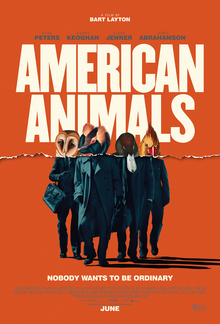
Spencer Reinhard, an art student seeking excitement or tragedy for inspiration, is given a tour of Transylvania University library's rare-book collection; his eye is drawn to a rare first edition of John James Audubon 's Birds of America. He and his friend Warren Lipka, a rebellious student on an athletic scholarship at the University of Kentucky, discuss the possibility of stealing it and other rare books. They note that the collection is guarded by only one librarian, whom they believe they could easily overpower before stealing the books and escaping via the staff elevator. Warren travels to Amsterdam to meet black-market buyers who express interest, informing Spencer they could make millions. They later enlist the help of two friends: Eric Borsuk to provide logistics and Chas Allen as the getaway driver. They make an appointment for a private viewing of the collection in order to gain access to the room, and arrive disguised as elderly businessmen; but they abort the heist when Warren sees multiple librarians in the room. Spencer wants to abandon the plan, but Warren persuades him and the others to try again the next day. Spencer acts as a lookout as Warren and Eric, without disguises, enter the library. Warren clumsily uses a stun gun on the librarian, making Eric help restrain her. They blunder to the exit, dropping The Birds of America, but escape with two books. The group travels to Christie's auction house in New York to get the authentication of value Warren said the Dutch buyers required. Spencer is told he has to return the next day and leaves his cell phone number with an assistant. Chas berates Spencer for using a phone number that can be identified as his, and they return to Lexington with the books. Shortly after, Spencer realizes the police will also be able to trace the email address they used to make the appointments with Christie's and the library; the FBI eventually does, and they are arrested. In documentary interviews with the real-life thieves filmed years after they are released from prison, they express regret. Spencer suspects Warren lied about going to Amsterdam in order to convince the others to partake in the heist. Eric and Chas now live in California as a writer and a fitness coach, respectively; Warren studies filmmaking in Philadelphia; and Spencer lives in Lexington as an artist.

Sid and Nancy
On 12 October 1978, police are summoned to the Hotel Chelsea in New York City, where they find Nancy Spungen dead. Her boyfriend, former Sex Pistols bassist Sid Vicious, is taken into custody. Sid is driven to a police station and told to describe what happened. A little more than a year earlier, in 1977, close friends and band members Sid and Johnny Rotten meet Nancy, a heroin -addicted American groupie who had come to London to bed the Sex Pistols. Sid dismisses her at first, as her intentions are obvious, but begins dating her after feeling sympathy for the rejection she faces from fellow punk performers. The two swiftly bond over heroin use, and it is implied that Nancy introduces Sid to the drug. Sid and Nancy fall deeply in love, but their self-destructive, drug-fueled relationship frays Sid's relationship with the rest of the band. Nancy is distraught when Sid departs on a month-long American tour without her. The tour is notably disastrous, with Sid strung out of his mind, often drunk or on methamphetamine, and physically violent. Phoebe, Sid's friend and road manager, unsuccessfully attempts to help him stop drinking. Meanwhile, Nancy remains in London, staying with her friend Linda, a dominatrix. Although several of Sid's friends and acquaintances warn him of Nancy's devastating effect on his life, Sid stubbornly ignores these warnings. On 17 January 1978, in the midst of the group's American tour, the band breaks up. Sid reunites with Nancy in New York City, and he attempts to start a solo career with Nancy as his manager. The two visit Paris to begin recording sessions, but the trip is unfruitful. Sid is quickly dismissed in the music industry as a has-been, and he and Nancy descend deeper into heroin addiction; Nancy also begins suffering from severe depression, and the couple eventually make a suicide pact. Nancy brings Sid to Philadelphia to meet her family, who are horrified by the couple's reckless behavior and physical state. Sid and Nancy return to New York and settle in the Hotel Chelsea, where they live in squalor and depend on opiates supplied by their drug dealer, Bowery Snax. Their love affair ends tragically one night when, during an argument in which Sid announces his plans to stop using heroin and return to England to restart his life, a suicidal Nancy begs him to kill her. She attacks him and they fight in a drug-induced haze, leading to him stabbing her, although whether it was intentional is left to interpretation. They fall asleep and later Nancy awakes and stumbles into the bathroom, where she collapses and dies, calling Sid for help. Sid is bailed out temporarily by his mother, who is also a heroin addict. After Sid wanders to a restaurant, some street kids convince him to dance with them. A taxi appears and picks Sid up, and he believes he finds Nancy alive in the back seat. The two embrace as the cab drives off. A postscript says that Vicious died of a heroin overdose, and lastly reads: "R.I.P. Nancy and Sid."

The Witness
The Case Kitty Genovese was murdered at about 3:20 am on March 13, 1964, in the Kew Gardens neighborhood of Queens, New York. The lede of the initial article in The New York Times about her death, written by Martin Gansberg, read: " For more than half an hour 38 respectable, law-abiding citizens in Queens watched a killer stalk and stab a woman in three separate attacks in Kew Gardens. " The film argues that although "absolutely riveting", most of that statement was inaccurate: Journalist Jim Rasenberger tells Bill Genovese in the film: "If the story had been reported more accurately, it still would have been a two or three day—maybe a four-day story; but it would not have been a 50-year story. We would still not be talking about it today." Bill Genovese's Investigation William "Bill" Genovese was 16 when his older sister Kitty was murdered. For many years, Kitty’s family found it too painful to look into the facts of her death. Starting in March 2004, however, Bill began his own investigation into whether it was true that 38 witnesses failed to help his sister. With leads from prosecutor Charles Skoller, he obtained the police interviews and the transcript of Winston Moseley's trial, and set about finding the witnesses or informants who were still alive. His findings, which are documented in the film, include the following: Only 5 of the "38 witnesses" were called to the testify at Moseley's trial, among them: According to defense attorney Sydney Sparrow (as reported by his son), Moseley was bright and manipulative. Moseley told the story of killing Kitty in a cold "conversational tone", and also confessed to murdering Annie Mae Johnson two weeks before Kitty. He shot Annie Mae four times as she was getting out of her car at night, then raped her in her house while her unknowing family members were upstairs, then set the house on fire. Moseley was sentenced to death for the murder of Genovese, but his sentence was reduced to life imprisonment on appeal. In 1968, he escaped from prison and terrorized Buffalo, New York, for 4 days, breaking into houses, raping a woman at gunpoint, and taking hostages before being captured by the FBI. He went on to complete a sociology degree from prison in 1977, and later claimed to be reformed. Bill attempts to interview Winston Moseley, who refuses, saying he was "tired of being exploited." Moseley's son Steven, a minister, does agree to meet with Bill, however. He says his father told him that Kitty had hurled racial slurs at Moseley, who "snapped" and killed her, but a dubious Bill points out that Moseley had previously killed Annie Mae Johnson, who was African American. Steven then states that he was scared to meet with Bill because the story in his family is that Kitty was related to the Genovese crime family, which Bill denies. Later, Bill receives a letter from Winston Moseley, which makes the "bizarre claim" that Moseley had just been an unwitting getaway driver the night Kitty was killed, and "an Italian mobster named Dominick" killed Kitty over an unpaid debt, threatening Moseley and his family if he revealed the truth. Bill concludes: "I've come to realize that the whole truth about Kitty's death will never be known, but maybe that's why the story continues to fascinate people…but I know she'd want me to move on."

Dragon: The Bruce Lee Story
In Hong Kong, Bruce Lee's father Lee Hoi-chuen awakens from a nightmare about a phantom, known as the Demon, haunting his young son. He subsequently enrolls him in Chinese martial arts training with instructor Yip Man. As a young adult, Bruce fights British sailors who are harassing a young Chinese woman. As a result, he must flee Hong Kong. His father insists he go to the US. In the US, Bruce works as a dishwasher at a Chinese restaurant until he gets in a brawl with four of the cooks. The restaurant owner Gussie Yang fires him but also lends him money and encourages him to go to college. While studying philosophy in college, Bruce begins to teach martial arts classes, where he meets Linda, a white American. Bruce marries Linda in defiance of her racist mother, Vivian. Linda suggests Bruce establish a martial arts school, but his Chinese peers demand he train only Chinese people. When Bruce refuses, they challenge him to settle the matter in combat. Bruce defeats a challenger named Johnny Sun in a secret, no-holds-barred match but Johnny attacks Bruce after he has admitted defeat, and Bruce sustains a debilitating back injury. While Bruce is temporarily paralyzed, Linda helps him write the martial arts book Tao of Jeet Kune Do. Linda gives birth to their first child, Brandon, and the couple reconcile with her mother. Some months later, during a martial arts tournament run by Ed Parker, Johnny challenges Bruce to a rematch. Bruce defeats and humiliates Johnny, earning the respect of the audience. Bruce is unaware that Johnny becomes crippled from his injuries in the fight. After the match, Bill Krieger, who later becomes Bruce's manager, offers him the role of Kato in the television series The Green Hornet. Bruce and Krieger also create the idea for the television series Kung Fu, agreeing that Bruce will feature in the lead role. At a cast party, Linda says she is pregnant with their second child, Shannon. Shortly afterwards, the cancellation of The Green Hornet is announced. Kung Fu later makes it to television but much to Bruce's frustration, it stars the white actor David Carradine. Bruce believes Krieger has betrayed him. Bruce returns to Hong Kong for his father's funeral. Philip Tan, a Hong Kong film producer, hires Bruce to star in the film The Big Boss. During the filming of the final scene, Johnny's brother Luke attacks Bruce in revenge for Johnny's humiliating defeat and subsequent disability; Bruce narrowly wins the fight. The Big Boss is a success and Bruce makes several more films, working as an actor, director, writer and editor. This causes a rift between Bruce and Linda, as Linda wishes to return to the US. Krieger offers Bruce a chance to work on a big-budget Hollywood film, to which Bruce agrees, partly because of Linda's wish to return home. On the 32nd day of filming Enter the Dragon, during the "room of mirrors" sequence, Bruce has a terrifying vision of the Demon that has haunted his and his father's dreams. This time, after being beaten and then shown his own grave, Bruce sees his son urging Bruce to save him. The Demon pursues Brandon, spurring Bruce to fight back, save Brandon and break the Demon's neck with a pair of Nunchaku. Bruce later films another scene from Enter the Dragon, the film that would make him an international star. In a voice-over, Linda tells the audience Bruce fell into a mysterious coma and died shortly before the film's release and says while many people want to talk about how he died, she prefers to remember how he lived.

Charlie Wilson's War
In 1980, Congressman Charlie Wilson, an East Texas Democrat, is more interested in partying than legislating, frequently throwing huge galas and staffing his congressional office with attractive young women. His social life eventually brings about a federal investigation into allegations of his cocaine use, conducted by federal prosecutor Rudy Giuliani as part of a larger investigation into congressional misconduct. The investigation results in no charge against Wilson. A friend and romantic interest, Joanne Herring, Houston socialite, political activist, diplomat, and television talk show host, encourages Charlie to do more to help the Afghan people, and persuades him to visit the Pakistani leadership. The Pakistanis complain about the inadequate support of the U.S. to oppose the Soviet Union, and they insist that Wilson visit a major Pakistan-based Afghan refugee camp. The Congressman is deeply moved by their misery and determination to fight, but is frustrated by the regional CIA personnel's insistence on a low key approach against the Soviet occupation of Afghanistan. Wilson returns home to lead an effort to substantially increase funding to the mujahideen. As part of this effort, Charlie befriends maverick CIA operative Gust Avrakotos and his understaffed Afghanistan group to find a better strategy, especially including a means to counter the Soviets' formidable Mil Mi-24 Hind helicopter gunship. This group was composed in part of members of the CIA's Special Activities Division, including a young paramilitary officer named Michael Vickers. As a result, Charlie's deft political bargaining for the necessary funding and Avrakotos' careful planning using those resources, such as supplying the guerrillas with FIM-92 Stinger missile launchers, turns the Soviet occupation into a deadly quagmire with their heavy fighting vehicles being destroyed at a crippling rate. Charlie enlists the support of Israel and Egypt for Soviet weapons and consumables, and Pakistan for distribution of arms. The CIA's anti-communism budget evolves from $5 million to over $500 million (with the same amount matched by Saudi Arabia), startling several congressmen. This effort by Charlie ultimately evolves into a major portion of the U.S. foreign policy known as the Reagan Doctrine, under which the U.S. expanded assistance beyond just the mujahideen and began also supporting other anti-communist resistance movements around the world. Charlie states that senior Pentagon official Michael Pillsbury persuaded President Ronald Reagan to provide the Stingers to the Afghans. Gust vehemently advises Charlie to seek support for post-Soviet occupation Afghanistan, referencing the "zen master's" story of the lost horse. He also emphasizes that rehabilitating schools in the country will help educate young children before they are influenced by the " crazies ". Charlie attempts to appeal this with the government but finds no enthusiasm for even the modest measures he proposes. In the end, Charlie receives a major commendation for his support of the U.S. clandestine services, but his pride is tempered by his fears of the blowback his secret efforts could yield in the future and the implications of U.S. disengagement from Afghanistan.

Tucker: The Man and His Dream
Detroit engineer Preston Tucker has been interested in building cars since childhood. During World War II he designed an armored car for the military and made money building gun turrets for aircraft in a small shop next to his home in Ypsilanti, Michigan. Tucker is supported by his large extended family, particularly his wife Vera, his sons Preston Jr. and Noble, and his daughter Marilyn Lee. As the war winds down, Tucker becomes inspired to build the "car of the future". The "Tucker Torpedo" will feature revolutionary safety designs, including disc brakes, seatbelts, a pop-out windshield, and headlights which swivel when the car turns. Tucker hires young designer Alex Tremulis to help with the design and enlists New York financier Abe Karatz to arrange financial support. Raising the money through a stock issue, Tucker and Karatz acquire the enormous Dodge Chicago Plant to begin manufacturing. Abe hires Robert Bennington to run the new Tucker Corporation on a day-to-day basis. Launching "the car of tomorrow" in a spectacular way, the Tucker Corporation is met with enthusiasm from shareholders and the general public. However, the Tucker board of directors, unsure of his ability to overcome the technical and financial obstacles ahead, send Tucker off on a publicity campaign and attempt to take complete control of the company. While Tucker travels the country, Bennington and directors change the design of the Tucker 48 to a more conventional design, eliminating the safety and engineering advances Tucker was advertising. At the same time, Tucker faces animosity from the Big Three automakers — General Motors, Ford and Chrysler —and from the authorities, led by Michigan Senator Homer S. Ferguson. Tucker returns from his publicity tour and confronts Bennington, who curtly informs him that he no longer has any power in the company to make decisions, and that the engine originally planned for the car is not viable. Tucker then receives a call from Howard Hughes, who sends a private plane to bring Tucker to his aircraft manufacturing site. Hughes advises Tucker to purchase the Aircooled Motors Company, which can supply both the steel Tucker needs, as well as a small, powerful helicopter engine that might replace Tucker's original 589 power plant. Unable to change Bennington's design, Tucker modifies the new engine and installs it in a test Tucker in the secrecy of his backyard tool-and-die shop. This prototype proves successful, both in durability and in crash-testing. However, Tucker is confronted with allegations of stock fraud. Ferguson's investigation with the U.S. Securities and Exchange Commission (SEC) causes Karatz—once convicted of bank fraud —to resign out of fear that his criminal record will prejudice the hearings. Yellow journalism all but ruins Tucker's public image, but the courtroom battle is resolved when he parades his entire production run of fifty Tucker 48s, proving that he has reached production status. After giving a speech to the jurors on how capitalism in the United States is harmed by efforts of large corporations against small entrepreneurs like himself, Tucker is acquitted on all charges, but the Tucker Corporation falls into bankruptcy. In the film's closing shot, Tucker's entire production line—fifty "cars of the future"—is driven through the streets of downtown Chicago, admired by everyone as they pass.

The 33
In August 2010, a group of 33 miners from Copiapó, Chile, work in the San José Mine when the mine collapses due to the owner's negligence in ignoring warning signs of instability. The collapse blocks the only path into the mine, leaving the miners trapped. They manage to make their way to a rescue chamber, but soon realize they are ill-prepared for a long stay. The radio is not working, the medical kit is empty, and there is very little food. Mario Sepúlveda emerges as a leader among the miners, taking charge of rationing food and keeping the group from spiraling into violence and despair. The mine company does not attempt to rescue the miners, and their families gather outside the gates of the mine. The Chilean government intervenes and orders the use of drilling to reach the trapped miners. The first few boreholes miss their target, but eventually, a successful one reaches the rescue chamber. The miners attach a note to the drill bit to let the surface know they are alive. The government sends in food, clothing, and establishes television communication with the surface. A second drilling system is prepared to retrieve the miners one by one. Over the next several weeks, there is much drama and tension as the rescuers work to free the miners. Finally, after more than two months of being trapped, all 33 miners are successfully rescued. The rescue becomes a source of inspiration and hope for people around the world.

Kill the Messenger
In 1996, San Jose Mercury News reporter Gary Webb interviews drug dealer Ronny Quail, who is outraged that the government used civil asset forfeiture to keep his house even after he was acquitted. Webb's ensuing article about the abuses of forfeiture garners repeated phone calls from a woman named Coral, whom he agrees to meet when she says she has documents that prove the government sponsored cocaine sales in the U.S. Coral gives Webb a transcript of grand jury testimony (normally kept secret) which was accidentally released to her boyfriend, an accused drug dealer, during discovery. After Webb reveals to the prosecutor in the case that he has the transcript, the government drops the charges against Coral's boyfriend in order to protect their main witness: Oscar Danilo Blandón. After Webb researches Blandón and comes across the pending case of "Freeway" Rick Ross, he is stunned to learn that Blandón is a paid informant. Armed with this knowledge, Ross' attorney elicits from Blandón his sworn testimony outlining the CIA 's alleged involvement in Contra cocaine trafficking—that the CIA actively supported Blandón and his partners’ smuggling of cocaine into the U.S. and used the profits to benefit the Nicaraguan Contras. Webb travels to a prison in Managua and speaks to Blandón's partner, Norwin Meneses, who confirms Oliver North 's involvement in the basic "drugs for guns" scheme to use profits from cocaine trafficking to fund the Contras. In Washington, D.C., Webb tracks down Fred Weil, a National Security Council employee who was an investigator on the Kerry Committee report, which touched on the same issues. Like many other people that Webb speaks to, Weil warns him that the subject may put him in danger. For good measure, federal agents summon Webb to a meeting where they warn him against publishing what he has learned. The paper publishes Webb's story as a three-part series with the title " Dark Alliance "; it is an immediate sensation. Humiliated by being scooped by a regional paper, the Los Angeles Times, Washington Post, and The New York Times all dig into Webb's reporting. Webb views their follow-up reporting as being far too deferential to the CIA. Eventually, their reporting turns to Webb himself, including an affair he had while working at The Plain Dealer. Webb is banished to the newspaper's Cupertino bureau to cover mundane local news. However, he continues to work on the story. He is awakened in his motel room one night by John Cullen, who is precisely the kind of CIA source with direct knowledge of the scheme that Webb's reporting needs. Webb's exhilaration at finding Cullen is quickly dampened when the paper reveals its plans to write an open letter calling into question aspects of its "Dark Alliance" reporting. At a Society of Professional Journalists dinner honoring Webb as the Bay Area "Journalist of the Year", he submits his resignation to his editors. An epilogue reveals that in 2004 Gary Webb was found dead in his apartment, shot twice in the head. His death was ruled a suicide.