Movies (Page 5)
Browse 2,069 movies from the database, mentioned on Hacker News, ranked by rating or popularity.
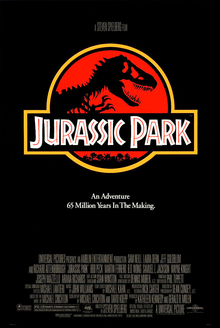
Jurassic Park
Industrialist John Hammond has created Jurassic Park, a theme park featuring de-extinct dinosaurs, on the tropical island Isla Nublar, off the coast of Costa Rica. After a Velociraptor kills a dinosaur handler, the park's investors, represented by lawyer Donald Gennaro, threaten to pull funding unless experts certify the island's safety. Gennaro invites the chaotician Ian Malcolm, while Hammond invites the paleontologist Alan Grant and the paleobotanist Ellie Sattler. Upon arrival, the group is shocked to see living Brachiosaurus and Parasaurolophus. At the park's visitor center, the group learns that the cloning was accomplished by extracting dinosaur DNA from prehistoric mosquitoes preserved in amber. DNA from frogs and other animals was used to fill in gaps in the dinosaurs' genome. To prevent the dinosaurs from breeding, they are all made female by chromosome manipulation. The group witnesses the hatching of a baby Velociraptor and visits the raptor enclosure. During lunch, they debate the ethics of cloning and of the park in general. Malcolm warns of the implications of genetic engineering while Grant and Sattler express uncertainty over the ability of humans and dinosaurs to coexist. Hammond's grandchildren, Lex and Tim, join the others for a park tour in two self-driving electric vehicles, while Hammond observes them from the control room. Most of the dinosaurs fail to appear, and the group encounters a sick Triceratops. The tour is cut short as a tropical storm approaches. The park employees leave for the mainland on a boat while the visitors return to their vehicles; Sattler stays behind to study the Triceratops. Jurassic Park's disgruntled computer programmer, Dennis Nedry, was previously bribed to steal frozen dinosaur embryos by Lewis Dodgson, a man working for Hammond's corporate rival. To access the embryo storage room, Nedry deactivates the park's security system, cutting power to the tour vehicles. Most of the park's electric fences have been deactivated, which allows a Tyrannosaurus rex to escape and attack the touring group. The Tyrannosaurus devours Gennaro and injures Malcolm while Grant, Lex, and Tim escape. On his way to deliver the embryos to the island's docks, Nedry gets lost in the rain, crashes his vehicle, and is killed by a venom-spitting Dilophosaurus. Sattler helps the game warden Robert Muldoon search for survivors; they find Malcolm just before the Tyrannosaurus returns and chases them away. Grant, Lex and Tim take shelter in a tree and encounter a Brachiosaurus herd, then discover the broken shells of dinosaur eggs the following morning. Grant concludes that the dinosaurs are breeding, which is possible because of their amphibian DNA—animals like West African frogs can change their sex in a single-sex environment. Unable to decipher Nedry's code to reactivate the security system, Hammond and chief engineer Ray Arnold decide to reboot the park's systems. They shut down the power grid and retreat to an emergency bunker while Arnold heads to a maintenance shed to complete the rebooting process. When Arnold fails to return, Sattler and Muldoon go to the shed, and discover that the shutdown has released the Velociraptors. Sattler turns the power back on before being attacked by a raptor and discovering Arnold's severed arm. While she escapes, Muldoon is killed by another Velociraptor. Grant, Lex and Tim reach the visitor center. Grant leaves to look for Sattler, leaving Lex and Tim inside. The raptors appear and pursue the children through a kitchen, but they escape and join Grant and Sattler. The group reaches the control room, and Lex restores the park's systems, allowing them to contact Hammond, who radios for a helicopter to take them off the island. As the group tries to leave they are cornered by the two raptors, but the Tyrannosaurus appears and fights the velociraptors. It kills the first by biting it, and throws the second into a skeleton on exhibit, killing it as well. The group flees and boards the helicopter, and Grant and Hammond agree not to endorse the park.

Looker
Dr. Larry Roberts, a renowned Beverly Hills plastic surgeon, performs cosmetic procedures on a clientele mainly consisting of female television models. Lisa Convey, one of his patients, falls into a trance state in her apartment after being exposed to a flash of light, unaware of the presence of a man lurking in her closet. She falls from her balcony moments later in what is suspected by police to be a suicide. Lieutenant Masters questions Roberts at his office, where his secretary finds that several medical records—including Lisa's—have mysteriously vanished. After Masters departs, patient Cindy Fairmont visits for a final follow-up appointment, followed by Tina Cassidy. A disturbed Tina begs Roberts to return her to her original appearance, claiming that the "perfect" models in the city are being murdered. As Tina departs, she leaves behind her purse, which contains a document from Digital Matrix Inc. (DMI). When Roberts attempts to return the purse to Tina, he sees a flash of light in her apartment window, and she too falls to her death. Roberts sees a man on her balcony, but he disappears. Fearing for Cindy's safety, Roberts invites her to join him for a fundraising dinner held by billionaire businessman John Reston, who introduces Roberts to the head of DMI, Jennifer Long. She explains that DMI used women's facial measurements for a visual technology experiment that was recently ended. Roberts then brings Cindy back to his residence and, despite her expectation of a romantic encounter, has her sleep in the guest room. The next day, Roberts accompanies Cindy to the filming of a television commercial where DMI technicians monitor the set using a computer. When Cindy is unable to hit her marks, the DMI technicians inform her that the commercial will be completed using CGI which will require Cindy to visit DMI. As Cindy undergoes a 3D body scan at the DMI laboratory, Jennifer tests Roberts' eyes with the computer. His point of focus is shown to be on the model rather than the products advertised. Jennifer divulges that, after surgery, Cindy and other models were assessed as visually "perfect" by the computer in still photos, but their scores were inconsistent while in motion. Roberts notices flashes of light from the "Looker" lab which Jennifer claims her security card will not allow them to enter. Roberts steals a security card from a technician before departing with Cindy and the theft is reported to Reston. While Cindy is visiting her parents, Roberts is exposed to a series of light flashes by the man from Tina's balcony after which hours pass without his awareness. When Cindy returns that night, the two drive to DMI and enter using the security card to breach the Looker lab. Roberts learns that Looker stands for "light ocular-oriented kinetic emotive responses" which uses high-intensity light to induce trances in those exposed. A man enters the Looker lab and attacks Roberts using the Looker gun. Roberts defends himself by using a pair of mirrored sunglasses to reflect the light, immobilizing the assailant. Later, Reston orders the man to abduct Cindy and murder Roberts. Arriving at Roberts's office, they kidnap Cindy. The next morning, Roberts is chased through the city by Reston's henchman, causing Roberts to crash his car, but he escapes. Roberts stows aboard a Reston Industries security car to infiltrate the company headquarters. Onstage for a gala demonstration, Reston introduces his company's newfound ability to create commercials using computer-generated actors. The audience is then mesmerized by Jennifer who is operating the computer from the room where she is holding Cindy. When Jennifer leaves the console, Reston's henchman kills her having mistaken her for Roberts. A struggle between Roberts and the henchman is ended by Reston shooting at Roberts and accidentally killing his own man. Lieutenant Masters, who has been following Roberts, arrives in time to kill Reston before he can shoot Roberts.

Network
In September 1975, Howard Beale, the longtime anchor for the UBS Evening News, the flagship evening news program of the Union Broadcasting System (UBS), learns from friend and news division president Max Schumacher that he has just two more weeks on the air because of declining ratings. The following night, Beale announces to his audience that he will kill himself on next Tuesday's newscast. UBS tries to immediately fire Beale, but Schumacher intervenes so that he can have a dignified farewell. Beale promises to apologize for his outburst, but once on the air, he launches into a rant about life being "bullshit". Beale's outburst causes ratings to spike, and much to Schumacher's dismay, UBS executives decide to exploit the situation. When Beale's ratings soon top out, programming chief Diana Christensen reaches out to Schumacher with an offer to help "develop" Beale's show. He declines the professional proposal but accepts her more personal pitch; the two begin an affair. When Schumacher decides to end Beale's "angry man" format, Christensen persuades her boss, Frank Hackett, to slot the evening news show under the entertainment division so she can develop it. Hackett bullies UBS executives to consent and fire Schumacher. In one impassioned diatribe, Beale galvanizes the nation, persuading viewers to shout, "I'm as mad as hell, and I'm not going to take this anymore!" from their windows. He is soon hosting a new program called The Howard Beale Show, top-billed as "the mad prophet of the airwaves". The show becomes the highest rated program on television, and Beale finds new celebrity preaching his angry populist message in front of a live studio audience that, on cue, chants his signature catchphrase. Schumacher and Christensen's romance withers as the show flourishes, but in the flush of high ratings, the two ultimately find their way back together; Schumacher separates from his wife of over 25 years for Christensen. Seeking another hit, Christensen cuts a deal with a terrorist group called the Ecumenical Liberation Army (ELA) for a new docudrama series, The Mao Tse-Tung Hour, for which the ELA will provide exclusive footage of their activities. Meanwhile, Beale discovers that Communications Corporation of America (CCA), the parent company of UBS, will be bought out by a larger Saudi conglomerate. He urges his audience to pressure the White House to quash the deal. This panics UBS because the network's debt load has made the merger essential for its survival. CCA chairman Arthur Jensen arranges a meeting with Beale, describing the interrelatedness of the participants in the international economy and the illusory nature of nationality distinctions. Jensen scolds Beale and persuades him to abandon his message and preach a new gospel that serves Jensen's interests. Christensen's fanatical devotion to her job and emotional emptiness ultimately drive Schumacher away, warning her that she will self-destruct if she continues on her current path. Audiences find Beale's new sermons on the dehumanization of society depressing and ratings start to slip, yet Jensen refuses to fire him. To boost the network's ratings, Christensen, Hackett and the other executives decide to hire the ELA to assassinate Beale on the air. The assassination succeeds, putting an end to The Howard Beale Show and kicking off the second season of The Mao Tse-Tung Hour. A voice-over proclaims, "This was the story of Howard Beale: the first known instance of a man who was killed because he had lousy ratings."

Moon
After an oil crisis, Lunar Industries makes a fortune by building Sarang Station, a facility on the far side of the Moon to mine the alternative fuel helium-3. The facility requires only one human to maintain operations and launch canisters bound for Earth containing helium-3. Samuel Bell has two weeks before ending his three-year work contract there. Chronic communication problems have disabled all live communications with Earth and limit him to occasional recorded messages from his wife Tess, who was pregnant with their daughter Eve when he left. Sam begins to suffer from hallucinations of a teenage girl and a disheveled man. One such image distracts him while he is out recovering a canister, causing him to crash his rover and fall unconscious. Sam awakes in the base infirmary with no memory of the accident. He overhears GERTY, an artificial intelligence which assists him, having a live chat with Lunar Industries management, despite the apparent communications failure. Lunar Industries orders Sam to remain on base and says that a rescue team will arrive for repairs. Suspicious, Sam fakes an emergency to persuade GERTY to let him outside. He travels to the crashed rover and finds his unconscious doppelganger. He takes the double back to the base, and GERTY tends to his injuries. The two Sams start to wonder if one of them is a clone of the other. After an argument and physical altercation, GERTY reveals that they are both clones of the original Sam Bell. GERTY activated the newest clone after the crash and convinced him that he was at the beginning of his three-year contract. His memories of his wife and daughter are implanted. The two Sams search the area, finding a communications substation beyond the facility's perimeter which has been interfering with the live feed from Earth. GERTY helps the older Sam access the recorded logs of past clones, who all fell ill as their contract expired, and he realizes that he is headed towards a similar fate, having already started to experience symptoms. Later, the older Sam discovers a secret vault containing hundreds of hibernating clones. Lunar Industries is using clones of the original Sam Bell to avoid the cost of training and transporting new astronauts, as well as deliberately jamming the live feed to prevent the clones from contacting Earth; clones, who believe they are entering hibernation at the end of their contract before their final return to Earth, are actually incinerated. The older Sam drives past the interference radius in another rover and tries to call Tess on Earth. He instead makes contact with Eve, now 15 years old, who says that Tess died years before. He hangs up when Eve tells her father on Earth that someone is calling regarding Tess. Returning, the older Sam's physical deterioration worsens. The two Sams realize that the incoming rescue team will kill them both if they are found together. The newer Sam convinces GERTY to wake another clone, planning to leave the awakened clone in the crashed rover and send the older Sam to Earth in one of the helium-3 transports. However, the older Sam, having learned that the clones break down at the end of the 3-year contract, knows that he will not live much longer. With his health declining, the older Sam suggests that he be placed back into the crashed rover to die so that Lunar Industries will not suspect anything, while the newer Sam escapes. Following GERTY's advice, the newer Sam reboots GERTY to wipe its records of the events. Before leaving, the newer clone reprograms a harvester to crash and wreck the jamming antenna, thereby enabling live communications with Earth; he also takes a helium-3 canister with him to Earth. The older Sam, back in the crippled rover, remains conscious long enough to watch the launch of the transport carrying the newer Sam. The rescue team is fooled after finding both a newly-awakened clone in the medical bay and the corpse of the older Sam inside the crashed rover.

Soylent Green
By 2022, the cumulative effects of overpopulation, global warming, and pollution have caused ecocide, leading to severe worldwide shortages of food, water, and housing, bringing human civilization to the brink of collapse. New York City has a population of 40 million, and only the elite can afford spacious apartments, clean water, and natural food in walled-off communities patrolled by armed guards. Their homes are fortified, with moats, security systems, and bodyguards for their tenants. Usually they have sex slaves, who are referred to as "furniture", have no human rights, and are passed from one apartment owner to the next. Meanwhile, the majority live in squalor, haul water from communal spigots, and eat highly processed food wafers made by the Soylent Corporation — a large food processing firm. Their mainstay products, Soylent Red and Soylent Yellow, are a staple food, and the latest product, a new, more nutritious, and flavorful wafer derived from plankton, Soylent Green, is introduced to the populace. NYPD Detective Robert Thorn lives in a cramped apartment with his aged co-worker and friend Sol Roth, a brilliant former college professor and police researcher (referred to as a "Book"), who helps him with his cases. Thorn is called to investigate the murder of the wealthy and influential William R. Simonson, a member of the Soylent Corporation's board, which he suspects was an assassination. With the help of Simonson's concubine Shirl, his investigation leads to a priest whom Simonson had visited shortly before his death. Due to the sanctity of the confessional, the visibly exhausted priest can only hint to Thorn at the contents of the confession. Soon after, the priest is murdered in the confessional by Tab Fielding, Simonson's former bodyguard. Under the direction of Governor Henry C. Santini, Thorn's superiors order him to end the investigation. Still, he continues. He soon becomes aware that a stalker is following him. As Thorn tries to control a violent mob during a Soylent Green shortage riot, he is attacked by the assassin who killed Simonson. The killer shoots three times at Thorn but misses, accidentally striking several innocent bystanders in the crowd. Thorn manages to locate the killer and throw him to the ground. The killer shoots Thorn in the leg before being crushed by the hydraulic shovel of a police riot-control vehicle, which continually scoops up shovelfuls of people in the crowd and swivels to dump them for disposal. In researching the case for Thorn, Roth brings two volumes of the Soylent Oceanographic Survey Report, 2015–2019, taken by Thorn from Simonson's apartment, to the team of other "Books" (elderly former professors and retired judges now turned researchers) at the "Supreme Exchange". The "Books" quickly conclude from the oceanographic reports that the oceans are dying and cannot actually produce the plankton from which Soylent Green is allegedly made, thus revealing that the ingredients in Soylent Green are, in fact, human bodies. This information confirms to Roth that Simonson's murder was ordered by his fellow Soylent Corporation board members, who knew Simonson was increasingly troubled by this truth and feared he might disclose it to the public. Shaken by the truth, Roth decides to "return to the home of God" and seeks assisted suicide at a government clinic. Thorn discovers this and rushes to stop him, but he arrives too late. Before dying, Roth whispers his discovery to Thorn, who is horrified. Thorn moves to uncover proof of crimes against humanity and to bring it to the attention of the Supreme Exchange so the case can be brought to the Council of Nations to take action. Thorn secretly boards a waste truck transporting human bodies from the euthanasia center to a waste-disposal plant, where he witnesses human corpses instead being processed and turned into Soylent Green. Thorn is discovered but escapes. As he returns to the Supreme Exchange, he is ambushed by Fielding and his men. Finding refuge in the church where Simonson confessed, Thorn kills his attackers but is seriously wounded in a gunfight. As paramedics tend to Thorn, he urges his commanding officer, Chief Hatcher, to spread the truth. Thorn shouts to the surrounding crowd, "Soylent Green is people!"
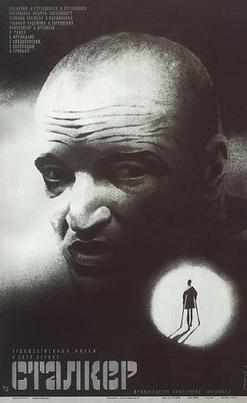
Stalker
"The Zone" is a huge tract of open land where the normal laws of physics supposedly do not apply, containing supernatural hazards. At the heart of the Zone lies a "Room" that is said to grant the wishes of anyone who steps inside. The government has fenced off the Zone, subjecting "Stalkers", people who illegally guide others through the Zone, to harsh prison time if caught crossing the border. One Stalker has just returned from a long prison sentence to his wife and daughter. To his wife's horror, a disaffected writer and a physics professor immediately hire the Stalker to take them through the Zone. Needing the money, he meets the Writer and Professor in a rundown bar-café, warning them that they must do what he says to survive the dangers that lie ahead. He explains that the Zone is a living thing that visitors must respect. The trio evades the Zone's military guards by following a train through the gate, riding through the Zone's vast wilderness on a railway work car. The Zone contains such human remnants as old abandoned industrial facilities, corpses, guns, and tanks. The Stalker cautiously tests for anomalies as they painstakingly make their way toward the Room, though nothing unusual occurs. The three men discuss their reasons for wanting to visit the Room as they travel: the Writer fears losing his inspiration, the calm Professor hopes to analyze the Zone in order to win a Nobel Prize, and the Stalker insists he has no motive beyond the altruistic aim of aiding the desperate to their desires. He mentions that his mentor, another Stalker named "Porcupine", obtained great riches by entering the Room but then hanged himself when he returned home. The trio draw lots to determine that the Writer will go first through an especially long, dark, ominous passageway that the Stalker calls the "meat grinder". Nervously, the Writer passes through without harm, shocking the Stalker, who reveals that the meat grinder kills anyone the Zone deems morally unworthy. The Writer forges ahead and delivers a soliloquy directly to camera about the futility of knowledge and feeling overwhelmed and criticized by other people. He returns to the others, and the Stalker reveals that Porcupine sent a brother ahead of him into the meat grinder, where the brother was killed. The Stalker then recites a poem about never being satisfied, and the Writer rages at the Stalker for assuming he was morally unworthy. Suddenly, a phone in the antechamber rings. The surprised Professor uses it to call an old enemy scientist, gloating about finding the Room. As the trio prepare to enter the Room, the Professor reveals his true intentions: he has brought a 20-kiloton bomb in his backpack to destroy the Room and therefore prevent evil men from abusing it for gain. He blames the Room, the Stalkers, and their clients for the recent rise of crime, political strife, and destructive science. After a brief scuffle over the bomb, the Stalker weeps, claiming that only the Room has given him meaning in his otherwise pitiful life and that it is the last beacon of hope for humanity. The Writer deduces that the Stalker's mentor Porcupine hanged himself because of the guilt the Room caused him when it presented him with riches rather than the return of his deceased brother, showing that Porcupine subconsciously cared more about wealth than love. Thus, the Room's ability to grant one's deepest and most secret desire additionally provides a window into the morality of one's soul. The Writer suggests that it is impossible to use the Room for selfish reasons because nobody can know their deepest subconscious desires. The Professor's fears soothed, he dismantles the bomb. The three men sit just outside the Room in silence; none attempt to enter it. The Stalker, the Writer, and the Professor are met back outside the Zone at the bar-café by the Stalker's wife and daughter. The Stalker returns home in total distress, lamenting to his wife how humanity has lost its capacity for faith, which is needed to traverse the Zone and live a good life. As the Stalker sleeps, his wife contemplates their relationship in a soliloquy delivered to the camera. She says that she would prefer an interesting life of hardship over an easy, boring one. The couple's daughter sits alone, while a love poem by Fyodor Tyutchev is recited through voice-over. The girl appears to use psychokinesis to push three drinking glasses across the table, a train shakes the room as it passes by, and Beethoven's "Ode to Joy" is heard.
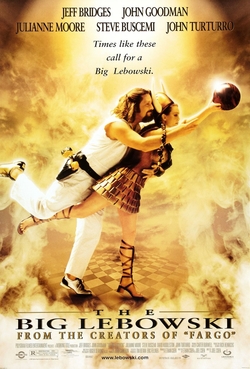
The Big Lebowski
In 1991, slacker and bowler Jeffrey "The Dude" Lebowski, is attacked in his Los Angeles home by two enforcers for porn kingpin Jackie Treehorn, to whom a different Jeffrey Lebowski's wife owes money. One enforcer urinates on the Dude's rug before they realize they have the wrong man, and leave. After consulting his bowling partners, Walter Sobchak, a Vietnam veteran with PTSD, and Donny Kerabatsos, the Dude visits philanthropist Jeffrey Lebowski ("the big Lebowski"), requesting compensation for the rug. Lebowski refuses, but the Dude tricks his assistant Brandt into letting him take a similar rug from the mansion. Outside, he meets Lebowski's much younger trophy wife, Bunny, and her German nihilist friend, Uli. Soon afterward, Bunny is apparently kidnapped, and Lebowski hires the Dude to deliver a ransom. That night, another group of thugs ambushes the Dude, taking his replacement rug on behalf of Lebowski's daughter, Maude. Convinced the kidnap was a ruse by Bunny, Walter fakes the ransom drop. He and the Dude return to the bowling alley, leaving the briefcase of money in the Dude's car. While they are bowling, the car is stolen. The Dude is confronted by Lebowski, who has an envelope from the kidnappers containing a severed toe, supposedly Bunny's. Maude asks the Dude to help recover the money her father illegally withdrew from the family's charity foundation. The police recover the Dude's car. The briefcase is missing, but the Dude finds a sheet of homework, signed by a teenager named Larry Sellers. Walter learns that Larry is the son of Arthur Digby Sellers, a writer for the television show Branded, which Walter reveres. The Dude and Walter visit Larry but get no information from him. An enraged Walter destroys a Corvette he thinks is Larry's, only to find out it belongs to a neighbor, who vandalizes the Dude's car in retaliation. Treehorn's thugs abduct the Dude and bring him to the porn kingpin, who demands to know where Bunny is. The Dude says Bunny faked her kidnapping and Larry has the money, then passes out from a spiked drink Treehorn gave him. He is briefly arrested while wandering intoxicated in Malibu. On his way home, Bunny, with all her toes, drives by, unnoticed by the Dude. Maude is waiting for the Dude at his home and has sex with him, wishing to become pregnant by a father with whom she will not have to interact. She tells the Dude that her father has no money of his own; he is dependent on an allowance that Maude gives him out of her inheritance from her late mother. The Dude and Walter confront Lebowski and find that Bunny has returned, having simply gone out of town. Bunny's nihilist friends took the opportunity to blackmail her husband, who in turn had tried to embezzle money from the family charity, blaming its disappearance on the blackmailers. The Dude believes the briefcase never contained any money. Walter suspects that Lebowski is faking his paralysis and lifts him out of his wheelchair, but his condition is real. Walter and the Dude are bowling when a rival bowler, Jesus Quintana, interrupts them. Walter had previously stated that he could not bowl on Saturdays since he is shomer Shabbos. Quintana implies that he does not believe Walter's excuse for not bowling on Saturday, threatens Walter and the Dude, and storms out. Outside the bowling alley, the nihilists set fire to the Dude's car and demand the ransom money. Walter fights them off, but Donny dies from a heart attack in the commotion. Unwilling to rent out an expensive receptacle at the funeral home, the Dude and Walter opt to put Donny's ashes in a coffee can instead. On a cliff overlooking the Pacific Ocean, Walter eulogizes Donny's death but ruins the moment by referring to his fallen comrades in Vietnam. As he scatters Donny's ashes, they are blown back onto the Dude by an updraft. As Walter tries to brush off the ashes, the Dude loses his temper and yells at him for everything that has happened. After Walter apologizes and consoles the Dude, the two go bowling. At the bowling alley, the Dude encounters the Stranger, the movie's narrator. Addressing the audience, the Stranger sums up the story, states that he remains inspired by the Dude, and reveals that Maude is pregnant with "a little Lebowski on the way."

The Big Short
In 2005, eccentric hedge fund manager Michael Burry discovers that the U.S. housing market is extremely unstable due to subprime loans. He draws this conclusion after recognizing similarities to the 1930s crisis and calculates that the market will collapse in 2007. Burry then meets with several major investment and commercial banks to purchase credit default swaps, but is required to pay substantial monthly premiums. The high premiums cause Lawrence Fields, Burry's principal client, to accost him for the high premiums that will bankrupt Burry's fund in a couple of years if his conclusion is wrong, though Burry holds firm. A Deutsche Bank executive later mentions Burry's dealings to his co-worker Jared Vennett. Vennett, sensing an opportunity, tries to secure investors for shorting the market, erroneously calling a trader at FrontPoint Partners who are nonetheless interested in his pitch. Vennett explains the fraud in the market and the disingenuity of seemingly safe bonds. Mark Baum, the head of FrontPoint, is moved by Vennett's pitch due to his disenchantment with banking's business model. The FrontPoint team travels to south Florida to investigate the veracity of Vennett's claims — finding empty neighborhoods and meeting with mortgage brokers who admit to fraudulent practices — and then decide to invest with Vennett. Meanwhile, young investors Charlie Geller and Jamie Shipley accidentally discover Vennett's presentation on a coffee table in the lobby of JPMorgan Chase. They are immediately convinced as they see the high potential payouts, but the small size of their fund requires them to enlist Ben Rickert, Shipley's childhood neighbor and a retired securities trader. Rickert agrees to help and the trio begin investing in credit default swaps. As defaults increase in early 2007, the values of credit default swaps and collateralized debt obligations (CDOs) inexplicably rise and their credit rating remains stable. Burry struggles with the lack of payout and he restricts withdrawals, leading Fields to sue. Baum talks to an acquaintance at Standard & Poor's, finding dishonesty amongst the credit rating agencies to maintain business with investment banks. Geller suspects the banks are committing fraud, leading him, Shipley and Rickert to visit the American Securitization Forum, where bankers are unconcerned about defaults. Shipley learns that the SEC has no regulations governing mortgage-backed securities activity. Geller convinces Shipley and Rickert to bet against higher-rated tranches of the bonds, since they are likely to fail if the lower-rated bonds fail. Vennett and the FrontPoint team also attend the Forum, where Baum learns from a CDO manager that the market for synthetic CDOs is twenty times larger than the market for the mortgages themselves, leading Baum to realize the entire world economy is set to collapse. Geller and Shipley see that New Century Financial, a leader in subprime lending has filed for bankruptcy, and they identify it as the beginning of the housing bubble bursting. At the same time, Baum finds that Bear Stearns is liquidating hedge funds and Burry has his phone calls ignored by the banks. Geller and Shipley realise that for the prices to have remained stable despite defaults continuing to increase, the banks must be freezing the prices of their securities in order to sell and short them before the market crashes. Outraged, Geller and Shipley contact an old friend who works for The Wall Street Journal, but he declines to report the story to preserve his relationships with the investment banks. As the subprime bonds continue to fall, Baum learns that Morgan Stanley, who owns FrontPoint, has also taken short positions against mortgage derivatives. However, it had sold short positions in higher-rated mortgage derivatives to offset the risk. Because even the higher-rated derivatives are collapsing in value, Morgan Stanley is facing severe liquidity problems. Despite pressure from his staff to sell their positions before Morgan Stanley collapses, Baum refuses to sell. Rickert, on vacation in England, sells Geller and Shipley's positions; the two receive huge profits but lose their faith in the system as Ben informs them that foreign bank systems are beginning to crash as well. Burry begins receiving calls from the banks he had originally taken short positions against. Burry yields a profit of $2.69 billion, with Fields alone receiving $489 million. While Baum is speaking at an industry panel, his team learns that Bear Stearns stock has fallen 38% in just ten minutes and the bank collapses shortly after. Baum is the last to sell, making over $1 billion, but laments that the banks and government will not take responsibility for the crisis. Vennett receives a large bonus for the profits he generated. FrontPoint continues to operate as per usual, but Burry closes his fund after public backlash. Geller and Shipley go their separate ways after unsuccessfully trying to sue the ratings agencies and Rickert returns to his retirement. Just prior to the credits, it is noted that most banks responsible for the crisis face no consequences for their actions, with one single trader, Kareem Serageldin, being imprisoned and that banks are again selling CDOs under a new label of the bespoke tranche opportunity.

The Dish
An old man drives up to the Parkes Radio Telescope to admire the dish. A technician gently cautions him that he has driven in through "the old entrance" and is therefore trespassing. Requesting that the man leave immediately, the technician encourages him to visit the observatory's nearby visitor centre and take the tour, as the dish has seen some amazing times. The old man thoughtfully agrees. The movie flashes back to July 1969, days before the launch of Apollo 11. NASA anticipates using the dish as a primary receiving antenna for the video transmission of Neil Armstrong 's historic first steps on the Moon. The dish's staff, Mitch, Glenn, and their boss, Cliff (the old man from the prologue) have been assigned a liaison by NASA, Al Burnett. Mitch resents Al, as he feels that Al is condescending; and that his presence likewise reflects a wider perception among NASA that the Australians are incompetent and unreliable. Cliff chastises Mitch for his hostility, explaining that Al's presence is justified, and that he and NASA merely want to ensure that the Moon landing proceeds as smoothly as possible. The major role that the dish is set to play in the Moon landing draws great interest upon the sleepy town of Parkes from major dignitaries, including the U.S. Ambassador and the Prime Minister. Parkes mayor, Bob, is delighted, as he played a key role in securing the dish's construction at Parkes, and thus the dish's prominent role in the Moon landing will be a boon to his political career. A power cut strikes Parkes. The dish's backup generator fails, as Mitch had previously conducted a maintenance procedure on it incorrectly. When the mains power returns, the station's tracking computers have been wiped of all their programming, and the dish can no longer locate Command Module Columbia ' s signal in space. Houston notices that they are no longer receiving any information from the Parkes station and queries them about the problem. Fearing that NASA may demote the team's role in the Moon landing if it learns of the mistake, Cliff falsely responds that the dish is receiving a clear signal from the spacecraft. Al reluctantly corroborates the lie. Mitch confesses his own culpability to Al, who immediately forgives him, mending their strained relationship. The four men work together to try to relocate Apollo 11's signal. After several hours and mishaps, they are able to lock on to the spacecraft's signal with minutes to spare before their scheduled shift as Apollo 11's main receiver begins, thus ensuring their mistake has gone undiscovered. After the Lunar Module Eagle makes a successful landing upon the Moon, Cliff notes with concern that the wind seems unusually strong. Regulations state that if the wind reaches 30 knots, the dish must be "stowed", meaning it can not be pointed at the Moon, and thus will not be able to receive Eagle ' s video broadcasts. Events conspire such that the Parkes dish becomes the only antenna on Earth capable of receiving the historic video footage of Armstrong's first steps upon the Moon. The wind reaches and exceeds 30 knots. Despite risking the total collapse of the dish, and therefore, their own lives, all four members of the dish team opt to keep the dish pointed at the Moon, adamant that allowing the world to witness and record the first moonwalk is worth the risk. The world watches in silent awe as man sets foot upon the Moon. As the Prime Minister, the ambassador, and Parkes dignitaries watch the moonwalk together, Bob is informed that the video feed is coming from the dish. Everybody is delighted, and the Prime Minister toasts Parkes. As the moonwalk concludes, the dish staff congratulate one another. Back in the present day, the technician once again insists that Cliff must leave. Cliff solemnly takes one last look at the dish before returning to his car. Before he leaves, the technician remarks that Cliff seems familiar, suggesting that Cliff's legacy is immortalized within the observatory's visitor centre. A title card explains that the dish withstood winds of over 60 mph (52 knots) to deliver the video footage of man walking on the Moon.


