Movies (Page 39)
Browse 2,069 movies from the database, mentioned on Hacker News, ranked by rating or popularity.
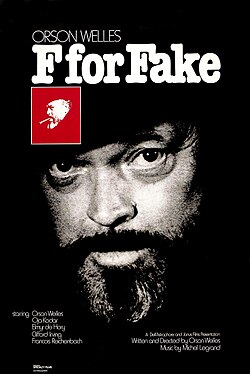
F for Fake
The film opens with Welles performing magic tricks for some children while Kodar watches nearby. Welles quotes Robert-Houdin to the effect that a magician is just an actor. Welles promises that for the next hour everything in the film will be based on solid fact. Kodar is then shown strolling around a street in a short dress while being ogled by the men on the street. Welles reveals the footage is taken from another experiment about girl-watching, where Kodar deliberately drew attention to herself and the men were unaware they were being filmed. Welles says her story will continue later in the film, and then narrates the story of Elmyr de Hory, an art forger who sold many fake paintings to museums and collectors all over the world. De Hory is shown throwing a dinner party at his home in Ibiza and being feted by European society, although he dances around the question of whether he is guilty or not. One of those filmed is Clifford Irving, who had published a biography of de Hory called Fake, and was later revealed to have been the forger of a fake "authorized biography" of Howard Hughes. Welles discusses the irony of Irving commenting on de Hory's forgery, while having committed a version of it himself (Welles states his belief that Irving must have been in the process of working on the hoax at the time he was filmed for the de Hory project). Irving and de Hory tell about the art dealers who were fooled by the forgeries, and Welles considers the question whether this means art dealers and appraisers are fake also. Welles presents more of Irving's story of having had secret contact with Hughes, and the odd stories of Hughes's behavior that may or may not have been true. He wonders if believing such stories makes a person credulous or not, and questions the true wisdom of so-called experts, who verified Irving's forgery as authentic. Reichenbach is shown telling how de Hory provided him with several paintings of questionable authenticity, but the art dealers he gave them to were willfully blind to it. Welles notes that de Hory does not even own the house he lives in; it is provided for him by an art dealer. Welles recounts his own past use of fakery: how he got a job in Ireland by falsely claiming to be a famous New York actor, and how his broadcast of The War of the Worlds made deliberate use of fake news to enhance the story. He also notes the coincidence that his first film Citizen Kane was originally going to be a fictionalized version of Howard Hughes’ life. Irving describes how de Hory was nearly destitute when younger and subsisted in America by making and selling forgeries that were indistinguishable from the real works, while remaining one step ahead of the law through frequent relocations. He finally moved to Ibiza, but was not prosecuted for lack of witnesses to the actual forging, as well as the scandal that might be aroused by revealing the depth of the art market's complicity in the deception. De Hory insists he never signed any forgery, and Welles wonders whether, given the fact that all art eventually falls away to ruin, a signature truly matters to any art work. He illustrates the point by shots of the cathedral of Chartres, pointing out that the names of the men who created the magnificent building and the sculptures which adorn it are unknown. They did not sign their work, but it has endured. Welles finally presents Kodar's story: she holidayed in the same village as Pablo Picasso, who noticed her and painted 22 pieces with her as the model. She insisted she be allowed to keep the paintings, but later when Picasso read about an acclaimed exhibit of 22 new pieces of his, he flew there in a rage, only to discover the pieces were all forgeries. Kodar took Picasso to her grandfather, the forger. In a verbal re-enactment by Welles (grandfather) and Kodar (Picasso), the forger defended his work with pride, saying he invented a new Picasso period. The grandfather suggests that the forgeries go un-reported, to allow him an artistic legacy that Picasso already has. Picasso angrily demanded the paintings back, which is impossible because the grandfather had burned them. Welles then confesses that he had promised everything in the "next hour" was true, and that hour had already passed. He admits the entire story of Kodar, her grandfather, and Picasso was made up. He apologizes, quotes Picasso's statement that art is a lie that makes us see the truth, and bids the audience good evening.

The Brain That Wouldn't Die
Dr. Bill Cortner saves a patient who had been pronounced dead, but the senior surgeon, Bill's father, condemns his son's unorthodox methods and theories of transplanting. While driving to his family's country house, Bill and his beautiful fiancée Jan Compton become involved in a car accident that decapitates her. Bill recovers her severed head and rushes to his country house basement laboratory. He and his disabled assistant Kurt revive the head in a liquid-filled tray. But Jan's new existence is agony, and she begs Bill to let her die. He ignores her pleas, and she grows to resent him. Bill decides to commit murder to obtain a body for Jan. He hunts for a suitable specimen at a burlesque nightclub, on the streets, and at a beauty contest. Jan begins communicating telepathically with a hideous mutant, an experiment gone wrong, locked in a laboratory cell. When Kurt leaves a hatch in the cell door unlocked, the monster grabs and tears off Kurt's arm. Kurt dies from his injuries. Bill lures an old girlfriend, figure model Doris Powell, to his house, promising to study her scarred face for plastic surgery. He drugs her and carries her to the laboratory. Jan protests Bill's plan to transplant her head onto Doris's body. He tapes Jan's mouth shut. When Bill goes to quiet the monster, it grabs Bill through the hatch and breaks the door from its hinges. Their struggles set the laboratory ablaze. The monster, a seven-foot giant with a horribly deformed head, bites a chunk from Bill's right cheek. Bill dies, and the monster carries the unconscious Doris to safety. As the lab goes up in flames, Jan says "I told you to let me die". The screen goes black, followed by Jan's maniacal cackle, welcoming her long-awaited death.

The Day of the Dolphin
A brilliant and driven scientist, Jake Terrell, and his wife, Maggie, along with their small team, are training dolphins to communicate with humans at their remote island research facility. They teach Alpha ("Fa"), a dolphin they have raised in captivity for four years, to speak simple English. They introduce him to a female dolphin captured from the wild, whom they name Beta ("Bea"). Fa regresses to his "native language" for a while, but soon teaches Bea to understand English, too. Terrell's research is funded by the Franklin Foundation, headed by Harold DeMilo (Fritz Weaver). An undercover government agent for hire, Curtis Mahoney (Paul Sorvino), blackmails DeMilo to allow him access to Terrell's facility under the guise of a freelance journalist writing about dolphin research. Although Terrell and his team attempt to stonewall Mahoney, he finds out the truth about Fa and Bea and threatens to publish his findings. To prevent this, Terrell agrees with DeMilo to reveal his progress to the Foundation board of directors, and travels to the mainland for a press conference. Once he and Maggie are there, the press conference is mysteriously cancelled, and Fa and Bea are stolen from the island. After the dolphins are kidnapped, Mahoney reveals that the Franklin Institute is planning to further train the dolphins to carry out a political assassination, using a magnetic limpet mine to kill the President of the United States. One of Terrell's team, David, is revealed to have been an undercover operative of the institute, and is helping them train the dolphins for the assassination attempt. Fa escapes and returns to the Terrells, and the conspirators set Bea off to place the mine on the President's yacht. Realizing what is happening, Jake tells Fa to stop Bea; Fa intercepts Bea, and redirects her to place the mine on the conspirators' boat, which is destroyed in the ensuing explosion, killing David and most of the board. Fa and Bea return to the Terrells, but as DeMilo approaches the island in a seaplane, Jake instructs Fa and Bea to escape and live free in the ocean. Fa is reluctant to go, having formed a bond with Jake and Maggie, but Jake gruffly orders him to leave; eventually, both dolphins escape, leaving Jake and Maggie awaiting DeMilo and reflecting on what happened.
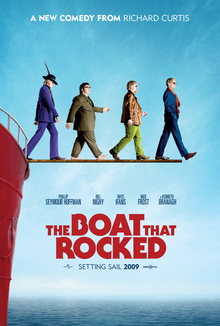
Pirate Radio
In 1966, various pirate radio stations broadcast to the United Kingdom from ships in international waters, specialising in rock and pop music not played on BBC Radio. Seventeen-year-old Carl, recently expelled from school, is sent to stay with his godfather Quentin, who runs the station Radio Rock anchored in the North Sea. The eclectic crew of disc jockeys and staffers, led by brash American DJ "The Count" and DJ "Doctor Dave". In London, government minister Sir Alistair Dormandy resolves to shut down pirate radio stations for their commercialism and immorality, instructing his subordinate Twatt to pursue legal stratagems to accomplish this. They attempt to cut off the pirates' revenue by prohibiting British businesses from advertising on unlicensed stations. Quentin counters by bringing massively popular DJ Gavin Kavanagh out of retirement on Radio Rock, enticing advertisers to pay their bills from abroad. Gavin's popularity creates a rivalry with The Count. Carl becomes smitten with Quentin's niece Marianne, but is heartbroken when she is seduced by Doctor Dave, while DJ "Simple" Simon Swafford marries glamorous fan Elenore in an onboard ceremony, but learns that she only married him to be near Gavin. The Count challenges Gavin to a game of chicken in defence of Simon's honour: The stubborn rivals climb the ship's radio mast to a dangerous height, but reconcile after they are both injured jumping into the ocean. Shortly after, Carl's mother Charlotte visits for Christmas, and denies that Quentin is his father. Carl gives her a cryptic message from reclusive late-night DJ "Smooth" Bob Silver, unexpectedly revealing that Bob is his father. Marianne arrives to apologise to Carl for sleeping with Dave, and she and Carl have sex. The following morning, the DJs announce news of the coupling to cheering fans across Britain. Meanwhile, Dormandy's vendetta against pirate radio advances when Twatt finds news of a fishing boat whose distress call was blocked by Radio Rock's powerful signal. Twatt proposes the creation of the Marine, &c., Broadcasting (Offences) Act 1967, making pirate radio stations illegal on the grounds that they endanger communication with other vessels. Despite heavy public support for the pirate stations, the act passes unanimously through Parliament and takes effect at midnight on 1 January 1967. The Radio Rock crew defy the law and continue broadcasting, firing up the ship's engine to evade arrest. The aging vessel's engine explodes, and the ship sinks. The DJs broadcast their position in hope of aid, and Twatt appeals to Dormandy to send rescue boats, but Dormandy refuses. Carl saves the oblivious Bob from his cabin while The Count vows to broadcast as long as possible. With the lifeboats inoperable, the crew gather on the prow as the ship goes down. They are rescued by dozens of fans in a fleet of small boats, with Carl being saved by Marianne. The Radio Rock ship disappears beneath the sea, with the Count emerging at the last moment.

The Heroes of Telemark
The Norwegian resistance sabotage the Vemork Norsk Hydro plant in the town of Rjukan in the county of Telemark, Norway, which the Nazis are using to produce heavy water, which could be used in the manufacture of an atomic bomb. Rolf Pedersen, a Norwegian physics professor, who, though originally content to wait out the war, is soon pulled into the struggle by local resistance leader Knut Straud (based on Knut Haukelid). Rolf's ex-wife Anna also becomes involved in the effort, and her relationship with Rolf reignites. Rolf and Knut sneak out of Norway on a passenger steamship to Britain that they hijack so they can deliver microfilmed plans of the hydroelectric plant to the British, who are impressed by the information. Then the two return to Norway by parachute to plan a commando raid against the plant. When a British plane carrying a force of Royal Engineers to undertake the raid is shot down over Norway by the Germans, Pedersen and Straud lead a small force of Norwegian saboteurs into the plant. The raid is successful, but the Germans quickly replace and repair the equipment. A Quisling (traitor) saboteur worms his way into the resistance group, after they debate whether to shoot him or not. He ends up escaping and betraying them, so that a German plane blows up their safe house. When the Nazis and the saboteur pursue Rolf and Knut, Rolf and the saboteur end up alone, and Rolf kills him. When Rolf and Knut learn of German plans to ship steel drums of heavy water to Germany, they sabotage the ferry carrying the drums, and it sinks in the deepest part of a fjord. Rolf himself ends up on the ferry when he sees a resistance comrade's widow and her young child getting aboard; Rolf improvises a "game" whereby all the children on board practise with lifejackets at the stern of the ship. Thus, when the ferry sinks, the children, and Rolf and the widow, are able to escape. Knut and Anna, in a small boat, come and help rescue passengers.

Good Burger
On the first day of summer, slacker high school student Dexter Reed takes his mother's car on a joyride while she is away on a business trip but is indirectly involved in a car crash with his school teacher, Mr. Wheat. With no driver's license or car insurance, Dexter is in danger of going to jail, but Mr. Wheat agrees to let him pay for the damage in exchange for not calling the police on him. With the damage estimated at $1,900 (which later becomes $2,500), plus $800 to fix his mother's car. Dexter decides to take a summer job to pay for the expenses. After his dismissal from the new and soon-to-open Mondo Burger restaurant for clashing with the owner and manager Kurt Bozwell, he ends up working for Good Burger instead, mainly as the delivery boy. There, he meets and reluctantly befriends the dimwitted but well-meaning cashier Ed alongside its other employees. While both are working together, Dexter soon recognizes Ed who caused his car crash, but eventually forgives him. After it's grand opening, Mondo Burger becomes an immediate success with its large burgers, hurting Good Burger's business. As Good Burger was days away from closing down, Dexter discovers that Ed made a tasty sauce for his lunch and suggests adding it to the burgers, which saves Good Burger and vastly increases its sales. Dexter exploits Ed's gullibility to extort money from him so that he can pay off his debt sooner, having him sign a contract that gives Dexter 80% of the bonus he receives for his sauce while warning Ed to never reveal the recipe to anyone. After failing to entice Ed with a higher hourly wage at Mondo Burger, Kurt, who wants the secret sauce for his restaurant and Good Burger shut down, sends an employee named Roxanne to seduce him into revealing the recipe. However, while on a double date with Dexter and co-worker Monique, Ed accidentally and clumsily injures her repeatedly, and she quits her job. The next day, Monique finds Dexter's contract and scolds him for taking advantage of Ed, causing Dexter to feel remorseful. Dexter tries to apologize to Ed, but before he can do so, he and Ed discover a stray dog rejecting a discarded Mondo Burger for a Good Burger. Suspicious, the two infiltrate Mondo Burger's kitchen in disguise and discover that their burgers are artificially enhanced with an illegal food chemical known as Triampathol. Kurt discovers them and has them committed to the Demented Hills Asylum to prevent them from sharing their discovery. Afterward, Kurt and his henchmen break into Good Burger and taint Ed's secret sauce with a synthetic toxin called shark poison. Otis, an elderly employee who was sleeping on the premises, catches them and attempts to call the police, but Kurt sends him to Demented Hills as well. After Otis informs Ed and Dexter about Kurt's scheme, they escape from Demented Hills and commandeer an ice cream truck to head back to Good Burger. Two Demented Hills employees chase after them in a truck, but Ed pelts their windshield with ice cream, eventually obstructing their view and causing them to crash. Ed arrives at Good Burger just in time to prevent an elderly woman from eating the poisoned sauce. Ed and Dexter return to Mondo Burger to expose their crimes to the police. While Dexter creates a distraction, Ed takes multiple cans of Triampathol and pours them into the meat grinder. As Kurt corners Dexter on the roof, Ed suddenly arrives with an empty can just before Mondo Burger collapses, as the burgers start exploding due to the excessive Triampathol. Afterwards, Mondo Burger is shut down and Kurt is arrested for poisoning Good Burger's sauce and using illegal Triampathol on his meat. After giving Mr. Wheat a down payment, Dexter apologizes to Ed for taking advantage of him and tears up the contract, telling him that he gets to keep all the profits. Ed and Dexter return to Good Burger, where their co-workers hail them as heroes.
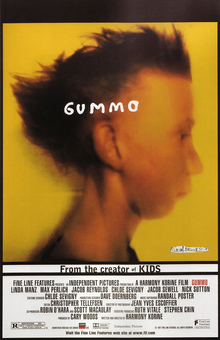
Gummo
A young boy named Solomon narrates the events of the tornado that devastated the city of Xenia, Ohio. A mute adolescent boy, known as Bunny Boy, wears only pink bunny ears, shorts, and tennis shoes on an overpass in the rain. A boy carries a cat by the scruff of its neck, and then drowns it in a barrel of water. The film then cuts to a different scene with Tummler — a friend of Solomon — in a wrecked car with a girl. They fondle each other, and Tummler realizes there is a lump in one of the girl's breasts. Tummler and Solomon then ride down a hill on bikes. In narration, Solomon describes Tummler as a boy with "a marvelous persona", whom some people call "downright evil". Later, Tummler aims an air rifle at a cat. Solomon stops him from killing the cat, protesting that it is a housecat. They leave and the camera follows the cat to its owners' house. The cat is owned by three sisters: teenagers, Dot and Helen, and pre- pubescent Darby. The film cuts back to Tummler and Solomon hunting feral cats, which they deliver to a local grocer who intends to butcher and sell them to a local Chinese restaurant. The grocer tells them that they have a rival in the cat-killing business. Tummler and Solomon buy glue from the grocer, which they use to get high via huffing. The film then cuts to a scene in which two foul-mouthed young boys dressed as cowboys destroy things in a junkyard. Bunny Boy arrives and the other boys pretend to shoot him dead with cap guns. Bunny Boy plays dead and the boys curse at his corpse, rifle through his pockets, then remove and throw one of his shoes. They grow bored with this and leave Bunny Boy sprawled on the ground. Tummler and Solomon track down a local boy who is poaching "their" cats. The poacher, named Jarrod Wiggley, is poisoning the cats, rather than shooting them. When Tummler and Solomon break into Jarrod's house with masks and weapons with intent to hurt him, they find photos of the young teen cross-dressing and his elderly grandmother, who is catatonic and attached to life support machinery. Jarrod is forced to care for her, which he had earlier opined was "disgusting". Seeing that Jarrod is not home, Tummler and Solomon decide to leave. Tummler then discovers the grandmother lying in her bed, states that it is "no way to live", and turns off the life support machine. A number of other scenes are interspersed throughout the film, including: an intoxicated man (played by Korine) flirting with a male dwarf; a man pimping his disabled sister to Solomon and Tummler; the sisters encountering an elderly child molester; a pair of twin boys selling candy door-to-door; a brief conversation with a tennis player who is treating his ADHD; a long scene of Solomon eating dinner while taking a bath in dirty water; a drunken party with arm- and chair-wrestling; and two skinhead brothers boxing each other in their kitchen. There are also a number of even smaller scenes depicting Satanic rituals, footage seemingly from home movies, and conversations containing racial bigotry. The penultimate scene in the movie is set to the song " Crying " by Roy Orbison, which had been previously mentioned by Tummler as the song his older sibling, who was transgender, would sing (the sibling eventually went to the "Big City" and abandoned him). It begins with Bunny Boy kissing the teenage sisters in a swimming pool, then cuts to Solomon and Tummler shooting the sisters' cat repeatedly with their air rifles in the rain. After showing some home video footage of tornadoes, it cuts to Bunny Boy running towards the camera through a field holding the body of the dead cat, which he shows to the audience, breaking the fourth wall. The final scene shows a girl, who shaved her eyebrows earlier in the movie, singing " Jesus Loves Me " in bed next to her mother (or sister). The film finally cuts to black as the girl singing is told to "dial it down" and go to bed.

The Fringe Dwellers
Trilby (Kristina Nehm) is a young Aboriginal woman living with her people on the outskirts of everyday Australian society. Trilby encourages her mother (Justine Saunders) to apply for a Housing Commission home being built in an area inhabited mostly by wealthier white families. Her mother, sister Noonah, and Trilby save enough for them all (father and younger brother as well) to move there from the "fringe". They buy some new furniture for the house and improve their station in life. But there is a culture clash. Trilby learns that her family is actually happier surrounded by their community and extended family, and that her own goals are not necessarily the goals of others in her life. With xenophobic neighbours casting a constant judgemental eye, Trilby and her boyfriend, Phil (Ernie Dingo), attempt to find happiness in their new environment. Trilby becomes pregnant, gives birth, but drowns her baby, making it look like an accident. Her family leave their suburban house after Trilby's father loses all their rent money in a card game: the family return to their house in the camp. Trilby, however, leaves on a bus bound for the city.

The Diving Bell and the Butterfly
The first third of the film is told from the main character's, Jean-Dominique Bauby, or Jean-Do as his friends call him, first person perspective. The film opens as Bauby wakes from his three-week coma in a hospital in Berck-sur-Mer, France. After an initial falsely positive description from one doctor, a neurologist explains that Bauby has locked-in syndrome, an extremely rare condition in which the patient is almost completely physically paralyzed, but remains mentally unchanged. At first, the viewer primarily hears Bauby's "thoughts" (he thinks that he is speaking but no one hears him), which are inaccessible to the other characters (who are seen through his one functioning eye). A speech therapist and physical therapist try to help Bauby become as functional as possible. Bauby cannot speak, but he develops a system of communication involving blinking his left eye as his therapist reads a list of letters; with this process, Bauby spells out messages one letter at a time. Gradually, the film's restricted point of view widens, and the viewer begins to see Bauby through scenes from his past as well as via the perspectives of those around him. The film shows a visit to Lourdes and conveys Bauby's fantasies about beaches, mountains, the Empress Eugénie and an erotic feast with one of his transcriptionists. We learn that Bauby had been editor of the popular French fashion magazine Elle, and that he had a deal to write a book reimagining The Count of Monte Cristo from a female perspective. He decides that he will still write a book, using his slow and exhausting communication technique. A woman from the publishing house with which Bauby had the original book contract takes dictation. The new book describes his current life, trapped in his body, which he sees as being suspended in murky water within an old-fashioned deep-sea diving bell with brass helmet, which is called a scaphandre in French. But those around him describe his still-vibrant spirit as a butterfly. The story of Bauby's writing is juxtaposed with his recollections and regrets prior to his stroke. We see his three children, their mother, his mistress, his friends, and his father. He encounters people from his past whose lives bear similarities to his own "entrapment": a friend who was kidnapped in Beirut and held in solitary confinement for four years, and his own 92-year-old father, who is confined to his own apartment, because he is too frail to descend four flights of stairs. Bauby eventually completes his memoir and hears the critics' responses. He dies of pneumonia ten days after its publication. The closing credits are accentuated by reversed shootings of breaking glacier ice (the forward versions are used in the opening credits), accompanied by the Joe Strummer & the Mescaleros song "Ramshackle Day Parade".

The Grab
The film follows investigative journalists at The Center for Investigative Reporting as they uncover efforts by sovereign powers, private finance, and mercenary groups to take control over global food and water supplies in preparation for potential production collapses due to climate change. The film outlines how several nation states and other actors use force, economics, and illegal mercenaries to take control of food and water stocks. The narrative begins with the 2014 purchase of US-based Smithfield Foods by Chinese WH Group, which the filmmakers say gave WH Group ownership of over a quarter of all pigs in the US. It then follows other hard-to-explain deals, such as the purchase of arid land in Arizona by a Saudi -based company, Russians hiring American cowboys to work in a region too cold for farmland, and Blackwater deals to secure land in Africa. They " follow the money " behind these strange commercial arrangements and identify connections between governments, commercial enterprises and legal and illegal military actors such as mercenary companies. The filmmakers ultimately draw the conclusion these actions are all part of separate efforts by these groups to position themselves to take advantage of collapses in food and water production due to the effects of climate change such as increased severe weather and drought. While the film is mostly archive and research image collages, it also contains some guerrilla film making, such as of the crew being denied access and detained at a Zambian airport.

The Fool
Dima Nikitin, a plumber, is a municipal repair-crew chief living in an unnamed Russian town. Determined to improve his family's finances by attending engineering school, he is negatively affected by his cynical community. He lives with his hasty mother, apathetic father, and wife and son. When Nikitin discovers a leaky pipe in a building and goes outside to inspect a related crack in the wall, he notices the entire building is leaning. Determining the building will collapse within the next 24 hours, the compassionate Nikitin attempts to alert authorities: Arriving at a birthday party for Mayor Nina Galaganova, he realizes everyone is too intoxicated to understand the severity as they dismiss the validity of Nikitin's claim with various cynical jokes. They finally become concerned once they realize they will be publicly ruined after the collapse. They begin to criticize each other the corruption they all participate in until they are faced with the difficulty of abruptly trying to relocate the building's 820 residents. Galaganova sends Public Housing Inspector Fedotov and Fire Chief Matyugin to assess the damage with Nikitin. The officials accept that the building will collapse after Nikitin demonstrates the tilt by rolling a bottle off the building's roof. They report their findings to Galaganova and her political entourage who all realize that an evacuation of this scale would cause a financial review and reveal years of administrative corruption. Galaganova and Deputy Mayor Bogachyov decide to pin the expected building collapse on Fedotov and Matyugin. Nikitin, Fedotov, and Matyugin are told by Police Chief Sayapin that arrangements are being made for evacuation. The three men are put into a police van allegedly to meet Galaganova, but instead, they are driven to a remote location on the city outskirts. Fedotov and Matyugin realize that Galaganova wants to eliminate them and use them as scapegoats for the collapse. Fedotov pleads with the policemen to release Nikitin and they reluctantly agree, instructing him to leave the city with his family immediately. Matyugin and Fedotov are executed. As Nikitin attempts to leave town with his family, he realizes no one is evacuating the building. When his wife Masha scolds him for wanting to help the residents, who are "nobodies", he says, "We live like animals and we die like animals because we are nobodies to each other." He tells her to leave and, taking matters into his own hands, goes from door to door urging residents to leave before the building collapses. As the residents all gather outside, they soon become annoyed by the disruption and decide they do not believe him. The final scene shows Nikitin laying in a fetal position after the angry residents all attack and severely beat him.

Gamer
In 2034, computer programmer Ken Castle invents self-replicating nanites that replace brain tissue and allow humans to control other humans' actions and see through their eyes. The first application of Castle's "Nanex" technology is a virtual community life simulation game, Society, which allows gamers to manipulate live actors as their avatars. Society becomes a worldwide sensation, making Castle the richest man in the world. He then creates Slayers, a third-person shooter where the "characters" are death-row prisoners using real weapons in specially designated areas. Unlike Society actors, Slayers participants are not paid; instead, they volunteer, and any Slayer who survives 30 matches will earn their freedom. John "Kable" Tillman is everyone's favorite, having survived a record 27 matches, and is controlled by 17-year-old gamer Simon Silverton. An activist organization called the "Humanz" hacks a talk-show interview with Castle and claims that his technology will one day be used to control people against their will. The Humanz also disrupts Society play, but Castle sees both these actions as trivial. However, Castle feels threatened by Kable's winning streak and introduces a new inmate into Slayers, Hackman, specifically to kill Kable. Unknown to anyone else, Hackman will not be controlled by a player, thus not be handicapped by the "ping" that causes a small but dangerous delay between the player's command and the Slayer's action. Kable's estranged wife, Angie, works as a Society character, but in spite of her earnings, she is refused custody of their daughter, Delia, who has been placed with a wealthy foster family. The Humanz contact Kable and Simon separately and offer to create a mod that will let him escape, but only if Simon relinquishes control during the game. Simon is even given a mod to speak freely to Kable. The escape is successful, and news outlets report that Kable has been fragged, which puts Simon in a difficult position: he is labeled a "cheater", locked out of his account which is spammed with hate mail, his father's asset frozen, and arrested by the FBI for helping Kable escape. Kable is brought to the Humanz' hideout; he refuses to help their fight against Castle but learns of Angie's current location in Society. He rescues her, escaping from both Hackman and Castle's security forces. Gina, the talk show host who secretly assists the Humanz, meets them. The Humanz deactivates the nanites in Angie and Kable's brains, and Kable remembers that the original nanites were tested on him while he was still in the military. Under Castle's control, Kable shot and killed his best friend and was imprisoned. Upon learning that Castle is the wealthy father who adopted Delia, Kable infiltrates his mansion to get her back. He locates Castle, who reveals that his henchmen have already tracked down the Humanz' lair and killed all of them. He also reveals that 98% of his own brain has been replaced with nanites, but this allows him to control others rather than be controlled. He plans to release airborne nanites, which will infect the entire country within six months, giving him ultimate control. Hackman attacks Kable, who easily kills him. Kable then attacks Castle but is frozen in place as Castle explains that his men have reactivated his and Angie's nanites. Unknown to Castle, Gina and Trace escape and patch into the Nanex, exposing the confrontation to the world and exposing Castle's plans worldwide. They also restore Simon's account, restoring access of Kable. Castle tries to manipulate Kable into killing his own daughter, but he resists, allowing Simon to control him and attack Castle. He and Simon wrestle for control, but Kable tells Castle to imagine his knife stabbing him. Castle unconsciously does so, allowing Kable to kill him and removing his control over everyone. With Castle dead, Kable convinces his technicians to deactivate the Nanex, freeing all the "characters" in Society and Slayers.