Movies (Page 36)
Browse 2,069 movies from the database, mentioned on Hacker News, ranked by rating or popularity.

Brotherhood of the Wolf
During the French Revolution, Marquis d'Apcher writes his memoirs in his castle. He recounts his experiences in 1764, when a mysterious beast terrorized the county, or historical area, of Gévaudan. Grégoire de Fronsac, a knight and the royal naturalist of King Louis XV, and his Iroquois companion Mani, arrive to capture the beast. Fronsac becomes interested in Marianne de Morangias, the daughter of a local count, whose brother, Jean-François, was also an avid hunter and a world traveller, whose arm was mangled and rendered useless while overseas. Fronsac is also intrigued by Sylvia, an Italian courtesan at the local brothel. While investigating another victim, Fronsac finds a fang made of steel. A traumatized child witness swears that the beast is controlled by what seems to be a human master. As the investigation proves unfruitful, the king's weapons master, Lord de Beauterne, arrives to put an end to the beast, and Fronsac is sent back to Paris. He realizes that the beast is actually an instrument of a secret society: The Brotherhood of the Wolf, which is working to undermine public confidence in the king and ultimately take over the country. Back in Gévaudan, the attacks by the real beast continue, and Fronsac returns to put an end to the beast's killings. At a secret rendezvous with Marianne, they are attacked by the beast, where it mysteriously refrains from attacking her. Fronsac, Mani, and a young Marquis set out into the forest and set up an array of traps to capture the beast; it is severely injured but escapes. Mani sets off alone in pursuit, where he finds a catacomb used as the beast's holding pen, inhabited by the Brotherhood. Outnumbered, Mani is shot and killed. Fronsac discovers Mani's body and performs an autopsy, finding a silver bullet —Jean-François' signature choice of ammunition. In a fit of rage, a vengeful Fronsac goes to the catacombs and slaughters many members, but is overpowered by the local authorities and imprisoned. Sylvia visits him in jail and reveals that she is a spy for the Holy See. She explains that Henri Sardis, the local priest and leader of the Brotherhood, believes that he is restoring worship of God to France. Pope Clement XIII has decided that Sardis is insane, and has sent her to eliminate him. She then poisons Fronsac, saying that he knows too much. Meanwhile, Jean-François comes to Marianne's room and reveals to her that he is the beast's master; it recognized his scent on her when it came near her, which is why it did not attack. He then rapes her when she rejects his advances. Sylvia's agents exhume Fronsac and he appears at one of the Brotherhood's sermons. He kills several members, including Jean-François, who reveals that he had regained use of his supposedly mangled arm. Sardis escapes into the mountains, but is mauled to death by a pack of wolves. Fronsac and the Marquis go to the beast's lair, where it lies severely wounded. It turns out that the beast was a lion that Jean-François brought back from Africa as a cub that was tortured into becoming vicious and trained to wear spiked metal armor. Fronsac takes pity and kills the beast in an act of mercy. Marquis d'Apcher finishes writing his account just before he is led to his execution by a revolutionary mob. He states that he doesn't know what happened to Fronsac and Marianne after the death of the beast; but he hopes that somewhere, they are happy together. A final scene shows Fronsac and Marianne sailing on a ship named Frère Loup—Brother Wolf.

Brick
High school student Brendan Frye discovers a note directing him to a pay phone, where he receives a call from his ex-girlfriend Emily Kostich, begging him for help. She mentions a "bad brick", "the Pin", and "Tug" before abruptly hanging up, apparently afraid of a passing black Ford Mustang, from which a distinctively-branded cigarette is thrown. Unable to locate Emily, Brendan enlists his friend Brain for help. An encounter with another ex-girlfriend, Kara, leads him to a party held by flirtatious upper-class girl Laura Dannon and her boyfriend, Brad Bramish. Laura points Brendan to Dode, Emily's drug-addicted new boyfriend, who arranges a meeting with Emily. Emily dismisses the phone call as a mistake and tells Brendan to let her go. Brendan steals her notepad and finds a note that leads him to her dead body in a tunnel the following morning where he is beaten by an unidentified assailant. Brendan decides to investigate her murder, hiding the body deeper within the tunnel to avoid police involvement. With help from Brain, Brendan realizes that "the Pin" refers to a local kingpin. Brendan picks a fight with Brad, hoping to attract the Pin's attention. Later, a man wearing a beanie attacks Brendan. Later Brendan sees the black Mustang in a parking lot and is attacked by the beanie-wearing thug as he demands to meet the Pin instead of fighting back. The man, revealed as Tug, the Pin's main enforcer, takes Brendan to the Pin's house. Laura reveals that she was at the Pin's house as well and drives Brendan back to school. She explains that Emily stole a "brick" of heroin after being rejected by the Pin's operation. Laura offers to help Brendan, but he distrusts her. The next day, the Pin hires Brendan. Dode calls Brendan and says he saw Brendan hide Emily's body and believes Brendan killed Emily. Brendan meets the Pin, who suspects that Tug is planning to betray him. At the Pin's house, Tug tells Brendan that the Pin had bought ten bricks of heroin and eight were sold off wholesale, the ninth was stolen and returned contaminated, and the final brick remains to be sold. The Pin reveals that Tug was also romantically involved with Emily. Brendan intercepts Dode on the way to the meeting and discovers Emily was pregnant when she died; Dode believes the baby was his. Brendan arrives at the meeting to find Dode demanding money to reveal who killed Emily. Tug goes berserk and shoots Dode in the head, then threatens the Pin, who walks away as Brendan faints. Brendan awakens in Tug's bedroom, and Tug tells him they are at war with the Pin. Brendan arranges a meeting between the two and waits in Tug's bedroom. Laura comforts him as he grieves for Emily, and he recognizes her cigarette as the same brand that was dropped from the Mustang during the call with Emily. At the meeting, chaos erupts when it is discovered that the tenth brick is missing. Tug beats the Pin to death while Brendan flees, escaping just as police arrive. As he goes, he passes the open trunk of Tug's car, where he has placed Emily's body to ensure that police blame her murder on Tug. The next day, Brendan meets Laura at the school. She reveals that Tug died after a shootout with the police. Brendan explains that he knows Laura set Emily up to take the fall for Laura's theft of the ninth brick, then manipulated Emily into meeting Tug, who panicked and killed her after she told him he was the father of her unborn child. Brendan has written a note to the school administration stating that the tenth brick is in Laura's locker. Laura vindictively tells Brendan that Emily did not want to keep the baby because she did not love the father, and that Emily was three months pregnant when she died, meaning the unborn child was his. The movie ends with Brendan and Brain on the football field watching Laura walk away.
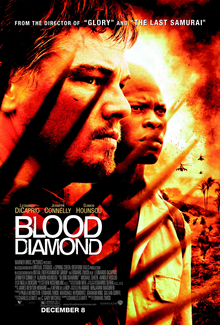
Blood Diamond
In 1999, Sierra Leone is ravaged by civil war. The Revolutionary United Front terrorizes the countryside and enslaves many locals to harvest diamonds, which fund their increasingly successful war effort. Solomon Vandy, a Mende fisherman from Shenge, is separated from his family and assigned to a workforce overseen by Captain Poison, a ruthless warlord. While mining a river, Vandy discovers an enormous pink diamond. Captain Poison tries to take the stone, but the area is suddenly raided by government troops. Vandy buries the stone before being captured. Vandy and Poison are incarcerated in Freetown with Danny Archer, a white Rhodesian gunrunner and Angola War veteran jailed for trying to smuggle diamonds into Liberia. The diamonds were intended for Rudolph van de Kaap, a corrupt Afrikaner mining executive from South Africa. Hearing of the pink diamond in prison, Archer arranges for him and Vandy to be freed. He travels to Cape Town to meet his employer: Colonel Coetzee, an Afrikaner formerly with the apartheid -era South African Defence Force (whom Archer also served under in the 32 Battalion), which now commands a private military company. Archer wants the diamond so he can sell it to Van de Kaap and retire, but Coetzee wants it as compensation for Archer's botched smuggling mission. Archer returns to Sierra Leone, locates Vandy, and offers to help him find his family if he will help recover the diamond. The RUF conquers Freetown, while Vandy's son Dia is captured to serve as a child soldier under a liberated Captain Poison. Archer and Vandy narrowly escape to Lungi, where they plan to reach Kono with the help of an American journalist, Maddy Bowen, in exchange for Archer providing evidence of the illicit diamond trade. Maddy helps Vandy locate his remaining family at a refugee camp in Guinea. While they travel, Archer reveals to Maddy that his parents were brutally killed by Black rebels after the fall of Rhodesia (now Zimbabwe). As a child, he fled to South Africa, where he eventually joined the military and served in Angola. Eventually, the trio arrive in Kono after a harrowing journey, where Coetzee and his private army—contracted by the Sierra Leone government—prepares to repulse the rebel offensive. While Maddy gets out with her story, the two men set out for Captain Poison's encampment. Dia, stationed with the RUF garrison there, is confronted by Vandy, but having been brainwashed he refuses to acknowledge his father. Archer radios the site's coordinates to Coetzee, who directs a combined air and ground assault on the camp. Vandy finds Captain Poison and beats him to death with a shovel as the mercenaries overwhelm the RUF defenders. Coetzee then forces Vandy to produce the diamond, but is killed by Archer, who realizes Coetzee would eventually kill them both. Dia briefly holds the pair at gunpoint, but Vandy confronts him again and renews their familial bond. Pursued by vengeful mercenaries, Archer discloses he has been mortally wounded and entrusts the stone to Vandy, telling him to take it for his family. Vandy and his son rendezvous with Archer's pilot, who flies them to safety while Archer makes a final phone call to Maddy; they share final farewells as he asks her to assist Vandy, and gives her permission to finish her article. Archer finally takes in the beautiful African landscape before dying. Vandy arrives in London and meets with a van de Kaap representative; he exchanges the pink diamond for a large sum of money and being reunited with his entire family. Maddy takes photographs of the deal to publish in her article on the diamond trade, exposing van de Kaap's criminal actions. Vandy appears as a guest speaker at a conference on " blood diamonds " in Kimberley, and is met with a standing ovation.

Ikiru
Kanji Watanabe has worked in the same monotonous, bureaucratic position in the Tokyo public works department for thirty years and is close to retirement. His wife is dead, and his married son, Mitsuo, lives with him only so he can legally claim his estate upon death. At work, Watanabe is a witness to constant bureaucratic inaction. In one case, a group of parents who simply want permission to drain a cesspool so they can install a playground are endlessly sent back and forth between different offices in the same building. After learning he has stomach cancer and has less than a year to live, Watanabe attempts to come to terms with his impending death. He plans to tell Mitsuo about the cancer but decides against it when his son does not pay attention to him. The old man explores the pleasures of Tokyo's nightlife, guided by an eccentric novelist whom he has just met. In a nightclub, Watanabe requests a song from the piano player, and sings " Gondola no Uta " (transl. Life is Brief) with great sadness. His singing greatly affects those watching him. Eventually, he realizes that hedonistic pleasure is only a distraction, not a solution. The following day, Watanabe encounters Toyo, a young female subordinate, who needs his signature on her resignation. He takes comfort in observing her joyous love of life and enthusiasm and tries to spend as much time as possible with her. She eventually becomes suspicious of his intentions and grows wary of him. After persuading her to join him for the last time, he opens up and asks for the secret to her love of life. She says that she does not know, but that she found happiness in her new job making toys, which makes her feel as if she is playing with all the children of Japan. Inspired, Watanabe decides that he should do something meaningful with his job. He surprises everyone by returning to work after a long absence and begins pushing for the playground project, overcoming concerns that he is intruding on the jurisdiction of other departments. Watanabe dies months later, and at his wake, his former co-workers gather after the opening of the playground to figure out what caused such a dramatic change in his behavior. As they drink, they slowly realize Watanabe must have known he was dying, even when his son denies this truth, as he was unaware of his father's condition. They also hear from a witness that, in the last few moments in Watanabe's life, he sat on the swing at the park he built, singing "Gondola no Uta" as the snow fell. The bureaucrats vow to honor Watanabe's memory by following his example yet fall back into the same patterns as before the second they return to their offices, except for one. The film ends with this specific bureaucrat overlooking children frolicking in the new playground and admiring the sky, just like Watanabe.

Blindness
The film begins with a young professional suddenly going blind in his car while at an intersection, with his field of vision turning white. A seemingly kind passerby offers to drive him home. However, he then steals the blind man's car. When the blind man's wife returns home, she takes him to an ophthalmologist who can identify nothing wrong and refers him for further evaluation. The next day, the doctor goes blind, and recognizes that the blindness must be caused by a communicable disease. Around the city, more citizens are struck blind, causing widespread panic, and the government organizes a quarantine for the blind in a derelict asylum. When a hazmat crew arrives to pick up the doctor, his wife lies that she has also gone blind in order to accompany him. In the asylum, the doctor and his wife are first to arrive and agree they will keep her sight a secret. They are joined by several others, including the driver, the thief, and other patients of the doctor. At this point, the "white sickness" has become international, with hundreds of cases reported every day. The government is resorting to increasingly ruthless measures to try to deal with the epidemic, including refusing aid to the blind. As more blinded people are crammed into what has become a concentration camp, overcrowding and lack of outside support cause hygiene and living conditions to quickly degrade. The doctor serves as the representative of his ward, and his sighted wife does what she can to assist her fellow inmates without revealing her ability. Anxiety over the availability of food undermines morale and introduces conflict between the prison's wards, as the soldiers who guard the camp become increasingly hostile. A man with a handgun appoints himself "king" of his ward, and takes control of the food deliveries, first demanding the other wards' valuables, and then for the women to have sex with their men. In an effort to obtain necessities, several women reluctantly submit to being raped. One of the women is killed by her assailant, and the doctor's wife retaliates, killing the "king" with a pair of scissors. Independently, other raped women sneak to the dead king's ward and set it on fire, which rapidly engulfs the building, with many inmates dying in the ensuing chaos. The survivors who escape the building discover that the guards have abandoned their posts, and they venture out into the city. Society has collapsed, with the city's population reduced to an aimless, zombie-like struggle to survive. The doctor's wife leads her husband and a few others from their ward in search of food and shelter. She discovers a well-stocked basement storeroom beneath a grocery store, barely escaping with aid from her husband when the throng around her smell the fresh food she is carrying. The doctor and his wife invite their new "family" to their apartment, where they establish a mutually supportive long-term home. Then, just as suddenly as his sight had been lost, the driver – the first person to lose his sight – recovers his sight, indicating that the body had fought off the disease, and that the blindness is ultimately temporary. They celebrate and their hope is restored.

Insomnia
When 17-year-old Tanja Lorentzen is found murdered in the city of Tromsø, far up in the Norwegian Arctic, Kripos police officers Jonas Engström (Stellan Skarsgård) and Erik Vik (Sverre Anker Ousdal) are called in to investigate. Engström, formerly with the Swedish police, moved to Norway after being caught having sex with the main witness in one of his cases. Vik is nearing retirement age, and his memory is failing. Engström devises a plan to lure the murderer back to the scene of the crime, but the stakeout is blown and the suspect flees into the fog, shooting one of the Norwegian police officers in the leg. Unbeknownst to his unarmed colleagues, Engström carries a gun from his days in the Swedish police, who routinely carry firearms. Firing at what he believes to be the suspect, Engstrom accidentally kills Vik, who had mistakenly run right instead of left as ordered. Realizing that everyone assumes Vik was shot by the fugitive, Engström decides not to admit his culpability. When one of his colleagues, Hilde Hagen (Gisken Armand), is assigned to investigate Vik's death, Engström becomes worried about ballistic fingerprinting and tampers with evidence to support his story. Haunted by guilt and unable to sleep with the midnight sun of the Arctic, Engström becomes increasingly unhinged and starts hallucinating about Vik. Engström learns from one of Tanja's friends that she had been seeing Jon Holt (Bjørn Floberg), a crime novelist. He correctly deduces that Holt killed Tanja, but Holt reveals that he saw Engström shoot Vik. The two decide to frame Tanja's boyfriend Eilert for her murder, with Engström later planting Holt's gun under Eilert's bed and Holt giving testimony about Eilert being abusive. However, Hagen is not convinced, and when new evidence emerges, Engström knows that it is only a matter of time until Holt is arrested. Engström tracks Holt to some waterfront properties that are slowly collapsing into the sea. Holt suspects that Engström has come to kill him and holds him at gunpoint, explaining how he killed Tanja in a fit of rage when she rejected his advances. Holt tries to flee across a pier, but the rotten floorboards give way and he falls into the water below, striking his head on the way down. He drowns as Engström watches. When Engström searches Holt's nearby house, he finds Tanja's dress, which Holt had removed before dumping the body. With Holt dead, and definitive proof he was the murderer, the case is closed. Just before he leaves town, Engström is visited by Hagen, who shows him a cartridge case found at the site where Vik was shot. She notes it is a Norma, which Engström confirms is a brand used by the Swedish police. Engström expects Hagen to arrest him, but instead she simply places the cartridge on a table and leaves. Engström drives out of town, his face and eyes showing great weariness, and he seems not to have recovered from his insomnia.

Blame!
In the distant future, civilization has reached its ultimate Net-based form. An infection in the past caused the automated systems to spiral out of control, resulting in a multi-leveled city structure that grows indefinitely in all directions. Now humanity has lost access to the city's controls and is hunted down to be purged as "illegal" by the defense system known as the Safeguard. In a village, a tribe known as the Electro-Fishers is facing eventual extinction, trapped between the threat of the Safeguard and dwindling food supplies. A girl named Zuru goes on a journey to find food with a group of friends, only to inadvertently trigger a Watchtower which spawns robotic exterminators. Most of her companions are killed, but Zuru and her close friend Tae are saved by a mysterious wanderer, Killy. Killy is brought to the village, where he meets Pop, their leader, who is interested in Killy after learning that he comes from 6000 levels below. Killy reveals that he is on a quest to find someone with the Net Terminal Gene, which would allow accessing the Netsphere and regaining control of the city. Killy solves the village's food problem by passing them a large number of rations. He leaves for an area below the village named the Rotting Shrine, and followed by Zuru and Tae, he finds the spoilt machine-corpse of Cibo, a former scientist from before the disaster. Cibo reveals that she built a shield generator that protects the village from the Safeguard and reveals that it is possible to produce more food rations at a nearby automated factory. Heeding her words, a group of Electro-Fishers including Tae and Zuru travel to the automated factory in search of more rations. Arriving there, Cibo logs into the system and produces a large number of rations, which the Electro-Fishers quickly begin gathering. However, right after she produces a machine for Killy, the system rejects her log-in and starts to mass-produce Exterminators to eliminate the Electro-Fishers. Cibo builds a new body for herself and they all escape through a railway car. During the ride, Killy is knocked unconscious fending off exterminators. Upon arrival, the Electro-Fishers celebrate the new supplies while also mourning the losses during the trip. Cibo secretly wakes Killy up with only Zuru as a witness and leads him down towards the shield generator with the machine. While heading down, Tae takes her gun to the observatory platform and shoots the shield generator, whereupon it is revealed that the real Tae was killed and impersonated by a Safeguard agent back at the factory. Calling herself Sanakan, she proceeds to kill most of the villagers, deeming them illegal residents while destroying the village in the process. Killy notices and runs back up to the village. Cibo travels further down, sets the machine and connects herself to it. The village elders frantically lead the rest to the top of the village, resisting Sanakan using their remaining weapons. Killy enters combat with Sanakan, who after knocking him down notes that he is a body stolen from the Safeguard. Zuru throws the gun to Killy and he manages to shoot Sanakan, but not before she destroys Cibo's body. In the Netsphere, Cibo pleads with the Authority controlling the Safeguard to let the villagers go. She is forbidden to do so, but is instead allowed access to the City's map, revealing an abandoned level safe from Safeguard control where the villagers can migrate to. Cibo, now functioning through her only remaining arm, leads the remaining villagers to an elevator, but a Watchtower spots them and begins spawning exterminators. Killy throws the device which has been keeping him safe from the Safeguard to Zuru, upon which he says that he still wants to find the Net Terminal Gene, which enables human control of the city and all machines, including the Safeguard. Killy seemingly sacrifices himself so that the villagers can escape. Later it is revealed that the Electro-Fishers successfully reached the abandoned level and established a new village there. Zuru's granddaughter reminisces of the times when she used to tell her about Killy, hopeful that Killy is still on his quest, which the final shot of the film confirms.

Casablanca
In December 1941, American expatriate Rick Blaine owns a nightclub and gambling den in Casablanca, then in French Morocco. "Rick's Café Américain" attracts a varied clientele, including Vichy French and German officials, refugees desperate to reach the still-neutral United States, and those who prey on them. Although Rick professes to be neutral in all matters, he ran guns to Ethiopia in 1935 and fought on the Republican side in the Spanish Civil War. Petty crook Ugarte boasts to Rick of letters of transit obtained by murdering two German couriers. The papers allow the bearers to travel freely around German-occupied Europe and to neutral Portugal. Ugarte plans to sell them at the club and persuades Rick to hold them for him; however, Ugarte is arrested by the local police under Captain Louis Renault, the unabashedly corrupt prefect of police. Ugarte is killed while in custody without revealing that Rick has the letters. Then, the reason for Rick's cynical nature—former lover Ilsa Lund—enters his establishment. Spotting Sam, Rick's friend and house pianist, Ilsa asks him to play " As Time Goes By ". Rick storms over, furious that Sam disobeyed his order to never perform that song again, and is stunned to see Ilsa. She is accompanied by her husband, Victor Laszlo, a renowned fugitive Czechoslovak Resistance leader. A flashback reveals Ilsa left Rick without explanation when the couple were planning to flee as the German army neared Paris in 1940, embittering Rick. Laszlo and Ilsa need the letters to escape, while German Major Strasser arrives in Casablanca to prevent that. When Laszlo makes inquiries, Signor Ferrari, an underworld figure and Rick's friendly business rival, divulges his suspicion that Rick has the letters. Laszlo returns to Rick's café that night and tries to buy them. Rick refuses to sell, telling Laszlo to ask his wife why. They are interrupted when Strasser leads a group of German officers in singing " Die Wacht am Rhein ". Laszlo orders the house band to play " La Marseillaise ", and Rick allows it. Patriotism grips the crowd and everyone joins in, drowning out the Germans. Afterwards, Strasser has Renault close the club on a flimsy pretext. Later, Ilsa confronts Rick in the deserted café; when he refuses to give her the letters, she threatens him with a gun but then confesses she still loves him. She explains that when they met and fell in love in Paris, she believed her husband had been killed while attempting to escape from a concentration camp. When she learned that Laszlo was alive and in hiding, she left Rick without explanation to nurse her sick husband. Rick's bitterness dissolves. He agrees to help, letting Ilsa believe she will stay with him, while Laszlo leaves Casablanca. When Laszlo unexpectedly shows up, having narrowly escaped a police raid on a Resistance meeting, Rick has waiter Carl spirit Ilsa away. Laszlo, aware of Rick's love for Ilsa, tries to persuade him to use the letters to take her to safety. When the police arrest Laszlo on a trumped-up charge, Rick persuades Renault to release him by promising to set Laszlo up for a much more serious crime: possession of the letters. To allay Renault's suspicions, Rick explains that he and Ilsa will use the letters to leave for America. When Renault tries to arrest Laszlo as arranged, however, Rick forces him at gunpoint to assist in their escape. At the last moment, Rick makes Ilsa board the plane to Lisbon with Laszlo, telling her that she would regret it if she stayed, "Maybe not today, maybe not tomorrow, but soon and for the rest of your life." Strasser, tipped off by Renault, drives up alone. Strasser attempts to stop the plane and then draws a gun on Rick; the latter shoots him dead. When policemen arrive, Renault pauses, then orders them to "round up the usual suspects." He suggests to Rick that they join the Free French in Brazzaville. As they walk away into the fog, Rick says, "Louis, I think this is the beginning of a beautiful friendship."

I, Daniel Blake
Daniel Blake, a widowed 59-year-old joiner from Newcastle, has had a heart attack. Though his doctor has not allowed him to return to work, he is deemed fit to do so after a Work Capability Assessment and is denied Employment and Support Allowance. Daniel is frustrated to learn that his doctor was not contacted about this decision and thus applies for an appeal, a process Daniel finds difficult because he must complete forms online and is not computer literate. Daniel befriends Katie Morgan, a single mother, after she is sanctioned for arriving late to her Jobcentre appointment. Katie and her children have just moved to Newcastle from a homeless shelter in London, as there is no affordable accommodation. Daniel helps the family by repairing objects, teaching them how to heat rooms without electricity, and crafting wooden toys for the children. During a food bank visit, Katie breaks down crying, having become overwhelmed by hunger due to feeding her children instead of herself. After she is caught shoplifting at a supermarket, a security guard secretly offers Katie work as a prostitute. Daniel surprises her at the brothel where she goes to work and begs her to give up the job, but Katie tearfully insists she has no other way to feed her children. As a condition for receiving Jobseeker's Allowance, Daniel must keep looking for work. He refuses a job at a garden centre because his doctor will not allow him to work yet. When his work coach tells him he must work harder to find a job or be sanctioned, Daniel spray paints "I, Daniel Blake, demand my appeal date before I starve" on the side of the building. Daniel earns the support of bystanders, including other people claiming benefits, but is arrested and cautioned by the police. Daniel sells most of his belongings and becomes a recluse but is pulled out of his depression by Katie's daughter, Daisy, who brings him a homemade meal to repay Daniel for his kindness. On the day of Daniel's appeal, Katie accompanies him to the tribunal, where a welfare adviser tells Daniel that his case looks promising. Upon seeing the judge and doctor who will decide his fate, Daniel becomes anxious and excuses himself to use the toilet, where he suffers another heart attack and dies. Later, Katie reads a eulogy at his public health funeral, including a speech he had intended to read at his appeal. The speech describes his feelings about how the welfare system failed him, and states, "I am not a blip on a computer screen or a national insurance number, I am a man."

Cool Hand Luke
In early 1950s Florida, decorated World War II veteran Lucas "Luke" Jackson drunkenly beheads several parking meters. He is sentenced to two years on a chain gang in a prison camp run by the Captain, a stern warden, and Walking Boss Godfrey, a quiet rifleman nicknamed "the man with no eyes" because he always wears mirrored sunglasses. There, even minor violations are punished by "a night in the box", a small wooden booth in the prison yard with limited air and space. Luke refuses to observe the established order among the prisoners and quickly runs afoul of their leader, Dragline. When the two have a boxing match, Luke is severely outmatched but refuses to acquiesce. Eventually, Dragline stops the fight, but Luke's tenacity earns the prisoners' respect and draws the guards' attention. Luke later wins a poker game by bluffing with a hand worth nothing. When Dragline points this out, Luke responds, "Yeah, well... sometimes nothin' can be a real cool hand," and Dragline christens him "Cool Hand Luke". After a visit from his sick mother, Arletta, Luke becomes more optimistic about his situation. He repeatedly shows defiance to the Captain and the guards, and his sense of humor and independence prove inspiring to the other prisoners. Luke's struggle for supremacy peaks when he leads a work crew in a seemingly impossible but successful effort to complete a road-paving job in less than a day. The prisoners start to idolize him after he wins a bet that he can eat 50 hard-boiled eggs in an hour. One evening, Luke receives notice that his mother has died. Anticipating that Luke might attempt to escape to attend the funeral, the Captain has him locked in the box. After being released, Luke becomes determined to escape. Under cover of a Fourth of July celebration, he makes his initial escape attempt. He is recaptured by local police and returned to the chain gang, where the Captain has Luke fitted with leg irons. When Luke talks back to the Captain, the Captain bludgeons Luke and declares, "What we've got here is failure to communicate." Shortly afterward, Luke escapes a second time. While free, Luke mails the prison a magazine that includes a photograph of himself with two beautiful women. Soon after, Luke is recaptured, returned to the prison camp, and fitted with two sets of leg irons. The Captain warns Luke that he will be killed if he ever attempts to escape again. Luke becomes annoyed by the other prisoners fawning over the magazine photo and says he faked it. At first, the other prisoners are angry, but when Luke returns after a long stay in the box and is punished by being forced to eat a massive serving of rice, the others help him finish it. For his escape, the guards brutalize Luke to the point of exhaustion, particularly when he is forced to repeatedly dig and refill a grave-sized hole in the prison yard. He eventually breaks down and begs for mercy, losing the respect of his fellow inmates. Luke seems to succumb to cowardice and become an errand boy for the guards, but when an opportunity presents itself, he flees again by stealing a truck, with Dragline joining him. After abandoning the truck, the pair agree to separate. Luke enters a church and talks to God, whom he blames for sabotaging him so he cannot win in life. Police cars appear moments later, and Dragline arrives to tell him that he will not be hurt if he surrenders peacefully. Instead, Luke mockingly repeats the Captain's warning speech at the police. Godfrey shoots him in the neck. Dragline carries Luke outside and surrenders, but charges at Godfrey and strangles him until he is subdued by the guards. While Luke is loaded into the Captain's car, Dragline tearfully implores him to live. Despite protests from local police, the Captain decides to take Luke to the distant prison infirmary instead of the local hospital, to ensure Luke will not survive the trip. A semi-conscious Luke weakly smiles as the car drives away. Some time later, the prison crew works near a rural intersection close to where Luke was shot, with Dragline now wearing leg irons and a new Walking Boss supervising. Dragline and the other prisoners fondly reminisce about Luke.

Clockwise
Brian Stimpson, headmaster of Thomas Tompion Comprehensive School, has been elected to chair the annual Headmasters' Conference meeting in Norwich. Openly careless as a young man, Stimpson is now compulsively organised and punctual and his school runs "like clockwork". Stimpson is the first headmaster of a comprehensive school to chair the Headmasters' Conference, an honour usually reserved for heads of more prestigious private schools. He talks about this at a school assembly, finishing with everyone singing the hymn " To Be a Pilgrim ", accompanied by music teacher Mr Jolly. Despite constant rehearsal of his speech and preparations for the journey to the conference, Stimpson's ordered world unwinds as a series of unfortunate circumstances delay him en route. He mistakenly boards the wrong train, missing his connection for Norwich, owing to a lingering habit of saying "right" as emphasis in situations where it would be mistaken for a direction; then, in his desperation to board the departing correct train, he leaves the text of his speech behind on the wrong one, and is finally left at the railway station by his wife, who thinks he departed on the train. Determined to get to Norwich on time, Stimpson searches for his wife at home and then at the hospital where she volunteers looking after dementia patients, but narrowly misses her. Attempting to hail a taxi, Stimpson stumbles across Laura Wisely, one of his sixth form students, who is driving and playing truant during a study break; he commandeers her and her car in a bid to drive to Norwich. Stimpson's wife sees the two at a petrol station, assuming that her husband is having an extramarital affair with the student and taking her down to attend the conference. Mrs Stimpson, who is still looking after three senile old women, drives after Stimpson and both parties forget to pay for their petrol. The police are called and, responding to a call from Laura's parents reporting the car as stolen and their daughter as missing, attempt to find Stimpson and arrest him for kidnapping. Stimpson's wife, Laura's parents, the police and Mr Jolly, who has secretly been dating Laura, all pursue Stimpson and Laura to the conference. Taking a break, Stimpson and Laura try to call the conference from a telephone box. A local mistakes them for vandals after Stimpson vents his frustrations at the malfunctioning phones, and calls the police. The local sends her daughter Pat to Stimpson, but she turns out to be a childhood friend and former girlfriend of Stimpson. Stimpson coerces her into driving them to the conference. After a series of wrong turns, the group desperately turn into a farmer's field in order to escape cows and a lorry, and get stuck in deep mud. Brian leaves the stuck car to seek help, and ends up at a monastery where he is persuaded to take a bath and collect himself. While he is gone, a local farmer tows the car out of the mud; Pat finally drives away in the car but is soon arrested for assaulting a police officer. All the while, Stimpson's wife and the others arrive at the conference uninvited, much to the horror of the headmasters; they attempt to sequester the growing group of concerned parents, wives, senile ladies and police officers as the conference continues. Stranded without transport, Laura and Stimpson (who is dressed in monks' robes, leaving his muddy suit with the monks) attempt to hitchhike. They are picked up by a wealthy car salesman, whom they persuade to come for a walk in the woods. They trick the traveller into swapping clothes with Stimpson under the guise of foreplay, but Stimpson and Laura run away and steal his car. Stimpson finally arrives at the conference in the torn suit of the car salesman and delivers an improvised recount of his lost speech, which becomes increasingly mocking and oppressive in tone to the disappointed headmasters. During his speech various characters, including the old women, Mr Jolly and Laura's parents walk into the hall, and Stimpson addresses them like he would late pupils, ordering and humiliating the entire collected group with the same authoritarian demeanour with which he runs his own school. Finally, he directs all of the headmasters to stand and sing "To Be A Pilgrim", in an identical manner to the school assembly at the start of the film, as he walks out of the building to face the police. The headmasters watch on as Stimpson and the rest of the party are all led away by police, with Stimpson still giving headmasterly orders to all the officers in the car.

Come and See
In 1943, Flyora and another Belarusian boy dig up a rifle from a trench to join the Soviet partisans. They do so in defiance of their village elder, who warns them that this would arouse the suspicions of the occupying Germans. The boys' activities are noticed by a reconnaissance aircraft. The next day, partisans arrive at Flyora's house to conscript him against his mother's wishes. Flyora is taken to a partisan camp in the forest, where he becomes a low-rank militiaman who performs menial tasks. When those partisans trained to fight leave, their commander Kosach orders Flyora and several other men to remain behind at the camp. Bitterly disappointed, Flyora walks into the forest weeping. He comes across Glasha, an emotionally unstable adolescent girl working as a partisan nurse. The forest is suddenly attacked by dive bombers and German paratroopers, forcing the duo to flee. They hide from German officers passing through the forest and sleep under a tree for the night. Flyora and Glasha travel to his village, only to find it deserted. Denying that his family is dead, Flyora believes they are hiding on a nearby island across a bog and runs off. Glasha follows, by chance seeing a pile of executed villagers behind his house, before yelling at Flyora to leave quickly. They become hysterical after wading through the bog, where Glasha screams at Flyora that his family is dead. Rubezh, a partisan fighter, rescues them and takes them to meet the surviving villagers. The village elder, severely burned by gasoline, tells Flyora of his family's deaths and repeats his warning about digging up the rifle. Once again hysterical, Flyora submerges his head in the bog, but Glasha and the villagers stop him. Rubezh takes Flyora and two other men to raid a warehouse for food. The group find the warehouse unexpectedly guarded by German troops and are forced to retreat. Flyora's two comrades are killed by a land mine. Rubezh and Flyora coerce a Nazi-collaborating farmer to hand over his cow, but a German machine gun kills Rubezh and the cow. Flyora attempts to steal a horse and cart from another man to transport the cow, but he convinces Flyora to hide his gun and Red Army jacket as SS troops appear. He takes Flyora to his house in Perekhody village. German troops and collaborators surround and occupy the village. Flyora runs outside and sees women, children, and the elderly being forcibly marched down the street. Flyora warns them that they are being herded to their deaths, but he is forced into a barn church with them. The Germans barricade the doors, leaving the people inside screaming while the soldiers laugh. Flyora and a young woman with a child exit the church; the woman's child is thrown back in while she is dragged off to be gang raped. The soldiers throw explosives into the church and barricade the windows. The church is set on fire, killing everyone inside as the soldiers celebrate. A German officer holds a pistol to Flyora's head to pose for a picture, then abandons him as the soldiers leave. Flyora wanders away from the scorched village, finding the aftermath of a partisan ambush on the escaping Germans. Flyora recovers his jacket and rifle, only to spot the gang-raped woman bleeding and stumbling in a fugue state. He finds Kosach and the partisans nearby, having captured some of the Germans and their collaborators responsible for the church fire. They plead for their lives, blaming a fanatical and unapologetic Obersturmführer. Kosach suggests that one collaborator douse the others with petrol; he willingly does so, but the partisans shoot them all before they can be set on fire. As the partisans leave, Flyora notices a boy looking at a painting of Hitler in a puddle. When the boy leaves, Flyora repeatedly shoots the portrait; a montage of clips from Hitler's life plays in reverse, but when Hitler is shown as a baby on his mother 's lap, Flyora stops shooting and cries. A title card states, " 628 Belorussian villages were destroyed, along with all their inhabitants ". Flyora rushes to rejoin his comrades.